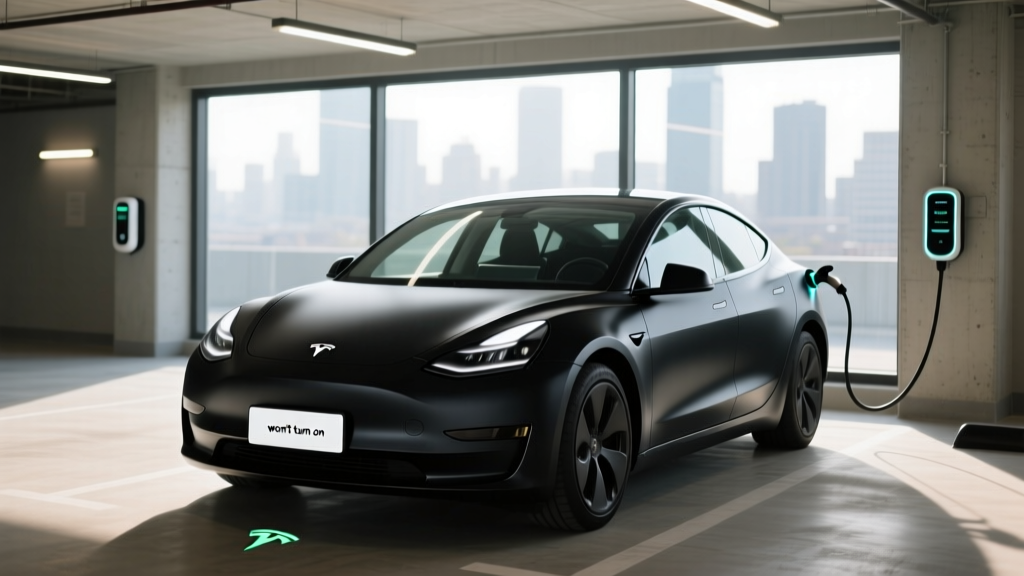
If you've slid into your Tesla and been greeted by a blank center display, you're not alone. The "Tesla screen won't turn on" issue is one of the most searched troubleshooting queries among owners, and it can range from a simple software glitch to a hardware fault. But before you panic, most cases are resolvable in under two minutes. This guide covers the fixes first, then delivers the full 2026 Tesla Model 3 review — range, charging, battery chemistry, pricing, and tax credit eligibility — so you know exactly what you're driving (or considering buying).
Tesla Screen Won't Turn On: Quick Fixes
A black or unresponsive touchscreen in a Tesla Model 3 or Model Y is usually a software hang, not a dead unit. Try these steps in order:
- Soft Reset (Scroll Wheels): Press and hold both steering wheel scroll buttons for about 10 seconds. The screen will go black, then the Tesla "T" logo appears as the infotainment system reboots. This fixes roughly 80% of blank-screen incidents.
- Hard Reset (Power Off): Go to Controls > Safety > Power Off (if the screen is partially responsive). Wait two minutes without touching any pedals or doors, then press the brake pedal to wake the car. If the screen is completely dead, sit in the driver's seat, close all doors, and wait 15 minutes — the car will enter sleep mode, then wake when you press the brake.
- Check the 12V/LV Battery: The touchscreen runs off the low-voltage (LV) battery, not the main traction pack. If your Tesla throws a "LV Battery Low" alert before the screen died, the 12V lithium-ion battery may need replacement. Tesla's LV battery typically lasts 3-5 years. A failing LV battery is a common root cause of repeated screen blackouts.
- Cable/Connector Issue: In rare cases (more common in pre-2023 Model 3 units), the display ribbon cable can loosen. This requires a Tesla Service Center visit and is covered under the 4-year/50,000-mile vehicle warranty.
2026 Tesla Model 3: Full Spec Table
With the screen sorted, let's look at what you're actually driving. The refreshed Model 3 (internally called "Highland" and continuing into 2026 with minor updates) offers three trims with distinct battery chemistries and performance profiles.
| Spec | RWD (Base) | Long Range AWD | Performance |
|---|---|---|---|
| EPA Range | 272 mi | 341 mi | 315 mi |
| Battery (Usable) | 57.5 kWh (LFP) | 75 kWh (NMC) | 75 kWh (NMC) |
| Drivetrain | RWD, single motor | AWD, dual motor | AWD, dual motor |
| Horsepower | 271 hp | 346 hp | 510 hp |
| 0-60 mph | 5.8 sec | 4.2 sec | 2.9 sec |
| MPGe (Combined) | 132 MPGe | 132 MPGe | 118 MPGe |
| Efficiency | 25 kWh/100mi | 25 kWh/100mi | 28 kWh/100mi |
| Base MSRP | $38,990 | $45,990 | $52,990 |
| Max DC Charge Rate | 170 kW | 250 kW | 250 kW |
| 10-80% DC Time | ~28 min | ~25 min | ~25 min |
Sources: EPA / fueleconomy.gov, Tesla spec sheets.
Real-World Range: What the EPA Sticker Doesn't Tell You
Model 3 RWD (EPA 272 mi): Expect 230-250 mi on highway road trips at 70+ mph; ~200-220 mi in sub-30°F winter weather.
Model 3 Long Range (EPA 341 mi): Expect 285-310 mi highway; ~250-270 mi in cold weather.
Model 3 Performance (EPA 315 mi): Expect 260-285 mi highway; aggressive driving drops this further.
The Model 3's efficiency is among the best in the segment — at roughly 25 kWh/100 miles for the RWD and Long Range trims, it extracts more miles per kilowatt-hour than nearly any competitor. But physics still applies: sustained highway speeds above 70 mph increase aerodynamic drag significantly, and cold weather reduces battery chemical reactivity while drawing power for cabin heating (the Model 3 uses a heat pump, which mitigates but doesn't eliminate cold-weather losses).
The LFP (lithium iron phosphate) battery in the RWD trim has a different charging profile than the NMC (nickel manganese cobalt) packs in the Long Range and Performance. Tesla recommends charging LFP batteries to 100% at least once a week, while NMC batteries benefit from daily limits set to 80-90% for longevity. This matters for daily range planning: an LFP RWD owner can use the full 272 miles regularly, while an NMC owner's practical daily range is closer to 273-307 miles (80-90% of 341).
Charging Speed: Home, Public, and the Curve Reality
| Charging Level | Power (kW) | Miles Added/Hour | Notes |
|---|---|---|---|
| Level 1 (120V) | ~1.4 kW | 3-5 mi/hr | Emergency/trickle only |
| Level 2 (240V, 48A) | 11.5 kW | ~44 mi/hr | Tesla Wall Connector; full overnight charge |
| DC Fast (RWD) | 170 kW peak | ~170 mi in 15 min | Sustains well to 60%, tapers sharply above 80% |
| DC Fast (LR/Perf) | 250 kW peak | ~200 mi in 15 min | Peak only at low SoC; expect ~150 kW avg from 10-80% |
Understanding the charge curve: The "250 kW peak" figure only applies at low states of charge (roughly 5-30% SoC) with a preconditioned battery. As the battery fills, charge speed tapers to protect cell health. A realistic 10-80% session on a V3 Supercharger averages around 150 kW for the Long Range, meaning the ~25-minute Tesla estimate assumes ideal conditions (warm battery, low starting SoC). In cold weather without preconditioning, add 5-10 minutes.
Home charging with the Tesla Wall Connector on a 60A circuit delivers 11.5 kW (48A continuous), adding roughly 44 miles per hour of charging. A full 10-100% charge for the Long Range takes about 7-8 hours — easily accomplished overnight. Installation typically costs $500-$2,000 depending on panel proximity and whether your home needs a panel upgrade from 100A to 200A service.
Pricing, Trims, and Federal Tax Credit Eligibility
| Trim | MSRP | §30D Credit Eligible? | Effective Price (w/ max credit) |
|---|---|---|---|
| RWD | $38,990 | Yes (if sourcing + income rules met) | ~$31,490 |
| Long Range AWD | $45,990 | Yes (under $55K sedan cap) | ~$38,490 |
| Performance | $52,990 | Yes (under $55K sedan cap) | ~$45,490 |
Critical §30D tax credit caveats (2026 rules): The federal EV tax credit under IRS §30D is up to $7,500, but eligibility depends on three factors that change frequently:
- MSRP Cap: Sedans must be under $55,000. All Model 3 trims currently qualify, but adding options (FSD, wheels, paint) can push the Performance close to the limit.
- Buyer Income Cap: Modified adjusted gross income must not exceed $150,000 (single), $225,000 (head of household), or $300,000 (joint filing).
- Battery Sourcing: The $7,500 credit splits into two halves — $3,750 for critical minerals and $3,750 for battery components. Sourcing requirements tighten annually. As of 2026, vehicles with battery components from a "foreign entity of concern" (FEOC) lose part or all of the credit. Check Tesla's current sourcing status on the IRS qualified vehicles list before purchasing.
- Point-of-Sale Transfer: You can now transfer the credit to the dealer at purchase for an immediate price reduction, rather than waiting to claim it on your tax return.
Always verify current eligibility with your tax professional and the IRS qualified vehicle list before finalizing a purchase. Rules can change mid-year.
Interior, Cargo, and Daily Livability
The refreshed Model 3 interior is significantly quieter and more refined than pre-2024 versions, with acoustic glass, ventilated front seats, and ambient lighting. The minimalist cabin centers entirely on the 15.4-inch touchscreen — which is exactly why a "Tesla screen won't turn on" situation feels so alarming. There are no physical buttons for climate, media, or glovebox release; everything routes through the display.
Cargo and passenger dimensions:
- Front legroom: 42.7 inches
- Rear legroom: 35.2 inches (tight for tall passengers on long trips)
- Cargo (rear trunk): 21.0 cu ft
- Frunk (front trunk): 3.1 cu ft
- Total cargo: ~24.1 cu ft (less than a Model Y or Hyundai Ioniq 5)
The rear seat is the Model 3's most common complaint — the floor is high due to the battery pack beneath, creating a "knees-up" seating position that's uncomfortable for adults on trips over an hour. Families with rear-facing child seats will find clearance tight. If passenger space is a priority, the Model Y is the logical step up.
Tech, Driver Assistance, and Warranty
Infotainment: The 15.4-inch touchscreen runs Tesla's proprietary OS with native navigation, streaming (Netflix, YouTube, Spotify), gaming, and a phone-as-key system. There is no Apple CarPlay or Android Auto — a dealbreaker for some buyers. The navigation system is excellent and integrates Supercharger routing with battery preconditioning automatically.
Driver Assistance (SAE Level 2):
Basic Autopilot includes adaptive cruise control and lane-keeping assist and is standard on all trims. Enhanced Autopilot ($6,000) adds auto lane change, Navigate on Autopilot, and Smart Summon. FSD Supervised ($8,000) adds traffic light/stop sign recognition and city street navigation. All require driver attention monitoring via the cabin camera.
Warranty coverage:
- New Vehicle Limited Warranty: 4 years / 50,000 miles
- Battery & Drive Unit (RWD, LFP): 8 years / 100,000 miles (70% minimum capacity retention)
- Battery & Drive Unit (Long Range/Performance, NMC): 8 years / 120,000 miles (70% minimum capacity retention)
Tesla's battery warranty guarantees that the pack will retain at least 70% of its original capacity during the warranty period. In practice, Tesla battery degradation data from fleet studies shows most Model 3 packs retain 90%+ capacity at 100,000 miles, with LFP packs showing particularly strong longevity due to their more stable chemistry.
Who Should Buy the 2026 Tesla Model 3?
Choose the Model 3 Long Range if: You take regular road trips (300+ miles), live in a cold-weather state, or need AWD. The 341-mile EPA range and 250 kW charging make it the most versatile trim.
Choose the Model 3 Performance if: Track mode and 2.9-second 0-60 times matter to you, and you're willing to sacrifice ~26 miles of range and slightly higher energy costs for it.
Look elsewhere if: You need spacious rear seating (check the Model Y or Ioniq 5), want Apple CarPlay (consider BMW i4 or Hyundai Ioniq 6), or require over 25 cu ft of cargo space.
Pros and Cons
- Best-in-class efficiency (~25 kWh/100mi)
- Supercharger network access (most reliable DC network in the US)
- Strong resale value relative to EV segment
- Over-the-air updates continuously add features
- Heat pump standard (cold-weather efficiency)
- LFP battery option for daily 100% charging without degradation worry
- Everything runs through the touchscreen — no physical buttons
- Cramped rear seat for adults on long trips
- No Apple CarPlay / Android Auto
- Panel gaps and build quality still inconsistent vs. legacy automakers
- FSD ($8,000) remains Level 2 despite the "Full Self-Driving" name
- Insurance costs 20-40% higher than comparable gas sedans in most states
Frequently Asked Questions
What is the real-world range of the 2026 Tesla Model 3?
The EPA rates the Long Range at 341 miles, but expect 285-310 miles on highway road trips at 70+ mph, and 250-270 miles in freezing temperatures. The RWD's 272-mile EPA rating translates to roughly 230-250 miles highway and 200-220 in cold weather. The heat pump helps, but cold weather always reduces lithium-ion battery performance.
How fast does the Model 3 charge at home and on the road?
At home on a Level 2 Tesla Wall Connector (11.5 kW / 48A), you'll add about 44 miles per hour — a full overnight charge takes 7-8 hours. On DC fast charging, the Long Range and Performance peak at 250 kW and achieve 10-80% in roughly 25 minutes under ideal conditions. The RWD peaks at 170 kW with a 10-80% time of about 28 minutes. Actual speeds depend on battery temperature and state of charge.
How much does the Model 3 cost after federal tax credits?
With the maximum $7,500 §30D credit, the RWD drops to approximately $31,490, the Long Range to ~$38,490, and the Performance to ~$45,490. However, eligibility requires meeting income caps ($150K single / $300K joint), the vehicle must stay under the $55K sedan MSRP cap, and battery sourcing requirements must be satisfied. Always verify on the IRS qualified vehicle list before purchasing.
Is the Model 3 worth buying vs. competitors like the Ioniq 6 or BMW i4?
The Model 3 wins on efficiency, Supercharger network access, and software integration. The Hyundai Ioniq 6 offers more rear-seat space, 800V ultra-fast charging (10-80% in ~18 minutes), and Apple CarPlay. The BMW i4 provides a more traditional luxury interior and CarPlay but at a higher price and lower efficiency. If you road-trip frequently, Tesla's Supercharger integration is a genuine advantage; if you prioritize interior quality or rear-seat comfort, test-drive the alternatives.
Why does my Tesla screen keep turning off, and is it covered under warranty?
Repeated screen blackouts are usually caused by a failing low-voltage (LV) battery or, less commonly, a loose display cable. The LV battery replacement costs around $300-500 if out of warranty. Display hardware failures are covered under the 4-year/50,000-mile new vehicle warranty. If your screen won't turn on after performing both a scroll-wheel reset and a full power-off cycle, schedule service through the Tesla app.
Does the 2026 Model 3 qualify for the full $7,500 federal EV tax credit?
All three Model 3 trims fall under the $55,000 sedan MSRP cap. However, the full $7,500 depends on current battery sourcing rules (critical minerals and components must meet domestic-content thresholds that tighten each year) and your personal income. Check the IRS qualified vehicles list for the specific month of your purchase, as Tesla's sourcing status can shift with supply chain changes.