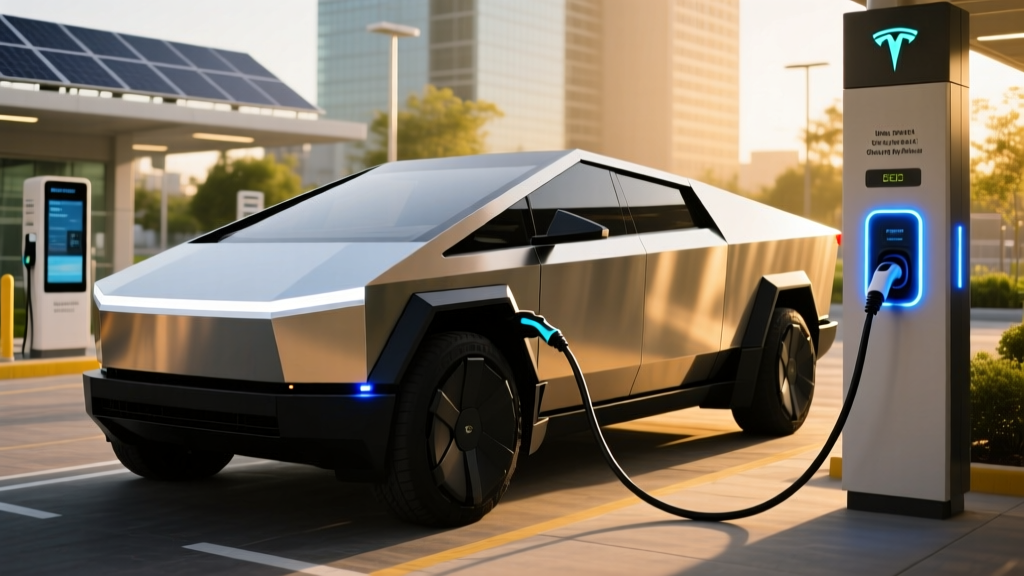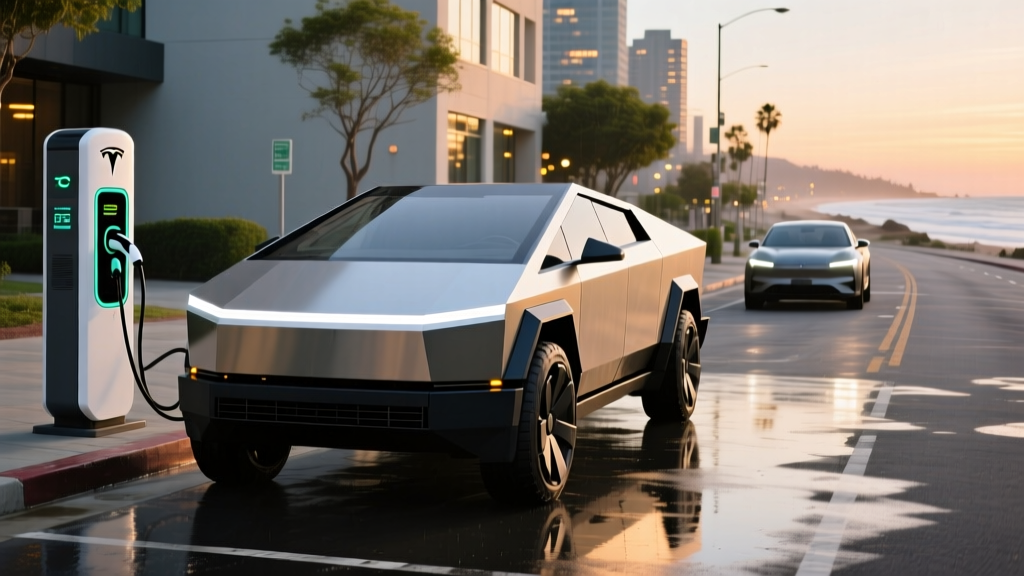
The Tesla Cybertruck Foundation Series arrived as the top-tier launch edition of Tesla's polarizing stainless-steel pickup, bundling Full Self-Driving (Supervised), Powershare vehicle-to-load capability, and early-build exclusivity into a six-figure package. Now that initial reservation holders have taken delivery and real-world data has accumulated, we can evaluate whether the Foundation Series justifies its premium over the standard AWD and Cyberbeast trims — or whether buyers are better served waiting for the more affordable variants.
This review covers the Foundation Series specifically — the fully loaded launch configuration — with EPA data, real-world range observations, charging-curve behavior, and a clear-eyed look at tax-credit eligibility under current IRS §30D rules.
Cybertruck Foundation Series at a Glance
| Specification | Value |
|---|---|
| Drivetrain | Tri-Motor AWD (Cyberbeast powertrain) |
| Horsepower | 845 hp (peak) |
| 0–60 mph | 2.6 seconds |
| Battery (usable) | ~123 kWh, NMC chemistry |
| EPA Range | 320 miles (with range extender: 470 mi) |
| Efficiency | 54 MPGe / 56 kWh/100 mi |
| Max DC Fast Charge | 250 kW (peak) |
| 10–80% DC Charge | ~28 minutes (estimated) |
| Level 2 Home Charging | 11.5 kW (~37 mi/hr) |
| Towing Capacity | 11,000 lbs |
| Payload | 2,500 lbs |
| Bed Length | 6 ft (72 in) |
| Cargo Volume (bed) | ~67 cu ft |
| Frunk | ~7 cu ft (lockable) |
| Base MSRP | $105,990 (includes destination) |
| Federal Tax Credit | Up to $7,500 (eligibility varies) |
| Battery Warranty | 8 years / 120,000 miles |
Real-World Range: What the EPA Sticker Doesn't Tell You
The EPA rates the Cybertruck AWD (dual-motor, which shares the same battery pack as the Foundation Series tri-motor) at 340 miles, while the Cyberbeast tri-motor — the powertrain underpinning the Foundation Series — is rated at 320 miles. Tesla's optional Range Extender battery pack, mounted in the bed, pushes the combined estimate to 470 miles.
EPA Sticker: 320 miles
Highway (70–80 mph, 75°F): ~260–280 miles
City / Mixed Driving: ~290–310 miles
Cold Weather (below 32°F, highway): ~200–230 miles
Towing (5,000+ lb trailer): ~150–180 miles
The Cybertruck's angular stainless-steel body produces a drag coefficient that hits highway efficiency hard. Expect a 15–20% reduction from EPA at sustained interstate speeds, and severe range loss when towing. The Range Extender adds roughly 40–45 kWh but eats 18 inches of bed depth.
Independent testing by outlets like Edmunds and real-world owner logs confirm that the Cybertruck's bluff frontal area and heavy curb weight (~6,800 lbs for the Cyberbeast) make it one of the least efficient EVs on sale at highway speed. The 56 kWh/100 mi combined figure translates to roughly $0.09–$0.12 per mile on home charging (at $0.15/kWh) and $0.18–$0.25 per mile on public DC fast charging.
Charging Speed: 250 kW Peak, but the Curve Tells the Real Story
The Cybertruck Foundation Series supports up to 250 kW peak DC fast charging on Tesla's V3 and V4 Superchargers via the native NACS connector. However, as with every large-battery EV, peak rate is not sustained rate.
| Charging Level | Power / Rate | Time or Miles Added |
|---|---|---|
| Level 1 (120V, 12A) | ~1.4 kW | ~3 miles per hour |
| Level 2 (240V, 48A) | 11.5 kW | ~37 miles per hour |
| DC Fast (V3 Supercharger) | Up to 250 kW peak | 10–80% in ~28 min |
| DC Fast (above 80%) | Tapers to ~40 kW | 80–100% adds ~25 min |
The 123 kWh (usable) NMC pack charges aggressively in the 10–50% window, sustaining 200+ kW when preconditioned. Above 60%, the curve tapers significantly — by 80%, you're looking at roughly 80–100 kW, and above 90% it drops to a trickle. This is standard behavior for large NMC packs, but it means that a 10–80% session is the practical sweet spot. Charging to 100% at a Supercharger adds nearly as much time as the first 70% did.
For home charging, the Cybertruck accepts 11.5 kW on a 48-amp Level 2 circuit (requiring a 60-amp breaker). A full overnight charge from 20% to 80% takes roughly 6–7 hours — adequate for daily use but slower than some competitors like the Ford F-150 Lightning Extended Range, which accepts up to 19.2 kW on Level 2 with the optional onboard charger.
Preconditioning matters. Navigating to a Supercharger via the Cybertruck's built-in nav automatically warms the battery, enabling peak charge rates. Arriving at a charger cold (without preconditioning) can cut peak speeds by 30–50% in cool weather.
Performance and Driving Dynamics
The Foundation Series uses the Cyberbeast tri-motor powertrain: one motor on the front axle and two on the rear, producing a combined 845 horsepower. Tesla claims a 2.6-second 0–60 mph time, which independent testing has validated in the 2.6–2.8 second range depending on surface and tire condition. This makes it one of the quickest production vehicles ever sold, let alone a 6,800-pound pickup.
Beyond straight-line speed, the Cybertruck's 48-volt electrical architecture enables steer-by-wire steering with no mechanical linkage between the wheel and the tires. The result is a variable-ratio steering system that requires less than one full turn lock-to-lock. It takes acclimation, but most owners report it becomes intuitive within a few days. Rear-wheel steering (up to 10 degrees) gives the 20-foot-long truck a surprisingly tight 37-foot turning circle.
The adaptive air suspension provides up to 16 inches of ground clearance in Off-Road mode and drops the truck for easier highway cruising and bed access. Ride quality is firm but well-controlled — the stainless-steel exoskeleton is extremely rigid, which helps handling but transmits more road imperfection than a body-on-frame competitor like the Rivian R1T.
Tech, Interior, and Standout Features
The Foundation Series includes everything Tesla offers, plus a few exclusives:
- Full Self-Driving (Supervised) — Tesla's most advanced Level 2 driver-assist suite, including automatic lane changes, navigate-on-autopilot, and traffic-light recognition. This is not autonomous driving; the driver must remain engaged at all times.
- Powershare (Vehicle-to-Load) — Up to 11.5 kW of continuous 120V/240V power output from the bed and frunk outlets. Sufficient to run power tools, a campsite, or essential home circuits during an outage.
- 18.5-inch front touchscreen with a secondary 9.4-inch rear-seat display for climate and media control.
- Safari Mode — allows the tonneau cover to remain partially open while driving, accommodating tall cargo.
- Stainless-steel exoskeleton with no paint (the Foundation Series is raw brushed steel; a color PPF wrap is the only way to change appearance).
Tesla's Autopilot and FSD (Supervised) are SAE Level 2 systems. The driver is legally and physically responsible for the vehicle at all times. FSD does not make the Cybertruck self-driving. Expect occasional phantom braking, inconsistent lane-centering in construction zones, and the need for constant visual supervision.
The interior is minimalist — some would say spartan. There is no instrument cluster (all info is on the central screen), no physical buttons for climate or wipers, and the yoke-style steering wheel (standard on Foundation Series) requires an adjustment period for low-speed maneuvers. Rear-seat space is adequate for adults but the upright seatback and flat cushion limit long-trip comfort compared to the Rivian R1T or Ford F-150 Lightning.
Pricing, Tax Credits, and What You'll Actually Pay
The Cybertruck Foundation Series launched at an MSRP of approximately $105,990, including the $1,995 destination fee. This price bundles the Cyberbeast powertrain, FSD (Supervised), Powershare, all-terrain tires, and Foundation Series badging. No standalone options exist — it's a take-it-or-leave-it package.
| Item | Amount |
|---|---|
| Base MSRP (incl. destination) | $105,990 |
| Optional Range Extender | ~$16,000 (adds ~150 mi range) |
| Federal §30D Tax Credit (max) | Up to $7,500 |
| Estimated Net Cost (with credit) | ~$98,490 |
Tax credit reality check: Under current IRS §30D rules, the Cybertruck qualifies as a truck (MSRP cap: $80,000 for trucks — however, the Foundation Series exceeds this cap). As of 2026, the $80,000 MSRP cap for trucks means the Foundation Series at $105,990 does not qualify for the $7,500 federal tax credit. Buyers considering a Cybertruck with credit eligibility should look at the standard AWD trim, which starts closer to the cap threshold, and verify current-year rules with a tax professional.
Additional buyer-income caps apply to qualifying trims ($150,000 single / $300,000 married filing jointly), and battery critical-mineral and component sourcing requirements must be met. Always verify eligibility on the official fueleconomy.gov tax credit lookup before purchasing.
How It Compares: Foundation Series vs. Key Rivals
| Spec | Cybertruck Foundation | Rivian R1T Tri-Motor | Ford F-150 Lightning Platinum |
|---|---|---|---|
| EPA Range | 320 mi | ~380 mi (Max Pack) | 320 mi (Ext. Range) |
| 0–60 mph | 2.6 sec | ~3.0 sec | ~3.8 sec |
| Max DC Charge | 250 kW | 220 kW | 150 kW |
| Towing | 11,000 lbs | 11,000 lbs | 10,000 lbs |
| Bed Length | 6 ft | 4.5 ft (+ tunnel) | 5.5 ft |
| Base Price | $105,990 | ~$106,000 | ~$98,000 |
| Tax Credit Eligible | No (MSRP cap) | Partial (varies) | Yes (under cap) |
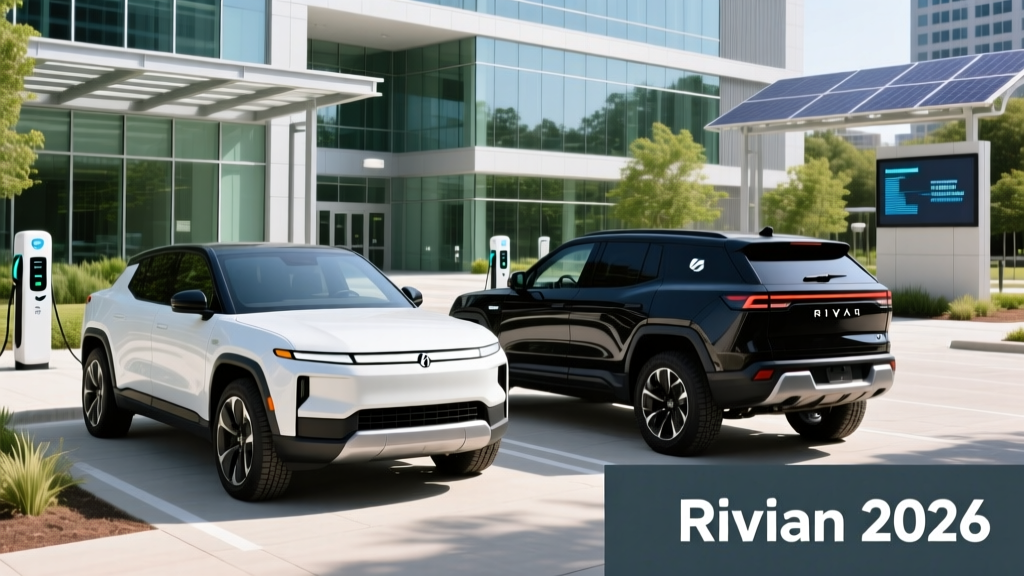
The Rivian R1T Tri-Motor Max Pack offers more real-world range and a more conventional (and more refined) interior, though at a similar price point. The F-150 Lightning is the value play — significantly cheaper, tax-credit eligible, with a more usable bed and better rear-seat comfort, but slower charging and less performance. The Cybertruck wins on raw acceleration, charge speed, and V2L capability, but loses on efficiency, interior comfort, and tax-credit access.
- Choose the Foundation Series if: You want the fastest, most tech-forward electric pickup available; you value V2L Powershare for job-site or off-grid use; you can charge at home and don't rely on the federal tax credit; you accept the minimalist interior and steep learning curve.
- Look at the Rivian R1T if: You prioritize range, interior quality, and a more traditional driving feel.
- Look at the F-150 Lightning if: You want a work-first electric truck with tax-credit eligibility, dealer service support, and a lower price.
Pros and Cons
- 2.6-second 0–60 is unmatched in the pickup segment
- 250 kW DC charging is among the fastest for any truck
- 11.5 kW Powershare V2L is a genuine job-site and backup-power tool
- Stainless-steel body needs no paint and resists minor scratches
- FSD (Supervised) included in the price — no subscription needed
- 11,000-lb towing with integrated scale and trailer-assist
- $105,990 price exceeds the §30D truck MSRP cap — no federal tax credit
- Highway efficiency is poor (~260 mi real-world at 75 mph)
- Rear-seat comfort lags behind Rivian and Ford
- Steer-by-wire and yoke require significant adaptation
- 6-foot bed is short for a full-size truck; Range Extender further reduces it
- No physical buttons — all controls are touchscreen-dependent
- Build-quality inconsistencies reported in early production units
Ownership Costs and Warranty
Tesla covers the Cybertruck's battery and drive units for 8 years or 120,000 miles, whichever comes first, with a guaranteed minimum 70% capacity retention over that period. The limited vehicle warranty is 4 years / 50,000 miles.
Insurance premiums for the Foundation Series are steep — early quotes from major carriers range from $3,500 to $5,500 annually depending on zip code and driving record, driven by the high MSRP, expensive stainless-steel body panels, and limited repair-network experience. Get an insurance quote before ordering.
Maintenance costs are low relative to a gas truck — no oil changes, no transmission fluid, minimal brake wear thanks to regenerative braking. Tesla recommends cabin-air-filter replacement every 2–3 years, tire rotation every 6,250 miles, and brake-fluid checks every 2 years. Expect tire costs to be higher than average given the Cybertruck's weight and custom 35-inch all-terrain tires.
Frequently Asked Questions
What is the real-world range of the Cybertruck Foundation Series?
The EPA rates the tri-motor Cyberbeast (which the Foundation Series uses) at 320 miles. In real-world highway driving at 70–80 mph, expect 260–280 miles. In cold weather below freezing, highway range can drop to 200–230 miles. With the optional Range Extender battery, total range extends to approximately 470 miles EPA.
How fast does the Cybertruck Foundation Series charge?
On a Tesla V3 or V4 Supercharger, the Foundation Series peaks at 250 kW and charges from 10–80% in approximately 28 minutes when the battery is preconditioned. On a 48-amp Level 2 home charger (11.5 kW), it adds roughly 37 miles of range per hour, or a full 10–80% charge in about 7 hours.
Does the Cybertruck Foundation Series qualify for the federal EV tax credit?
Under current IRS §30D rules, the $80,000 MSRP cap for trucks disqualifies the Foundation Series at its $105,990 price. Lower-priced Cybertruck trims (when available) may qualify if they fall under the cap and the buyer meets income and battery-sourcing requirements. Always verify on fueleconomy.gov and consult a tax professional.
Is the Cybertruck Foundation Series worth it vs. the Rivian R1T or F-150 Lightning?
It depends on priorities. The Foundation Series wins on acceleration (2.6 sec 0–60), charge speed (250 kW), and V2L capability. The Rivian R1T Max Pack offers more range and a more refined interior. The F-150 Lightning is significantly cheaper and tax-credit eligible. For buyers who value performance and tech above comfort and efficiency, the Cybertruck is compelling. For work-oriented or budget-conscious buyers, the Lightning or R1T may be the smarter choice.
How reliable is the Cybertruck's battery long-term?
Tesla warranties the battery for 8 years / 120,000 miles with a 70% minimum capacity retention guarantee. The NMC chemistry in the Cybertruck is proven in Tesla's Model S and Model X platforms, where typical degradation is 10–12% over 100,000 miles. The large 123 kWh pack means even with 10% degradation, usable range remains substantial.
Can the Cybertruck Foundation Series tow a large trailer?
Yes — the Foundation Series is rated for 11,000 lbs of towing. However, towing at or near that capacity will reduce range to approximately 150–180 miles and requires the integrated trailer-brake controller. Tesla's trailer-assist features help with hitching and backing, but high-speed towing stability is adequate rather than class-leading compared to the F-150 Lightning or R1T.