Why the Tesla Cybercab Austin Delay Matters
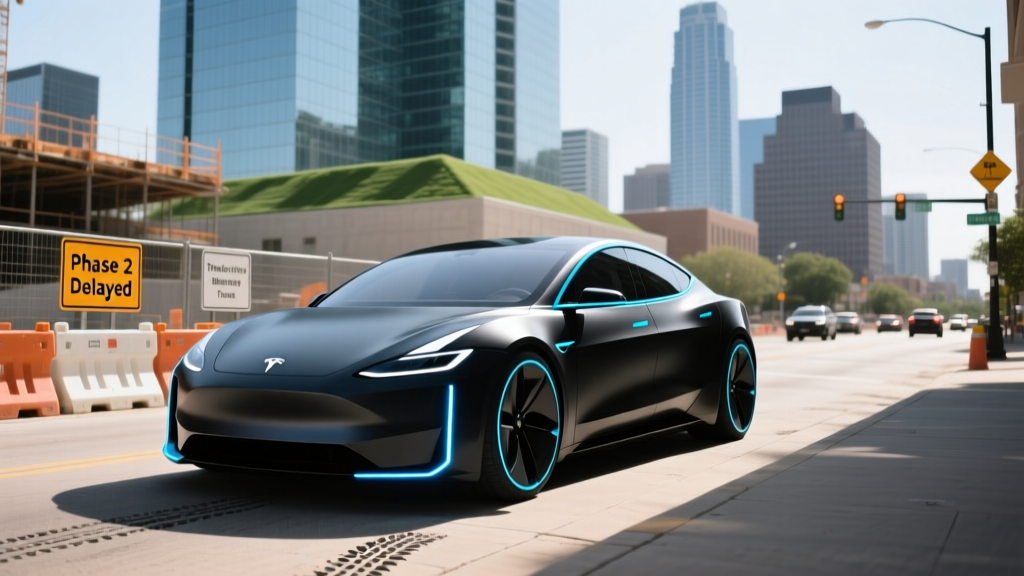
If you have been tracking Tesla's robotaxi ambitions, you likely already know that the company's purpose-built, steering-wheel-free Cybercab was originally slated for production in Austin, Texas, by late 2025. That timeline has slipped, and the tesla cybercab austin delay has become a focal point for both EV enthusiasts and investors trying to gauge when Tesla's Level 4 autonomous ride-hailing service will actually reach paying customers.
This article breaks down the confirmed and preliminary specifications for the Cybercab, explains the reasons behind the Austin production delay, and provides a realistic assessment of what riders and fleet operators can expect when the vehicle finally enters service.
Cybercab Preliminary Specifications at a Glance
Because the Cybercab has not yet entered full production, the figures below reflect Tesla's announced targets and preliminary filings. Final EPA certification numbers may differ at launch.
| Attribute | Value |
|---|---|
| EPA Est. Range (Target) | ~250 miles |
| Battery Capacity | ~50 kWh usable (est., LFP chemistry) |
| Drivetrain | Rear-Wheel Drive (single motor) |
| Horsepower | ~200 hp (est.) |
| 0–60 mph | Not disclosed (not a priority metric for robotaxi) |
| Max DC Fast Charge | ~170 kW (est., NACS connector) |
| 10–80% DC Charge Time | ~25 minutes (est.) |
| Level 2 Home Charging | ~7.7 kW / ~30 mi/hr (NACS) |
| Efficiency (Target) | ~140 MPGe / ~24 kWh/100 mi |
| Seating | 2 passengers |
| Cargo Volume | ~15 cu ft (est.) |
| Base MSRP (Fleet/Rideshare) | ~$30,000 (announced target) |
| Federal Tax Credit (§30D) | Not applicable — fleet/commercial use |
| Warranty (Battery/Powertrain) | TBD — expected 8 yr / 120,000 mi |
Real-World Range: What Riders and Operators Should Expect
Real-World Expectation: ~190–220 miles in mixed urban/highway driving; ~160–180 miles in cold weather (below 40°F) or sustained 70+ mph highway use.
Tesla's Cybercab is designed primarily for dense urban and suburban ride-hailing routes, not long-distance road trips. The ~50 kWh LFP (lithium iron phosphate) battery pack prioritizes cycle life and cost over raw energy density. LFP chemistry degrades more slowly over thousands of charge cycles — critical for a vehicle expected to log 60,000–100,000 miles per year in fleet service.
However, LFP batteries are more susceptible to range loss in cold temperatures because they lack the energy density to support aggressive cabin heating without preconditioning. In Austin's climate, where winter lows rarely dip below freezing for extended periods, cold-weather range loss will be modest (roughly 10–15%). Operators in colder deployment cities should budget for 25–35% range reduction in winter.
For urban ride-hailing duty cycles — frequent stops, low average speeds, heavy regenerative braking — real-world efficiency could actually exceed the EPA estimate, as regen recaptures energy that conventional braking wastes.
Charging Speed and Fleet Turnaround Time
Charging speed is arguably the most critical operational metric for a robotaxi. Every minute a Cybercab sits at a charger is a minute it is not generating fare revenue.
| Charging Level | Power (kW) | Rate | Use Case |
|---|---|---|---|
| Level 1 (120V) | ~1.4 kW | ~5 mi/hr | Emergency / overnight depot top-off |
| Level 2 (240V / 32A) | ~7.7 kW | ~30 mi/hr | Overnight depot charging (8–10 hrs for full charge) |
| DC Fast Charge (NACS) | Peak ~170 kW | 10–80% in ~25 min | Mid-shift rapid top-up at Supercharger or Megacharger stations |
The estimated 170 kW peak DC charge rate is modest by 2026 passenger-EV standards (many competitors now peak at 250–350 kW), but it is adequate for the Cybercab's smaller battery. A smaller pack charges to 80% faster in absolute time because there are fewer kWh to push through the charge curve.
Tesla has also signaled that Cybercab fleets will use a combination of Tesla Supercharger stations and dedicated depot Megachargers. The real operational question is whether Tesla will deploy enough dedicated fleet-charging infrastructure in Austin to avoid competing with consumer Supercharger demand during peak hours.
Charge curve caveat: Like all EVs, the Cybercab will sustain peak kW only through roughly 30–50% State of Charge. Above 80%, charging slows dramatically to protect battery longevity — a factor fleet operators must account for when scheduling mid-shift charges.
Understanding the Austin Production Delay
Tesla originally announced that Cybercab production would begin at its Austin Gigafactory, leveraging the same production lines and workforce building the Model Y. The tesla cybercab austin delay stems from several converging factors:
- Regulatory approval timeline: The Cybercab has no steering wheel, pedals, or mirrors. This means it does not meet current Federal Motor Vehicle Safety Standards (FMVSS) and requires either an NHTSA exemption or new rulemaking. As of early 2026, that regulatory pathway remains in progress.
- Full Self-Driving (FSD) validation: Tesla's supervised FSD is classified as SAE Level 2 — requiring an attentive human driver. The Cybercab requires Level 4 autonomy (no human driver, geofenced areas). Bridging that gap requires billions of validation miles and regulatory sign-off.
- Manufacturing retooling: The Cybercab's unboxed manufacturing process — assembling large sub-assemblies rather than a traditional body-in-white line — requires new tooling and workflow validation at Austin.
- Purpose-built component supply chain: The steer-by-wire system, redundant sensor suite, and custom interior (no driver controls) require suppliers to ramp production of components that do not exist in any other Tesla vehicle.
Current reporting suggests low-rate initial production could begin in mid-to-late 2026, with meaningful fleet deployment in Austin pushing into 2027. This is a significant slip from the originally announced 2025 timeline.
The Cybercab is designed for SAE Level 4 — fully driverless within a defined operational design domain (geofenced urban/suburban areas, certain weather conditions). This is fundamentally different from Tesla's current FSD (Supervised), which is SAE Level 2 and requires a licensed, attentive human driver at all times. The Cybercab will have no steering wheel or pedals — a Level 4 vehicle cannot be driven manually.
Pricing, Tax Credits, and Fleet Economics
Tesla has publicly stated a target Cybercab production cost of under $30,000 and a projected ride cost of roughly $0.20 per mile for passengers. However, the Cybercab is not expected to be sold to individual consumers — at least not initially. It will be deployed through Tesla's own ride-hailing network or licensed to fleet partners.
| Item | Detail |
|---|---|
| Target Production Cost | ~$30,000 (pre-incentives) |
| Consumer Purchase | Not planned initially — fleet/robotaxi only |
| Federal §30D Tax Credit | Not applicable (commercial/fleet use; no individual buyer) |
| Commercial EV Credit (§45W) | Potentially eligible — up to $7,500 per vehicle for qualified commercial use |
| Projected Cost Per Mile (Rider) | ~$0.20/mi (Tesla estimate, before fees) |
For context on tax credits: the IRS §30D clean vehicle credit applies to new vehicles purchased by individual taxpayers for personal use, subject to MSRP caps ($55,000 sedans / $80,000 SUVs/trucks), buyer income limits, and battery critical-mineral sourcing requirements. Since the Cybercab is not being sold to individual consumers, §30D does not apply. Fleet operators may instead qualify for the §45W commercial clean vehicle credit, which has different eligibility criteria.
Competitor Comparison: Cybercab vs. Waymo and Cruise
The Cybercab is entering a robotaxi space already populated by operational Level 4 services. Here is how it stacks up against the current market leaders:
| Feature | Tesla Cybercab | Waymo 6th-Gen (Jaguar I-PACE) | Cruise Origin |
|---|---|---|---|
| SAE Level | Level 4 (target) | Level 4 (operational) | Level 4 (paused/restructuring) |
| Steering Wheel | No | Yes (retained) | No |
| Current Status | Delayed — not yet operational | Operational in Phoenix, SF, LA, Austin | Production paused (2024) |
| Estimated Range | ~250 mi | ~230 mi (EPA, I-PACE base) | ~150 mi (est.) |
| Seating | 2 passengers | 3–4 passengers | 4–6 passengers |
| Sensor Suite | Camera-only (Tesla Vision) | LiDAR + cameras + radar | LiDAR + cameras + radar |
| Geofenced Cities (2026) | None yet (Austin first) | 4+ cities live | None (suspended) |
The most significant differentiator is Tesla's camera-only approach. Waymo and Cruise rely on LiDAR, radar, and cameras for redundancy. Tesla's bet is that its neural-network vision system, trained on billions of miles of FSD data from consumer vehicles, can match or exceed multi-sensor fusion — a claim that remains unproven at Level 4 without a safety driver.
Pros and Cons
Pros
- Purpose-built for ride-hailing — low operating cost per mile
- LFP battery chemistry offers superior cycle life for high-mileage fleet use
- Tesla's massive FSD training dataset provides a potential autonomy advantage at scale
- Projected sub-$30,000 production cost undercuts current robotaxi hardware
- NACS connector ensures access to the largest fast-charging network in the US
Cons
- Not yet available — Austin production delayed, no firm rider launch date
- Camera-only sensor suite is unproven for Level 4 without a human safety net
- Only 2-passenger seating limits ride-pooling and larger group trips
- No FMVSS exemption secured yet for a vehicle without steering wheel or pedals
- Cold-weather and heavy-rain operational limits unknown
- Cannot be purchased by individual consumers — fleet-only model
Who Should Pay Attention to the Cybercab?
The Cybercab is not a vehicle you can buy today, and the Austin delay means it will not be a vehicle you can ride in 2026 either. However, several audiences should track its progress:
- Rideshare drivers and fleet operators: If Tesla opens the Cybercab platform to licensed fleet partners, it could dramatically reduce per-mile operating costs compared to human-driven ride-hailing.
- Urban commuters in Austin and future deployment cities: A ~$0.20/mile robotaxi could undercut Uber and Lyft pricing significantly in geofenced zones.
- Investors and industry analysts: The Austin delay is a signal that Tesla's Level 4 timeline is more aggressive than its regulatory and manufacturing reality supports.
- EV buyers considering a Tesla today: The Cybercab delay does not affect the Model 3, Model Y, or other consumer Tesla vehicles currently on sale. Those remain available with current FSD (Supervised) — a Level 2 system requiring driver attention.
Frequently Asked Questions
What is causing the Tesla Cybercab Austin delay?
The delay stems from three primary factors: (1) the Cybercab requires a federal FMVSS exemption or new rulemaking because it lacks a steering wheel, pedals, and mirrors; (2) Tesla must validate its vision-only system to Level 4 autonomy standards without a safety driver; and (3) the unboxed manufacturing process requires new tooling at the Austin Gigafactory.
When will the Tesla Cybercab actually launch in Austin?
Based on current reporting and regulatory timelines, low-rate production may begin in mid-to-late 2026, with meaningful rider-facing deployment in Austin likely in 2027. This is a delay of approximately 18–24 months from the originally announced schedule.
Can I buy a Tesla Cybercab for personal use?
No. Tesla has stated the Cybercab is designed for its own ride-hailing fleet and potential fleet partners. Individual consumer purchase is not part of the current plan.
Does the Cybercab qualify for the $7,500 federal EV tax credit?
No. The IRS §30D credit applies to personal-use vehicle purchases by individual taxpayers. The Cybercab is a commercial fleet vehicle. Fleet operators may qualify for the separate §45W commercial clean vehicle credit, subject to different rules.
How does Tesla's camera-only approach compare to Waymo's LiDAR system?
Waymo's 6th-generation system uses LiDAR, radar, and cameras for redundant perception. Tesla relies exclusively on cameras and neural-network processing. While Tesla's vision system has shown rapid improvement in Level 2 FSD testing, Level 4 operation without a human backup driver in complex urban environments remains unproven with a camera-only architecture. This technical risk is a contributing factor to the Austin delay.
What is the real-world range of the Cybercab?
Tesla targets approximately 250 miles of EPA-estimated range. In real-world urban ride-hailing duty cycles with frequent regenerative braking, expect 200–220 usable miles. In cold weather or sustained highway operation, that figure could drop to 160–180 miles.
How fast does the Cybercab charge?
Preliminary estimates suggest a peak DC fast-charge rate of ~170 kW via the NACS connector, achieving a 10–80% charge in approximately 25 minutes. Overnight Level 2 charging at fleet depots (~7.7 kW) would add roughly 30 miles of range per hour.