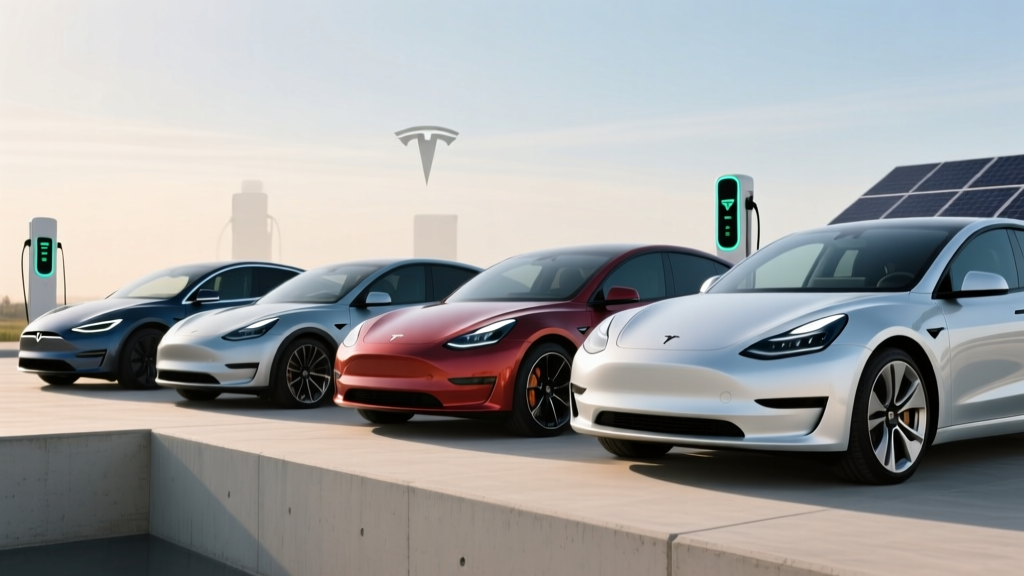
Tesla's Sales Trajectory: From Niche to Dominance
Understanding how many Tesla vehicles have been sold each year reveals the company's evolution from a low-volume sports car maker to the world's most recognized EV brand. Tesla does not break out deliveries by individual model in every quarterly report, but aggregate annual figures from Tesla Investor Relations paint a clear picture of exponential growth:
| Year | Total Global Deliveries | Key Models |
|---|---|---|
| 2012 | ~2,650 | Model S |
| 2015 | ~50,580 | Model S, Model X |
| 2018 | ~245,240 | Model S, Model X, Model 3 |
| 2020 | ~499,550 | Model 3, Model Y launch |
| 2022 | ~1,313,851 | Model 3, Model Y, Semi pilot |
| 2024 | ~1,789,226 | Model 3, Y, Cybertruck, Semi |
| 2025 (full year) | ~2.0+ million (est.) | Refreshed Model Y, Cybertruck ramp |
Cumulative lifetime deliveries surpassed 7 million units by early 2025, with the Model 3 and Model Y accounting for roughly 95% of recent volume. That scale gives Tesla an unmatched Supercharger network advantage and deep real-world reliability data — but it also means these are no longer rare vehicles. Let's examine what buying into that ecosystem actually looks like in 2026.
2026 Tesla Model 3 and Model Y: Core Specs at a Glance
Most buyers cross-shopping Tesla are choosing between the refreshed Model 3 sedan and the updated Model Y crossover. Here are the exact numbers that matter:
| Spec | Model 3 Long Range AWD | Model Y Long Range AWD |
|---|---|---|
| EPA Range | 341 mi | 320 mi |
| Battery (usable) | ~75 kWh, NMC | ~75 kWh, NMC |
| Peak DC Charge Rate | 250 kW | 250 kW |
| 10–80% DC Time | ~25 min | ~25 min |
| Level 2 (11.5 kW) | ~44 mi/hr | ~41 mi/hr |
| 0–60 mph | 4.2 sec | 4.8 sec |
| Horsepower | ~346 hp | ~384 hp |
| Drivetrain | Dual-motor AWD | Dual-motor AWD |
| Efficiency | 132 MPGe / 25 kWh/100mi | 122 MPGe / 28 kWh/100mi |
| Cargo Volume | 23 cu ft (rear seats up) | 34 cu ft (rear seats up) |
| Rear Legroom | 35.3 in | 41.6 in |
| Battery Warranty | 8 yr / 120,000 mi | 8 yr / 120,000 mi |
| Base MSRP | $47,740 | $49,630 |
Charging Speed: Home and DC Fast Charging
Tesla's NACS connector is now the North American standard, adopted by Ford, GM, Rivian, and others. That means Supercharger access is no longer a Tesla-exclusive advantage — but the network's reliability still leads. At a V3 or V4 Supercharger, both the Model 3 and Model Y peak at 250 kW, though that peak holds only between roughly 10–30% state of charge before tapering. The full 10–80% session takes about 25 minutes; 80–100% adds another 25+ minutes due to the charge curve.
At home on a Tesla Wall Connector (48-amp circuit, 60-amp breaker), you'll see 11.5 kW, recovering roughly 44 miles per hour for the Model 3. A full overnight charge from 20% to 100% takes about 7 hours. If your home has only a 120V outlet (Level 1), expect just 3–4 miles per hour — adequate only for very low daily mileage.
Pricing, Tax Credits, and Total Cost
Tesla's pricing has stabilized after years of volatility. As of early 2026, the Model 3 RWD starts at $38,990, while the Long Range AWD tested here lists at $47,740. The Model Y Long Range AWD begins at $49,630, and the new 7-seat option adds $2,500.
Federal tax credit eligibility under IRS §30D is nuanced. Both the Model 3 and Model Y built at Giga Texas currently qualify for the full $7,500 credit, which can be transferred to the dealer as a point-of-sale rebate. However, eligibility depends on:
- Buyer income caps: $150,000 single / $300,000 joint modified AGI
- MSRP caps: $55,000 for sedans (Model 3) / $80,000 for SUVs and trucks (Model Y)
- Battery sourcing: Critical minerals and components must meet phased domestic-content thresholds per IRS guidance
Always verify your specific VIN's eligibility at fueleconomy.gov before purchase — Tesla's supply chain shifts can move models in and out of compliance quarter to quarter.
| Trim | MSRP | After $7,500 Credit | Est. 5-Year Fuel Cost* |
|---|---|---|---|
| Model 3 RWD | $38,990 | $31,490 | $3,200 |
| Model 3 LR AWD | $47,740 | $40,240 | $3,400 |
| Model Y LR AWD | $49,630 | $42,130 | $3,800 |
*Based on 15,000 mi/yr, $0.16/kWh national average, per fueleconomy.gov.
Technology, Driver Assistance, and Ownership Experience
Tesla's minimalist interior centers on a 15.4-inch touchscreen controlling everything from climate to glovebox release. The infotainment system remains the most responsive in the industry, with native streaming, gaming, and over-the-air updates that add features post-purchase. Build quality on 2025–2026 Fremont and Shanghai cars has improved markedly, with tighter panel gaps and updated acoustic glass.
Notable drawbacks include the absence of physical stalks on the refreshed Model 3 (turn signals are steering-wheel buttons), no Apple CarPlay or Android Auto, and insurance premiums that run 20–40% higher than comparable EVs from Hyundai or Ford, according to industry averages.
Who Should Buy a Tesla in 2026?
The Model 3 suits single professionals or couples prioritizing efficiency and driving dynamics — it's the sharper handler with better range per dollar. The Model Y fits families needing cargo space, rear-seat comfort, and the optional third row for young children. Both are strong road-trip vehicles thanks to Supercharger density, but if you regularly tow (3,500-lb max) or need ground clearance for unpaved roads, the Model Y is the clear pick.
Choose Model Y if: You need cargo volume, rear-seat legroom for adults, or plan family road trips with gear.
Pros and Cons
- Class-leading efficiency and real-world range
- Supercharger network reliability (17,000+ U.S. stalls)
- Over-the-air updates add features over time
- Strong resale value relative to most EVs
- Point-of-sale tax credit simplifies purchase
- No Apple CarPlay / Android Auto
- Higher insurance premiums than rivals
- FSD Supervised is expensive and still Level 2
- Model 3 turn-signal buttons take adaptation
- Service-center wait times in high-volume metro areas
Is a Tesla Worth It vs. Key Competitors?
Against the Hyundai Ioniq 6 (361-mi range, $39,000 base) and Ford Mustang Mach-E (320-mi, $42,995), the Model 3 holds advantages in charging speed and software polish. The Model Y faces stiffer competition from the Kia EV9 (three-row, 304-mi) and Chevrolet Equinox EV (319-mi, ~$33,000 after credit), but Tesla's Supercharger ecosystem and lower depreciation still tip the scales for high-mileage drivers.
If you charge primarily at home and rarely road-trip, the cost gap narrows — a Hyundai or Kia may offer better value. But if you regularly drive 200+ miles between stops, Tesla's charging infrastructure remains the most stress-free option in 2026.
Frequently Asked Questions
What is the real-world range of the 2026 Tesla Model 3 and Model Y?
Expect ~280–300 miles highway for the Model 3 Long Range, ~260 for the Model Y, and 15–25% less in sustained sub-30°F cold. The EPA figures (341 and 320) assume mixed driving at moderate temperatures.
How fast does a Tesla charge at home and on the road?
On a 48-amp Level 2 Wall Connector, both models add ~41–44 miles per hour. At a 250-kW Supercharger, 10–80% takes about 25 minutes; full charges take longer due to taper above 80%.
Does the Tesla Model 3 or Model Y qualify for the $7,500 federal tax credit?
Both currently qualify, but eligibility depends on your income (≤$150K single / ≤$300K joint), the vehicle's MSRP (within caps), and battery-sourcing compliance. Verify at fueleconomy.gov before purchasing.
Is Tesla's Full Self-Driving actually self-driving?
No. FSD Supervised is an SAE Level 2 system requiring constant driver attention. It handles many scenarios well but is not autonomous — you remain legally responsible for the vehicle.
What's the biggest drawback of owning a Tesla?
Higher insurance costs, the lack of Apple CarPlay, and service-center bottlenecks in major metros are the most common complaints. The Supercharger network opening to other brands also reduces Tesla's exclusivity advantage.
How does Tesla's warranty compare to competitors?
Tesla's 8-year/120,000-mile battery warranty (70% capacity retention) matches Hyundai and Kia's 10-year/100,000-mile coverage in practical terms, though Hyundai's longer year count offers peace of mind for low-mileage owners.