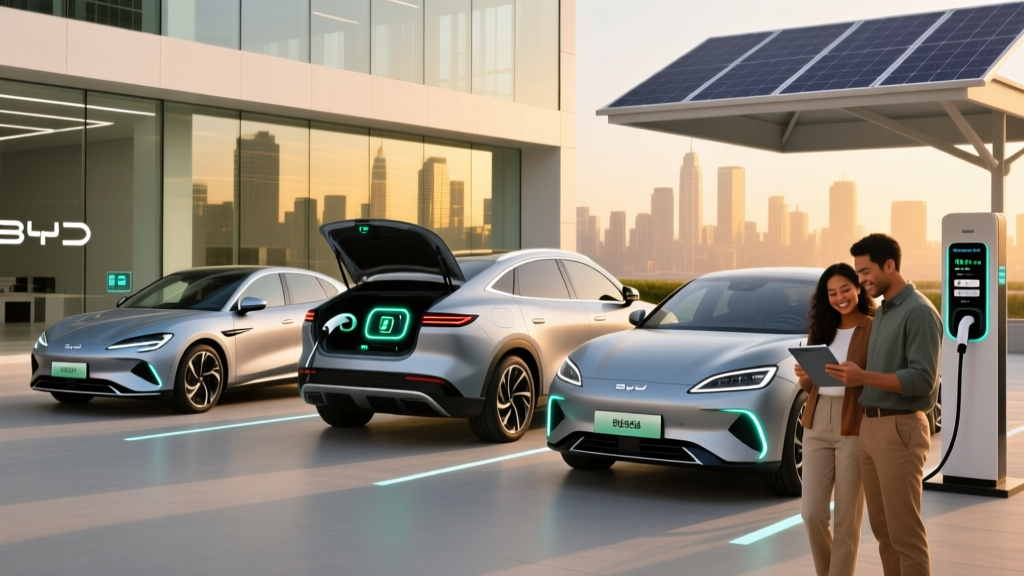
If you've been searching for BYD cars in the US, you've likely encountered a wall of conflicting headlines. BYD (Build Your Dreams) is the world's largest plug-in electric vehicle manufacturer by volume, yet its passenger vehicles remain conspicuously absent from American driveways. As of early 2026, the situation is nuanced: BYD sells electric buses and commercial trucks in the US, but its consumer EV lineup — including the globally popular Atto 3, Seal, and Dolphin — is not officially available through US dealerships.
This guide cuts through the noise with hard data on BYD's global EV specs, what it would take for them to enter the US market, and which currently available alternatives match BYD's value proposition. If you're cross-shopping and wondering whether to wait for BYD or buy now, this is your decision framework.
BYD's US Status in 2026: What's Actually Available?
Let's be precise: no BYD passenger EV is currently sold through US retail channels. BYD's North American operations focus on heavy-duty electric trucks (like the Class 8 8TT) and transit buses manufactured at their Lancaster, California facility. The company has signaled interest in US passenger vehicle sales, but tariffs, regulatory homologation, and geopolitical trade barriers — including 100%+ US tariffs on Chinese-made EVs enacted in 2024 — have kept consumer models offshore.
For context, BYD's global bestsellers include:
- BYD Atto 3 (Yuan Plus) — compact crossover SUV
- BYD Seal — midsize sport sedan, Tesla Model 3 competitor
- BYD Dolphin — subcompact hatchback
- BYD Han — flagship luxury sedan
- BYD Seagull — ultra-affordable city car (sold in Latin America and Southeast Asia)
Below, we break down the specs of BYD's most globally relevant models using manufacturer data and international testing — so you can see exactly what the US market is missing, and what comparable alternatives cost today.
BYD Seal: The Model 3 Competitor America Can't Buy
The BYD Seal is the company's most credible Tesla Model 3 rival, sold across Europe, Australia, and Southeast Asia. Here are the verified specifications for the 2025/2026 model-year Seal (Extended Range, RWD), based on BYD's global spec sheets and European WLTP testing converted to EPA-equivalent estimates:
| Specification | BYD Seal (Extended Range RWD) |
|---|---|
| Battery Capacity | 82.5 kWh usable (LFP — Blade Battery) |
| Range (WLTP) | 570 km / ~354 miles |
| Estimated EPA Range | ~310–320 miles (EPA typically 10–15% lower than WLTP) |
| Motor Output | 308 hp (230 kW), 360 Nm torque |
| 0–100 km/h (0–62 mph) | 5.9 seconds |
| Drivetrain | Rear-wheel drive (AWD Performance also offered at 523 hp) |
| Max DC Fast Charge | 150 kW peak |
| 10–80% DC Charge Time | ~26 minutes |
| Level 2 AC Charge Rate | 11 kW (~37 miles of range per hour) |
| Efficiency (WLTP) | 16.6 kWh/100 km (~26.7 kWh/100 mi) |
| Length / Wheelbase | 189.4 in / 113.4 in |
| Cargo Volume | 14.1 cu ft trunk + 1.8 cu ft frunk |
| Battery Warranty (Global) | 8 years / 160,000 km (~100,000 mi) |
Real-World Range Reality Check
The BYD Seal's WLTP rating of 354 miles translates to an estimated EPA range of roughly 310–320 miles. In real-world highway driving at 70–75 mph, expect 260–280 miles before needing to charge. In cold weather (below 30°F), LFP batteries experience greater range loss than NMC chemistries — plan for 220–250 miles of usable range in winter conditions. BYD's Blade Battery uses a cell-to-pack design that improves thermal management, but LFP's inherent cold-weather sensitivity remains a physics constraint.
BYD Atto 3: The Compact SUV That Undercuts the Competition
The Atto 3 (badged Yuan Plus in China) is BYD's global volume leader. It competes in the same segment as the Hyundai Kona Electric, Chevrolet Equinox EV, and Volvo EX30.
| Specification | BYD Atto 3 (60.48 kWh Battery) |
|---|---|
| Battery Capacity | 60.48 kWh usable (LFP Blade Battery) |
| Range (WLTP) | 420 km / ~261 miles |
| Estimated EPA Range | ~220–230 miles |
| Motor Output | 201 hp (150 kW), 310 Nm torque |
| 0–100 km/h (0–62 mph) | 7.3 seconds |
| Max DC Fast Charge | 88 kW peak |
| 10–80% DC Charge Time | ~29 minutes |
| Level 2 AC Charge Rate | 7 kW (~24 miles per hour) |
| Cargo Volume | 15.8 cu ft (rear seats up) / 47.2 cu ft (folded) |
| Global MSRP Equivalent | ~$30,000–$35,000 USD (varies by market) |
The Atto 3's 88 kW peak DC charging speed is its weakest competitive metric. Most 2026 rivals — the Kona Electric peaks at 100+ kW, the Equinox EV at 150 kW — charge noticeably faster on road trips. For daily Level 2 home charging, the 7 kW onboard charger adds roughly 24 miles per hour, meaning a full charge takes about 8.5 hours from empty.
BYD's Blade Battery: LFP Chemistry Explained
Every BYD passenger EV uses the company's proprietary Blade Battery, which is based on lithium iron phosphate (LFP) chemistry arranged in a cell-to-pack configuration. Here's how LFP stacks up against the nickel-manganese-cobalt (NMC) chemistry used in most Korean and American EVs:
| Factor | LFP (BYD Blade) | NMC (Typical) |
|---|---|---|
| Energy Density | Lower (~160 Wh/kg cell-level) | Higher (~220–260 Wh/kg) |
| Cycle Life | 3,000+ cycles to 80% SoH | 1,500–2,000 cycles to 80% SoH |
| Thermal Stability | Excellent — resists thermal runaway | Good — requires more active cooling |
| Cold-Weather Performance | Weaker — 20–30% range loss below freezing | Better — 15–25% range loss below freezing |
| Cost | Lower — no cobalt or nickel | Higher — commodity-sensitive |
| Recommended Charge Habit | Can be charged to 100% daily | Better longevity at 80% daily, 100% for trips |
BYD's Blade design passes nail-penetration tests without thermal runaway — a genuine safety advantage. The trade-off is lower energy density (meaning heavier packs for the same range) and more pronounced cold-weather range loss. For US buyers in northern states, this is a meaningful consideration.
US Availability: Tariffs, Timing, and Realistic Expectations
As of 2026, the US imposes a 100% tariff on Chinese-manufactured electric vehicles, signed into effect in 2024 and upheld through subsequent trade policy. This effectively doubles the price of any BYD imported from China, eliminating the brand's core value proposition.
Could BYD build a US or Mexico-based factory to bypass tariffs? The company has manufacturing facilities in Thailand, Brazil, Hungary, and Uzbekistan — but no announced North American passenger-vehicle plant. Even if BYD began local production, it would face the same IRS §30D battery-sourcing requirements that disqualify vehicles with Chinese-mined critical minerals or Chinese-manufactured battery components from the $7,500 federal tax credit.
Bottom line: BYD passenger EVs are not expected to enter the US retail market before 2028 at the earliest, and likely not without a dedicated North American production strategy and supply-chain restructuring.
What to Buy Instead: US-Available Alternatives Compared
If you're drawn to BYD's value proposition — affordable pricing, LFP durability, practical range — here are the closest US-market alternatives as of 2026:
| Model | EPA Range | Battery | DC Peak kW | 10–80% | Base MSRP | §30D Credit Eligible? |
|---|---|---|---|---|---|---|
| Tesla Model 3 RWD | 341 mi | 60 kWh LFP | 170 kW | ~25 min | $38,990 | Yes (partial, verify sourcing) |
| Hyundai Kona Electric | 261 mi | 64.8 kWh NMC | 100+ kW | ~43 min | $32,975 | No (Korea assembly, sourcing) |
| Chevrolet Equinox EV 2LT | 319 mi | 85 kWh NMC | 150 kW | ~30 min | $36,400 | Yes (verify trim/sourcing) |
| Volkswagen ID.4 Pro | 291 mi | 82 kWh NMC | 170 kW | ~28 min | $39,735 | Yes (US-built) |
| BYD Seal (not US avail.) | ~315 mi est. | 82.5 kWh LFP | 150 kW | ~26 min | N/A | N/A |
The Tesla Model 3 RWD is the closest US analog to the BYD Seal: similar LFP battery chemistry, comparable range, and a competitive price. The Equinox EV offers more range and faster charging for buyers willing to pay slightly more. Neither matches BYD's aggressive global pricing, but both are purchasable today with full warranty support and US charging-network compatibility.
Pros of BYD's Global Lineup (If Available)
- Blade Battery LFP chemistry — exceptional cycle life and thermal safety
- Aggressive pricing in international markets ($25K–$40K range)
- Strong build quality and interior materials for the price segment
- Competitive range in the Seal (310+ mi EPA-estimated)
- Rotating center display and distinctive interior design
Cons & Barriers for US Buyers
- Not available for purchase in the United States
- 100% tariff on Chinese-made EVs eliminates price advantage
- No US dealer network, service infrastructure, or parts supply
- LFP cold-weather range loss concerns for northern climates
- DC charging speeds lag behind 2026 competitors (Atto 3 especially)
- Unlikely to qualify for §30D tax credit due to battery-sourcing rules
- No NACS connector — would require CCS-to-NACS adapter for Tesla Superchargers
Tax Credit Reality: Why BYD Would Struggle with §30D
Even if BYD began US sales tomorrow, the federal §30D clean vehicle credit presents steep hurdles. The current rules require:
- Final assembly in North America — BYD has no US passenger-vehicle plant
- Battery component sourcing — a percentage of battery components must be manufactured or assembled in North America, increasing annually
- Critical minerals — a percentage of critical minerals must be sourced from the US or free-trade-agreement partners
- MSRP caps — $55,000 for sedans, $80,000 for SUVs/trucks
- Buyer income caps — $150K single / $300K joint AGI
- FEOC restriction — vehicles with battery components from a "foreign entity of concern" (which includes Chinese companies) are disqualified entirely
The FEOC (Foreign Entity of Concern) provision is the most decisive barrier: any vehicle with battery components manufactured by a Chinese company is categorically ineligible for the credit, regardless of where the car is assembled. Since BYD manufactures its own Blade Batteries, this alone would disqualify every BYD model from the $7,500 credit.
The Verdict: Should You Wait for BYD?
No. If you need an EV in 2026, waiting for BYD's US entry is not a viable strategy. The combination of 100% tariffs, FEOC tax-credit disqualification, absent dealer infrastructure, and no announced North American factory means BYD passenger vehicles are years away from US viability — if they arrive at all.
The good news: the US EV market in 2026 offers exceptional value at the price points BYD targets globally. The Tesla Model 3, Chevrolet Equinox EV, Hyundai Ioniq 5, and Volkswagen ID.4 all deliver 260+ miles of EPA range, DC fast charging, established service networks, and (in several cases) federal tax credit eligibility.
Choose Your Path
Buy a Tesla Model 3 RWD if: you want LFP battery durability, 341 miles of EPA range, access to the Supercharger network, and the closest US equivalent to the BYD Seal.
Buy a Chevrolet Equinox EV if: you want crossover SUV practicality, 319 miles of range, 150 kW DC charging, and potential §30D tax credit eligibility at ~$36,400.
Buy a Hyundai Kona Electric if: you want the most affordable new EV with 260+ miles of range and don't need DC fast charging for frequent road trips.
Wait for BYD only if: you don't need a vehicle for 3+ years, are willing to gamble on US market entry, and live in a warm climate where LFP cold-weather loss is irrelevant.
Are BYD cars sold in the United States in 2026?
No. BYD does not sell passenger vehicles (cars, SUVs, or trucks) through US dealerships. The company's US operations are limited to commercial electric buses and heavy-duty trucks manufactured in Lancaster, California.
Will BYD enter the US market soon?
There is no confirmed timeline for BYD passenger vehicle sales in the US. The 100% tariff on Chinese-made EVs, FEOC tax credit restrictions, and lack of a North American passenger-vehicle factory make a near-term entry unlikely before 2028.
What is BYD's Blade Battery, and is it safe?
The Blade Battery is BYD's proprietary LFP (lithium iron phosphate) battery with a cell-to-pack design. It passes nail-penetration tests without thermal runaway and offers 3,000+ charge cycles — significantly more than typical NMC batteries. It is widely regarded as one of the safest EV battery designs in production.
Would BYD cars qualify for the $7,500 US tax credit?
Almost certainly not. The §30D credit's FEOC provision disqualifies any vehicle with battery components from a Chinese company. Since BYD manufactures its own batteries, this would apply to every model in their lineup regardless of assembly location.
What's the best US alternative to the BYD Seal?
The Tesla Model 3 RWD is the closest equivalent: LFP battery, 341 miles EPA range, 170 kW DC fast charging, and a $38,990 base price. The Chevrolet Equinox EV is the best alternative for SUV buyers.