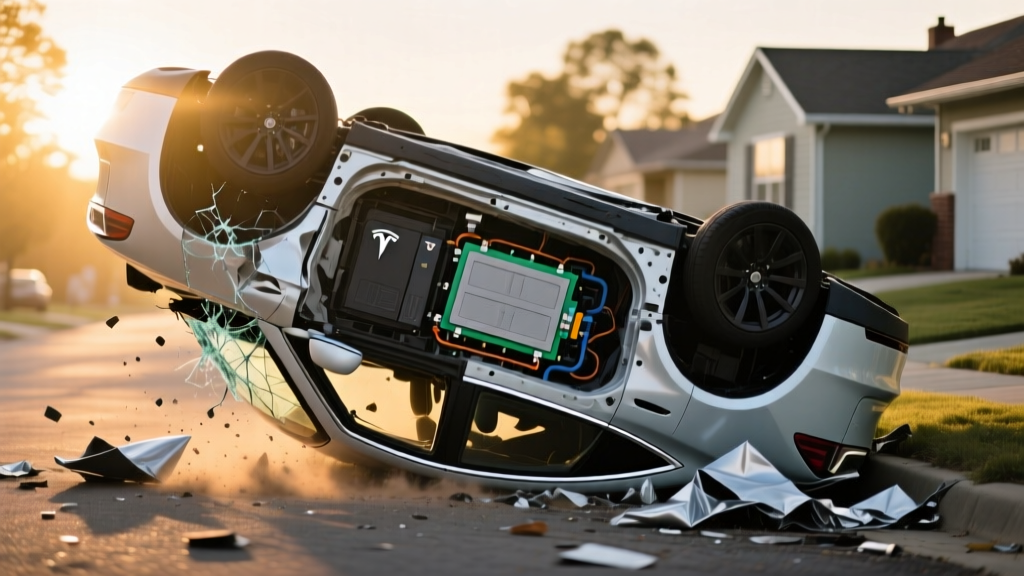
If you've searched "Tesla flipped upside down," you've likely seen the viral crash-test footage or real-world incident photos showing a Model Y or Model 3 resting on its roof after a rollover. The images are dramatic — but they also reveal something important about how electric vehicles are engineered for structural integrity. Unlike a gas car with a thin stamped-steel roof and a hollow engine bay, a Tesla's battery pack sits low in the chassis, acting as a structural floor that dramatically lowers the center of gravity and reinforces the entire body shell.
This review takes a hard look at what actually happens when a Tesla ends up upside down: the roof crush ratings, the battery enclosure engineering, the real-world rollover data from NHTSA and IIHS, and whether the structural design translates into a safer ownership experience. We'll use the 2026 Tesla Model Y Long Range AWD as our reference vehicle, since it's Tesla's highest-volume seller and the model most commonly featured in these viral rollover scenarios.
Why a Tesla Flipped Upside Down Looks Different Than a Gas Car
When a conventional internal-combustion vehicle rolls over, the roof pillars (A-pillars, B-pillars, C-pillars) bear the entire load. The engine bay and trunk are essentially crumple zones with no structural contribution to roof strength. In a Tesla, the architecture is fundamentally different.
The battery pack — a rigid, flat enclosure bolted to the underside of the vehicle — functions as a stressed structural member. It resists torsional flex and distributes impact forces across the entire floor pan rather than concentrating them at the roof pillars. This is why Tesla's roof crush test results consistently exceed federal requirements by a wide margin.
| Spec | Value |
|---|---|
| EPA Range | 320 miles |
| Battery Capacity (Usable) | ~75 kWh (NMC chemistry) |
| Drivetrain | Dual-Motor AWD |
| Horsepower | 384 hp (combined) |
| 0–60 mph | 4.8 seconds |
| MPGe (Combined) | 122 MPGe |
| Efficiency | 27 kWh/100 mi |
| Max DC Fast Charge | 250 kW (peak) |
| 10–80% DC Fast Charge | ~25 minutes |
| Level 2 Home Charging | 11.5 kW (~44 mi/hr) |
| Cargo Volume (rear seats up) | 30.2 cu ft |
| Cargo Volume (rear seats folded) | 72.1 cu ft |
| Base MSRP | $48,990 |
| Battery Warranty | 8 years / 120,000 miles |
Roof Crush Strength: The Numbers Behind the Headlines
The National Highway Traffic Safety Administration (NHTSA) requires that a vehicle's roof withstand a force equal to 1.5 times the vehicle's weight applied to one side before the roof crushes more than 5 inches. This is the Federal Motor Vehicle Safety Standard (FMVSS) 216 baseline.
The Insurance Institute for Highway Safety (IIHS) uses a stricter standard for its "Good" roof strength rating: the roof must withstand 4.0 times the vehicle's weight. The Model Y has consistently earned the IIHS "Good" rating for roof strength, and independent testing has shown peak crush resistance well above even that threshold.
For a Model Y weighing approximately 4,400 lbs, a 4.0x strength-to-weight ratio means the roof can withstand roughly 17,600 lbs of force before significant deformation. In practical terms, that's enough to support the weight of another full-size SUV stacked on top — which is exactly what the viral "Tesla stacked on Tesla" marketing stunt demonstrated.
The structural advantage comes from a combination of factors:
- Mega-castings: Tesla uses large single-piece aluminum castings for the front and rear underbody, reducing the number of joints and welds that could become failure points under load.
- Battery pack as floor: The rigid battery enclosure, filled with tightly packed cells and structural adhesives, acts as a shear plate that distributes roof load across the full width of the vehicle.
- High-strength steel pillars: The A-pillars and B-pillars use ultra-high-strength steel reinforcements that resist buckling.
Battery Safety When a Tesla Is Upside Down
The most common concern when people see a Tesla flipped upside down is: will the battery catch fire? It's a fair question. Lithium-ion battery thermal events are intense and difficult to extinguish, and they receive outsized media coverage relative to their frequency.
Here's what the engineering tells us:
The battery enclosure is armored. The Model Y's battery pack is housed in a reinforced enclosure with a titanium-reinforced skid plate on the bottom (which becomes the top when inverted). The enclosure is designed to withstand significant impact energy without cell penetration. In rollover scenarios, the battery is typically the least damaged component because it sits at the vehicle's lowest point — meaning it's the last part to contact the ground in a single-roll event, and it's shielded by the roof structure in a multi-roll scenario.
Thermal propagation barriers exist between cells. Tesla uses fire-retardant barriers between cell groups within the pack. If one cell group is compromised, the barriers slow or prevent thermal propagation to adjacent groups, giving occupants critical time to exit.
High-voltage disconnects are automatic. In any collision event that triggers the airbag system, the vehicle's high-voltage contactors open within milliseconds, isolating the battery pack from the rest of the vehicle's electrical system. This means even if the car is upside down with structural damage, the high-voltage system is de-energized outside the battery enclosure.
According to NHTSA data, EV battery fires occur at a significantly lower rate per vehicle-mile than internal combustion engine fires. The National Fire Protection Association has documented that gasoline vehicles experience engine-bay fires at rates orders of magnitude higher than EV battery thermal events.
Real-World Range & Efficiency: What Owners Actually See
Real-World Expectation: 270–295 miles in mixed driving; 240–260 miles sustained highway at 75+ mph; 210–240 miles in sub-freezing winter conditions.
The 2026 Model Y Long Range AWD carries an EPA sticker of 320 miles. But as with every EV, real-world results depend heavily on speed, temperature, and terrain.
In moderate weather (55–75°F) with mixed city/highway driving, owners consistently report 280–300 miles of usable range before hitting a 10% state of charge. The regenerative braking in stop-and-go traffic recovers significant energy, often pushing real-world city range close to or even above the EPA figure.
At sustained highway speeds of 75–80 mph, aerodynamic drag dominates and range drops to approximately 240–260 miles. This is physics, not a Tesla-specific problem — every EV loses range at high speed. The Model Y's 0.23 Cd drag coefficient helps, but it can't eliminate the penalty.
In cold weather (below 32°F), expect a 20–30% range reduction. The heat pump (standard on all 2026 Model Y trims) significantly reduces the cabin-heating energy penalty compared to resistive heaters, but battery chemistry itself becomes less efficient at low temperatures. Preconditioning the battery while plugged in — using the Tesla app to warm the pack before departure — recovers much of this loss for daily commutes.
Efficiency is rated at 122 MPGe combined (27 kWh per 100 miles) by the EPA. That's among the most efficient vehicles in its class, translating to roughly $0.04–$0.06 per mile when charging at home on a national-average electricity rate of $0.16/kWh.
Charging Speed: DC Fast Charging and Home Level 2
Charging infrastructure is the single biggest factor in day-to-day EV satisfaction. Here's what the 2026 Model Y delivers:
| Level | Max Power | Speed (Approx.) | Notes |
|---|---|---|---|
| Level 1 (120V) | 1.4 kW | ~4–5 mi/hr | Emergency/trickle only |
| Level 2 (240V, 48A) | 11.5 kW | ~44 mi/hr | Home Wall Connector or equivalent |
| DC Fast (V3 Supercharger) | 250 kW peak | 10–80% in ~25 min | Peak rate only below 40% SoC; tapers above |
| DC Fast (V4 Supercharger) | Up to 250 kW* | Similar to V3 for this pack | V4 hardware capable of higher rates for future packs |
*The 2026 Model Y Long Range charges at a peak of 250 kW on both V3 and V4 Superchargers. The charge curve is aggressive below 40% state of charge (SoC), sustaining above 200 kW, then tapers progressively. Expect the 10–80% session to take approximately 25 minutes at a V3 or V4 stall that isn't shared with another vehicle.
At home on a Tesla Wall Connector (hardwired, 60A circuit, delivering 48A to the car), you'll add roughly 44 miles of range per hour. A full overnight charge from 20% to 80% takes about 5–6 hours, which is more than sufficient for daily use.
The Model Y uses the NACS (North American Charging Standard) connector natively — the same connector now adopted by Ford, GM, Rivian, Hyundai, and most other major automakers. This gives Tesla owners first-party access to the entire Supercharger network, which remains the most reliable and geographically comprehensive DC fast-charging network in the United States.
Pricing, Trims, and Federal Tax Credit Eligibility
The 2026 Tesla Model Y is available in three primary configurations:
- Long Range RWD: ~$44,990 MSRP — 320+ miles range, single motor
- Long Range AWD: ~$48,990 MSRP — 320 miles range, dual motor
- Performance AWD: ~$53,990 MSRP — 303 miles range, dual motor, 3.3s 0–60
| Trim | Base MSRP | §30D Credit (Max) | Effective Price* |
|---|---|---|---|
| Long Range RWD | $44,990 | Up to $7,500 | From ~$37,490 |
| Long Range AWD | $48,990 | Up to $7,500 | From ~$41,490 |
| Performance AWD | $53,990 | Up to $7,500 | From ~$46,490 |
*Effective price assumes full §30D eligibility. Actual credit amount varies based on battery sourcing, buyer income, and MSRP cap compliance. See IRS §30D guidelines for current-year rules.
The federal EV tax credit under IRS §30D can provide up to $7,500, but eligibility is not automatic. Key requirements for 2026 include:
- MSRP cap: SUVs must have an MSRP at or below $80,000 (all Model Y trims qualify).
- Income cap: Adjusted gross income must not exceed $150,000 (single), $225,000 (head of household), or $300,000 (joint filers).
- Battery sourcing: A percentage of critical minerals and battery components must be sourced from the U.S. or free-trade-agreement countries. This requirement tightens annually — check the current-year IRS qualified vehicle list before purchasing.
- Point-of-sale transfer: As of 2024, buyers can transfer the credit to the dealer for an immediate price reduction at purchase, rather than waiting to claim it on their tax return.
Who Should Buy the Model Y — And Who Shouldn't
- You want access to the Supercharger network for road trips without adapter hassles.
- You value top-tier roof crush strength and low rollover risk.
- You need hatchback cargo versatility (72.1 cu ft with seats folded).
- You want over-the-air updates that meaningfully improve the vehicle over time.
- You prefer traditional physical controls (the Model Y routes nearly everything through the touchscreen).
- You need a truck bed or serious towing capacity (max 3,500 lbs).
- You want the latest interior material luxury — the cabin is minimalist, not opulent.
The Model Y is best suited for tech-forward commuters and small families who charge at home and take occasional road trips. The Supercharger network makes it the most practical EV for multi-state travel. The cargo area handles strollers, groceries, and camping gear with ease, and the low center of gravity makes it feel planted in corners despite its crossover ride height.
Pros and Cons
- Best-in-class roof crush strength — structural battery floor reduces rollover risk
- Supercharger network access (native NACS, no adapter)
- 122 MPGe combined — among the most efficient in its segment
- OTA updates add features post-purchase
- Spacious hatchback cargo area (72.1 cu ft max)
- Heat pump standard — less winter range loss
- Minimalist interior lacks physical buttons (climate, mirrors, glovebox all on-screen)
- Ride quality on 20" wheels can be firm on rough pavement
- No Apple CarPlay or Android Auto
- Insurance costs run 15–30% higher than comparable gas crossovers
- Visibility: thick rear pillars create blind spots (mitigated by camera-based mirror view)
Is the Model Y Worth It vs. Key Competitors?
The Model Y competes directly with the Hyundai Ioniq 5, Ford Mustang Mach-E, and Kia EV6. Here's how it stacks up on the metrics that matter:
- Range: Model Y's 320 miles edges the Ioniq 5 (305 mi) and Mach-E Extended Range (312 mi).
- Charging: The Ioniq 5 and EV6 charge faster on 350 kW CCS stations (10–80% in ~18 min vs. ~25 min for the Model Y), but Tesla's Supercharger network is more reliable day-to-day than third-party CCS networks.
- Safety: All four vehicles earn IIHS Top Safety Pick+ ratings. The Model Y's roof strength is a standout differentiator.
- Cargo: Model Y's 72.1 cu ft leads the segment; the Ioniq 5 offers 59.3 cu ft.
- Price: The Ioniq 5 SEL starts ~$3,000 lower, but with fewer standard features.
The Model Y's strongest competitive advantage remains the Supercharger ecosystem. If you road-trip more than twice a year, the reliability and ubiquity of Tesla's charging network is a tangible daily benefit that spec sheets don't capture.
Frequently Asked Questions
What is the real-world range of the 2026 Tesla Model Y?
The EPA rates it at 320 miles. In real-world mixed driving, expect 270–295 miles. Highway driving at 75+ mph drops that to 240–260 miles, and sub-freezing winter temperatures can reduce range to 210–240 miles without preconditioning.
How fast does the Model Y charge at home and on the road?
On a home Level 2 Wall Connector (11.5 kW), you'll gain about 44 miles of range per hour — a full overnight charge covers any daily commute. On a V3 Supercharger at 250 kW peak, a 10–80% session takes approximately 25 minutes, with the charge rate tapering above 80% state of charge.
How much does the Model Y cost after the federal tax credit?
The Long Range AWD starts at $48,990 MSRP. If you qualify for the full $7,500 §30D credit (subject to income caps, MSRP limits, and battery sourcing rules), the effective price drops to approximately $41,490. Eligibility varies — consult the IRS qualified vehicle list and a tax professional.
Does the Tesla Model Y qualify for the federal EV tax credit?
As of 2026, the Model Y qualifies for up to $7,500 under §30D, provided the buyer meets income requirements (≤$300,000 joint AGI) and the vehicle's battery meets critical-mineral and component sourcing thresholds. The credit can be transferred to the dealer at point of sale for an immediate price reduction.
What are the biggest pros and cons of the Model Y?
Pros: outstanding roof strength, Supercharger access, segment-leading cargo space, high efficiency (122 MPGe), heat pump standard. Cons: touchscreen-only controls, no CarPlay/Android Auto, firm ride on large wheels, higher insurance premiums.
Is the Model Y worth buying vs. the Ioniq 5 or Mach-E?
If you prioritize charging-network reliability and cargo versatility, the Model Y leads. If you want faster peak DC charging speeds or prefer physical buttons and CarPlay, the Ioniq 5 or Mach-E may suit you better. All three are excellent vehicles — test-drive each before deciding.
Is Autopilot or FSD self-driving?
No. Tesla's Autopilot and Full Self-Driving (Supervised) are SAE Level 2 driver-assistance systems. They require continuous driver attention and hands-on-wheel supervision. They can manage highway lane-keeping and adaptive cruise, but they do not make the vehicle autonomous. Only Level 4 services like Waymo operate without a human driver.