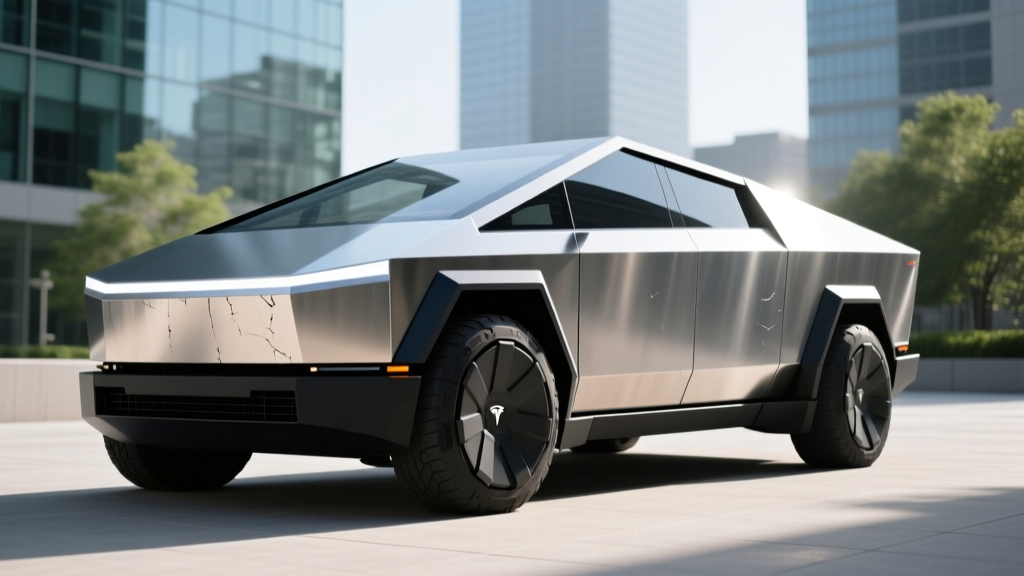
The Tesla Cybertruck's most polarizing feature isn't its acceleration or its steer-by-wire system — it's the Cybertruck shell: the ultra-hard 30X cold-rolled stainless steel exoskeleton that replaces the conventional body-on-frame architecture found in legacy pickups. In this 2026 review, we examine whether the stainless steel unibody delivers on its promises of durability, efficiency, and practicality, while breaking down every spec that matters to real buyers: EPA range, charging curves, tax credit eligibility, and how the exoskeleton holds up after thousands of miles of ownership.
What Exactly Is the Cybertruck Shell?
Unlike traditional trucks that use stamped aluminum or steel panels bolted onto a separate frame, the Cybertruck employs what Tesla calls an "exoskeleton" design. The Cybertruck shell consists of 1.8mm-thick 30X cold-rolled stainless steel panels that serve as both the exterior skin and a structural load-bearing member. These panels are formed using an air-bending process rather than traditional stamping dies — a manufacturing choice that eliminates the need for expensive tooling but creates the flat, angular geometry that defines the truck's appearance.
The shell integrates with a cast aluminum rear underbody (part of Tesla's megacasting strategy) and a steel front underbody structure. The result is a unibody vehicle with no separate frame rails, which reduces weight compared to a body-on-frame design while maintaining torsional rigidity. Tesla claims the 30X stainless alloy — the same family used in SpaceX Starship components — resists dents, corrosion, and minor impacts far better than conventional painted truck bodies.
But the shell also introduces ownership realities that buyers should understand before signing a delivery agreement. Let's break them all down.
Range, Efficiency, and the Exoskeleton's Aero Advantage
The angular Cybertruck shell isn't just an aesthetic choice — it directly impacts aerodynamic efficiency. Despite its brutalist appearance, the Cybertruck achieves a drag coefficient (Cd) of approximately 0.34, competitive with some crossovers and significantly better than conventional pickups like the Ford F-150 (Cd ~0.39-0.42). The flat panels and integrated bed cover (the motorized tonneau that is itself a stainless steel panel) reduce turbulence at highway speeds.
- Dual Motor AWD: EPA 340 miles — Expect ~285-305 mi at sustained 75 mph highway; ~250-270 mi in sub-30°F cold weather
- Cyberbeast (Tri-Motor AWD): EPA 320 miles — Expect ~270-290 mi highway; ~235-255 mi in freezing conditions
- Rear-Wheel Drive (RWD): EPA 250 miles (announced base trim, limited availability) — Expect ~210-225 mi highway
The stainless shell contributes to a heavier curb weight (~6,600-6,800 lbs depending on trim), which partially offsets the aero gains. Cold-weather range loss of 20-25% is typical for any lithium-ion EV, but the Cybertruck's heat pump and battery thermal management help mitigate this compared to older EV platforms.
Efficiency ratings from fueleconomy.gov place the Dual Motor AWD at approximately 67 MPGe combined (roughly 50 kWh per 100 miles driven), while the Cyberbeast drops to around 63 MPGe combined due to its tri-motor powertrain and higher performance tuning.
| Trim | EPA Range | Real-World Highway | MPGe (Combined) | kWh/100mi |
|---|---|---|---|---|
| RWD (Base) | 250 mi | ~210-225 mi | ~70 MPGe | ~48 |
| Dual Motor AWD | 340 mi | ~285-305 mi | 67 MPGe | 50 |
| Cyberbeast (Tri-Motor) | 320 mi | ~270-290 mi | 63 MPGe | 53 |
Battery Chemistry, Capacity, and Long-Term Degradation
The 2026 Cybertruck Dual Motor and Cyberbeast trims use a structural battery pack with an estimated ~123 kWh of usable capacity (total pack capacity is slightly higher, with a top/bottom buffer to protect longevity). Tesla uses a 4680-cell format in a structural pack where the battery cells themselves serve as a stressed member between the front and rear castings.
As of the 2026 model year, Tesla continues to use NMC (nickel manganese cobalt) chemistry in the Cybertruck pack. NMC offers higher energy density than LFP (lithium iron phosphate), which is critical here given the truck's heavy curb weight and the need to hit 340 miles of range without an impossibly large pack. The trade-off is that NMC cells are more sensitive to sustained high-state-of-charge storage and extreme heat, so Tesla recommends daily charging to 80-90% for routine use.
| Spec | Detail |
|---|---|
| Usable Capacity | ~123 kWh |
| Cell Format | 4680 cylindrical |
| Chemistry | NMC (Nickel Manganese Cobalt) |
| Pack Architecture | Structural (load-bearing) |
| Thermal Management | Active liquid cooling + heat pump |
| Daily Charge Recommendation | 80-90% SoC |
On degradation: Tesla's 4680 NMC cells have shown promising longevity in Model Y applications, with fleet data suggesting approximately 10-12% capacity loss over 150,000 miles under typical usage. The Cybertruck's larger pack means that even with moderate degradation, usable range remains substantial over the vehicle's life.
Charging Speed: DC Fast Charge and Home Level 2
Charging a ~123 kWh battery pack demands serious infrastructure. Here's what the Cybertruck shell houses in terms of charging capability:
| Charging Level | Max Rate | Speed / Time | Notes |
|---|---|---|---|
| Level 1 (120V) | ~1.4 kW | ~3-4 mi/hr | Emergency/trickle only |
| Level 2 (240V, 48A) | 11.5 kW | ~30-33 mi/hr; full charge in ~11 hr | Home Wall Connector |
| Level 2 (240V, 32A) | 7.7 kW | ~20-22 mi/hr; full charge in ~16 hr | Mobile Connector on dryer outlet |
| DC Fast Charge (V4 Supercharger) | ~250 kW peak | 10-80% in ~30 min | Sustained rate tapers above 60% SoC |
| DC Fast Charge (350 kW CCS) | ~200 kW sustained avg | 10-80% in ~35-40 min | Via NACS-to-CCS adapter at non-Tesla networks |
Charging curve reality check: The Cybertruck peaks at approximately 250 kW at low states of charge (around 10-15% SoC), but the charge curve tapers progressively. From 60-80% SoC, you'll see rates drop to 80-120 kW, and above 80%, speeds fall sharply to protect cell health. This means the advertised "30-minute 10-80%" time is accurate, but a 10-100% charge will take closer to 55-65 minutes. Plan road-trip stops accordingly.
The Cybertruck uses the NACS (North American Charging Standard) connector natively, giving it seamless access to Tesla's Supercharger network — the most reliable and extensive DC fast-charging network in the US. With Tesla opening Superchargers to NACS-equipped vehicles broadly, Cybertruck owners have a significant infrastructure advantage over CCS-only trucks.
Performance: What 845 Horsepower Does in a Stainless Steel Truck
The Cybertruck shell adds mass, but Tesla compensates with serious powertrain output:
| Trim | Drivetrain | Horsepower | 0-60 mph | Top Speed | Towing |
|---|---|---|---|---|---|
| RWD | Single Motor RWD | ~277 hp | ~6.5 sec | 110 mph | 7,500 lbs |
| Dual Motor AWD | Dual Motor AWD | ~600 hp | 3.9 sec | 130 mph | 11,000 lbs |
| Cyberbeast | Tri-Motor AWD | 845 hp | 2.6 sec | 130 mph | 11,000 lbs |
The Cyberbeast's 2.6-second 0-60 time makes it the quickest production pickup ever sold, outpacing the Rivian R1T Tri-Motor and the GMC Hummer EV. But the more relevant daily metric is the Dual Motor's 3.9-second sprint — genuinely sports-car quick in a 6,700-pound truck.
Towing capacity of 11,000 lbs is competitive with heavy-duty gas trucks, but real-world towing range drops significantly. Expect roughly 55-65% of rated range when towing a loaded 8,000-lb trailer at highway speed — meaning a 340-mile EPA Dual Motor becomes a ~190-210-mile tow vehicle. The integrated trailer brake controller and tow/haul drive mode help manage the load, but plan charging stops carefully when hauling.
Pricing, Trims, and Federal Tax Credit Eligibility
The Cybertruck's pricing has shifted since its 2023 unveiling, and the 2026 model year reflects Tesla's current production reality:
| Trim | Base MSRP | As-Tested (Common Config) | §30D Tax Credit Eligible? |
|---|---|---|---|
| RWD (Base) | ~$60,990 | ~$62,500 | Yes — up to $7,500 (subject to income + sourcing rules) |
| Dual Motor AWD | ~$79,990 | ~$84,000 | Yes — up to $7,500 (under $80K truck MSRP cap) |
| Cyberbeast | ~$99,990 | ~$104,000 | No — exceeds $80,000 MSRP cap for trucks under §30D |
Critical tax credit caveats: Under IRS §30D rules, the Cybertruck qualifies as a pickup truck, meaning the MSRP cap is $80,000 (not $55,000 as for sedans). The Dual Motor AWD at ~$79,990 base just clears this threshold, but adding options that push the MSRP above $80,000 will disqualify it. The Cyberbeast, at ~$99,990, is firmly above the cap and does not qualify for the federal credit.
Additional §30D requirements include:
- Buyer income caps: Modified AGI ≤ $150,000 (single), $225,000 (head of household), $300,000 (joint)
- Battery sourcing: Critical minerals and battery component percentages must meet annual thresholds that increase yearly — verify current-year compliance on the fueleconomy.gov credit lookup
- Point-of-sale transfer: As of 2024+, eligible buyers can transfer the credit to the dealer at purchase for an immediate price reduction rather than waiting to claim it on their tax return
Consult a tax professional before assuming eligibility — sourcing rules and income thresholds can change annually.
Cargo, Interior Space, and the Vault Bed
The Cybertruck shell creates a 6-foot bed that Tesla calls "the Vault" — a fully enclosed, lockable space thanks to the powered stainless steel tonneau cover (which is itself part of the exoskeleton design language). With the tonneau closed, the bed becomes weather-sealed, functioning like a massive trunk.
| Measurement | Value |
|---|---|
| Bed Length | 72 inches (6 ft) |
| Bed Volume (tonneau closed) | ~67 cu ft |
| Frunk (Front Trunk) | ~7.1 cu ft |
| Total Enclosed Cargo | ~74 cu ft |
| Front Legroom | ~41.3 in |
| Rear Legroom | ~35.4 in |
| Seating | 5-passenger (3 front / 3 rear in 2026 config) |
| Curb Weight | ~6,600-6,840 lbs (trim dependent) |
| Ground Clearance | Up to 17.4 in (adaptive air suspension) |
The 6-foot bed is shorter than a standard F-150 SuperCrew 6.5-foot bed, but the fully enclosed, lockable nature of the Vault is a genuine advantage for secure cargo hauling. The frunk adds useful grocery-bag or charging-cable storage. Rear legroom, however, is tighter than an F-150 or Rivian R1T — tall passengers on long trips will notice the compromise.
Standout Tech and the Shell's Unique Features
The Cybertruck shell isn't just a body — it enables features no other truck offers:
- Stainless steel exterior: No paint to scratch or chip. Minor scuffs can be polished out with Scotch-Brite pads. However, fingerprints and smudges are highly visible and require regular wiping with microfiber and stainless steel cleaner.
- Armor glass: Tesla's laminated glass is designed to resist impacts (though early production units showed cracking under extreme stress — later production runs have improved durability).
- Steer-by-wire: No mechanical connection between the yoke and the wheels. This enables a variable-ratio steering rack (fewer turns lock-to-lock at low speeds) but takes acclimation for drivers used to traditional steering feel.
- 48-volt electrical architecture: Reduces wiring harness weight and enables higher-power accessories, including the bed's integrated 240V outlet (up to 9.6 kW of power export capability for tools, camping, or emergency home backup via Powershare).
- Autopilot / FSD (Supervised): Tesla's Level 2 driver-assistance suite. Note: FSD Supervised is not self-driving — the driver must remain attentive and hands-ready at all times. The system excels at highway lane-keeping and navigation-assisted lane changes but requires active supervision.
- 18.5-inch center touchscreen + 9.4-inch rear screen: All vehicle controls are screen-based, including glovebox release, windshield wiper speed, and mirror adjustment.
Who Should Buy the Cybertruck — And Who Shouldn't
- You want a secure, lockable bed (the Vault) for tools, gear, or bikes without a camper shell
- You value the Supercharger network for road-trip towing and long-distance driving
- You want sports-car acceleration in a utility vehicle (Cyberbeast or Dual Motor)
- You don't mind the polarizing design and the maintenance quirks of raw stainless steel
- You need 240V power export for job sites or off-grid camping
- You need a full-size 8-foot bed or maximum rear-seat passenger comfort
- You want a conventional steering wheel and traditional driving dynamics
- You frequently drive in areas with limited Supercharger or NACS DC charging access
- You prefer a proven, long-production-run platform with extensive third-party service options
- The Cyberbeast's $100K price exceeds your budget, and you need features the Dual Motor omits
Cybertruck Shell: Biggest Pros and Cons
- Dent-resistant, paint-free stainless exoskeleton eliminates paint repair costs
- Lockable, weather-sealed Vault bed with 240V power export
- Best-in-class Supercharger network access via native NACS
- 340-mile EPA range (Dual Motor) is among the best of any electric truck
- 2.6-second 0-60 (Cyberbeast) is unmatched in the pickup segment
- Adaptive air suspension with up to 17.4" ground clearance for off-road use
- Stainless shell shows fingerprints, water spots, and requires specific cleaning products
- Rear legroom (35.4") is tighter than F-150 Lightning and Rivian R1T
- Towing reduces range by 35-45% — plan charging stops carefully when hauling
- Cyberbeast ($99,990+) does not qualify for the $7,500 federal tax credit
- Steer-by-wire takes acclimation; no traditional steering feedback
- Panel gap consistency and early build-quality concerns persist in owner forums
- Insurance premiums are higher than average for the segment due to repair complexity
Warranty Coverage
| Component | Coverage |
|---|---|
| Basic Vehicle | 4 years / 50,000 miles |
| Battery & Drive Unit | 8 years / 120,000 miles (minimum 70% capacity retention) |
| Stainless Steel Body/Shell | 4 years / 50,000 miles (corrosion and structural defects) |
| Roadside Assistance | 4 years / 50,000 miles |
Tesla's 8-year/120,000-mile battery warranty with a 70% retention threshold is competitive with the broader EV market. If the pack degrades below 70% of its original capacity within the warranty period, Tesla will repair or replace it. Given the 4680 NMC cells' early track record and the Cybertruck's active thermal management, significant degradation within the warranty window appears unlikely under normal use — but the heavy vehicle weight and frequent DC fast charging could accelerate wear in high-mileage scenarios.
Frequently Asked Questions
What is the real-world range of the Cybertruck?
The Dual Motor AWD carries a 340-mile EPA rating. In real-world highway driving at 75 mph, expect 285-305 miles. In sub-freezing temperatures, range drops to roughly 250-270 miles. The Cyberbeast's tri-motor setup yields 320 EPA miles, with similar real-world reductions.
How fast does the Cybertruck charge at home and on the road?
At home on a Level 2 Tesla Wall Connector (48A/11.5 kW), you gain roughly 30-33 miles per hour, with a full charge taking about 11 hours. On a V4 Supercharger, the Cybertruck peaks at ~250 kW and charges from 10-80% in approximately 30 minutes. Above 80%, charging slows significantly to protect the NMC cells.
Does the Cybertruck qualify for the federal EV tax credit?
The Dual Motor AWD (base MSRP ~$79,990) and the RWD base model qualify for up to $7,500 under IRS §30D, provided the buyer meets income caps ($150K single / $300K joint) and the battery meets current-year critical-mineral and component sourcing thresholds. The Cyberbeast (~$99,990) exceeds the $80,000 truck MSRP cap and does not qualify. Always verify current sourcing compliance on fueleconomy.gov and consult a tax professional.
Is the Cybertruck worth buying vs. the F-150 Lightning or Rivian R1T?
The Cybertruck wins on Supercharger network access, lockable enclosed cargo (the Vault), and raw acceleration. The F-150 Lightning offers a larger bed, more rear-seat space, and a more conventional driving experience. The Rivian R1T provides a more refined interior, better off-road capability (quad-motor), and a gear tunnel for extra storage. Your choice depends on whether the Cybertruck shell's unique benefits — paint-free durability, secure bed, and Tesla's charging network — outweigh its compromises in rear-seat comfort and polarizing design.
Does the stainless steel Cybertruck shell rust or corrode?
30X cold-rolled stainless steel is highly corrosion-resistant and will not rust like conventional carbon steel. However, it can develop surface staining, water spots, and discoloration from environmental contaminants. Tesla recommends cleaning with a microfiber cloth and a stainless-steel-safe cleaner. Avoid chlorine-based cleaners or abrasive pads that can embed iron particles and cause surface rust spots.
How much does insurance cost for the Cybertruck?
Cybertruck insurance premiums run 20-40% higher than comparable gas trucks due to the vehicle's price, repair complexity (specialized stainless steel bodywork and structural battery pack), and high performance. Dual Motor owners report annual premiums in the $2,800-$4,200 range depending on state, driving record, and coverage level. Get quotes from multiple insurers before purchase.
Is FSD (Full Self-Driving) actually self-driving?
No. Tesla's FSD (Supervised) is an SAE Level 2 driver-assistance system. It handles steering, acceleration, and braking on highways and some city streets, but the driver must remain fully attentive, keep hands ready, and be prepared to take over instantly. It is not autonomous driving. Only Level 4 systems like Waymo's robotaxi service operate without a human driver.