BYD Reliability: The Question Every US EV Shopper Is Asking
BYD has become the world's largest plug-in vehicle manufacturer, surpassing Tesla in total NEV (new energy vehicle) deliveries and expanding aggressively across Europe, Southeast Asia, Latin America, and Australia. But for US-based EV shoppers, the question isn't whether BYD can sell cars globally — it's whether BYD reliability holds up in real-world, long-term ownership, and whether buying one stateside is even viable in 2026.
This guide breaks down what we know about BYD's durability from global fleet data, the engineering behind its Blade Battery platform, how its models stack up on range, charging, and pricing against US-market competitors, and the regulatory realities that affect whether you can actually put a BYD in your driveway.
BYD's Track Record: Global Fleet Data and Owner Feedback
BYD doesn't sell passenger vehicles in the United States as of 2026, which means there's no NHTSA crash-test data, no IIHS ratings, and no J.D. Power dependability scores for BYD models on US soil. That's a critical gap. However, we can piece together a reliability picture from other markets:
- European fleet data: BYD entered Europe in 2022 and expanded through 2025. Early warranty claims have been relatively low, though independent long-term (5+ year) data remains limited. German ADAC and UK fleet operators have reported acceptable first-year reliability, with most complaints centered on software/infotainment bugs rather than powertrain failures.
- Australian market: The BYD Atto 3 (known as the Yuan Plus in China) became one of Australia's top-selling EVs. Owner surveys from Drive.com.au and local EV forums show high satisfaction with battery performance but recurring complaints about suspension tuning on rough roads and occasional OTA update glitches.
- China domestic market: With millions of BYD EVs and PHEVs on Chinese roads, the sample size is enormous. Taxi and ride-hailing fleets (notably BYD's own partnerships with DiDi) have logged hundreds of thousands of miles per vehicle with Blade Battery packs showing modest degradation — typically 8-12% capacity loss over 300,000 km (~186,000 miles), per fleet operator reports.
- Commercial vehicles: BYD's electric buses operate in over 70 countries, including limited US deployments (though largely curtailed by federal transit funding restrictions). These high-mileage commercial units have demonstrated strong powertrain durability, which lends credibility to BYD's battery engineering claims.
The bottom line: BYD's core EV hardware — motors, inverters, and especially the Blade Battery — appears robust. The weak points are software maturity, build-quality consistency across trim levels, and the lack of a US dealer/service network to support owners if something goes wrong.
The Blade Battery: LFP Chemistry and Why It Matters for Reliability
The centerpiece of BYD's reliability story is its proprietary Blade Battery, a lithium iron phosphate (LFP) cell designed in a long, thin form factor that BYD claims improves thermal stability and pack-level safety. Here's why LFP matters:
| Attribute | LFP (BYD Blade) | NMC/NCA (Tesla, Hyundai, BMW) |
|---|---|---|
| Energy Density | Lower (~160-180 Wh/kg cell-level) | Higher (~250-300 Wh/kg cell-level) |
| Cycle Life | 3,000-5,000+ cycles to 80% SoH | 1,000-2,000 cycles to 80% SoH |
| Thermal Runaway Risk | Very low — passes nail penetration test | Moderate — requires robust BMS and cooling |
| Cold-Weather Performance | Weaker — 25-35% range loss below freezing | Better — 15-25% range loss below freezing |
| Cost per kWh | Lower (no cobalt or nickel) | Higher |
| Recommended Charge Habit | Can charge to 100% regularly | Best kept 20-80% for longevity |
The Blade Battery's LFP chemistry gives BYD a structural reliability advantage: these cells degrade more slowly over thousands of charge cycles, are far less prone to thermal runaway, and don't require the careful state-of-charge management that NMC packs demand. If you're a driver who prefers to charge to 100% every night without worrying about long-term damage, LFP is the better choice.
The trade-off is energy density and cold-weather range. BYD vehicles tend to be heavier for a given range target, and drivers in northern US states should budget for significant winter range reduction — a factor we'll quantify below.
Range, Charging, and Efficiency: BYD Seal as the Benchmark
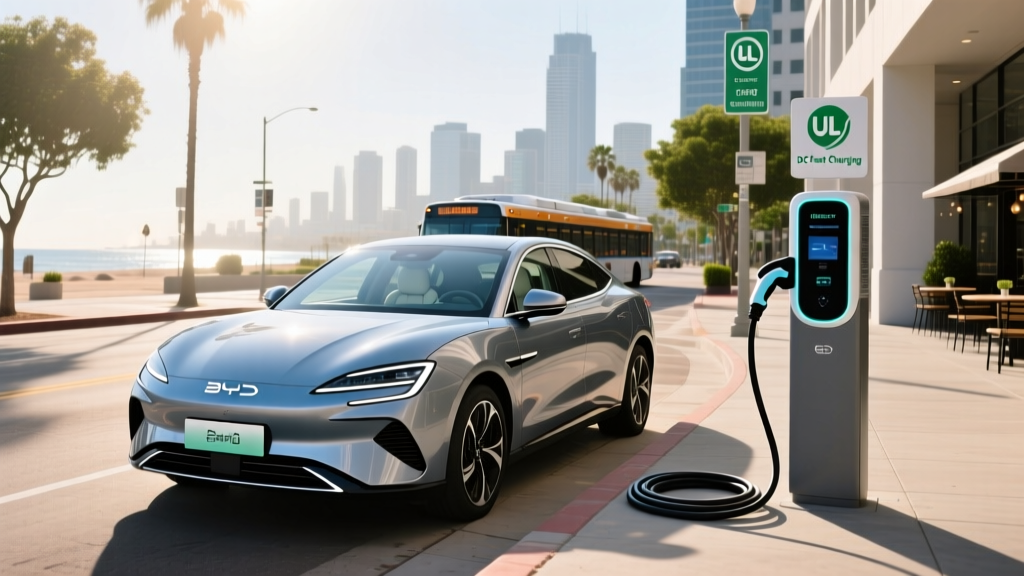
Since BYD doesn't sell in the US, there are no EPA-rated figures for current BYD models. However, the BYD Seal (a Tesla Model 3 competitor sold in Europe and Australia) provides the best apples-to-apples comparison for US shoppers evaluating BYD's capabilities. Below are WLTP figures with EPA-equivalent estimates based on the typical 10-15% WLTP-to-EPA reduction.
WLTP Rating: 570 km (354 miles)
Estimated EPA Equivalent: ~305 miles
Real-World Highway (70 mph): ~250-270 miles
Real-World Cold Weather (30°F, mixed driving): ~210-230 miles
LFP chemistry amplifies cold-weather losses. Preconditioning the battery before driving helps, but BYD's thermal management system is generally considered a step behind Tesla's heat-pump efficiency.
| Metric | Value |
|---|---|
| Battery Capacity | 82.5 kWh (usable), LFP Blade |
| Max DC Fast Charge | 150 kW peak |
| 10-80% DC Fast Charge | ~26 minutes |
| Level 2 Home Charging (11 kW AC) | ~8.5 hours (0-100%) |
| Level 2 Miles per Hour | ~35 miles/hr at 11 kW |
| 0-60 mph | 5.9 seconds (RWD) / 3.8 seconds (AWD Performance) |
| Horsepower | 201 hp (RWD) / 523 hp (AWD) |
| Drivetrain | RWD standard; AWD optional |
| Efficiency (WLTP) | ~16.6 kWh/100 km (~26.7 kWh/100 mi) |
| Estimated MPGe | ~126 MPGe combined (EPA est.) |
The Seal's 150 kW peak DC charge rate is competitive but not class-leading — the Hyundai Ioniq 6 peaks at ~240 kW and charges 10-80% in about 18 minutes on a 350 kW station. BYD's charging curve is relatively flat through 60% SoC but tapers noticeably past 80%, which is typical for LFP packs. On a road trip, plan for 25-30 minute stops at 150+ kW chargers.
Pricing, Availability, and the US Import Problem
Here's where the BYD conversation hits a wall for American buyers. As of 2026, BYD has no official US passenger vehicle sales operation. The reasons are layered:
- 100% tariff on Chinese-made EVs: Under Section 301 trade actions finalized in 2024 and reinforced through 2025, Chinese-manufactured electric vehicles face a 100% import tariff entering the United States. A BYD Seal with a European MSRP equivalent of ~$42,000 would cost over $84,000 before dealer markup if imported legally — obliterating its value proposition.
- No US dealer network: BYD has not announced any US dealership partnerships, service centers, or parts distribution for passenger vehicles. Even if you could import one, warranty service and collision repair would be essentially unsupported.
- Federal tax credit ineligibility: Under IRS §30D rules, the $7,500 federal EV tax credit requires vehicles to be assembled in North America (final assembly rule). BYD manufactures in China, Thailand, Brazil, and Hungary — none of which qualify. There is zero path to the credit for any current BYD model.
- Connected vehicle ban: The US Department of Commerce finalized rules in 2024 banning the sale of connected vehicles with Chinese-manufactured hardware and software components, effective for model year 2027 vehicles. This creates an additional regulatory barrier for BYD's tech-heavy vehicles.
| Vehicle | Est. EPA Range | Base MSRP | Tax Credit Eligible? | Effective Price |
|---|---|---|---|---|
| BYD Seal (if importable) | ~305 mi (est.) | ~$84,000+ (w/ tariff) | No | $84,000+ |
| Tesla Model 3 Long Range | 363 mi | $42,490 | Partial/Full* | $34,990-$42,490 |
| Hyundai Ioniq 6 SEL | 361 mi | $42,600 | No (Korea assembly) | $42,600 |
| Chevrolet Equinox EV LT | 319 mi | $33,600 | Yes* | $26,100-$33,600 |
| BMW i4 eDrive40 | 307 mi | $57,900 | No (MSRP cap) | $57,900 |
*Tax credit eligibility depends on buyer income (AGI ≤ $150K single / $300K joint), MSRP caps ($55K sedans / $80K SUVs), battery sourcing requirements, and point-of-sale transfer rules. Verify current eligibility at fueleconomy.gov and with a tax professional.
Interior, Tech, and Ownership Experience
For context on what BYD offers in markets where it does sell, here's a summary based on the Seal and Atto 3 (the two models most relevant to US shoppers cross-comparing):
BYD Seal Interior & Tech
- Rotating 15.6-inch center display — a BYD signature that toggles between portrait and landscape depending on the app
- 10.25-inch digital instrument cluster with customizable layouts
- ADAS suite: Adaptive cruise, lane-keep, blind-spot monitoring, 360° camera — functional but not class-leading; no hands-free highway driving like GM Super Cruise or Ford BlueCruise
- SAE Level 2 driver assist only — driver must remain fully engaged at all times
- Cargo: 14.1 cu ft trunk + 1.8 cu ft frunk (RWD); rear seats fold 60/40
- Legroom: 41.5 in front / 37.8 in rear (competitive with Model 3)
Notable Drawbacks Reported by Global Owners
- Infotainment software can feel sluggish; some apps crash or lag behind Western competitors
- Translation and localization issues in non-Chinese markets (improving but inconsistent)
- Suspension tuning is firm — some reviewers note harshness over rough pavement
- No Apple CarPlay in some markets (Android Auto available); wireless phone charging is slow (~5W)
- OTA updates occasionally introduce new bugs while fixing old ones
Pros
- Blade Battery (LFP) offers exceptional cycle life and thermal safety
- Competitive range for the price in non-US markets
- Strong build quality on higher trims
- Can charge to 100% regularly without degradation anxiety
- Aggressive global expansion means rapid software iteration
Cons
- Not available in the US — no sales, service, or parts network
- 100% tariff makes importing financially nonsensical
- Zero federal tax credit eligibility
- DC fast charging slower than Hyundai/Kia/Tesla competitors
- LFP cold-weather range loss is significant in northern climates
- Software and infotainment lag behind US-market leaders
Warranty Coverage: What BYD Offers Abroad
In European and Australian markets, BYD typically provides:
- Vehicle warranty: 6 years / 150,000 km (~93,000 miles)
- Battery warranty: 8 years / 200,000 km (~124,000 miles) with a 70% state-of-health retention guarantee
- Roadside assistance: 6 years in most markets
The battery warranty is strong on paper and competitive with the US industry standard of 8 years / 100,000 miles. However, without US service infrastructure, a warranty is only as good as the network behind it. For comparison, Hyundai offers 10-year/100,000-mile powertrain coverage on the Ioniq 6, backed by thousands of US dealers.
Who Should Consider BYD — and Who Shouldn't
Consider BYD if: You live outside the US (Europe, Australia, Southeast Asia, Latin America) and want a value-oriented EV with excellent battery longevity. The Blade Battery's LFP chemistry is ideal for high-mileage drivers who charge to 100% daily and prioritize long-term degradation resistance over peak cold-weather range.
Look elsewhere if: You're a US-based buyer. The 100% tariff, lack of service network, tax credit ineligibility, and connected-vehicle regulatory barriers make BYD a non-starter stateside in 2026. Instead, consider the Tesla Model 3, Chevrolet Equinox EV, or Hyundai Ioniq 6 for comparable range and pricing with full US support.
Frequently Asked Questions
Is BYD reliable compared to Tesla and other established EV brands?
Based on global fleet data, BYD's core EV hardware — particularly the Blade Battery and electric motors — demonstrates strong reliability. The weak spots are software stability and build-quality consistency. Without US-market data from J.D. Power or Consumer Reports, a direct comparison remains incomplete, but high-mileage Chinese taxi fleets and European owner surveys suggest the powertrain is durable.
Can I buy a BYD in the United States in 2026?
No. BYD does not sell passenger vehicles in the US. Even if you attempted a grey-market import, the 100% Section 301 tariff would roughly double the vehicle's cost, and you'd have no warranty support, no service network, and no eligibility for the federal EV tax credit.
Does BYD qualify for the $7,500 federal EV tax credit?
No. Under IRS §30D, vehicles must undergo final assembly in North America to qualify. All BYD passenger vehicles are assembled outside North America. Additionally, the connected-vehicle ban on Chinese hardware/software further restricts BYD's US market entry path.
How does the BYD Blade Battery compare to Tesla's LFP pack?
Both use LFP chemistry, which offers superior cycle life and thermal safety compared to NMC. BYD's Blade form factor is proprietary and claims enhanced structural rigidity and pack-level energy density. Tesla sources LFP cells from CATL for standard-range Model 3/Y vehicles. In practice, both demonstrate low degradation (~5-10% over 100,000 miles), though BYD's longer track record with LFP at scale gives it a slight credibility edge in this chemistry.
Will BYD ever sell cars in the US?
BYD executives have stated they are "studying" the US market, but the 100% tariff, connected-vehicle ban, and geopolitical climate make near-term entry extremely unlikely. BYD is instead focusing on building factories in Europe (Hungary), Southeast Asia (Thailand, Indonesia), Latin America (Brazil), and Turkey to serve markets with friendlier trade conditions. A US launch before 2028-2029 appears improbable at best.
What's the best US-available alternative to a BYD Seal?
The Tesla Model 3 Long Range (363 mi EPA, ~$42,490) is the closest functional competitor with superior charging speed, software, and Supercharger access. Budget-conscious buyers should look at the Chevrolet Equinox EV (319 mi, ~$33,600 before credit). For efficiency-focused drivers, the Hyundai Ioniq 6 SEL (361 mi, ~$42,600) is compelling despite lacking the federal credit due to Korean assembly.