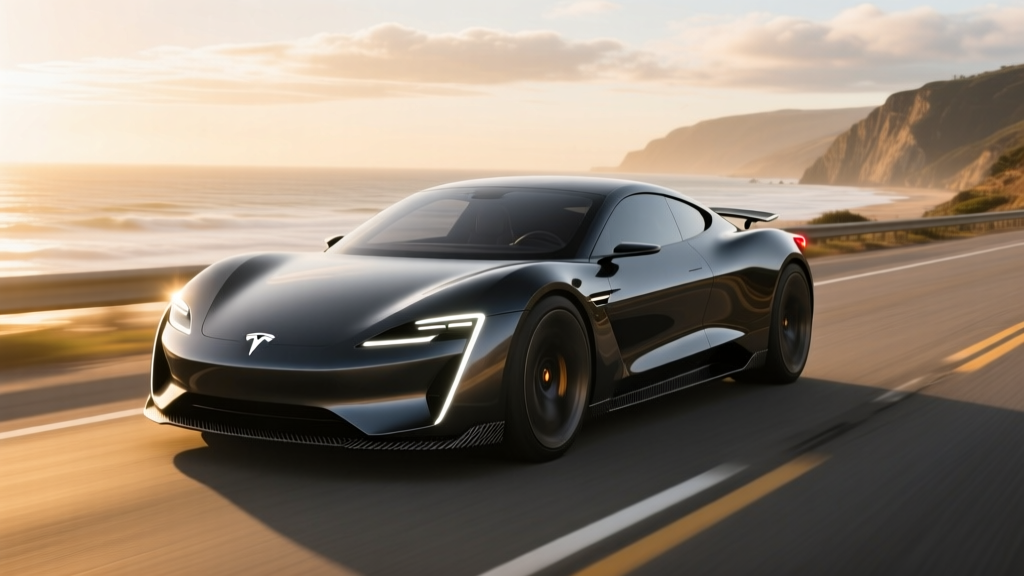
If you've been following Tesla's product roadmap, you already know the next-generation Roadster holds the record for the most-delayed vehicle reveal in the company's history. Originally unveiled in November 2017 with a promised 2020 production start, the two-seat-plus sports car has slipped through multiple target years. As of early 2026, Tesla still lists the Roadster on its website as an upcoming model, but no firm production date has been confirmed. So the question every enthusiast keeps asking — when will the Tesla Roadster come out — still doesn't have a definitive answer.
What we do have is a collection of announced (and in some cases, revised) specifications, Elon Musk's public statements, and enough context from Tesla's current manufacturing priorities to build a realistic picture. Below, we break down everything known about the next-gen Roadster, separate confirmed engineering targets from aspirational claims, and explain what this means for buyers weighing a high-performance EV purchase in 2026.
Tesla Roadster Release Timeline: What We Know in 2026
Tesla's Roadster timeline reads like a case study in automotive ambition colliding with manufacturing reality. Here's the sequence of public commitments and delays:
- November 2017: Roadster unveiled at the Tesla Semi event. Promised 620-mile range, 0-60 mph in 1.9 seconds, 2020 production.
- 2019: Production pushed to 2021.
- 2021: Musk confirmed delay to 2023, citing prioritization of the Cybertruck and 4680 battery cell ramp.
- 2023: Musk stated the Roadster would ship in 2024, with a "design reveal" event held in February 2024 where he claimed 0-60 in under 1 second with the SpaceX cold-gas thruster package.
- 2024–2025: No production units delivered. Tesla's earnings calls focused on the more affordable next-gen platform, Robotaxi (Cybercab), and Optimus robot.
- Early 2026: The Roadster remains listed as an upcoming product on Tesla's site. No production start date has been officially confirmed.
Announced Specs: Range, Battery, and Performance Targets
Tesla has floated a series of headline-grabbing numbers for the Roadster. It's critical to treat these as targets, not EPA-certified figures — the vehicle has not undergone formal testing.
| Specification | Announced / Estimated Figure |
|---|---|
| EPA Range (claimed) | 620 miles |
| Battery Capacity | ~200 kWh (announced) |
| Battery Chemistry | Likely NMC/NCA (high energy density required) |
| Drivetrain | Tri-motor AWD (one front, two rear) |
| 0-60 mph | 1.9 sec (base); <1.0 sec (SpaceX thruster pkg) |
| Top Speed | 250+ mph (claimed) |
| Torque (wheel) | 10,000 Nm (claimed, ~7,376 lb-ft) |
| Seats | 2+2 (two front, two small rear) |
| Body Style | 2-door convertible (removable glass roof) |
| Max DC Fast Charge | Not confirmed; likely 250-350 kW (est.) |
| Base MSRP (announced) | $200,000 (Founders Series $250,000) |
The 620-Mile Range Claim: Real-World Reality Check
Claimed range: 620 miles
Realistic highway expectation: ~480–530 miles at 70 mph
Cold-weather (below 32°F) expectation: ~400–450 miles
Note: No EPA certification exists for this vehicle. These estimates are based on typical EV highway and cold-weather efficiency losses of 15–25% and 30–35%, respectively.
A 200 kWh battery pack is enormous — roughly double the capacity of a Tesla Model S Long Range. Even with the Roadster's low-slung, aerodynamic profile (Tesla has claimed a drag coefficient below 0.30), sustaining 620 miles requires averaging roughly 3.2 miles per kWh. That's achievable in moderate city driving with heavy regenerative braking, but highway driving at 75 mph typically drops efficiency to 2.5–2.8 mi/kWh in high-performance EVs.
The bigger practical question is weight. A 200 kWh NMC pack could add 1,800–2,200 lbs to the vehicle, pushing total curb weight potentially above 4,800 lbs. That mass works against both efficiency and the handling dynamics a sports car demands. Tesla's 4680 structural battery pack may mitigate some of this, but physics is physics — more energy stored means more mass to accelerate and brake.
Charging Speed: What a 200 kWh Battery Means at the Plug
Tesla has not published official charging specs for the Roadster, but we can extrapolate from the company's current Supercharger V4 architecture and the physics of large battery packs.
| Charging Level | Power / Rate | Estimated Time / Recovery |
|---|---|---|
| Level 1 (120V) | ~1.4 kW | ~3–4 mi/hr (weeks for full charge) |
| Level 2 (240V, 48A) | ~11.5 kW | ~35 mi/hr; ~17 hrs 10–100% |
| DC Fast Charge (est.) | Peak ~250–350 kW | 10–80% in ~35–50 min (est.) |
Here's the challenge with a 200 kWh pack: even at a peak rate of 350 kW, you're adding roughly 17.5 kWh per minute at best. Filling from 10% to 80% means pushing ~140 kWh into the pack. Sustained peak rates are never maintained across the full curve — charging tapers significantly above 50–60% State of Charge (SoC) to protect battery health. Expect a realistic 10–80% session of 35 to 50 minutes at a V4 Supercharger, assuming Tesla enables higher C-rate charging on this pack.
For home charging, most Roadster buyers will want a hardwired Level 2 wall connector on a 60A circuit (delivering 48A continuous). At 11.5 kW, overnight charging from 20% to full takes roughly 14 hours — feasible for a weekend top-up, but daily depletion of a 200 kWh pack is unlikely given the claimed range.
Performance and Drivetrain: Tri-Motor AWD and the SpaceX Package
The Roadster's tri-motor layout — one motor on the front axle, two on the rear — mirrors the architecture in the Model S Plaid, but with next-generation powertrain refinements. The base 1.9-second 0-60 mph claim would place it among the fastest production cars ever built, rivaling the Rimac Nevera and Lotus Evija.
The more controversial claim is the optional SpaceX cold-gas thruster package, which Musk stated in 2024 could enable sub-1-second 0-60 times. This system would use compressed air or cold-gas thrusters mounted around the vehicle to increase downforce and traction during launch. While technically feasible in controlled conditions, this package raises serious questions about street legality, safety certification, and practicality. No regulatory body (NHTSA or otherwise) has approved compressed-gas propulsion assist for public roads.
Expected horsepower figures have not been published, but a tri-motor configuration with Tesla's latest carbon-sleeve rotors could produce 1,500+ hp at the wheels. Top speed claims of 250+ mph place the Roadster in hypercar territory, though tire technology and thermal management at those speeds are non-trivial engineering challenges.
Pricing, Tax Credits, and Who Should Consider It
| Trim / Edition | Announced MSRP | Federal §30D Credit |
|---|---|---|
| Roadster (Base) | $200,000 | Not eligible |
| Founders Series | $250,000 | Not eligible |
The IRS §30D federal tax credit caps eligibility at $55,000 MSRP for sedars and $80,000 for SUVs, trucks, and vans. At a $200,000 starting price, the Roadster is categorically ineligible for the $7,500 credit. Buyer income caps ($150,000 single / $300,000 joint MAGI) and battery critical-mineral sourcing requirements are moot at this price point — no buyer will be claiming this credit.
Who this EV suits best: The Roadster is a halo car — a low-volume statement of engineering capability aimed at collectors, Tesla loyalists, and performance enthusiasts who already own a daily-driver EV. It is not a practical commuter, family vehicle, or road-trip workhorse. Cargo space is expected to be minimal (likely under 5 cu ft combined front trunk and rear shelf), and the 2+2 seating means the rear seats are suitable only for children or luggage. If your use case involves daily driving, towing, or carrying more than two adults, the Model S, Lucid Air, or Porsche Taycan are far more practical choices.
Tesla Roadster vs. Competitors: How It Stacks Up
| Model | EPA Range | 0-60 mph | Price | Availability |
|---|---|---|---|---|
| Tesla Roadster (announced) | 620 mi (claimed) | 1.9 sec | $200,000 | Not available |
| Rimac Nevera | ~280 mi (WLTP) | 1.85 sec | ~$2,400,000 | Limited production |
| Lotus Evija | ~217 mi (WLTP) | <3.0 sec | ~$2,300,000 | Limited production |
| Tesla Model S Plaid | 396 mi (EPA) | 1.99 sec | $108,490 | Available now |
| Lucid Air Sapphire | 427 mi (EPA) | 1.89 sec | $249,000 | Available now |
The Tesla Model S Plaid delivers 95% of the Roadster's base performance claim at roughly half the price, with four doors, real cargo space, and an EPA-certified 396-mile range you can actually use today. The Lucid Air Sapphire matches or beats the Roadster's 0-60 time while offering a luxury sedan's practicality. Unless the Roadster's specific design, convertible top, and halo-car exclusivity matter to you, the performance-per-dollar argument heavily favors existing models.
Warranty, Tech, and Notable Drawbacks
Tesla has not published warranty terms for the Roadster, but based on current Tesla policy for high-performance models, expect:
- Basic Vehicle Warranty: 4 years / 50,000 miles
- Battery & Drive Unit Warranty: 8 years / 150,000 miles (with minimum 70% capacity retention)
Tech features will almost certainly include Tesla's latest infotainment stack, a 17-inch center display, yoke-style steering option, and Autopilot as standard with Full Self-Driving (Supervised) available as an add-on. Note that FSD Supervised is an SAE Level 2 driver-assistance system — the driver must remain fully engaged and responsible at all times. It is not autonomous driving.
- Record-breaking claimed range (620 mi)
- Sub-2-second 0-60 mph (base model)
- Convertible sports car with Tesla Supercharger access
- Tri-motor AWD with torque vectoring
- Low center of gravity (skateboard battery)
- Not available — no confirmed production date
- $200K+ price; no federal tax credit eligibility
- 200 kWh pack means extremely long charge times
- Likely 4,800+ lb curb weight hurts handling
- 2+2 seating is impractical for adults in rear
- SpaceX thruster package legality is unproven
- Opportunity cost: Model S Plaid delivers similar performance now
So, When Will the Tesla Roadster Actually Come Out?
Based on Tesla's current production priorities in 2026 — ramping the Cybercab robotaxi, expanding 4680 cell production, and launching the more affordable next-generation vehicle platform — the Roadster appears to be low on the manufacturing queue. Tesla's Austin and Berlin Gigafactories are focused on volume models, and the Roadster's low-volume, high-complexity build would likely slot into a niche production line (possibly Fremont).
A realistic production window is late 2027 at the earliest, more likely 2028, assuming Tesla's higher-priority programs stay on track. Musk has a documented history of timeline optimism — the Cybertruck was announced in 2019 and didn't reach meaningful production until late 2023, a four-year gap. The Roadster, with its more exotic engineering targets, faces similar or greater delays.
For buyers who want extreme EV performance today, the Model S Plaid ($108,490), Lucid Air Sapphire ($249,000), and Porsche Taycan Turbo GT ($230,000) are all in production, EPA-certified, and available for test drives. Waiting for the Roadster means betting on a vehicle whose final specs, pricing, and delivery date remain unconfirmed.
Frequently Asked Questions
What is the real-world range of the Tesla Roadster?
Tesla claims 620 miles, but no EPA certification exists. Based on typical high-performance EV efficiency losses, expect roughly 480–530 miles on the highway and 400–450 miles in cold weather (below 32°F). Real-world range will depend heavily on driving style, temperature, and whether the 200 kWh pack achieves the energy density Tesla has targeted.
How fast does the Roadster charge at home and on DC fast chargers?
No official specs have been published. Estimated DC fast charging at a Tesla V4 Supercharger could peak at 250–350 kW, with a 10–80% session taking roughly 35–50 minutes due to the massive 200 kWh battery. Home Level 2 charging at 11.5 kW (48A) would take approximately 17 hours from 10% to full.
How much does the Tesla Roadster cost after tax credits?
The announced base price is $200,000, with the Founders Series at $250,000. The Roadster does not qualify for the $7,500 federal §30D tax credit because it far exceeds the MSRP cap ($55,000 for cars, $80,000 for SUVs/trucks/vans). The price you see is the price you pay, plus destination fees, taxes, and any optional packages.
Is the Roadster worth waiting for vs. buying a Model S Plaid or Lucid Air Sapphire?
If you need a car now and want extreme performance, no — the Model S Plaid delivers 1.99-second 0-60 times and 396 miles of EPA range for $108,490, available today. The Roadster makes sense only if you specifically want a two-door convertible sports car with Tesla branding and are willing to wait until at least 2027–2028 with no guarantee on final specs.
Does the Tesla Roadster qualify for any state or local EV incentives?
Most state and local incentives have price caps well below $200,000. Check your state's energy office or DMV for specific programs, but plan on paying full price. State incentive rules vary by jurisdiction and change frequently — consult official state sources for current eligibility.
Can I still reserve a Tesla Roadster?
Tesla previously accepted $50,000 reservations (with $5,000 due upfront). Check Tesla's official Roadster page for current reservation availability and terms, as these have changed multiple times since 2017.