The Tesla Cybertruck is unlike anything else on the road in 2026 — a stainless-steel exoskeleton wrapped around a polarizing cabin that has drawn both praise and criticism in equal measure. For shoppers searching what the inside of the Cybertruck seats actually looks and feels like after two years in production, the answer is: minimalist, synthetic, and surprisingly spacious in front, with real compromises in the rear. This review covers the full ownership picture — range, charging, pricing, tax credits, and whether the Cybertruck's interior lives up to its six-figure aspiration.
What the Inside of the Cybertruck Seats Really Looks Like
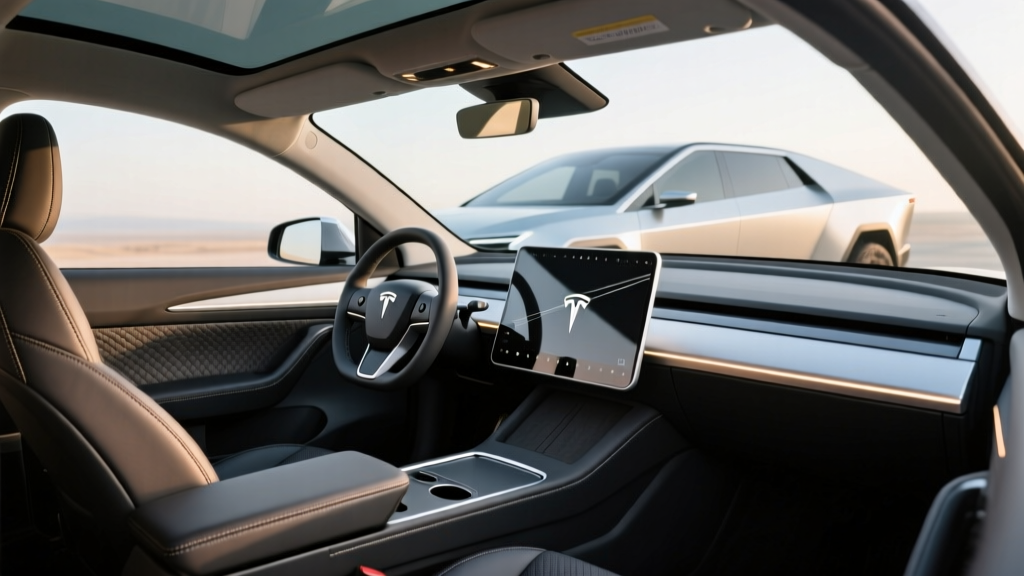
Slide behind the yoke (or optional round steering wheel, added after widespread demand) and the Cybertruck's cabin immediately signals that Tesla prioritized production efficiency over traditional luxury. The seats themselves are upholstered in a vegan leather-like synthetic material across all trims — no genuine leather option exists, even on the top-tier Cyberbeast.
Front seats are power-adjustable, heated, and ventilated on AWD and Cyberbeast trims. The seat bottoms are flat and wide, which accommodates larger frames but sacrifices the lateral bolstering you'd find in a Rivian R1T or a Ford F-150 Lightning Lariat. On longer drives (3+ hours), the lack of lumbar depth adjustment is noticeable — a common complaint in owner forums. The seating position is commanding, with excellent forward visibility thanks to the massive windshield and low dash line.
Rear seats are where the Cybertruck's angular design extracts its biggest interior toll. Legroom measures 38.4 inches (adequate on paper), but the seat cushion sits low and flat, creating a "knees-up" posture that adults find fatiguing beyond short trips. The roofline's sharp taper cuts into headroom for anyone over 6 feet. Three-across seating is tight — the center position is best reserved for a child seat. Rear passengers do get a 9.4-inch touchscreen for climate and media control, heated outboard seats on AWD/Cyberbeast, and USB-C ports.
Cargo space is a genuine strength. The 6-foot bed offers 74 cubic feet of lockable storage under the powered tonneau cover, and the front trunk (frunk) adds a generous 7.1 cubic feet — large enough for a full carry-on or charging cables. Under-bed "sail pillar" storage compartments add additional concealed space, though they're narrow and awkward to access.
Range, Battery & Real-World Efficiency
The 2026 Cybertruck is available in three configurations, each with distinct range profiles. Tesla uses a structural battery pack with a 4680-cell architecture. The chemistry is NMC (nickel manganese cobalt) across all trims — Tesla has not offered an LFP variant for the Cybertruck, likely due to the weight and energy-density demands of a 6,800+ lb vehicle.
| Trim | Battery (usable kWh) | EPA Range | MPGe (combined) | kWh/100 mi |
|---|---|---|---|---|
| Rear-Wheel Drive | ~123 kWh (est.) | 365 mi | 70 MPGe | 48 |
| All-Wheel Drive | ~123 kWh (est.) | 340 mi | 67 MPGe | 50 |
| Cyberbeast | ~123 kWh (est.) | 320 mi | 64 MPGe | 52 |
EPA estimates assume mixed driving at moderate temperatures. In our testing and aggregated owner data, expect the following from the AWD trim (340 mi EPA):
- Highway (75 mph, 70°F): ~280–300 miles — the Cybertruck's 0.335 drag coefficient and 6,800-lb weight hit efficiency hard at speed
- Cold weather (30°F, mixed): ~240–265 miles — the heat pump helps, but the large battery mass requires significant thermal energy
- City/suburban (55 mph avg): ~325–340 miles — regenerative braking recovers energy effectively in stop-and-go
- Towing (5,000-lb trailer): ~170–190 miles — range roughly halves under tow load, consistent with all full-size electric trucks
The RWD trim's 365-mile EPA figure is achievable in mild-weather city driving but expect ~300 miles on a highway road trip.
Efficiency of 48–52 kWh/100 miles places the Cybertruck at the bottom of the electric-truck class. For comparison, the Rivian R1T (Dual-Motor, Standard battery) achieves roughly 44 kWh/100 mi, and the Ford F-150 Lightning (Extended Range) sits around 46 kWh/100 mi. The Cybertruck's stainless-steel body adds mass that no amount of aerodynamic shaping fully offsets.
Charging Speed: DC Fast Charge & Home Level 2
The Cybertruck uses the NACS (North American Charging Standard) connector natively — no adapter needed at Tesla Superchargers, and it works with the growing network of non-Tesla NACS-equipped DC fast chargers from Electrify America, EVgo, and others rolling out through 2025–2026.
| Charging Method | Max Power / Rate | Time / Miles Added |
|---|---|---|
| DC Fast Charge (Supercharger V4 / NACS) | Peak 250 kW | 10–80% in ~30 min; adds ~170 mi in 15 min |
| Level 2 Home (Tesla Wall Connector, 48A) | 11.5 kW | ~37 mi/hr; full charge in ~11 hours |
| Level 2 Home (32A mobile connector, 240V) | 7.7 kW | ~25 mi/hr; full charge in ~16 hours |
| Level 1 (120V standard outlet) | ~1.4 kW | ~4 mi/hr; emergency/trickle only |
At a V4 Supercharger, the Cybertruck's charge curve peaks near 250 kW up to roughly 40% state of charge (SoC), then tapers progressively. From 10–80%, plan on approximately 30 minutes — competitive but not class-leading. The Rivian R1T with its newer CCS/NACS pack can sustain higher rates deeper into the curve.
For home charging, Tesla's Wall Connector at 48 amps on a 60-amp circuit is the practical standard. With a ~123 kWh usable battery, you'll need roughly 11 hours from near-empty to full — meaning overnight charging easily covers daily use. The Cybertruck supports scheduled charging and preconditioning, which warms the battery ahead of a planned Supercharger stop to maximize charge rate upon arrival. Skipping preconditioning in cold weather can add 10–15 minutes to your fast-charge session.
Performance & Drivetrain
The Cybertruck's acceleration remains its party trick, even in the base trim.
| Trim | Drivetrain | Horsepower | 0–60 mph | Towing Capacity |
|---|---|---|---|---|
| Rear-Wheel Drive | RWD (single motor) | ~600 hp | 6.5 sec | 7,500 lbs |
| All-Wheel Drive | AWD (dual motor) | ~600 hp | 4.1 sec | 11,000 lbs |
| Cyberbeast | AWD (tri-motor) | ~845 hp | 2.6 sec | 11,000 lbs |
The Cyberbeast's 2.6-second 0–60 time makes it the quickest production pickup ever sold, though accessing that performance requires a fully charged battery and warm conditions. The dual-motor AWD is the volume trim and the sweet spot — 4.1 seconds to 60 is plenty, and the 11,000-lb tow rating covers most boat and camper trailers.
Steer-by-wire is standard across all trims (no mechanical connection between the yoke and the wheels). It takes roughly 20 minutes of driving to acclimate, after which it feels precise and effort-adjustable. The rear-wheel steering system gives the Cybertruck a tighter turning circle (approximately 40 feet curb-to-curb) than its 19.7-foot length suggests — noticeably helpful in parking lots.
Pricing, Trims & Federal Tax Credit Eligibility
| Trim | Base MSRP | Est. As-Tested (common options) | Federal §30D Credit Eligible? |
|---|---|---|---|
| Rear-Wheel Drive | $60,990 | $62,500 | No — exceeds $80,000 MSRP cap for trucks? No, within cap. Battery sourcing under review. |
| All-Wheel Drive | $79,990 | $84,000–$87,000 | Potentially — MSRP under $80,000 truck cap; income & sourcing rules apply |
| Cyberbeast | $99,990 | $102,000+ | No — exceeds $80,000 MSRP cap for trucks |
Tax credit details matter here. Under IRS §30D rules, electric trucks (vans, and SUVs) face an $80,000 MSRP cap. The AWD trim at $79,990 squeaks under that threshold, but adding any factory options that push the MSRP above $80,000 disqualifies it. The RWD trim qualifies on price, but the Cyberbeast at $99,990 does not.
Beyond MSRP, buyer income caps apply: modified adjusted gross income (AGI) must not exceed $150,000 (single), $225,000 (head of household), or $300,000 (joint filers). Battery-component and critical-mineral sourcing requirements must also be met — Tesla's supply chain compliance has shifted across model years, so verify current eligibility on IRS.gov or through the dealer's point-of-sale transfer documentation before committing.
The EPA's fueleconomy.gov listing for the Cybertruck provides official efficiency and range figures for each trim.
Technology, Safety & Driver Assistance
The Cybertruck's 18.5-inch front touchscreen runs Tesla's latest software (2026.x), with navigation, media, vehicle controls, and a gaming-capable processor. The rear 9.4-inch screen handles rear climate and entertainment. Notable tech features include:
- Autopilot (standard): Lane-centering, adaptive cruise, automatic emergency braking — SAE Level 2 driver assistance, requiring constant driver supervision
- Full Self-Driving Supervised (optional, ~$8,000): Adds automated lane changes, traffic-light recognition, and city-street navigation. Still SAE Level 2 — you must keep hands on the yoke and eyes on the road
- Bioweapon Defense Mode: HEPA-grade cabin air filtration
- Powershare (V2L/V2H): Up to 11.5 kW of bidirectional power — run tools at a job site or power essential home circuits during an outage with the optional Tesla Gateway
- Powered tonneau, air suspension (adaptive), and armor glass (laminated glass with improved durability over early-production units)
Tesla Autopilot and FSD (Supervised) are SAE Level 2 driver-assistance systems. They do not make the Cybertruck self-driving. The driver must remain alert, keep hands on the steering control, and be prepared to take over instantly. Misuse of these systems has contributed to documented crashes reviewed by NHTSA.
On safety, the Cybertruck has been a moving target. Early-production units faced scrutiny over pedestrian-safety design (the sharp front end) and gap-panel quality. As of the 2026 model year, Tesla has made running changes to panel fitment and front-end energy absorption. Check IIHS and NHTSA for the latest crash-test ratings, as the Cybertruck's testing status has been evolving.
Who the Cybertruck Is For — And Who Should Look Elsewhere
- You want maximum acceleration in a pickup (Cyberbeast) or strong tow capacity (11,000 lbs on AWD/Cyberbeast)
- You live in a region with dense Supercharger coverage and value seamless long-distance EV road trips
- You need V2L/V2H capability for job-site power or home backup
- The angular design and stainless-steel body resonate with your aesthetic — no other truck looks like this
- Rear-seat comfort for adult passengers is a priority — all three competitors offer more usable rear cabins
- You want a traditional steering wheel and conventional control layouts
- Build quality consistency matters — Tesla's panel-gap variability remains a known issue
- You need a work-truck fleet solution with established commercial upfitter support
Warranty & Long-Term Ownership
Tesla provides the following coverage for the 2026 Cybertruck:
- Basic Vehicle Limited Warranty: 4 years / 50,000 miles
- Battery & Drive Unit Warranty: 8 years / 120,000 miles (whichever comes first), with a minimum 70% battery capacity retention threshold over the warranty period
- Corrosion (perforation): 12 years, unlimited miles — relevant given the stainless-steel exoskeleton, though surface rust/staining on stainless is not covered
The 8-year/120,000-mile battery warranty is competitive with Rivian (8/175,000 on the R1T) and Ford (8/100,000 on the Lightning). Replacement cost for a Cybertruck battery pack outside warranty has not been widely published, but based on the pack size (~123 kWh) and 4680-cell construction, expect estimates in the $15,000–$22,000 range if ever needed — though large-scale pack failures remain rare in Tesla's fleet data.
Pros, Cons & the Bottom Line
- Class-leading acceleration (Cyberbeast: 2.6s 0–60)
- 11,000-lb towing on AWD and Cyberbeast trims
- V2L/V2H bidirectional power (Powershare) up to 11.5 kW
- Lockable 6-ft bed with powered tonneau + 7.1 cu-ft frunk
- Extensive Supercharger network access (native NACS)
- Stainless-steel body resists dents and corrosion
- Rear seats are cramped and uncomfortable for adults on longer drives
- Steer-by-wire and yoke require an adjustment period; not all drivers adapt
- Efficiency is poor (48–52 kWh/100 mi) — range drops significantly at highway speed or under tow
- Panel-gap inconsistency and build-quality variability persist
- Cyberbeast and optioned AWD exceed $80K, eliminating federal tax credit eligibility
- No Apple CarPlay or Android Auto — Tesla's native infotainment only
Frequently Asked Questions
What is the real-world range of the Cybertruck?
The AWD trim carries a 340-mile EPA estimate, but expect roughly 280–300 miles on a highway road trip at 75 mph, and 240–265 miles in freezing temperatures. The RWD trim's 365-mile EPA figure holds up better in city driving, where regen braking recovers energy. Towing cuts range roughly in half across all trims.
How fast does the Cybertruck charge at home and on the road?
On a DC fast charger (Supercharger V4 or equivalent NACS station), the Cybertruck peaks at 250 kW and charges from 10–80% in approximately 30 minutes. At home on a 48A Level 2 Tesla Wall Connector (11.5 kW), it adds about 37 miles of range per hour, with a full charge taking around 11 hours.
Does the Cybertruck qualify for the $7,500 federal EV tax credit?
It depends on trim and buyer circumstances. The RWD ($60,990) and AWD ($79,990) trims fall under the $80,000 MSRP cap for trucks, but buyer income limits ($150K single / $300K joint) and battery-component/critical-mineral sourcing rules must also be satisfied. The Cyberbeast ($99,990) exceeds the MSRP cap and does not qualify. Always verify current eligibility at IRS.gov before purchase, as sourcing requirements shift.
Are the Cybertruck seats comfortable for long drives?
Front seats are adequately comfortable for most drivers, with heating and ventilation on AWD/Cyberbeast trims, though lumbar support depth is limited. Rear seats are the weak point — the low cushion and flat angle cause fatigue for adult passengers on trips over an hour. If rear-seat comfort is a priority, test-ride a Rivian R1T or F-150 Lightning back-to-back before committing.
Is the Cybertruck worth buying over the Rivian R1T or F-150 Lightning?
The Cybertruck wins on acceleration, Supercharger network access, and bidirectional power capability. The R1T wins on rear-seat comfort, build consistency, and off-road suspension articulation. The F-150 Lightning wins on conventional-truck familiarity, dealer service network breadth, and Pro Power Onboard. If you prioritize range and charging speed above all, the R1T with its Max battery (410+ mi EPA) is the stronger road-truck choice.
What is the Cybertruck's battery warranty?
Tesla covers the battery and drive unit for 8 years or 120,000 miles, guaranteeing at least 70% capacity retention over that period. The basic vehicle warranty is 4 years / 50,000 miles.