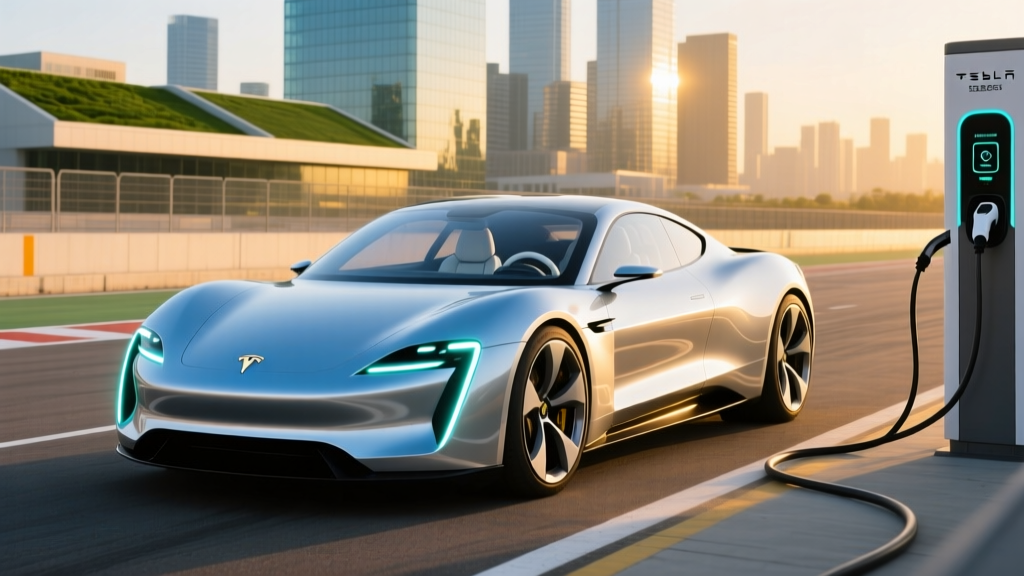
The Tesla Roadster has occupied a strange space in the EV world since Elon Musk first pulled the wraps off the second-generation model in November 2017. Nearly a decade later, it remains one of the most anticipated — and most delayed — vehicles in automotive history. If you've been searching for clarity on how much is the Tesla Roadster, you're not alone. The pricing picture is layered: a base model, a limited Founders Series, and a reservation structure that has changed multiple times.
This profile covers everything we know as of early 2026 about the Roadster's announced specifications, pricing tiers, tax credit eligibility, and how it stacks up against the hypercar EV competition. Because the Roadster is not yet in production, all figures below are based on Tesla's most recent public disclosures and should be treated as preliminary until deliveries begin.
Tesla Roadster Pricing: Base, Founders Series, and Reservation Costs
The headline answer to "how much is the Tesla Roadster" depends on which version you're looking at. Tesla has outlined two distinct tiers:
| Item | Base Roadster | Founders Series |
|---|---|---|
| Base MSRP | ~$200,000 | ~$250,000 |
| Reservation Deposit | $50,000 | $250,000 (full payment) |
| Production Cap | No stated limit | 1,000 units |
| Estimated As-Tested (w/ options) | $210,000–$230,000 | $250,000 (all-inclusive) |
The Founders Series was announced as a limited run of 1,000 units, each requiring the full $250,000 upfront. These units historically receive priority production scheduling and may include exclusive badging or configuration options. The base Roadster's $200,000 price tag requires a $50,000 reservation deposit — a commitment that Tesla has, at various points, allowed reservation holders to defer or restructure.
For context, the original first-generation Roadster (2008–2012) launched at approximately $109,000. The second-generation model's price reflects its positioning as a true hypercar competitor rather than a premium sports car.
Announced Performance and Powertrain Specifications
Tesla's claimed performance figures for the Roadster are staggering, even by 2026 standards. If delivered as specified, the Roadster would sit at or near the top of every performance metric for a production road-legal vehicle.
| Metric | Announced Value |
|---|---|
| Drivetrain | Tri-Motor AWD (one front, two rear) |
| Horsepower | ~1,000+ hp (wheel torque: 10,000 N·m) |
| 0–60 mph | 1.9 seconds (base); sub-1.0s w/ SpaceX package |
| Quarter Mile | 8.8 seconds |
| Top Speed | 250+ mph |
| Battery Capacity | ~200 kWh (announced, chemistry TBD) |
| EPA Range (claimed) | 620 miles |
| Seats | 2+2 (two front, two small rear) |
| Removable Roof | Yes — glass panel stows in trunk |
The tri-motor layout — one motor driving the front axle and two independent motors on the rear — enables torque vectoring across all four wheels. This architecture is similar in concept to what Tesla deployed in the Model S Plaid, but scaled for higher output.
The most controversial claim is the optional SpaceX cold-gas thruster package, which Tesla has suggested could enable sub-1.0-second 0–60 times. This package, if it reaches production, would use compressed air thrusters positioned around the vehicle for acceleration and braking augmentation. Independent verification of this system does not yet exist.
Range and Efficiency: 620 Miles Claimed, but What's Realistic?
EPA Claimed: 620 miles
Real-World Highway Expectation: ~450–520 miles at 70–75 mph
Cold-Weather (below 32°F): Expect 30–40% reduction — potentially 370–430 miles
Note: These are projections based on Tesla's claim and typical EV efficiency losses. No EPA certification has been published for the Roadster.
A 200 kWh battery pack is enormous — roughly double the capacity of a Model S Long Range and significantly larger than any current production EV. Even accounting for the Roadster's performance-oriented tires, low-slung aerodynamics, and heavy battery mass, a 620-mile EPA figure is theoretically achievable with the energy density Tesla has described.
However, real-world highway driving at sustained speeds above 70 mph typically reduces EV range by 15–25% compared to EPA combined-cycle testing. Cold weather compounds this further, as battery chemistry becomes less efficient and cabin heating draws additional power. The Roadster's low ground clearance and sports-car insulation may also limit the effectiveness of any heat pump system compared to taller, more voluminous vehicles.
Efficiency will likely land in the range of 30–36 kWh per 100 miles under mixed driving, which would translate to roughly 90–110 MPGe. These figures are preliminary estimates and will depend heavily on the final production weight, tire compound, and thermal management system.
Charging Speed: What We Know and What's Missing
Tesla has not published definitive charging specifications for the Roadster. However, based on the architecture of Tesla's current Supercharger network and the 200 kWh battery, we can make informed projections:
| Charging Level | Projected Rate | Estimated Time / Miles Added |
|---|---|---|
| Level 1 (120V) | ~1.4 kW | ~3–4 miles per hour |
| Level 2 (240V, 48A) | ~11.5 kW | ~30–35 miles per hour; full charge ~18–20 hours |
| DC Fast Charge (V4 Supercharger) | Peak ~350 kW (projected) | 10–80% in ~35–45 minutes (estimated) |
The 200 kWh battery creates a charging-time challenge. Even at a sustained 350 kW peak — which Tesla's V4 Supercharger cabinets can theoretically deliver — filling 80% of a 200 kWh pack means pushing roughly 160 kWh through the charger. Accounting for the charge curve taper that occurs above 50–60% State of Charge, a 10–80% session will likely take 35–45 minutes at a best-case V4 stall.
For home charging, a full Level 2 charge from near-empty will require approximately 18–20 hours. Most Roadster owners will likely charge opportunistically rather than from 0% to 100%, but this is an important consideration for those without consistent home charging access. A 200 kWh battery is simply a large energy reservoir, and physics dictates that filling it takes time regardless of the charge rate.
Federal Tax Credit Eligibility Under IRS §30D
Given the Roadster's price, federal tax credit eligibility is a legitimate question — and the answer is almost certainly no.
The IRS §30D Clean Vehicle Credit imposes an MSRP cap of $55,000 for sedans and $80,000 for SUVs, vans, and pickup trucks. The Tesla Roadster, as a sports car, falls under the $55,000 sedan cap. At an announced base price of ~$200,000, the Roadster exceeds this cap by roughly $145,000. It does not qualify for the federal $7,500 EV tax credit regardless of buyer income or battery sourcing.
Beyond the MSRP cap, the §30D credit also requires:
- Buyer income limits: Modified AGI not exceeding $150,000 (single), $225,000 (head of household), or $300,000 (joint filers)
- Battery component sourcing: Increasingly strict North American manufacturing and critical mineral requirements that phase in through 2029
- Final assembly: Vehicle must undergo final assembly in North America
Even if the MSRP cap did not apply (which it does), most Roadster buyers would likely exceed the income thresholds. For the latest §30D rules, consult the IRS Clean Vehicle Credit page or speak with a qualified tax professional.
Who Is the Tesla Roadster For?
The Roadster is not a practical daily driver, a family hauler, or a commuter appliance. It's a statement vehicle aimed at a narrow buyer profile:
Best suited for:
- Collectors and enthusiasts who want a halo EV with record-breaking performance claims
- Current Tesla owners seeking the brand's flagship — the ultimate expression of Tesla engineering
- Hypercar buyers cross-shopping the Rimac Nevera, Lotus Evija, or Pininfarina Battista
- Those who value the Tesla Supercharger network and over-the-air update ecosystem in a sports car format
Not ideal for:
- Anyone needing practical cargo space (the trunk is small, and the rear seats are essentially package shelves)
- Buyers who want a confirmed delivery date — the Roadster has been delayed multiple times since 2017
- Those seeking federal or state EV incentives
- Daily commuters who need easy ingress/egress and ride comfort over rough roads (ground clearance is expected to be very low)
Roadster vs. the Competition: Rimac Nevera and Lotus Evija
| Metric | Tesla Roadster | Rimac Nevera | Lotus Evija |
|---|---|---|---|
| Status | Announced | In Production | In Production |
| Price | ~$200,000 | ~$2,200,000 | ~$2,300,000 |
| Horsepower | ~1,000+ hp | 1,914 hp | 1,972 hp |
| 0–60 mph | 1.9s (claimed) | 1.85s | <3.0s |
| Range (claimed/tested) | 620 mi (claimed) | ~340 mi (WLTP) | ~217 mi (WLTP) |
| Battery | ~200 kWh | 120 kWh | 70 kWh |
| Units Planned | No cap stated | 150 | 130 |
The Roadster's key advantage is price. At roughly one-tenth the cost of a Nevera or Evija, it promises hypercar-adjacent performance at a fraction of the entry cost. Its claimed 620-mile range also dwarfs the competition, which prioritize power density over energy capacity.
The trade-off is availability. Both the Nevera and Evija are real, deliverable, and independently tested. The Roadster remains a reservation and a promise. Buyers who want a confirmed vehicle today will look elsewhere.
Warranty, Service, and Ownership Considerations
Tesla has not published Roadster-specific warranty terms. Based on Tesla's current vehicle warranty structure, a reasonable projection would be:
- Basic Vehicle Warranty: 4 years / 50,000 miles
- Battery & Drive Unit Warranty: 8 years / 150,000 miles (with minimum 70% capacity retention)
These projections are based on the Model S and Model X warranty terms as listed on Tesla's warranty page. The Roadster's performance orientation could lead Tesla to adjust these terms — high-output tri-motor systems and a 200 kWh pack may carry different coverage parameters.
Service is another consideration. Tesla's mobile service and Supercharger network are industry-leading, but the Roadster's low production volume, unique body panels, and specialized drivetrain components may result in longer repair wait times compared to high-volume Tesla models. Owners should factor in the possibility of limited service-center familiarity with the vehicle in its early production years.
Frequently Asked Questions
Is the Tesla Roadster available to buy right now?
No. As of early 2026, the second-generation Tesla Roadster is an announced vehicle. Tesla has not begun production or deliveries. Reservations have been accepted since 2017 with a $50,000 deposit, but no firm delivery date has been confirmed.
How much does the Tesla Roadster cost after tax credits?
The Roadster does not qualify for the federal §30D EV tax credit because its ~$200,000 MSRP far exceeds the $55,000 sedan cap. The effective purchase price remains the full MSRP — approximately $200,000 for the base model and $250,000 for the Founders Series, plus applicable state taxes and fees.
Will the Roadster really get 620 miles of range?
Tesla claims 620 miles on a ~200 kWh battery. This figure has not been EPA-certified. Real-world highway driving at 70+ mph will likely yield 450–520 miles, with further reductions in cold weather. It would still be the longest-range production EV if delivered as claimed.
Does the Roadster use NACS or CCS charging?
Tesla vehicles use the NACS (North American Charging Standard) connector natively. The Roadster will charge on Tesla's Supercharger network and, with the appropriate adapter, on CCS-equipped public chargers. Tesla has been transitioning its Supercharger network to support non-Tesla vehicles as well.
What is the SpaceX thruster package?
Tesla has described an optional cold-gas thruster system developed with SpaceX that would use compressed air to augment acceleration, braking, and cornering. If produced, it could enable a sub-1.0-second 0–60 time. This system has not been independently verified or demonstrated in a production vehicle.
How does the Roadster compare to a Model S Plaid?
The Model S Plaid delivers 1,020 hp, a 1.99-second 0–60, and ~396 miles of EPA range for approximately $89,990. The Roadster promises similar or better acceleration with significantly more range and a sports-car form factor — at more than double the price and without confirmed availability. For buyers who want Tesla performance today, the Plaid is the proven option.