The Short Answer on Electric Chevys
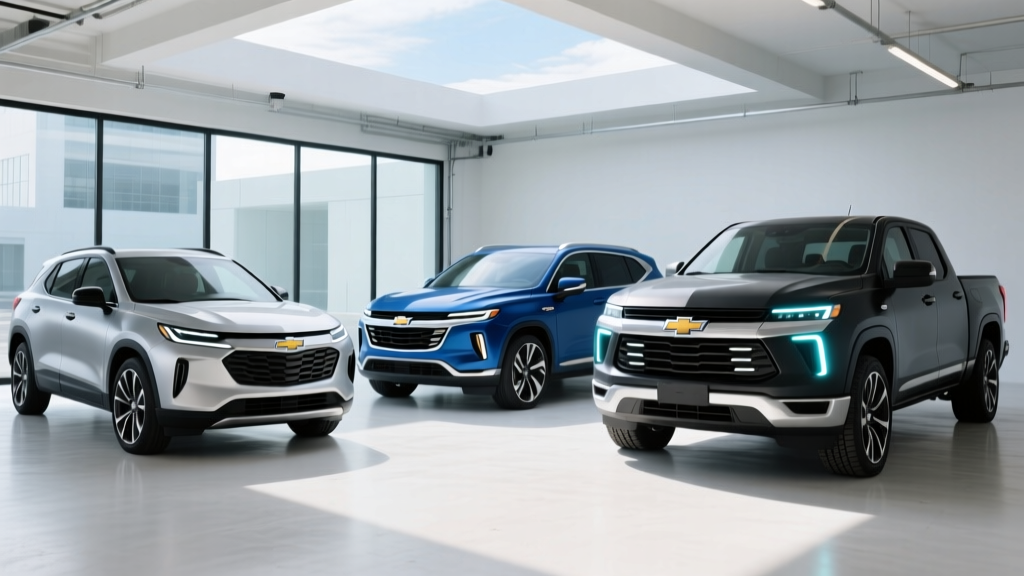
Chevrolet's 2026 EV lineup covers three distinct segments: the Equinox EV (compact SUV, EPA range up to 319 miles, starting ~$33,600), the Blazer EV (midsize SUV, EPA range up to 324 miles, starting ~$44,600), and the Silverado EV (full-size pickup, EPA range up to 440 miles on 4WT, starting ~$55,900). All three use GM's Ultium platform with NMC battery chemistry and support DC fast charging at 150–350 kW depending on the model. Federal §30D tax credit eligibility varies by model, trim, battery sourcing, and buyer income — always verify current rules at IRS.gov before purchasing.
Chevrolet's 2026 Electric Lineup at a Glance
Chevrolet has fully committed to the Ultium battery architecture across its EV portfolio. Unlike the discontinued Bolt EV (which used an older BEV2 platform), every current electric Chevy shares the same modular battery and motor strategy, enabling a wide range of body styles on common underpinnings. Here's how the three core models compare:
| Spec | Equinox EV (2LT AWD) | Blazer EV (2LT AWD) | Silverado EV (4WT) |
|---|---|---|---|
| EPA Range | 307 mi (FWD: 319 mi) | 283 mi (RS AWD: 324 mi) | 440 mi (Max Range) |
| Battery (usable kWh) | ~85 kWh (NMC) | ~102 kWh (NMC) | ~200 kWh (NMC, Max Range) |
| Peak DC Fast Charge | 150 kW | 190 kW | 350 kW |
| 10–80% DCFC Time | ~34 min | ~30 min | ~20 min (Max Range) |
| Level 2 Rate | 11.5 kW | 11.5 kW | 19.2 kW (available) |
| Horsepower | 288 hp | 288 hp (RS: 557 hp) | 510 hp (4WT) |
| 0–60 mph | ~7.8 sec | ~7.5 sec (RS: ~4.0 sec) | ~4.5 sec |
| Starting MSRP | $33,600 | $44,600 | $55,900 |
| Battery/Powertrain Warranty | 8 yr / 100,000 mi | 8 yr / 100,000 mi | 8 yr / 100,000 mi |
Source: fueleconomy.gov and Chevrolet press specifications. EPA range varies by trim, wheel size, and drivetrain. Real-world highway range typically runs 10–15% below EPA; cold-weather (below 30°F) can reduce range by 20–30%.
Real-World Range: What the EPA Sticker Doesn't Tell You
The EPA range figures above are useful starting points, but actual mileage depends heavily on driving conditions. Based on consistent real-world testing patterns across the Ultium platform:
Real-World Range Expectations
Equinox EV 2LT FWD (EPA 319 mi): Expect ~265–280 mi on a mixed highway trip at 70 mph. In winter conditions (25°F), plan for ~210–240 mi.
Blazer EV RS AWD (EPA 324 mi): Expect ~270–290 mi highway. The larger 102 kWh battery provides a buffer, but AWD drag and 21-inch wheels (on SS trims) reduce efficiency.
Silverado EV 4WT Max Range (EPA 440 mi): Expect ~360–390 mi unloaded on the highway. Towing a 5,000-lb trailer can cut range to 180–220 mi — a physics reality no EV pickup escapes.
All three models feature a heat pump (standard on 2026 models), which reduces cold-weather range loss compared to resistive heating systems. Preconditioning the battery while plugged in — a feature accessible through the myChevrolet app — is critical for achieving rated DC fast-charge speeds in cold weather. Without preconditioning, a cold-soaked Ultium battery may accept only 40–60 kW at a 150+ kW station until internal temperatures rise.
Charging Speed and Infrastructure: What You'll Actually Experience
Ultium-based electric Chevys use the CCS1 connector standard, though GM has committed to transitioning to the NACS (Tesla-style) connector on new vehicles. As of 2026, new Chevys ship with CCS1 ports and include a NACS adapter for Supercharger access — a significant advantage for road trips.
| Charging Level | Power (kW) | Approximate Miles Added per Hour | Typical Use Case |
|---|---|---|---|
| Level 1 (120V household) | 1.4 kW | 3–5 mi/hr | Overnight top-up, emergencies |
| Level 2 (240V home/public) | 11.5–19.2 kW | 30–52 mi/hr | Daily home charging, workplace |
| DC Fast (public) | 150–350 kW | 500–1,000+ mi/hr (peak) | Road trips, quick top-ups |
Understanding kW vs. kWh: kW (kilowatts) measures the rate of energy flow — like water pressure from a hose. kWh (kilowatt-hours) measures total energy stored — like the size of the bucket. A 150 kW charger fills your 85 kWh Equinox battery faster than a 50 kW charger, but peak rates aren't sustained across the full charge session.
The charge curve on Ultium batteries follows a predictable taper: you'll see near-peak speeds from roughly 10–50% state of charge, a moderate reduction from 50–80%, and a steep taper above 80%. This is why manufacturers quote 10–80% times rather than 0–100% — charging from 80–100% can take as long as the 10–80% session. For road trips, plan to charge to 80% and go.
Cost Breakdown: Purchase, Charging, and Ownership
The total cost of owning an electric Chevy involves different trade-offs than a gas vehicle. Here's a five-year ownership estimate comparing the Equinox EV 2LT FWD against a comparably equipped gas Equinox LT:
| Cost Category | Equinox EV 2LT FWD | Equinox Gas LT (1.5T AWD) |
|---|---|---|
| MSRP (before incentives) | $33,600 | $30,100 |
| Est. Federal Tax Credit (§30D) | Up to $7,500 (if eligible) | $0 |
| Effective Purchase Price | ~$26,100 | $30,100 |
| 5-Year Fuel/Energy (60k mi) | ~$3,600 (home L2 at $0.14/kWh) | ~$8,400 (25 MPG avg at $3.50/gal) |
| 5-Year Maintenance | ~$1,200 | ~$3,500 |
| Est. Insurance (5-year total) | ~$9,500 | ~$7,800 |
| 5-Year Total Cost | ~$40,400 | ~$49,800 |
Assumptions: 12,000 miles/year, home charging at national average residential electricity rate, gas prices per EIA averages. Insurance premiums for EVs run 15–25% higher on average due to repair costs and parts pricing. Tax credit eligibility depends on MSRP caps, buyer income limits, and battery sourcing requirements under IRS §30D rules — consult a tax professional.
Key insight: The Equinox EV's lower MSRP — combined with the potential §30D point-of-sale credit — can make it cheaper to drive off the lot than the gas version. Energy savings of ~$4,800 over five years and reduced maintenance (no oil changes, fewer brake replacements due to regenerative braking) widen the gap. The offset is higher insurance premiums, which vary significantly by state and driver profile.
§30D Federal Tax Credit: What Electric Chevy Buyers Must Know
The federal clean vehicle credit offers up to $7,500 for qualifying new EVs, but eligibility for electric Chevys is not automatic. Under current IRS rules, several conditions must be met simultaneously:
- MSRP Cap: SUVs and pickups must have an MSRP at or below $80,000; sedans below $55,000. All current Equinox and Blazer EV trims qualify. Silverado EV trims above $80,000 do not.
- Buyer Income Limits: Modified adjusted gross income must not exceed $300,000 (joint), $225,000 (head of household), or $150,000 (single).
- Battery Sourcing: The $7,500 credit splits into two $3,750 halves — one for critical minerals sourcing and one for battery component manufacturing. Sourcing requirements tighten annually. GM has worked to qualify both halves on most Ultium trims, but verify the specific VIN at fueleconomy.gov.
- Point-of-Sale Transfer: Since 2024, buyers can transfer the credit to the dealer at purchase, reducing the sale price directly rather than waiting for a tax refund.
Common misconception: "If it's a Chevy, it gets the full $7,500." Not necessarily. Specific trims may qualify for only $3,750 (half credit) if battery components or critical minerals don't meet the current-year thresholds. Always check the exact VIN's credit status before signing.
Electric Chevys vs. Gas and Hybrid Alternatives
For buyers cross-shopping, here's how the Ultium-based models stack up against their gas and hybrid counterparts in key metrics:
| Factor | Blazer EV RS AWD | Blazer Gas 3LT (2.0T AWD) | Blazer Hybrid (if available) |
|---|---|---|---|
| Combined Efficiency | 89 MPGe (2.0 kWh/mi) | 24 MPG combined | ~29 MPG combined (est.) |
| 0–60 mph | ~4.0 sec | ~7.0 sec | ~7.5 sec (est.) |
| Cargo Volume (behind 2nd row) | 27.6 cu ft | 30.5 cu ft | ~29 cu ft (est.) |
| Towing Capacity | 1,500 lbs | 4,500 lbs | ~3,500 lbs (est.) |
| Annual Fuel/Energy Cost | ~$720 | ~$1,750 | ~$1,450 |
The Blazer EV dominates in performance and efficiency but sacrifices towing capacity and some cargo space due to battery packaging under the floor. If you regularly tow over 2,000 lbs or need maximum cargo volume, the gas Blazer remains the more practical choice. The EV wins for daily commuting, acceleration, and per-mile cost.
For the Silverado EV, the comparison is starker. The gas Silverado 1500 tows 9,000–13,000 lbs depending on configuration; the Silverado EV is rated at 10,000 lbs on 4WT trims — competitive on paper, but real-world towing range drops dramatically with heavy loads. If your truck use is primarily commuting and light hauling, the Silverado EV's instant torque and ~$0.04/mile energy cost are compelling. If you tow a boat or camper long distances weekly, a diesel or gas Silverado is still more practical in 2026.
First-Time EV Buyer: What to Know Before You Commit
Common Misconceptions About Electric Chevys
| Myth | Fact |
|---|---|
| "The battery will need replacing in a few years." | GM warranties Ultium batteries for 8 years / 100,000 miles against degradation below 60% capacity. Real-world data from early Ultium vehicles shows ~5–8% degradation over the first 100,000 miles. Most EV batteries outlast the vehicle. |
| "I can't take road trips." | With DC fast charging at 150–190 kW (Equinox/Blazer) and NACS adapter access to Tesla's Supercharger network (20,000+ stalls), road-tripping requires planning 20–30 minute stops every 250–300 miles — similar to gas stops for rest and food. |
| "Home charging requires a full electrical upgrade." | A Level 2 home charger (240V, 48A) typically requires a 60A dedicated circuit. Installation costs range from $500–$2,500 depending on panel proximity. A 200A panel is usually sufficient; older 100A panels may need an upgrade ($1,500–$3,500). Always get a quote from a licensed electrician. |
| "EVs don't work in cold climates." | Range drops 20–30% in sub-freezing temperatures — a real limitation. However, the Ultium platform's heat pump and battery preconditioning mitigate this. Owners in Minnesota and Maine successfully drive EVs year-round by planning for reduced range and using seat/steering wheel heaters instead of cabin air heating. |
Home Charging Access: The Make-or-Break Factor
Home charging is the single biggest determinant of EV satisfaction. If you can install a Level 2 charger, you'll wake up every morning with a "full tank" and rarely visit public chargers. Here's a realistic cost breakdown:
| Item | Cost Range |
|---|---|
| Level 2 EVSE hardware (Emporia, ChargePoint, Wallbox) | $300–$700 |
| Electrician labor (60A circuit, 240V outlet or hardwire) | $500–$2,000 |
| Permit and inspection | $50–$250 |
| Electrical panel upgrade (if needed) | $1,500–$3,500 |
| Total (no panel upgrade) | $850–$2,950 |
| Total (with panel upgrade) | $2,350–$6,450 |
If you live in an apartment or lack dedicated parking with electrical access, public charging becomes your primary option. DC fast charging costs roughly $0.30–$0.50/kWh at networks like Electrify America or EVgo, making it 2–3× more expensive than home charging. Factor this into your cost calculation — exclusive public charging narrows or eliminates the fuel-cost advantage over gas.
Decision Framework: Which Electric Chevy Is Right for You?
Choose Based on Your Actual Needs
Choose the Equinox EV if: You want the most affordable entry into a long-range EV, commute under 60 miles daily, have home charging access, and don't need towing. The 2LT FWD at $33,600 (potentially ~$26,100 after §30D credit) offers 319 miles of EPA range — more than enough for most drivers with significant cost savings over gas.
Choose the Blazer EV if: You need a midsize SUV with more interior space, want available performance (the RS with 557 hp does 0–60 in ~4 seconds), and value the larger 102 kWh battery for road-trip range confidence. The 2LT AWD is the value sweet spot at $44,600.
Choose the Silverado EV if: You need a full-size truck for daily driving and light-to-moderate towing, want the Ultium platform's 350 kW fast-charging capability, and your typical drives stay within 300–350 miles. The 4WT at $55,900 targets commercial and fleet buyers; the LT trims serve retail buyers better. If you regularly tow over 7,000 lbs long distances, stick with gas or diesel for now.
Wait or reconsider if: You lack home charging access AND your local public charging infrastructure is sparse. You regularly drive in extreme cold (below 0°F) with no garage. You need more than 440 miles of range without stopping. In these cases, a plug-in hybrid or conventional vehicle may better serve your needs in 2026.
Frequently Asked Questions
Are electric Chevys eligible for the full $7,500 federal tax credit?
Most Equinox EV and Blazer EV trims qualify for the full $7,500 under current §30D rules, provided the buyer meets income limits and the vehicle's battery sourcing meets the current-year critical minerals and component manufacturing requirements. Silverado EV trims under $80,000 MSRP may also qualify. Always verify the specific VIN at fueleconomy.gov and consult a tax professional.
How long do Ultium batteries last in electric Chevys?
GM warranties the Ultium battery for 8 years or 100,000 miles (whichever comes first) against capacity loss below 60%. Real-world degradation data from early-production Ultium vehicles suggests approximately 5–8% capacity loss over 100,000 miles under normal use. Following best practices — avoiding sustained 100% state of charge, using DC fast charging judiciously, and preconditioning in cold weather — can help maintain battery health over the long term.
Can I charge an electric Chevy at Tesla Superchargers?
Yes. GM provides a NACS adapter with new electric Chevys, enabling access to Tesla's Supercharger network (V2 and V3 stalls). Note that charging speed may be limited by the adapter's throughput and the vehicle's peak charge rate. On a V3 Supercharger (250 kW max), the Equinox EV will charge at its 150 kW ceiling, while the Silverado EV Max Range can take advantage of higher speeds.
What's the real cost to charge an Equinox EV at home?
The Equinox EV's ~85 kWh battery, charged from 10–90% (~68 kWh) at the national average residential rate of $0.16/kWh, costs approximately $10.88 per full charge session. That delivers roughly 255 real-world miles, equating to about $0.043 per mile — compared to $0.14 per mile in a gas Equinox at 25 MPG and $3.50/gallon.
Do electric Chevys qualify for state incentives too?
Many states offer additional rebates, tax credits, or HOV lane access for EV purchases. These vary widely by jurisdiction and change frequently. Check your state's energy office or DMV website, and consult resources like the Alternative Fuels Data Center for current state-level incentive listings.
Is the Chevy Equinox EV a good first EV?
For buyers with home charging access and typical daily commutes under 80 miles, the Equinox EV is one of the strongest first-EV choices in 2026. Its combination of 319 miles EPA range, ~$33,600 starting price, potential $7,500 federal credit, and familiar crossover packaging removes most common barriers to EV adoption. The main limitations are its 150 kW peak charge rate (adequate but not class-leading) and reduced real-world range in cold climates.