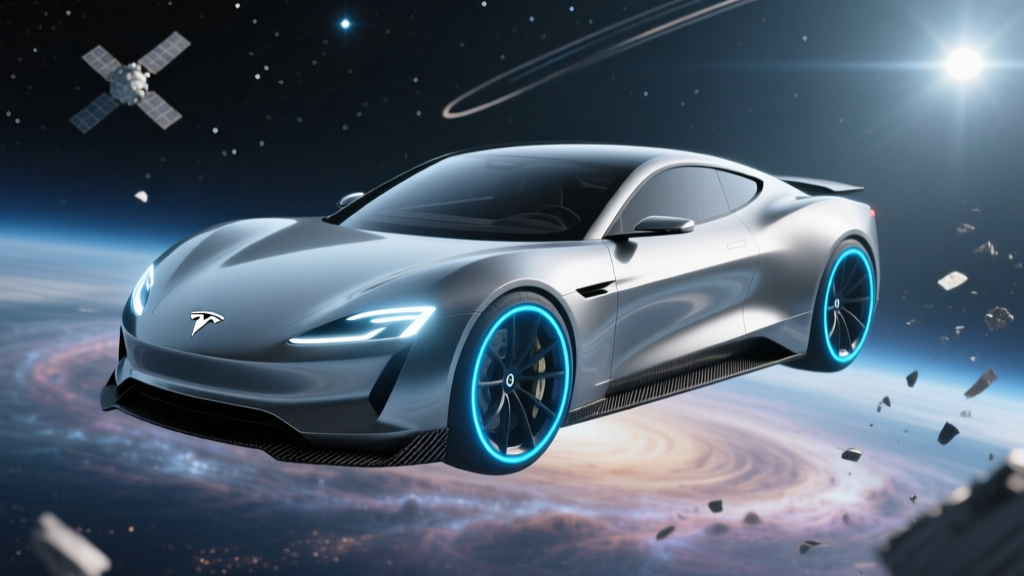
On February 6, 2018, SpaceX's Falcon Heavy test flight lofted a Midnight Cherry Tesla Roadster — with a spacesuit-clad mannequin dubbed "Starman" behind the wheel — on an interplanetary trajectory. It remains the most unusual vehicle launch in automotive history and the only production car to orbit the Sun. In 2026, more than eight years later, that Roadster is still out there, silently circling the inner solar system. Here's what the launch means for Tesla lore, the car's current orbital status, and how the original Roadster's real-world specs compare to the long-promised next-generation Roadster.
The Tesla Roadster Launched in Space: What Actually Happened
The cherry-red first-generation Tesla Roadster served as the dummy payload for Falcon Heavy's maiden flight from Kennedy Space Center's LC-39A. Elon Musk chose his personal car rather than a concrete mass simulator, reasoning that if the rocket exploded, at least the loss would be "entertaining." The Roadster, mounted atop a Tesla-designed adapter on the second stage, was pushed past Earth orbit into a heliocentric ellipse with an aphelion near Mars' orbital distance. David Bowie's "Space Oddity" played on the onboard speakers (until the battery died roughly 12 hours in), and a dashboard screen read "Don't Panic" — a nod to Douglas Adams.
Three camera pods streamed live footage during the first few hours, including the iconic shot of Starman with Earth in the background. After the live feed ended, the Roadster went dark — no telemetry, no transmitters, just passive orbital mechanics.
Where Is the Space Tesla Roadster Now (2026)?
The Roadster and its Falcon Heavy second-stage booster remain in a 1.0 AU × 1.66 AU heliocentric orbit with a ~2.5-year period and a 1-degree inclination to the ecliptic. Independent orbit trackers, including The Sky Live's Roadster tracker, estimate its position using the last known ephemeris. As of early 2026, the Roadster has completed roughly three full solar orbits since launch and has accumulated more than 4 billion miles of travel — far exceeding any Tesla odometer on Earth.
Because the car carries no active beacon, its exact position carries growing uncertainty. Current estimates place it somewhere between Earth's and Mars' orbits, likely tens of millions of miles from either planet. A close Earth approach isn't expected until at least 2047, and a collision with Earth or Venus within the next million years is calculated at roughly 6% and 2.5%, respectively, per University of Toronto orbital simulations.
The Original Tesla Roadster: Real-World Specs That Went to Orbit
The car circling the Sun is a 2008-series Tesla Roadster (likely a 2010-model-year 2.0 Sport based on Musk's ownership timeline). Here's what was actually on that rocket — and how those specs hold up against modern EVs.
| Spec | Value |
|---|---|
| EPA Range | 244 miles |
| Battery Capacity | 53 kWh (usable), NMC lithium-ion |
| Motor / Drivetrain | Single AC induction, RWD |
| Horsepower | 288 hp (Sport) |
| 0–60 mph | 3.7 seconds (Sport) |
| Top Speed | 125 mph (electronically limited) |
| Efficiency | 135 MPGe / 28 kWh/100 mi |
| Charging (AC) | ~16.8 kW (70 A) via HPWC; 3–4 hr full charge |
| DC Fast Charging | Not supported |
| Curb Weight | 2,690 lb |
| Original MSRP (2010 Sport) | ~$128,500 |
Real-World Range Reality (On Earth)
The 244-mile EPA figure was impressive in 2010, but owners consistently reported 180–210 miles in mixed driving, and as little as 140–160 miles at sustained 75 mph highway speeds or in cold weather below 40°F. The Roadster's air-cooled battery pack lacked the sophisticated thermal management of modern Teslas, making it sensitive to temperature extremes. In space, of course, the pack has long since frozen solid — lithium-ion cells cannot function in the vacuum's thermal cycling without active heating.
What's Happened to the Roadster in Space Since 2018
A few notable milestones in the Roadster's orbital life:
- October 2018: First Mars orbit crossing — the Roadster passed within ~5 million miles of Mars.
- 2020: Completed its first full heliocentric orbit and returned near its launch trajectory.
- 2023–2024: Amateur astronomers using large-aperture telescopes attempted to re-image the car; it remains far too faint (magnitude 22+) for routine visual tracking.
- 2026: Estimated to be outbound toward aphelion, roughly 150 million miles from the Sun.
The Roadster's paint, rubber tires, carbon-fiber body panels, and plastic interior components have been bombarded by solar UV and cosmic radiation for eight years. Materials scientists predict severe fading, embrittlement, and outgassing — the car likely looks more chalky white than cherry red today. The lithium-ion battery, subjected to thousands of deep thermal cycles between roughly -150°C and +120°C, is certainly inert.
The Next-Gen Tesla Roadster: Status in 2026
Announced in November 2017 alongside the Semi, the second-generation Tesla Roadster has slipped through numerous production timelines — originally 2020, then 2022, then 2023, then 2025, and now widely expected no earlier than late 2026 or 2027. As of this writing, Tesla has not confirmed a firm production date, and the new Roadster is not currently available for purchase. Reservations ($50,000 fully refundable) were paused in 2024.
| Attribute | 2008–2012 Roadster | Next-Gen Roadster (Announced) |
|---|---|---|
| EPA Range (target) | 244 mi | 620 mi (claimed, unverified) |
| Battery | 53 kWh NMC | ~200 kWh (claimed), chemistry TBD |
| 0–60 mph | 3.7 s (Sport) | 1.9 s (claimed, w/ SpaceX package) |
| Drivetrain | RWD, single motor | AWD, tri-motor |
| Top Speed | 125 mph | 250+ mph (claimed) |
| Base Price | ~$109,000 (2008) | ~$200,000 (announced) |
| Production Status | Ended 2012 | Not yet in production |
The next-gen Roadster's claimed 620-mile range and 1.9-second 0–60 time, if achieved, would reset benchmarks. But Tesla's history of timeline slippage on low-volume halo cars (the original Roadster itself shipped a year late) means buyers should treat these as engineering targets, not guarantees. Per Tesla's official Roadster page, specs remain preliminary.
Why the Space Roadster Still Matters in 2026
The Falcon Heavy demo flight did three things that still echo through the EV and aerospace industries:
- It proved Falcon Heavy could push payload beyond Earth orbit — a prerequisite for Artemis, commercial lunar landers, and eventual Mars missions.
- It gave Tesla the most memorable product launch in automotive history, reinforcing the brand's tech-forward image during the critical Model 3 ramp.
- It created a permanent cultural artifact — a car as a piece of space history, tracked by astronomers and cited in every EV origin story.
For EV shoppers today, the more relevant takeaway is how far the technology has come. The 2008 Roadster's 244-mile range and 53 kWh pack are now matched or exceeded by a $38,000 Tesla Model 3 RWD. A 2026 Model 3 Long Range AWD delivers 363 miles EPA from a ~75 kWh LFP/NMC pack with 250 kW DC fast charging — roughly five times the original Roadster's charging capability (which had none) and 50% more range.
Frequently Asked Questions About the Tesla in Space
Is the Tesla Roadster still in space in 2026?
Yes. The Roadster and its Falcon Heavy second stage remain in a heliocentric orbit between Earth and Mars. It has completed roughly three solar orbits since the 2018 launch and is estimated to have traveled over 4 billion miles. No tracking beacon is active, so its exact position carries growing uncertainty.
Will the Tesla Roadster ever come back to Earth?
Not in any foreseeable timeframe. Orbital simulations by University of Toronto researchers suggest a close Earth approach won't occur until at least 2047, and the probability of eventual collision with Earth is roughly 6% over the next million years. It's far more likely to remain in solar orbit indefinitely or be perturbed into a different trajectory by planetary encounters.
Can you still buy the original Tesla Roadster?
Only on the used market. Tesla produced approximately 2,450 Roadsters between 2008 and 2012. As of 2026, surviving examples typically sell for $120,000–$200,000+ at auction, depending on mileage, condition, and battery health. Tesla offered an 8-year/100,000-mile battery warranty on new units, but that coverage has long expired on every original Roadster.
Does the Tesla Roadster qualify for the federal EV tax credit?
No. The IRS §30D credit applies only to new qualifying vehicles purchased new, with MSRP caps ($55,000 for sedans, $80,000 for SUVs/trucks/vans), buyer income limits ($150K single / $300K joint), and strict battery critical-mineral and component sourcing rules. The original Roadster is long discontinued, and the next-gen Roadster's announced ~$200,000 price would exceed MSRP caps regardless. Used-EV credits (§25E) cap at $4,000 on vehicles under $25,000 — also inapplicable.
How fast would the next-gen Tesla Roadster be?
Tesla has claimed a 1.9-second 0–60 mph time with the optional "SpaceX package" (cold-gas thrusters) and roughly 2.1 seconds without. If achieved, this would make it the quickest production car ever sold. However, these figures are unverified, the vehicle is not yet in production, and Tesla has a history of revising performance claims between announcement and delivery.
What condition is the space Tesla in today?
After eight years of vacuum, radiation, and extreme thermal cycling, the Roadster is likely unrecognizable from its launch-day appearance. UV exposure has bleached the paint, rubber tires have cracked and outgassed, and the lithium-ion battery pack is inert. It remains structurally intact but cosmetically and functionally destroyed — a derelict sculpture, not a drivable car.