The $5.8 billion joint venture between Volkswagen Group and Rivian, announced in mid-2024, was pitched as a win-win: VW would gain access to Rivian's praised electrical architecture and software stack, while Rivian would get the capital it desperately needed to survive and scale. But as we move through 2026, the partnership has hit a series of friction points that prospective EV buyers — whether eyeing a Rivian R1T/R1S or a future VW electric model — need to understand before writing a check.
This isn't a traditional vehicle review. Instead, it's a deep-dive buyer's guide on the Volkswagen Rivian joint venture partnership challenges, what they mean for current and upcoming models from both brands, and whether the headwinds should change your purchase calculus.
The Partnership in Brief: What Was Promised
In June 2024, VW Group committed up to $5 billion in an investment and joint venture with Rivian. The core deal: a 50/50 joint venture company would integrate Rivian's zonal hardware architecture and software platform into future Volkswagen Group vehicles — including Audi, Porsche, and potentially Scout Motors models. In return, VW injected Rivian with immediate capital to fund the upcoming R2 crossover and R3 platform.
The pitch to consumers was straightforward: Rivian's tech (which has earned praise for its over-the-air update cadence and integrated vehicle software) would help VW close the gap with Tesla and Hyundai on software quality, while VW's manufacturing scale would help Rivian reduce per-unit costs and eventually achieve profitability.
Where the Volkswagen Rivian Joint Venture Partnership Challenges Surface
By early 2026, several concrete challenges have emerged that affect product timelines, software integration, and ultimately what lands in your driveway.
Software Integration Complexity
Rivian's electrical architecture is built around a zonal controller design — fewer electronic control units (ECUs), with high-speed ethernet backbone connecting major zones. VW's existing MEB platform (underpinning the ID.4, ID. Buzz, and others) uses a more traditional distributed ECU architecture. Bridging the two isn't a plug-and-play exercise; it requires rethinking how vehicle functions — from thermal management to ADAS sensor fusion — communicate at the protocol level.
Industry reports through 2025 indicated that the JV's first integrated VW product has been pushed from a 2026 target to late 2027 or 2028. For buyers hoping a next-gen VW ID.5 or ID.7 would benefit from Rivian software in the near term, that timeline shift matters.
Cultural and Engineering Workflow Clashes
Rivian operates with a Silicon Valley-style rapid iteration cycle — pushing OTA updates every few weeks, sometimes with significant feature additions. VW's development process, typical of legacy German OEMs, follows longer validation cycles with extensive hardware-in-the-loop testing before any software reaches production vehicles. Aligning these workflows inside a joint venture entity has reportedly slowed decision-making on key architecture choices.
Scalability Questions for Rivian's Architecture
Rivian's current architecture is proven at low-to-medium volume (roughly 50,000–80,000 vehicles annually through 2025). VW needs it to scale to millions of vehicles per year across multiple brands and platforms. Whether the architecture's supply chain, semiconductor dependencies, and software stack can handle that volume without significant re-engineering remains an open question — and a core part of the Volkswagen Rivian joint venture partnership challenges.
Financial Pressure on Rivian
Despite VW's capital injection, Rivian continued to report significant per-vehicle losses through 2025. The R1T and R1S, while critically acclaimed, are low-volume, high-cost products. The upcoming R2 crossover (targeted at a ~$45,000 starting price) is the make-or-break vehicle for Rivian's financial sustainability. Any JV-related distraction that slows R2 development or diverts engineering talent is a risk factor for buyers who've placed deposits.
What This Means for Current Rivian Buyers: R1T and R1S (2026 Model Year)
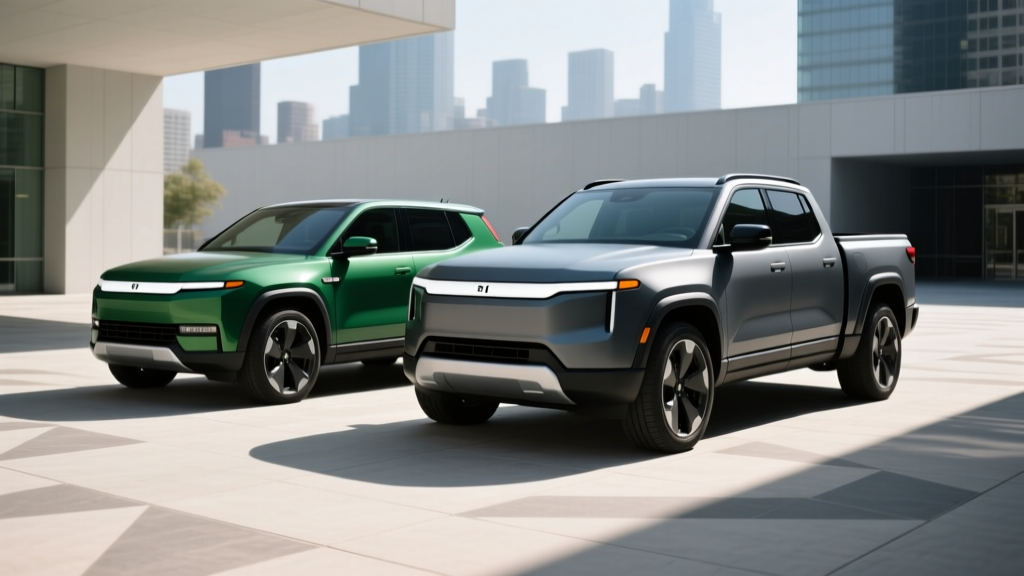
The JV challenges don't directly degrade the 2026 R1T and R1S — these vehicles are built on Rivian's existing, proven platform. If anything, VW's capital has helped Rivian continue iterating on the R1 line. Here's what the current models offer:
| Spec | Value |
|---|---|
| EPA Range (Standard Battery) | ~270 miles |
| EPA Range (Max Battery) | ~352 miles |
| Battery Capacity (Max Pack) | ~149 kWh (NMC lithium-ion) |
| Battery Chemistry | NMC (Nickel Manganese Cobalt) |
| Max DC Fast Charge Rate | ~200 kW peak |
| 10–80% DC Fast Charge Time | ~30 minutes (estimated) |
| Level 2 Home Charge Rate | 11.5 kW (~25 mi/hr) |
| 0–60 mph (Dual-Motor) | ~4.5 seconds |
| 0–60 mph (Tri-Motor) | ~3.0 seconds |
| Horsepower (Dual-Motor) | ~533 hp |
| Horsepower (Tri-Motor) | ~850 hp |
| Drivetrain | AWD (Dual/Tri-Motor) |
| MPGe (Combined, Dual-Motor Max) | ~70 MPGe |
| Efficiency | ~48 kWh/100 mi |
| Towing Capacity | 11,000 lbs |
| Cargo (Bed + Frunk + Gear Tunnel) | ~54 cu ft bed + 11 cu ft frunk + 11 cu ft tunnel |
| Base MSRP (Dual-Motor Standard) | ~$69,900 |
| Battery Warranty | 8 years / 175,000 miles |
| Vehicle Warranty | 5 years / 60,000 miles |
Charging Speed: The Practical Picture
Rivian's DC fast-charging peak of ~200 kW is competitive but not class-leading — the Hyundai Ioniq 5 and Kia EV6 can peak above 240 kW on 800V architectures. Here's how charging breaks down in practice:
| Charging Level | Power (kW) | Approx. Miles Added per Hour | Notes |
|---|---|---|---|
| Level 1 (120V outlet) | ~1.4 kW | ~3 mi/hr | Emergency/trickle only |
| Level 2 (240V, 48A) | 11.5 kW | ~25 mi/hr | Full overnight charge in ~12–14 hrs |
| DC Fast Charge (peak) | ~200 kW | ~140+ mi in 20 min | Peak rate sustained to ~50–60% SoC, then tapers |
The charge curve matters: Rivian's NMC pack holds near-peak speed through roughly 50–60% State of Charge, then tapers progressively. A 10–80% session takes approximately 30 minutes at a capable 200+ kW charger (such as Electrify America or Tesla Superchargers via adapter). Above 80%, the rate drops sharply — plan your road-trip stops around the 10–80% window for efficiency.
One practical note: Rivian has been expanding NACS compatibility. As of 2025–2026, Rivian vehicles can access the Tesla Supercharger network using an included or available adapter, dramatically expanding the fast-charging footprint for road trips.
Federal Tax Credit and Pricing: What You'll Actually Pay
This is where the IRS §30D rules require careful attention. The federal EV tax credit is not a flat $7,500 for every buyer — eligibility depends on multiple factors that change frequently.
| Trim / Config | MSRP | Federal Credit Potential | Effective Price |
|---|---|---|---|
| Dual-Motor Standard Battery | ~$69,900 | Up to $7,500* | ~$62,400* |
| Dual-Motor Max Battery | ~$79,900 | Up to $7,500* | ~$72,400* |
| Tri-Motor Max Battery | ~$99,000+ | Up to $7,500* | ~$91,500+* |
*Critical §30D caveats for 2026:
- MSRP Cap: Pickup trucks (R1T) have an $80,000 MSRP cap. The Tri-Motor configuration exceeds this, making it ineligible for the federal credit. The R1S SUV has a separate $80,000 cap for SUVs/vans.
- Income Cap: Modified adjusted gross income must not exceed $300,000 (joint filers), $225,000 (head of household), or $150,000 (individual). See IRS §30D guidelines for current-year details.
- Battery Sourcing: The credit is split into two $3,750 halves — one for critical minerals sourcing and one for battery component manufacturing. Sourcing requirements tighten annually. Rivian's supply chain qualifies for varying portions depending on the model year and pack configuration. Always verify current eligibility on the IRS qualified vehicles list before purchasing.
- Point-of-Sale Transfer: As of 2024+, eligible buyers can transfer the credit to the dealer at purchase, reducing the out-of-pocket price immediately rather than waiting for tax filing.
For the R1T Dual-Motor Standard at ~$69,900, a qualifying buyer could see the effective price drop to roughly $62,400 — still a premium truck, but meaningfully offset. Always consult a tax professional and check fueleconomy.gov for the latest qualified vehicle list.
What the Partnership Challenges Mean for the Rivian R2
The R2 — Rivian's smaller, more affordable crossover targeting a ~$45,000 starting price — is the vehicle most affected by the VW-Rivian JV dynamics. Here's why:
The R2 is planned for production at Rivian's new Normal, Illinois factory expansion (and potentially a future Georgia facility). The JV's technology-sharing agreement doesn't directly delay R2 hardware, but it does pull engineering resources. Rivian's software team, in particular, is split between maintaining/improving R1 vehicles, developing R2's software stack, and fulfilling JV obligations to VW.
If the JV integration hits further snags, two scenarios are possible:
- Rivian prioritizes R2 over VW deliverables: This protects the R2 timeline (currently targeted for 2026 production start) but could strain the partnership and risk future VW capital.
- Rivian diverts talent to JV milestones: This could delay R2 production ramp or result in a less polished software experience at launch — a real concern given that early R1T software had its own rough patches.
For R2 reservation holders, the key metric to watch is Rivian's quarterly earnings calls — specifically, whether R2 production timelines are being maintained or slipping quarter-over-quarter.
Competitor Context: Should You Wait or Buy Now?
If you're cross-shopping based on the partnership uncertainty, here's how the R1T and R1S stack up against alternatives:
Pros: Rivian R1T/R1S
- Best-in-class adventure utility: gear tunnel, camp kitchen option, 11,000-lb towing
- Excellent OTA software cadence — features improve post-purchase
- Tri-Motor performance (850 hp, ~3.0s 0–60) rivals supercars in a truck body
- Expanding Supercharger access via NACS adapter
- Strong community and owner experience
Cons: Rivian R1T/R1S
- Premium pricing — most trims exceed $75,000 before options
- Highway efficiency (~48 kWh/100 mi) lags more aero-efficient SUVs
- Service center network still limited in rural areas
- JV partnership uncertainty introduces long-term risk to software support continuity
- Real-world cold-weather range loss of 20–30% on NMC packs
Key competitors to consider:
- Ford F-150 Lightning: Lower starting price (~$55,000), larger service network, but less refined software and lower towing range efficiency.
- Tesla Cybertruck: Polarizing design, strong Supercharger network integration, stainless steel build, but limited proven reliability data and higher pricing on AWD/Beast trims.
- Chevrolet Silverado EV: Massive 400+ mile range on max pack, competitive pricing, but larger footprint and fewer lifestyle-oriented features.
- Hyundai Ioniq 5 / Kia EV9 (if SUV shopping): Far better charging speed (800V architecture, 10–80% in ~18 min), lower price points, but no truck utility.
Who Should Buy a Rivian Now vs. Wait
Buy a Rivian R1T/R1S now if:
- You need a capable electric truck for towing, camping, or adventure use today
- You can charge at home (Level 2) and have access to DC fast charging for road trips
- You qualify for the §30D tax credit and can bring the effective price into your budget
- You value OTA software improvements and a strong owner community
Wait if:
- You're targeting the R2 at ~$45,000 — the JV challenges may affect its launch timeline and software maturity
- You want a VW-badged EV with Rivian tech — that product is likely 2028+ at the earliest
- You're concerned about long-term service network density in your region
- You need maximum highway range efficiency — a more aerodynamic SUV or sedan will serve you better
Frequently Asked Questions
What is the real-world range of the Rivian R1T?
The EPA rates the R1T Max Pack at approximately 352 miles. In real-world highway driving at 70–75 mph in mild weather, expect 280–310 miles. In cold weather (below 30°F), that drops to roughly 220–260 miles. The Standard Battery pack (270 mi EPA) delivers roughly 210–230 miles on the highway in mild conditions.
How fast does the Rivian R1T charge at home and on the road?
At home on a 240V Level 2 charger (48A), the R1T charges at 11.5 kW, adding roughly 25 miles of range per hour — a full charge takes 12–14 hours. On DC fast chargers, the R1T peaks at approximately 200 kW, with a 10–80% session taking about 30 minutes. The charge rate tapers significantly above 80% SoC.
Does the Rivian R1T qualify for the federal EV tax credit?
It depends. The R1T Dual-Motor Standard Battery (~$69,900 MSRP) falls under the $80,000 pickup MSRP cap and may qualify for up to $7,500 if the buyer meets income requirements and the battery sourcing criteria are satisfied. The Tri-Motor configuration (~$99,000+) exceeds the MSRP cap and is ineligible. Always verify on the IRS qualified vehicles list and consult a tax professional.
Is Rivian at risk of going under because of the VW partnership challenges?
Rivian's financial position has improved thanks to VW's capital injection, but the company still operates at a per-vehicle loss. The R2 launch is the critical near-term catalyst. The VW JV challenges are real but unlikely to be existential for Rivian in isolation — the bigger risk is R2 execution and production ramp. VW has a strong incentive to see Rivian succeed, given its $5B+ commitment.
Should I be worried about software support if the VW-Rivian JV falls apart?
Even if the JV were to dissolve, Rivian's core software team and architecture would remain intact for R1 and R2 vehicles. The JV is primarily about licensing and integrating Rivian tech into VW products, not about VW building Rivian's software. The main risk would be loss of future VW capital, which could slow Rivian's growth and R2/R3 development timelines.
Is the Rivian R1T worth buying over the Ford F-150 Lightning?
If you prioritize lifestyle features (gear tunnel, camp kitchen, quad-motor performance), superior OTA software, and adventure-oriented design, the R1T is the stronger choice despite its higher price. If budget, service network density, and fleet/commercial support matter more, the F-150 Lightning is the pragmatic pick. Both are capable trucks — the decision comes down to use case and price tolerance.
What are the biggest Volkswagen Rivian joint venture partnership challenges?
The primary challenges include: (1) integrating Rivian's zonal architecture with VW's distributed ECU platforms, (2) aligning rapid-iteration software culture with VW's longer validation cycles, (3) scaling Rivian's architecture from ~80K to millions of vehicles annually, and (4) managing engineering resource allocation between JV obligations and Rivian's own R2/R3 product timelines.
The Volkswagen Rivian joint venture partnership challenges are real but nuanced. For current R1T and R1S buyers, the immediate product is unaffected — you're buying a proven, well-regarded EV with strong specs and an expanding charging network. For those waiting on the R2 or a future VW-badged Rivian-tech vehicle, patience is warranted, and monitoring quarterly production and JV milestone updates is essential. The partnership's long-term success will shape the EV landscape for years to come, but your buying decision today should be grounded in the vehicles that actually exist — not the ones still on the roadmap.