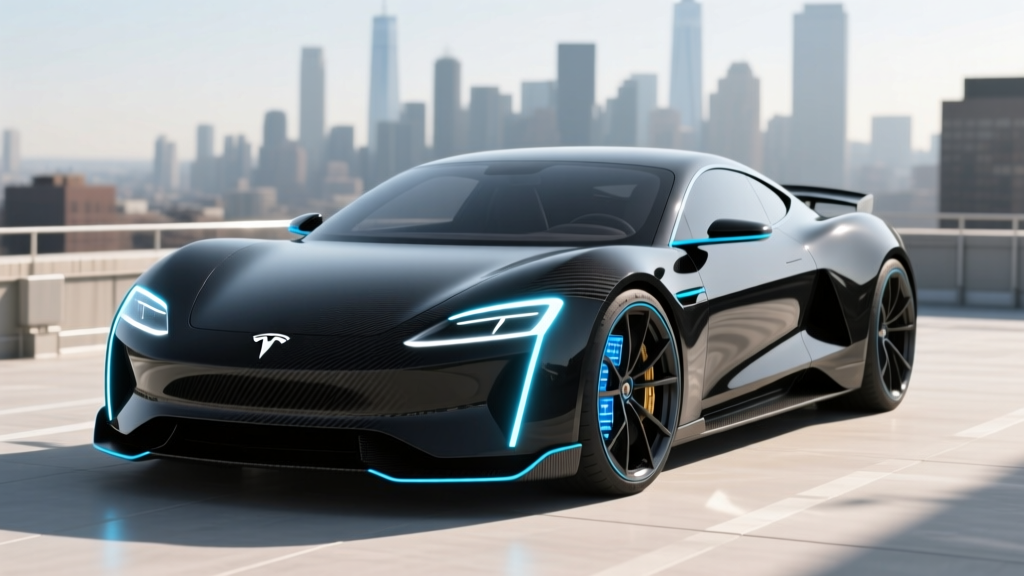
The next-generation Tesla Roadster has been one of the longest-running "coming soon" stories in the EV industry. First teased in 2017 with a 2020 target, then pushed repeatedly, the car now appears to be tracking toward a late-2025 or 2026 production start. As of early 2026, Tesla has not opened general orders or published final EPA-certified specifications, so every figure below reflects Tesla's stated targets, engineering previews, and informed estimates — not sticker-window facts. If you're researching the 2026 Tesla Roadster, here's the most grounded picture available today.
Projected Specs at a Glance
| Spec | Tesla Target / Estimate | Notes |
|---|---|---|
| EPA Range (target) | ~620 miles | Unverified by EPA; real-world highway likely 450–520 mi |
| Battery Capacity | ~200 kWh usable | Expected NMC/NCA chemistry (not LFP) |
| Drivetrain | Tri-motor AWD | One front, two rear motors; torque vectoring |
| Horsepower | ~1,000+ hp (est.) | SpaceX package claims higher |
| 0–60 mph | 1.9 sec (base) / <1 sec (SpaceX) | With rollout subtracted; street-tire dependent |
| Top Speed | 250+ mph | Electronically limited |
| Max DC Fast Charge | ~350 kW (est.) | On V4 Superchargers; 800V architecture expected |
| 10–80% DC Time | ~25–30 min (est.) | Large pack means long tail even at high kW |
| Level 2 Home Charge | ~11.5 kW / ~34 mi/hr | 48A on Wall Connector; full charge >17 hours |
| Base MSRP (est.) | $200,000 | Founders Series previously listed at $250K |
| Federal Tax Credit | Not eligible | Exceeds §30D MSRP cap for sports cars |
| Battery Warranty (est.) | 8 yr / 150,000 mi | Based on Tesla's current high-end pack policy |
Range: Big Battery, Real-World Physics
The ~200 kWh pack is the largest Tesla has ever put in a passenger car, roughly double a Model S Plaid. Chemistry is almost certainly a nickel-based NMC or NCA cell — LFP would be too heavy and too low in energy density for a performance halo car. Expect a usable buffer of 5–8% at the bottom to protect long-term State of Health (SoH), meaning the raw cell-level capacity is slightly higher than 200 kWh.
For context, the longest-range production EV sold in the U.S. today tops out around 400–510 EPA miles. If Tesla hits 620 EPA, it would reset the category — but the EPA test cycle is gentler than sustained highway driving, which is what Roadster buyers will actually do on weekend runs.
Charging Speed: Big Pack, Long Tail
| Level | Power | Miles Added per Hour | Notes |
|---|---|---|---|
| Level 1 (120V) | ~1.4 kW | ~4 mi/hr | Emergency/top-up only |
| Level 2 (240V, 48A) | 11.5 kW | ~34 mi/hr | Overnight: ~18 hrs for 0–100% |
| DC Fast (V4 Supercharger) | ~350 kW peak | ~1,000+ mi/hr at peak | 10–80% in ~25–30 min |
Charging a 200 kWh battery is a physics problem, not a marketing problem. Even at a sustained 350 kW — which the car will not hold for the full session due to thermal and SoC taper — you're moving roughly 140 kWh between 10% and 80%. That math yields the 25–30 minute estimate above, which is competitive with other large-pack EVs but far from the "15-minute pit stop" smaller packs can manage.
Critically, the Roadster is expected to use an 800V-class architecture (similar to the Cybertruck), which is what enables the high peak kW without excessive current and cable heat. Preconditioning the battery before a DC stop — a feature Tesla's navigation already triggers automatically — will be essential to hitting peak rates. Cold-soak the pack and you'll see the curve flatten well below 350 kW for the first several minutes.
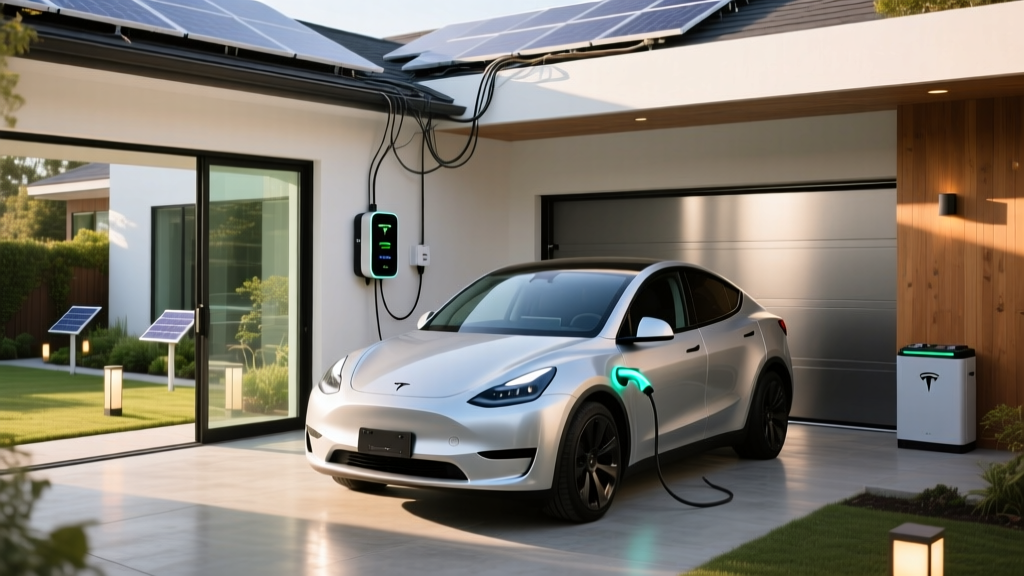
Home charging a 200 kWh pack on a standard 11.5 kW Level 2 Wall Connector takes over 17 hours from near-empty. Most owners will charge in the 20–80% daily window, which cuts that to roughly 10 hours overnight — perfectly fine for a weekend car, less ideal if you plan daily long-distance use.
Performance and Drivetrain
The base Roadster uses a tri-motor layout: one front motor and two rear motors, enabling torque vectoring across the rear axle. Tesla has quoted a 1.9-second 0–60 mph time for the base configuration — already among the quickest production cars ever measured.
The optional SpaceX package, which Tesla has said adds cold-gas thrusters around the body, targets a sub-1-second 0–60 with rollout subtracted. This is a drag-strip number that depends on prepped surfaces and specialized tires; on a public road with street rubber and ambient dust, expect the car to feel violently quick but not literally sub-one. Top speed is quoted above 250 mph, electronically governed.
Total system output is estimated above 1,000 hp for the base tri-motor, with the SpaceX package pushing higher. Braking will need to match: expect large carbon-ceramic rotors as either standard or a costly option, because repeated high-speed stops will overwhelm conventional steel brakes on a car this heavy.
Pricing, Trims, and the Tax-Credit Reality
| Configuration | Estimated MSRP | Federal §30D Credit | Effective Price |
|---|---|---|---|
| Roadster Base | $200,000 | $0 (over MSRP cap) | $200,000 |
| Roadster Founders Series | $250,000 | $0 | $250,000 |
| Roadster + SpaceX Package | $250,000+ | $0 | $250,000+ |
Under current IRS §30D rules, the federal EV tax credit caps eligible vehicles at an MSRP of $80,000 for SUVs/pickups/vans and $55,000 for sedans and other body styles. The Roadster, classified as a sports car, falls well above either cap. Add the buyer income limits ($300K joint / $150K single MAGI) and the battery critical-mineral and component sourcing requirements, and the credit is functionally unavailable for this model regardless of buyer profile. Per IRS guidance on new clean vehicle credits, buyers should confirm eligibility with a tax professional before counting on any incentive.
State-level incentives may still apply — California's CVRP, for example, has its own income and price thresholds — but at this price point, most buyers will pay full sticker plus destination and any dealer-installed options.
Interior, Cargo, and Daily Usability
The Roadster is a 2+2 with a removable glass roof panel (targa-style). Rear seats are best described as occasional — suitable for children or luggage overflow, not adults on any trip longer than a grocery run. Front legroom should be generous given the car's wheelbase, but exact inches have not been published.
Cargo space is limited. Expect a modest rear trunk plus a shallow front trunk (frunk), with combined volume likely in the 10–15 cubic-foot range — enough for two weekend bags, not a Costco run. This is a sports car, and packaging reflects that priority.
The infotainment system will run Tesla's current UI on a large central touchscreen, with no physical instrument cluster behind the wheel. Expect the full Tesla software suite: navigation with Supercharger routing, over-the-air updates, Sentry Mode, Dashcam, and the Tesla app. Autopilot will be standard; Full Self-Driving (Supervised) will be an option. Both are SAE Level 2 driver-assist systems — the driver must remain engaged at all times. This is not a Level 4 robotaxi, and Tesla does not market it as one for this model.
Warranty and Long-Term Ownership
Tesla's current battery and drive unit warranty on premium models is 8 years / 150,000 miles, whichever comes first, with a minimum 70% capacity retention threshold over that period. The Roadster is expected to follow this policy, though the large pack size means even 70% retention still leaves over 400 miles of range — a strong floor.
Replacement cost for a 200 kWh pack, out of warranty, is substantial. Current industry pricing for large NMC packs runs $130–$180 per kWh at the pack level, implying a $26,000–$36,000 replacement before labor. Most owners will never reach this point, but it's a number worth knowing before purchase.
Insurance premiums on a 1,000-hp, $200K+ EV will be high. Quotes vary by state and driver profile, but expect annual premiums in the $4,000–$8,000 range for typical buyers — a meaningful line item in the total cost of ownership.
Who the 2026 Tesla Roadster Is For
Buy it if: You want a halo EV with unmatched straight-line performance, 400+ real-world highway miles between stops, and Tesla's Supercharger network. You already have a daily driver and this is a weekend/track car.
Skip it if: You need rear-seat practicality, low insurance costs, or a vehicle eligible for the federal tax credit. A Model S Plaid delivers 90% of the performance for a third of the price.
The Roadster competes less with other EVs and more with internal-combustion hypercars and grand tourers. Its closest EV analog is the Rimac Nevera (roughly $2M, limited production) or the upcoming Lucid Air Sapphire in spirit, though the Lucid is a sedan at a fraction of the price. Against gas exotics — Ferrari SF90, Lamborghini Revuelto — the Roadster's advantage is instant torque and running cost; its disadvantage is brand prestige and the exclusivity that comes with a $200K Tesla versus a $500K Maranello product.
Frequently Asked Questions
What is the real-world range of the 2026 Tesla Roadster?
Tesla targets ~620 EPA miles. Real-world highway driving at 70 mph in moderate temperatures should yield roughly 500–520 miles. In cold weather (below 40°F) or at sustained speeds above 80 mph, expect 420–480 miles. The 200 kWh pack gives a large margin, but aerodynamic drag and temperature are undefeated.
How fast does the Roadster charge at home and on the road?
On a V4 Supercharger at ~350 kW peak, 10–80% should take roughly 25–30 minutes. At home on a Level 2 Wall Connector (11.5 kW), a full charge takes over 17 hours; a typical 20–80% daily charge takes about 10 hours. Level 1 (120V) adds about 4 miles per hour and is emergency-only for a pack this size.
Does the 2026 Tesla Roadster qualify for the federal EV tax credit?
No. Under IRS §30D rules, the credit's MSRP cap is $55,000 for non-SUV/pickup vehicles. The Roadster's ~$200,000 base price disqualifies it regardless of buyer income or battery sourcing. Consult IRS.gov or a tax professional for your specific situation.
Is it worth buying versus a Model S Plaid or Rimac Nevera?
If you want maximum Tesla performance without the Roadster's price, the Model S Plaid (~$90K, 1,020 hp, ~390 EPA miles) is the rational choice. The Roadster justifies its premium only if you value the exclusivity, the removable roof, the 620-mile range target, and the halo-car experience. The Rimac Nevera is in a different price stratum entirely and competes on craftsmanship, not value.
When can I actually buy one?
As of early 2026, Tesla has not opened general retail orders. Reservation holders from prior years are expected to get priority. Production timing has slipped multiple times; treat any announced date as preliminary until Tesla confirms deliveries are underway. Monitor Tesla's official Roadster page for updates.
What are the biggest pros and cons?
- Projected 620-mile EPA range — class-leading by a wide margin
- Sub-2-second 0–60 (base); sub-1 with SpaceX package
- Full access to Tesla Supercharger network
- OTA updates and Tesla software ecosystem
- Removable glass roof; targa experience
- ~$200K+ price with no federal tax credit
- Production date has slipped repeatedly — delivery risk is real
- Insurance costs will be very high
- Tiny rear seats and limited cargo
- 200 kWh pack means long home-charge times
Sources: Tesla Roadster official page, IRS §30D clean vehicle credit guidance, fueleconomy.gov for EPA testing methodology. All performance and range figures are manufacturer targets or analyst estimates and are subject to change upon EPA certification and production start.