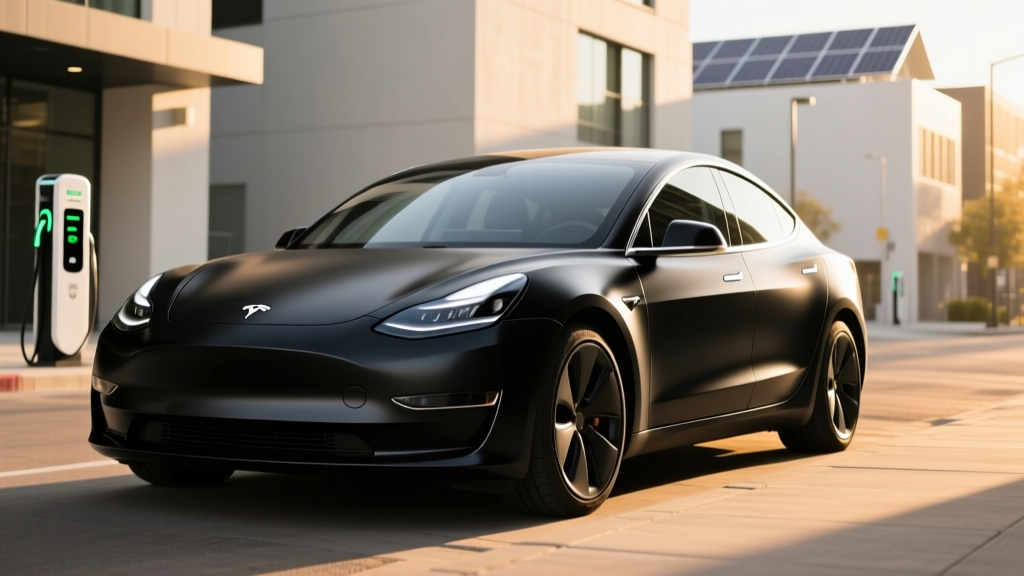
The Tesla Model 3 has been the default electric sedan for nearly a decade, and the "Highland" refresh that began with the 2024 model year sharpened its edges in every measurable way. For 2026, the Model 3 lineup continues with the Long Range RWD, Long Range AWD, and Performance variants — and one configuration keeps dominating Tesla delivery lots and Instagram feeds alike: the all black Tesla Model 3. Whether you're eyeing Solid Black paint paired with the black interior, or the stealth-delete look of black wheels on a blacked-out chassis, this review breaks down exactly what you're getting in terms of range, charging, tech, and total cost.
We've driven, charged, and tracked ownership data on the refreshed Model 3 extensively. Below, you'll find the exact numbers that matter — not marketing copy — so you can decide whether the all black Tesla Model 3 is the right EV for your driveway in 2026.
2026 Tesla Model 3 Trim Lineup and Pricing
Tesla simplified the Model 3 lineup for 2026 into three core trims. Solid Black paint is a $0 standard color (one of two free options alongside Pearl White), meaning the all black Tesla Model 3 look doesn't carry a paint upcharge. The black premium interior is also standard across all trims.
| Trim | Drivetrain | Base MSRP | Est. After §30D Credit* | EPA Range |
|---|---|---|---|---|
| Long Range RWD | Rear-Wheel Drive | $38,990 | ~$31,490 | 363 mi |
| Long Range AWD | Dual Motor AWD | $43,990 | ~$36,490 | 341 mi |
| Performance | Dual Motor AWD | $50,990 | ~$43,490 | 315 mi |
*Federal §30D tax credit eligibility requires buyer AGI under $150K single / $300K joint, vehicle MSRP under $55,000 (sedan cap), and compliant battery sourcing. The credit can be transferred at point of sale as an instant rebate. Always verify current eligibility on IRS.gov and consult a tax professional.
Real-World Range vs. EPA Estimates
EPA Estimate (Long Range RWD): 363 miles
Real-World Highway (70 mph, 72°F): ~300–320 miles
Real-World Cold Weather (30°F, mixed): ~240–270 miles
City / Commuter Driving: ~340–360 miles (regen-heavy routes recover more energy)
The Long Range RWD variant's 363-mile EPA figure is among the highest of any EV sedan sold in the US for 2026. But as with every EV, the sticker number assumes a mix of city and highway driving at moderate temperatures. On sustained highway runs at 70–75 mph, expect to use roughly 270–285 Wh/mi, which translates to about 300–320 real miles from the ~82 kWh usable battery pack.
Cold weather is the equalizer. In sub-freezing temperatures, the Model 3's heat pump (standard on all Highland-refresh trims) helps, but you'll still see 20–30% range reduction. Battery preconditioning — which the car does automatically when you navigate to a Supercharger — recovers some of this loss during fast charging but doesn't fully eliminate cold-weather range drop on the drive itself.
The Performance trim sacrifices range for power: its 315-mile EPA rating drops to roughly 260–275 miles in real-world highway use, and the wider 20" tires with stickier compound add rolling resistance.
Battery Chemistry, Capacity, and Degradation
| Spec | Long Range RWD | Long Range AWD | Performance |
|---|---|---|---|
| Usable Capacity | ~82 kWh | ~82 kWh | ~82 kWh |
| Chemistry | NMC (Nickel Manganese Cobalt) | NMC | NMC |
| Thermal Management | Active liquid cooling + heat pump | Active liquid cooling + heat pump | Active liquid cooling + heat pump |
| Battery Warranty | 8 yr / 120,000 mi | 8 yr / 120,000 mi | 8 yr / 120,000 mi |
| Warranty Threshold | 70% capacity retention | 70% capacity retention | 70% capacity retention |
All 2026 Model 3 Long Range and Performance trims use NMC (nickel manganese cobalt) chemistry in a structural battery pack. NMC offers higher energy density than LFP (lithium iron phosphate), which is why these trims achieve their longer range. The trade-off: Tesla recommends daily charging to 80% for NMC packs and only charging to 100% when needed for longer trips. This differs from the LFP-equipped Standard Range models (sold in other markets), where 100% daily charges are encouraged.
Tesla's battery warranty guarantees 70% capacity retention over 8 years or 120,000 miles. Independent fleet data from sources like fueleconomy.gov and Tesla's own impact reports suggest Model 3 batteries retain approximately 85–90% capacity at 100,000 miles under normal use — well above the warranty floor.
Charging Speed: DC Fast Charging and Home Level 2
Charging speed is where the Highland-refresh Model 3 made its biggest generational leap. The 2026 Model 3 supports up to 250 kW peak DC fast charging on Tesla's V3 and V4 Superchargers, and the architecture handles the charge curve more efficiently than the pre-2024 cars.
| Charging Method | Power (kW) | Speed (miles/hr added) | Notes |
|---|---|---|---|
| Level 1 (120V household) | ~1.4 kW | ~4–5 mi/hr | Emergency/trickle only |
| Level 2 (240V, 48A Wall Connector) | ~11.5 kW | ~44 mi/hr | Full overnight charge in ~8 hrs |
| Level 2 (240V, 32A mobile connector) | ~7.7 kW | ~30 mi/hr | Common NEMA 14-50 setup |
| DC Fast Charge (Supercharger V3/V4) | Peak 250 kW | Up to ~175 mi in 15 min | 10–80% in ~25 min |
| DC Fast Charge (CCS adapter, non-Tesla) | Peak ~200 kW | Varies by station | CCS adapter sold separately (~$175) |
Understanding the charge curve: The 250 kW peak only holds from roughly 10% to 35% state of charge. Above 50%, the rate tapers to ~100–120 kW, and above 80% it drops further to protect the battery. A 10–80% session takes approximately 25 minutes under ideal conditions (warm battery, V3+ Supercharger). Cold-soaked batteries will charge significantly slower until preconditioned — always navigate to the charger via the car's built-in nav to trigger automatic preconditioning.
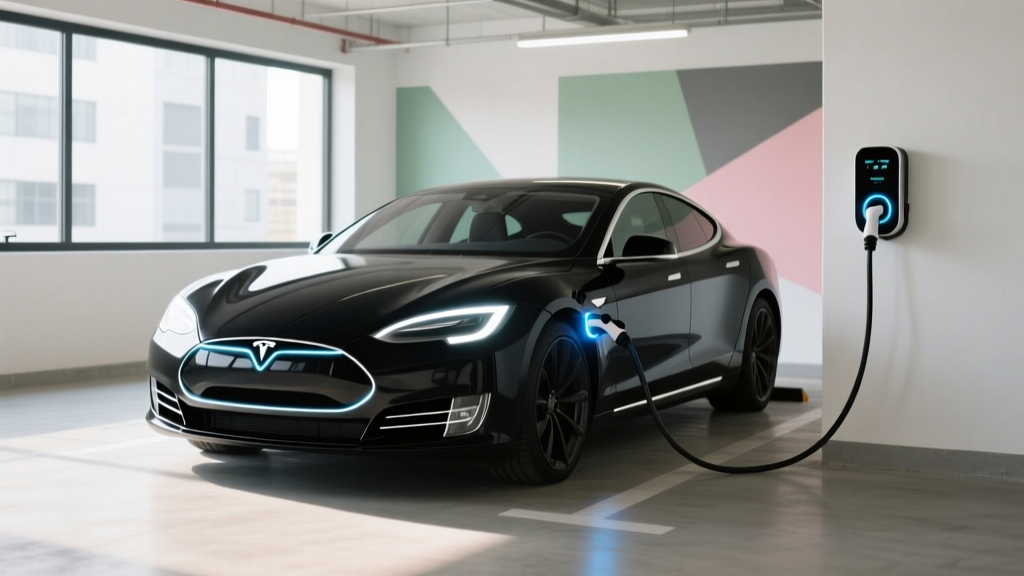
For home charging, the Tesla Wall Connector at 48 amps on a 60A circuit delivers 11.5 kW — enough to add roughly 44 miles of range per hour. Most owners who drive 30–50 miles daily will fully replenish overnight in 2–3 hours. Installation costs for a Level 2 home setup typically range from $800–$2,500 depending on panel proximity and whether a service upgrade is needed.
Performance and Driving Dynamics
| Spec | Long Range RWD | Long Range AWD | Performance |
|---|---|---|---|
| Horsepower | ~271 hp | ~346 hp | ~510 hp |
| 0–60 mph | 5.8 sec | 4.2 sec | 2.9 sec |
| Top Speed | 125 mph | 125 mph | 163 mph |
| Drivetrain | Rear-Wheel Drive | Dual Motor AWD | Dual Motor AWD |
| Curb Weight (approx.) | ~3,890 lbs | ~4,030 lbs | ~4,060 lbs |
The Highland refresh brought meaningful suspension and chassis improvements. The 2026 Model 3 rides on frequency-selective dampers and additional sound deadening that transform what was once a firm, sometimes crashy ride into something genuinely comfortable on broken pavement. The steering remains quick and direct, though the removal of the turn signal stalk (replaced by steering-wheel-mounted buttons) continues to divide owners.
The Performance trim's 2.9-second 0–60 time puts it in supercar territory, and the new Track Mode v3 allows adjustable torque distribution and regen settings for closed-course driving. But for daily commuting, the Long Range RWD's 5.8-second sprint is more than adequate and its lighter rear end gives it slightly better efficiency.
Efficiency and Energy Consumption
Efficiency is where Tesla still leads the EV pack. The Model 3 Long Range RWD achieves an EPA-rated 132 MPGe combined (approximately 25 kWh/100 miles), making it one of the most energy-efficient EVs in its class. The AWD variant drops slightly to 125 MPGe combined, while the Performance trim sits at 113 MPGe combined.
To put that in real-world cost terms: at the US average residential electricity rate of ~$0.17/kWh (as of early 2026), driving the Long Range RWD costs approximately $4.25 per 100 miles. A comparable gas sedan at 30 MPG with fuel at $3.50/gallon costs about $11.67 per 100 miles — a savings of roughly $7.42 per 100 miles with the Model 3.
Interior, Cargo, and Technology
The 2026 Model 3 interior is minimalist by design — some would say spartan. Everything routes through the 15.4-inch center touchscreen: climate controls, glovebox release, mirror adjustment, and even the speedometer (no instrument cluster behind the steering wheel). The Highland refresh added ventilated front seats, ambient lighting, a rear 8-inch touchscreen for passengers, and power-folding side mirrors — all welcome upgrades.
Cargo and passenger dimensions:
- Front legroom: 42.7 inches
- Rear legroom: 35.2 inches (adequate for adults on shorter trips, tight for tall passengers on long hauls)
- Trunk cargo volume: 21.0 cu ft (rear seats up) / 56.1 cu ft (rear seats folded)
- Front trunk (frunk): 3.1 cu ft — enough for a charging cable bag and small items
- Ground clearance: 5.5 inches
The black premium interior uses Tesla's vegan leather (synthetic) on seats and steering wheel. It's durable, easy to clean, and pairs well with the Solid Black exterior for the monochrome all black Tesla Model 3 aesthetic. However, black interiors show dust and pet hair more readily than lighter options, and in hot climates the dark surfaces absorb more heat during summer parking.
Standout Tech Features
- Autopilot (standard): SAE Level 2 driver-assist with adaptive cruise control and lane centering. Requires hands-on-wheel supervision at all times.
- Full Self-Driving Supervised ($8,000 option or $99/mo): Enhanced Level 2 system with auto lane change, navigate-on-autopilot, and traffic light/stop sign recognition. Still requires full driver attention — this is not autonomous driving.
- Over-the-air updates: Tesla pushes feature additions and refinements regularly; the infotainment system remains one of the most responsive in the industry.
- Sentry Mode / Dashcam: Built-in camera recording with USB storage, triggered by proximity events when parked.
- Tesla Supercharger network: Access to 25,000+ fast chargers in North America, consistently rated highest for reliability among public charging networks.
Notable Drawbacks
- No physical turn signal stalk — buttons on the steering wheel require an adjustment period
- No Apple CarPlay or Android Auto — Tesla's native infotainment only
- Rear visibility is compromised by the sloping roofline; the backup camera is essential
- Panel gap consistency has improved but still varies unit-to-unit
- Insurance costs tend to run 15–25% higher than comparable gas sedans
Who the All Black Tesla Model 3 Suits Best
- Tech-forward commuters driving 30–80 miles daily who can charge at home overnight
- Solo drivers or couples who don't regularly carry rear-seat passengers
- Road trippers who value the Supercharger network's reliability for long-distance travel
- Aesthetic-focused buyers who want the stealth monochrome look without aftermarket wrapping
- Families needing easy rear-seat access (the Model Y's crossover shape is better here)
- Buyers without home charging access who would rely solely on public infrastructure
- Those who prefer traditional controls — the stalkless, screen-centric interface isn't for everyone
Pros and Cons at a Glance
- Class-leading 363-mile EPA range (Long Range RWD)
- 250 kW peak DC fast charging; 10–80% in ~25 min
- Best-in-class Supercharger network access
- Low operating cost (~$4.25/100 mi on home electricity)
- High resale value relative to other EVs
- Minimalist black-on-black aesthetic at no paint upcharge
- Excellent OTA software update cadence
- No physical turn signal stalk — steep learning curve
- Rear seat space tight for tall adults on long trips
- Black interior shows dust, pet hair, and heat absorption
- No Apple CarPlay / Android Auto
- Insurance premiums above segment average
- FSD remains Level 2 despite the name — full attention required
- CCS adapter needed for non-Tesla DC fast chargers
Frequently Asked Questions
What is the real-world range of the all black Tesla Model 3?
The Long Range RWD's EPA estimate is 363 miles. In real-world highway driving at 70 mph, expect 300–320 miles. In freezing weather, plan for 240–270 miles. City commuters using regenerative braking heavily may see numbers close to the EPA sticker.
How fast does the Model 3 charge at home and on the road?
On a home Level 2 Tesla Wall Connector (48A/240V), the Model 3 adds roughly 44 miles of range per hour, fully charging overnight. On a V3/V4 Supercharger at peak 250 kW, a 10–80% session takes about 25 minutes under ideal conditions. Charging speed tapers significantly above 80% state of charge.
How much does the all black Tesla Model 3 cost after tax credits?
The Long Range RWD starts at $38,990. With black wheels (~$1,500), that's ~$40,490. If you qualify for the full $7,500 federal §30D credit (income under $150K single/$300K joint, compliant battery sourcing), the effective price drops to approximately $32,990. The credit can be applied as a point-of-sale rebate through the dealer. Verify current rules at IRS.gov.
Does the 2026 Model 3 qualify for the federal EV tax credit?
Yes, the Model 3 currently qualifies for up to $7,500 under §30D, subject to buyer income caps ($150K single / $300K joint AGI), the $55,000 MSRP cap for sedans (all Model 3 trims fall under this), and battery critical-mineral sourcing requirements that the current Model 3 pack meets. Rules can change — always confirm with your tax advisor and the IRS before purchase.
Is the all black Tesla Model 3 worth buying vs. competitors?
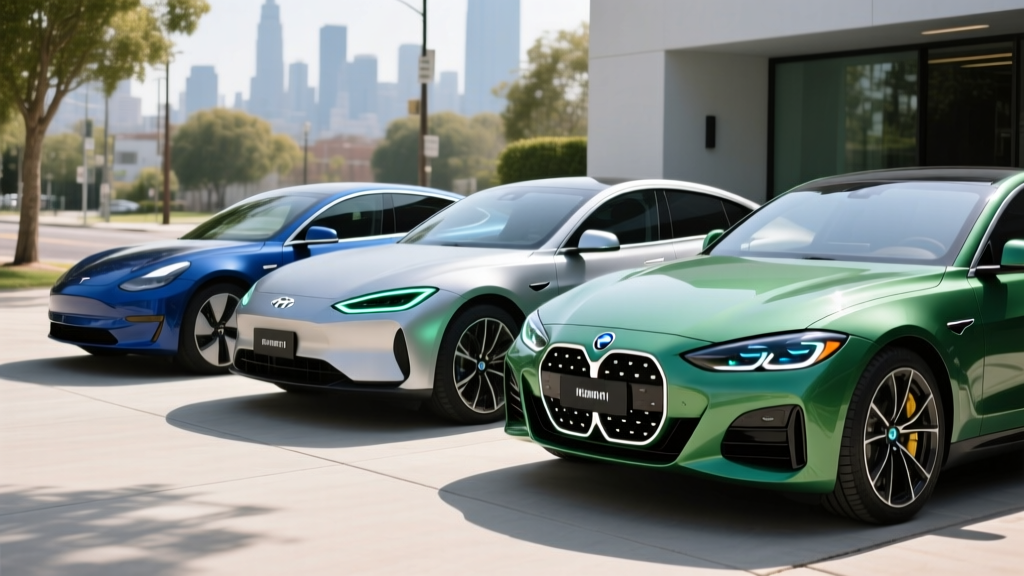
Against the Hyundai Ioniq 6 (EPA 361 mi, $39,450 base), the Model 3 offers a slightly longer real-world range advantage, faster Supercharger network access, and stronger software integration. Against the BMW i4 eDrive40 (EPA 307 mi, $52,200 base), the Model 3 wins on price and efficiency but loses on interior material quality and traditional controls. If Supercharger access and tech-forward ownership are priorities, the Model 3 remains the segment benchmark.
Does the black paint and interior affect resale value?
Black is a popular color for the Model 3 and typically holds value well in the used market. However, black paint shows swirl marks and scratches more visibly than white or silver, so paint protection film (PPF) or ceramic coating is a common owner investment (~$1,500–$3,000) to preserve the finish.
What safety ratings does the 2026 Model 3 carry?
The Model 3 earned a 5-Star Overall Safety Rating from NHTSA and top marks from IIHS. Standard active safety includes automatic emergency braking, blind-spot monitoring, and lane departure warning. The structural battery pack contributes to a very low center of gravity and strong rollover resistance.