Why Austin Drivers Are Choosing the 2026 Tesla Model Y
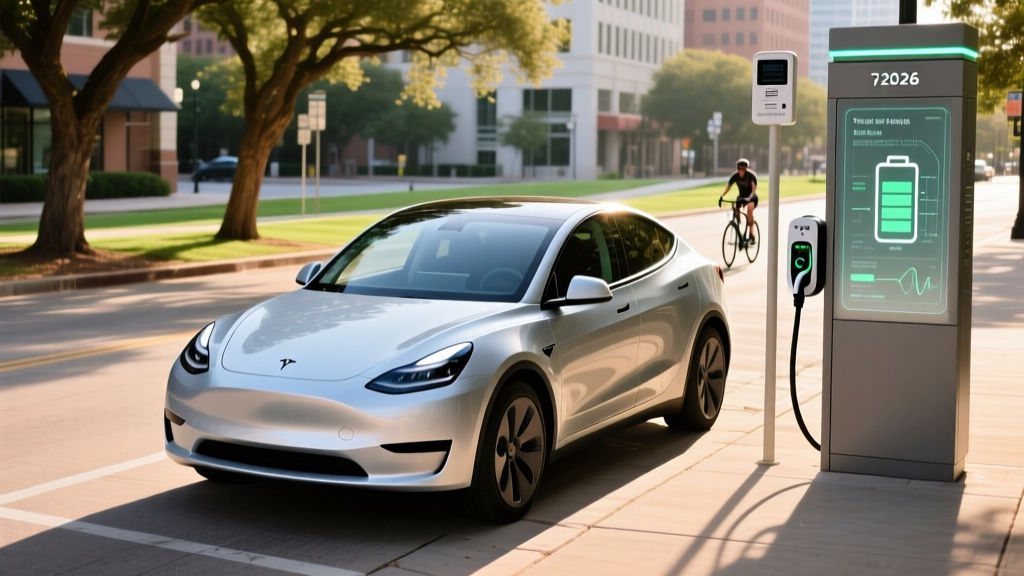
Search for "Tesla Road Austin TX" and you'll find a city that has become one of the most EV-dense metros in the United States. With Tesla's Gigafactory Texas producing vehicles locally, a robust Supercharger network blanketing the I-35 corridor, and year-round warm weather that preserves battery range, Austin is arguably the best city in America to own an electric vehicle. The 2026 Tesla Model Y remains the default choice for Austin commuters, families, and road-trippers — but is it still the right pick against a growing field of competitors?
This guide breaks down the 2026 Model Y with exact numbers: EPA range, charging speeds, real-world Texas efficiency, federal tax credit eligibility under current IRS §30D rules, and total cost of ownership for Austin-area drivers.
2026 Tesla Model Y: Key Specifications at a Glance
| Spec | Long Range AWD | Performance AWD | Rear-Wheel Drive |
|---|---|---|---|
| EPA Range | 320 miles | 295 miles | 260 miles |
| Battery (usable) | ~75 kWh (NMC) | ~75 kWh (NMC) | ~57.5 kWh (LFP) |
| Drivetrain | Dual-Motor AWD | Dual-Motor AWD | Single-Motor RWD |
| Horsepower | 384 hp | 456 hp | 295 hp |
| 0-60 mph | 4.8 sec | 3.5 sec | 6.6 sec |
| Max DC Fast Charge | 250 kW | 250 kW | 170 kW |
| 10-80% DC Charge Time | ~25 min | ~25 min | ~32 min |
| Level 2 Home Charge | 11.5 kW (~44 mi/hr) | 11.5 kW (~44 mi/hr) | 11.5 kW (~44 mi/hr) |
| MPGe (combined) | 122 MPGe | 111 MPGe | 133 MPGe |
| Efficiency | 28 kWh/100mi | 30 kWh/100mi | 25 kWh/100mi |
| Base MSRP | $44,990 | $49,990 | $39,990 |
| Cargo (behind 2nd row) | 30.2 cu ft | 30.2 cu ft | 30.2 cu ft |
| Cargo (seats folded) | 72.1 cu ft | 72.1 cu ft | 72.1 cu ft |
| Rear Legroom | 39.5 in | 39.5 in | 39.5 in |
| Battery Warranty | 8 yr / 120,000 mi | 8 yr / 120,000 mi | 8 yr / 100,000 mi |
| Vehicle Warranty | 4 yr / 50,000 mi | 4 yr / 50,000 mi | 4 yr / 50,000 mi |
Source: Tesla specifications; fueleconomy.gov for EPA data.
Real-World Range: What Austin Drivers Actually Get
Long Range AWD: EPA 320 mi → Expect ~280-300 mi mixed driving; ~260-275 mi sustained highway at 75 mph; ~310+ mi city/regen-heavy driving.
Performance AWD: EPA 295 mi → Expect ~250-270 mi mixed; ~230-250 mi highway.
RWD (LFP): EPA 260 mi → Expect ~230-245 mi mixed; ~210-225 mi highway.
Cold-weather note: Austin winters are mild (rarely below 35°F), so range loss is minimal — typically 5-10% on the coldest days. Drivers in North Texas or those making Panhandle road trips in January should budget 15-20% loss.
The Model Y's efficiency is among the best in its class. The RWD variant's LFP (lithium iron phosphate) battery sacrifices some energy density for longevity and lower cost, but its lighter curb weight helps it achieve the lineup's best MPGe rating. For Austin's stop-and-go traffic on MoPac and I-35, regenerative braking recovers meaningful energy, pushing real-world city range above EPA estimates in many cases.
On highway road trips — say Austin to Houston (165 miles) or Austin to Dallas (195 miles) — expect to arrive with roughly 30-40% battery remaining in the Long Range model, even at sustained 75-80 mph speeds with A/C running. This is comfortable territory with no range anxiety.
Charging Speeds: Supercharger, Home, and Austin Infrastructure
| Charging Level | Power (kW) | Miles Added per Hour | Typical Use Case |
|---|---|---|---|
| Level 1 (120V standard outlet) | ~1.4 kW | ~3-5 mi/hr | Emergency / overnight trickle |
| Level 2 (240V home wall connector) | 11.5 kW | ~44 mi/hr | Daily home charging |
| DC Fast Charge (V3 Supercharger) | Up to 250 kW | ~1,000+ mi/hr (peak) | Road trips; 10-80% in ~25 min |
| DC Fast Charge (V4 Supercharger) | Up to 250 kW (current vehicles) | Same as V3 | Newer stations; same vehicle-side limit |
Austin's Supercharger network is one of the strongest in the country. Key stations include the Domain, South Congress, Barton Creek, and multiple locations along I-35 north toward Round Rock and south toward San Marcos. Tesla's NACS (North American Charging Standard) connector is native — no adapter needed. For non-Tesla chargers (Electrify America, EVgo), a NACS-to-CCS adapter may be required depending on the station.
Charging curve reality: The Long Range and Performance models peak at 250 kW only between roughly 10-30% State of Charge. Above 50%, the rate tapers to ~100 kW; above 80%, it drops further to ~50 kW or less. This is why Tesla quotes 10-80% times rather than 0-100%. If you're arriving at a Supercharger with 5% battery, your first 15 minutes will add significantly more range than your last 15 minutes.
Home charging in Austin: A Tesla Wall Connector on a 60-amp circuit (48-amp continuous) delivers the full 11.5 kW. Most Austin homes with a 200-amp electrical panel can accommodate this without an upgrade. Installation typically costs $500-$1,500 if the panel is near the garage; $2,000-$4,000 if a longer conduit run or panel upgrade is needed. Austin Energy offers a residential EV rate plan that can reduce overnight charging costs significantly.
Pricing, Tax Credits, and Austin-Area Ownership Costs
| Trim | MSRP | Federal §30D Credit | Effective Price |
|---|---|---|---|
| Model Y RWD | $39,990 | $3,750 (partial credit, subject to sourcing) | ~$36,240 |
| Model Y Long Range AWD | $44,990 | $3,750 (partial credit, subject to sourcing) | ~$41,240 |
| Model Y Performance AWD | $49,990 | $3,750 (partial credit, subject to sourcing) | ~$46,240 |
Federal tax credit details (2026 rules): Under IRS §30D, the Model Y qualifies for a partial credit because its battery components and critical minerals do not fully meet domestic-sourcing thresholds that have tightened since 2024. The exact credit amount can shift as Tesla adjusts its supply chain. Key eligibility requirements:
- MSRP cap: SUVs/vans/pickups must be under $80,000 — all Model Y trims qualify.
- Income cap: Modified AGI must not exceed $150,000 (single), $225,000 (head of household), or $300,000 (joint).
- Point-of-sale transfer: You can apply the credit as a dealer discount at purchase rather than waiting for tax filing.
- Assembly: Model Y is assembled at Giga Texas (Austin), meeting North American final-assembly requirements.
Verify current credit eligibility at IRS.gov §30D before purchasing. Credit amounts and sourcing rules are subject to change. Consult a tax professional for your specific situation.
Austin Charging Cost vs. Gasoline
At Austin Energy's residential EV rate (~$0.08/kWh off-peak), fully charging a Long Range Model Y (75 kWh) costs roughly $6.00 for 320 miles of range — about $0.019 per mile. A comparable gas SUV getting 25 MPG at $3.10/gallon costs $0.124 per mile. Over 15,000 annual miles, that's $1,875 in fuel savings with the Model Y.
Performance, Interior, and Standout Technology
The 2026 Model Y continues to offer brisk acceleration that outpaces most gas-powered competitors in its price range. The Performance trim's 3.5-second 0-60 time is sports-car territory, while even the RWD model's 6.6-second sprint is adequate for highway merging and passing on Mopac Expressway.
Interior and cargo: The refreshed interior (introduced for the 2025 model year and carried forward) features improved material quality, ventilated front seats, ambient lighting, and a rear-seat touchscreen for climate and entertainment. Cargo space is generous at 30.2 cu ft behind the second row and 72.1 cu ft with seats folded — enough for Costco runs, camping gear, or airport luggage for a family of four. The front trunk (frunk) adds additional storage for charging cables and small items.
Infotainment: The 15.4-inch center touchscreen runs Tesla's proprietary OS with native navigation, streaming (Netflix, YouTube, Spotify while parked), and over-the-air updates. There is no Apple CarPlay or Android Auto — a dealbreaker for some buyers. Tesla's navigation is excellent and automatically routes through Superchargers on long trips, pre-conditioning the battery for optimal charge speed upon arrival.
Driver assistance: Basic Autopilot (adaptive cruise + lane centering) is standard. Full Self-Driving (Supervised) remains a $8,000 option or $99/month subscription. It is critical to understand that FSD is SAE Level 2 — the driver must remain fully attentive, hands on or near the wheel, and ready to take over at any moment. It is not autonomous driving.
Tesla Autopilot and FSD (Supervised) require continuous driver engagement. The system assists with steering, acceleration, and braking but does not replace the driver. Only Level 4 services (e.g., Waymo robotaxis) operate without a human driver. Never treat FSD as "self-driving."
Warranty, Reliability, and Long-Term Battery Outlook
Tesla's battery and drive unit warranty covers 8 years or 120,000 miles (whichever comes first) for Long Range and Performance models, and 8 years or 100,000 miles for the RWD. The warranty guarantees at least 70% battery capacity retention during the coverage period.
LFP vs. NMC chemistry: The RWD model uses an LFP (lithium iron phosphate) battery, which offers superior cycle life and can be charged to 100% daily without significant degradation concerns. The Long Range and Performance models use NMC (nickel manganese cobalt) chemistry, which provides higher energy density but benefits from daily charge limits of 80-90% for longevity. Austin's mild climate is an advantage here — extreme heat and cold accelerate battery degradation, and Austin avoids both for most of the year.
Real-world degradation data from Tesla's fleet suggests approximately 10-12% capacity loss after 150,000 miles for NMC packs, and potentially less for LFP. Replacement costs, should the battery fall outside warranty, currently range from $12,000-$16,000 depending on the pack — a significant expense, but one that very few owners face within the vehicle's typical lifespan.
Pros, Cons, and Competitor Comparison
- Class-leading Supercharger network access
- Excellent efficiency (25-30 kWh/100mi)
- Strong cargo capacity (72.1 cu ft max)
- Over-the-air updates improve the car over time
- Built locally at Giga Texas — supports local jobs
- Low operating cost vs. gas competitors
- No Apple CarPlay / Android Auto
- Ride quality firm on Austin's rougher roads
- FSD subscription is expensive and not truly autonomous
- Insurance premiums 15-25% higher than gas equivalents
- Partial federal tax credit (not full $7,500)
- Minimalist interior not for everyone
Model Y vs. Key Competitors
vs. Hyundai Ioniq 5: The Ioniq 5 offers 800V architecture (faster peak charging at 350 kW on compatible chargers) and a more comfortable ride, but Austin's Electrify America station density is lower than Tesla's Supercharger network. The Model Y wins on charging convenience in Texas.
vs. Ford Mustang Mach-E: The Mach-E offers CarPlay and a more traditional driving feel, but its efficiency and range trail the Model Y. Ford's BlueCruise is competitive with Autopilot for hands-free highway driving on approved roads.
vs. Rivian R1S: The R1S is a larger, more capable off-road SUV with three rows, but starts above $75,000. Different buyer profile entirely.
Who Should Buy the 2026 Tesla Model Y in Austin?
- You have home charging access (garage or driveway with 240V capability)
- You road-trip frequently within Texas and want reliable DC fast-charging
- You want the lowest per-mile operating cost in a crossover SUV
- You value over-the-air software improvements and a strong resale market
- You need Apple CarPlay or prefer traditional dealership service
- You want a plush, quiet ride over sporty efficiency
- You cannot install a Level 2 charger at home and lack workplace charging
Frequently Asked Questions
What is the real-world range of the Tesla Model Y in Austin?
Expect 280-300 miles mixed driving in the Long Range AWD, with highway range around 260-275 miles at 75 mph. Austin's mild climate means minimal cold-weather range loss compared to northern states.
How fast does the Model Y charge at home and on the road?
At home on a Level 2 Wall Connector (11.5 kW), you add about 44 miles per hour — a full overnight charge. At a V3 Supercharger, 10-80% takes approximately 25 minutes for Long Range and Performance models.
How much does the Model Y cost after federal tax credits?
As of 2026, the Long Range AWD starts at $44,990 with a partial $3,750 federal credit, bringing the effective price to approximately $41,240. Verify eligibility on IRS.gov as sourcing rules change.
Does the Tesla Model Y qualify for the federal EV tax credit?
Yes, partially. The Model Y qualifies for a reduced credit (currently $3,750) because not all battery components meet the full domestic-sourcing thresholds required for the maximum $7,500. Income caps and MSRP limits also apply.
Is the Model Y worth buying over competitors in 2026?
For Austin drivers who prioritize charging infrastructure, efficiency, and local manufacturing, the Model Y remains the strongest all-around electric crossover. If CarPlay support, ride comfort, or 800V ultra-fast charging matter more, consider the Hyundai Ioniq 5 or Ford Mustang Mach-E.
Is Tesla's Full Self-Driving actually self-driving?
No. FSD (Supervised) is an SAE Level 2 driver-assistance system. The driver must remain fully engaged and is legally responsible for the vehicle at all times. It is not autonomous.