The Short Answer: No Oil Changes, Ever
Electric cars do not need oil changes. Battery-electric vehicles (BEVs) have no internal combustion engine, which means no engine oil, no oil filter, and no scheduled oil changes — ever. This single fact eliminates one of the most frequent and annoying maintenance tasks gas-car owners face, saving roughly $35–$75 per visit, or $150–$300+ annually depending on your driving habits.
However, EVs are not maintenance-free. They still require attention to tires, brakes, cabin air filters, windshield washer fluid, battery coolant, and reduction-gear lubricant. The total annual maintenance bill for a typical EV runs $300–$500, compared to $900–$1,200 for a comparable gasoline sedan, according to fueleconomy.gov and industry data.
Why EVs Don't Use Engine Oil
Engine oil exists to lubricate the hundreds of moving parts inside an internal combustion engine (ICE): pistons, crankshafts, camshafts, valves, and timing chains. A typical 4-cylinder gas engine contains over 200 moving components that generate intense friction and heat, requiring constant oil circulation and periodic replacement as the oil degrades.
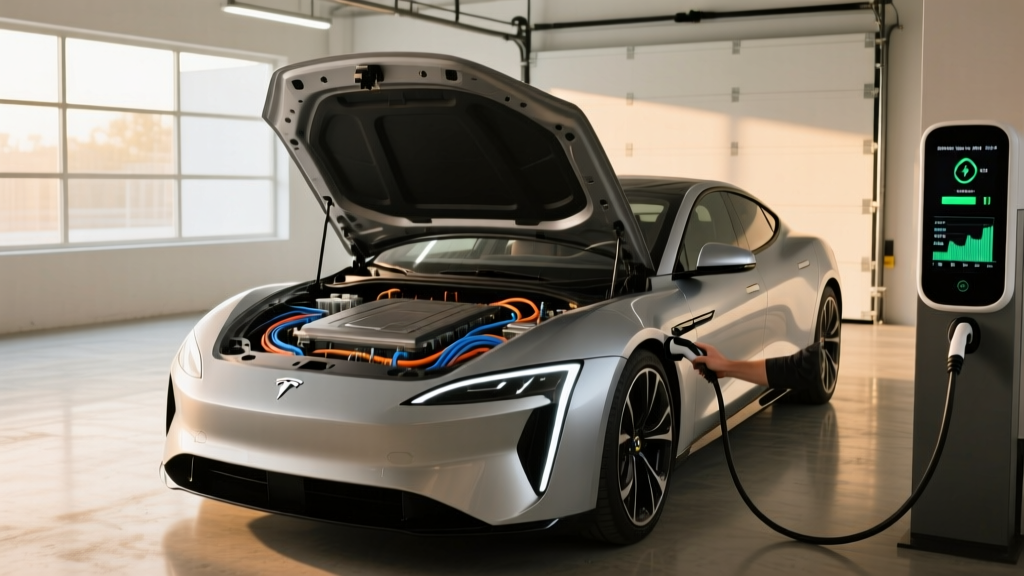
An electric motor is radically simpler. It has essentially one moving part — the rotor spinning inside the stator — with no metal-on-metal contact. There is no combustion, no exhaust, no piston slap, and no carbon buildup. The electric motor in a Tesla Model 3, Hyundai Ioniq 5, or Ford Mustang Mach-E requires zero lubrication from the owner.
What EVs do have is a reduction gear (sometimes called a single-speed transmission) that transfers torque from the motor to the wheels. This gear unit contains a small amount of specialized lubricant — typically 1–2 liters of gear oil — but it is sealed and designed to last the life of the vehicle. Some manufacturers recommend a gear-fluid inspection or exchange at 100,000–150,000 miles, but this is a rare, low-cost service, not a recurring oil change.
EV vs Gas: Full Maintenance Cost Breakdown
To put the oil question in context, here's a side-by-side look at what you actually pay to keep each type of vehicle running over five years and 75,000 miles of mixed driving.
| Maintenance Item | BEV (e.g., Tesla Model 3 RWD) | Gas Sedan (e.g., Toyota Camry LE) |
|---|---|---|
| Engine oil & filter changes | $0 | $750–$1,125 (15–20 changes at $35–$75 ea.) |
| Transmission fluid | $0–$80 (gear inspection) | $150–$250 (ATF exchange at 60k mi) |
| Brake pads & rotors | $0–$200 (regen extends life to 100k+ mi) | $600–$1,000 (2–3 pad replacements) |
| Coolant flush | $100–$150 (battery thermal loop, ~5 yr) | $100–$150 |
| Cabin air filter | $80–$120 (every 2 yr / 20k mi) | $80–$120 |
| Spark plugs | $0 | $200–$400 (at 60k mi for iridium) |
| Air intake filter | $0 | $60–$100 |
| Tire rotation & replacement | $800–$1,200 (EVs wear tires faster due to torque & weight) | $600–$900 |
| Wiper blades, washer fluid, bulbs | $100–$150 | $100–$150 |
| Total estimated 5-yr cost | $1,260–$1,980 | $2,640–$4,195 |
Net 5-year maintenance savings with a BEV: roughly $1,000–$2,200. The U.S. Department of Energy has estimated that BEV maintenance costs average about 6.1 cents per mile versus 10.1 cents per mile for gasoline vehicles — a 40% reduction.
What Fluids and Maintenance Do EVs Actually Require?
While you'll never visit a quick-lube shop for an oil change, EVs still depend on several fluids and wear items. Here's the full list:
Battery Coolant (Thermal Management Fluid)
The lithium-ion battery pack operates within a narrow temperature window — ideally 60–80°F for longevity. A liquid cooling/heating loop circulates glycol-based coolant through channels in the battery. Most manufacturers specify a coolant flush every 5 years or 100,000–150,000 miles. Cost: $100–$200 at a dealer. Neglecting this can accelerate battery degradation.
Reduction Gear Lubricant
The single-speed reduction gear between motor and axle uses a small quantity of gear oil. This is typically "lifetime" fluid, but some manufacturers (Hyundai/Kia, for example) recommend inspection at high mileage. Replacement, if needed, costs $50–$100.
Brake Fluid
EVs use conventional hydraulic brakes, and brake fluid absorbs moisture over time. Expect a flush every 2–3 years at $80–$120. Regenerative braking significantly reduces pad and rotor wear — many EV owners report original brake pads lasting 100,000+ miles — but the fluid itself still degrades.
Windshield Washer Fluid
Same as any car. Fill as needed.
Tires
This is the one area where EVs can cost more than gas cars. Electric motors deliver instant torque from 0 RPM, and EVs are typically 500–1,000 lbs heavier than comparable gas vehicles due to the battery pack. Combined, this accelerates tread wear by 20–30%. Budget for tire replacement every 30,000–40,000 miles rather than 50,000+. Many owners opt for EV-specific tires (e.g., Michelin Pilot Sport EV, Hankook iON evo) designed with reinforced sidewalls and low rolling resistance. Expect $800–$1,400 for a set of four.
Cabin Air Filter
Replace every 15,000–20,000 miles or every 2 years. Cost: $30–$60 for the part if you DIY, $80–$120 at a dealer.
12V Auxiliary Battery
Every EV still has a conventional 12-volt battery that powers the computers, lights, and door locks. These last 3–5 years and cost $150–$300 to replace. If the 12V dies, the car won't start — even if the main traction battery is full. This catches many new EV owners off guard.
Hybrids and PHEVs: The Middle Ground on Oil
It's worth clarifying: while pure BEVs need zero oil, hybrids (HEVs) and plug-in hybrids (PHEVs) still require regular oil changes because they have a gasoline engine. However, because the electric motor shares the workload, the engine runs fewer miles, and some owners can stretch oil-change intervals slightly. A Toyota RAV4 Prime PHEV or Honda CR-V Hybrid still needs oil every 5,000–10,000 miles — you simply can't eliminate it.
| Powertrain | Oil Changes? | Annual Maintenance Cost (est.) | Example Models (2026) |
|---|---|---|---|
| Battery Electric (BEV) | No | $300–$500 | Tesla Model 3, Hyundai Ioniq 5, Chevy Equinox EV |
| Plug-in Hybrid (PHEV) | Yes (every 5k–10k mi) | $500–$800 | Toyota RAV4 Prime, Jeep Wrangler 4xe |
| Hybrid (HEV) | Yes (every 5k–10k mi) | $500–$800 | Toyota Prius, Honda Accord Hybrid |
| Gasoline (ICE) | Yes (every 5k–7.5k mi) | $700–$1,200 | Toyota Camry, Honda Civic |
Common EV Maintenance Myths — Busted
| Myth | Fact |
|---|---|
| "EVs are completely maintenance-free." | False. Tires, brakes, coolant, cabin filters, washer fluid, and the 12V battery all need attention. But total upkeep is 40–50% cheaper than gas. |
| "You need to change the oil in an electric car." | BEVs have no engine oil. The reduction gear has sealed lubricant that rarely needs service. |
| "EV batteries need regular fluid top-offs." | Modern EV batteries use sealed liquid cooling loops. There's no user-serviceable fluid to check or fill. |
| "EV brakes wear out faster." | The opposite. Regenerative braking handles most deceleration, often pushing brake-pad life past 100,000 miles. Brake fluid still needs periodic flushing, though. |
| "EV tires are the same as gas-car tires." | EVs are heavier and produce instant torque. Standard tires wear faster. EV-optimized tires with higher load ratings and low rolling resistance are strongly recommended. |
| "Dealers overcharge for EV maintenance." | Most EV maintenance is simple: cabin filter, tire rotation, fluid top-off. Many tasks are DIY-friendly, and independent EV shops are increasingly common. |
Real-World Ownership Considerations Before You Buy
The maintenance savings are real, but a smart EV purchase decision goes beyond oil. Here's what first-time buyers should weigh:
Home Charging Access
Over 80% of EV charging happens at home. A Level 2 (240V) home charger adds 25–44 miles of range per hour of charging (at 7.2–11.5 kW), meaning an overnight session fully replenishes most batteries. Installation costs $500–$2,000 depending on your electrical panel — if you need a 200-amp panel upgrade, add $1,500–$3,000. If you live in an apartment or lack dedicated parking, public charging becomes your primary option, which is more expensive ($0.30–$0.60/kWh at DC fast chargers vs. $0.12–$0.18/kWh at home) and less convenient.
Cold-Weather Range Loss
Lithium-ion batteries lose efficiency in cold temperatures. In sub-freezing conditions, expect 15–30% less range than the EPA sticker. A vehicle rated for 310 miles EPA may deliver 220–260 miles on a 20°F winter highway drive. A heat pump (standard on many 2026 models including the Ioniq 5, Model 3, and Equinox EV) mitigates cabin-heating energy draw but doesn't eliminate the loss entirely. Preconditioning the battery while plugged in helps preserve range and charging speed.
Insurance Costs
EV insurance premiums run 10–25% higher than comparable gas cars, driven by higher repair costs (especially battery replacement after collision) and greater vehicle value. Average annual EV insurance: $1,800–$2,400 depending on model, state, and driving record. Always get quotes before purchasing.
Upfront Price and Tax Credits
EVs still carry a higher sticker price than comparable gas vehicles, though the gap is narrowing. The federal §30D tax credit can offset up to $7,500 for new EVs, but eligibility depends on MSRP caps ($55,000 for sedans, $80,000 for SUVs/trucks), buyer income limits ($150k single / $300k joint AGI), and battery critical-mineral and component sourcing requirements. The credit can now be transferred to the dealer at point of sale as an instant discount. Verify current-year eligibility on irs.gov before relying on the credit in your budget.
Decision Framework: Is an EV Right for Your Maintenance Budget?
Choose a BEV if:
- You want to eliminate oil changes and reduce annual maintenance by $500–$800+
- You have access to home or workplace Level 2 charging
- Your daily commute is under 250 miles round-trip (covers 95%+ of US drivers)
- You plan to keep the car 5+ years to offset the higher purchase price with fuel and maintenance savings
- You qualify for the §30D tax credit or your state offers EV rebates
Choose a PHEV if:
- You want electric-only commuting (25–45 miles) but need gas flexibility for road trips
- You lack reliable home charging and don't want to depend on public infrastructure
- You accept oil changes as a trade-off for zero range anxiety
Stick with gas or hybrid if:
- You regularly tow heavy loads (trailers, boats) where EV range drops 40–50%
- You live in an area with minimal public charging and no home charging option
- Your budget can't absorb the higher upfront cost even after incentives
Frequently Asked Questions
Do Teslas need oil changes?
No. Tesla Model 3, Model Y, Model S, and Model X are all battery-electric vehicles with no engine oil. Tesla's recommended service schedule includes cabin air filter replacement, tire rotation, brake fluid check, and A/C desiccant bag replacement — but never an oil change.
Does an electric car need any fluid at all?
Yes. EVs use battery coolant, brake fluid, windshield washer fluid, and reduction gear lubricant. None of these require frequent changes like engine oil. Coolant flushes happen every ~5 years; brake fluid every 2–3 years.
How often do you service an electric car?
Most manufacturers recommend a basic inspection every 12 months or 12,000–15,000 miles. This typically covers tire rotation, cabin filter replacement, brake inspection, and fluid level checks. Total annual service cost is usually $200–$400.
Do electric cars last as long as gas cars?
EV powertrains have far fewer moving parts than gas engines, which theoretically improves longevity. Federal law mandates that EV batteries carry a warranty of at least 8 years / 100,000 miles (10 years / 150,000 miles in CARB states). Real-world data shows most modern NMC and LFP batteries retain 85–92% capacity at 150,000 miles. The rest of the vehicle (suspension, interior, electronics) ages similarly to any car.
What's the most expensive maintenance on an EV?
Tires. Due to instant torque and higher vehicle weight, EV tires wear 20–30% faster than on gas cars. Budget $800–$1,400 every 30,000–40,000 miles for a quality set. The second potential high-cost item is out-of-warranty battery replacement, which runs $5,000–$15,000+ depending on pack size — but this is rare within the first 150,000 miles for modern chemistries.
Can I do my own EV maintenance?
Yes, for basics. Cabin air filter replacement, tire rotation (if you have a jack and torque wrench), windshield washer fluid, and wiper blades are all owner-serviceable. Coolant flushes and brake fluid changes are best left to professionals due to the high-voltage system. Never open or tamper with the orange-shielded high-voltage components — they carry 400–800V and can be lethal.