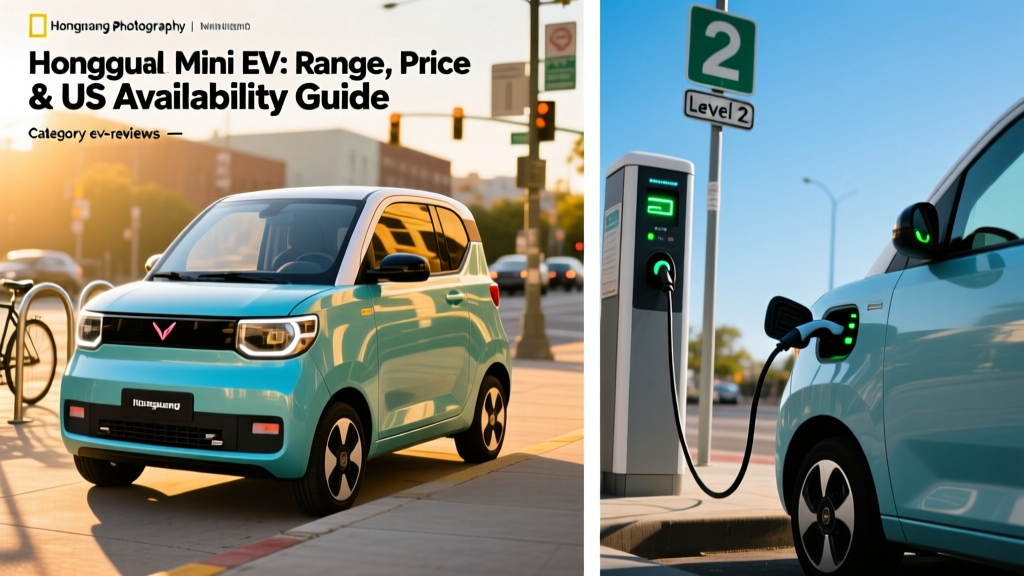
Can You Buy the Hongguang Mini EV in the United States?
Short answer: No. The Wuling Hongguang Mini EV — one of the world's best-selling electric vehicles by volume — is not sold, certified, or homologated for the US market as of 2026. General Motors (which holds a stake in SAIC-GM-Wuling, the joint venture that produces it) does not import it, and the vehicle does not meet NHTSA Federal Motor Vehicle Safety Standards (FMVSS) required for street-legal sale in the United States.
If you've seen this micro-EV trending on social media and want to know what it actually offers — and what US-legal alternatives exist — this guide breaks down the real specs, the ownership economics, and practical substitutes you can actually buy.
What Is the Hongguang Mini EV? A Spec Breakdown
The Wuling Hongguang Mini EV is a two-door, four-seat micro electric vehicle produced by SAIC-GM-Wuling, a joint venture between China's SAIC Motor, General Motors, and Liuzhou Wuling Motors. Launched in China in 2020, it became the best-selling EV in China by unit volume within months, largely due to an ultra-low starting price equivalent to roughly $4,500–$7,000 USD depending on trim and model year.
Here are the key specifications based on the most recent generation available in China (2024–2025 Macaron and Gameboy editions):
| Specification | Base Model | Macaron / Gameboy Trim |
|---|---|---|
| Battery Capacity | 9.3 kWh (LFP) | 13.9–26.7 kWh (LFP) |
| CLTC Range | ~120 km (~75 mi) | 170–300 km (~105–186 mi) |
| Estimated EPA-Equivalent Range | ~55–60 mi | ~80–145 mi |
| Motor Output | 20 kW (27 hp) | 30–50 kW (40–67 hp) |
| Top Speed | ~100 km/h (62 mph) | ~100–120 km/h (62–75 mph) |
| 0–50 km/h (0–31 mph) | ~5.2 seconds | ~3.5–4.5 seconds |
| AC Charging (Level 2) | ~1.5–2 kW | ~3.3–6.6 kW |
| DC Fast Charging | Not available | Optional on Gameboy (est. ~15 kW peak) |
| 10–80% Charge Time (Level 2) | ~4–5 hours | ~2.5–4 hours |
| Length × Width × Height | 2,920 × 1,493 × 1,621 mm | 3,061 × 1,520 × 1,659 mm |
| Curb Weight | ~665 kg (1,466 lb) | ~750–850 kg (1,653–1,874 lb) |
| Price (China MSRP) | ~¥32,800 (~$4,500) | ~¥49,800–¥72,800 (~$6,800–$10,000) |
Important context on range figures: China's CLTC (China Light-Duty Vehicle Test Cycle) range ratings are notably more generous than the US EPA cycle. As a rule of thumb, multiply CLTC range by roughly 0.75–0.80 to estimate an EPA-equivalent figure. In real-world highway or cold-weather driving, expect a further 15–30% reduction from even the EPA-equivalent estimate. A 170 km CLTC rating translates to roughly 80 miles of realistic mixed-use driving in moderate temperatures.
Why the Hongguang Mini EV Isn't Available in the US
Several regulatory and practical barriers prevent this vehicle from reaching American driveways:
FMVSS Compliance
Every vehicle sold new in the US must comply with over 50 Federal Motor Vehicle Safety Standards administered by NHTSA. These cover crashworthiness, airbags, seatbelts, lighting, electronic stability control, and more. The Hongguang Mini EV was engineered for Chinese GB safety standards, which differ substantially from FMVSS. Retrofitting for compliance would require significant structural redesign — economically unviable for a vehicle in this price bracket.
25% Import Tariff on Chinese Vehicles
US tariffs on Chinese-manufactured automobiles, which have escalated since 2024 and now include additional duties under Section 301 trade provisions, add a 25% or higher surcharge on top of the standard 2.5% auto import duty. This alone would push the landed cost of a base Hongguang Mini EV well above its value proposition.
No US Dealer or Service Network
Even if imported through a gray-market loophole (such as the 25-year import rule, which doesn't apply to a vehicle this new), you'd have no authorized service centers, no warranty support, no parts supply chain, and no US-spec recall coverage. Insurance would be difficult or impossible to obtain at standard rates.
Federal Tax Credit Ineligibility
Under IRS §30D rules for 2026, the clean vehicle credit requires the vehicle to be assembled in North America (with limited exceptions), meet battery-component and critical-mineral sourcing requirements, fall under MSRP caps ($55,000 for sedans, $80,000 for SUVs/trucks), and the buyer must meet income thresholds. A Chinese-market micro-EV fails the North American assembly requirement outright.
Hongguang Mini EV vs. US-Legal Micro-EV Alternatives
If the appeal is an ultra-compact, affordable electric city car, here's how the Hongguang compares to vehicles you can actually purchase and register in the United States:
| Specification | Hongguang Mini EV (China) | 2025 Chevrolet Bolt EV | 2025 Nissan LEAF S | Neighborhood EV (LSV class)* |
|---|---|---|---|---|
| EPA Range | ~55–145 mi (est.) | 259 mi | 212 mi | 30–50 mi |
| Battery | 9.3–26.7 kWh LFP | 65 kWh (est.) | 60 kWh | 5–15 kWh |
| Peak Charge Rate | ~2–6.6 kW AC | ~115 kW DC | ~100 kW DC | ~1–3 kW AC |
| Top Speed | 62–75 mph | 93 mph | 94 mph | 25 mph (LSV legal limit) |
| Highway Capable? | Yes (in China) | Yes | Yes | No (roads ≤35 mph only) |
| US MSRP | N/A | ~$28,900 | ~$29,190 | $8,000–$15,000 |
| FMVSS Compliant | No | Yes | Yes | LSV standards only |
| §30D Tax Credit Eligible | No | Up to $7,500 (if sourcing rules met) | Likely no (Japan assembly) | No |
*Low-Speed Vehicles (LSVs) are federally limited to 25 mph and can only operate on roads with speed limits of 35 mph or below (state laws vary). They are not a substitute for a full-size passenger vehicle.
Real Ownership Costs: What a US Equivalent Actually Costs
Since the Hongguang isn't available, let's model the five-year cost of owning the closest US-legal equivalent — a compact EV like the 2025 Chevrolet Bolt EV — compared to a similarly priced gas subcompact (e.g., 2025 Mitsubishi Mirage at ~$18,000 MSRP, 39 MPG combined):
| Cost Category (5 Years) | Compact EV (~$29,000 MSRP) | Gas Subcompact (~$18,000 MSRP) |
|---|---|---|
| Purchase Price (after incentives) | ~$21,500 (with $7,500 §30D credit, if eligible) | $18,000 |
| Fuel / Electricity (12,000 mi/yr) | ~$3,600 (at $0.14/kWh, 3.5 mi/kWh) | ~$6,500 (at $3.20/gal, 39 MPG) |
| Maintenance | ~$1,200 (tires, cabin filter, brake fluid) | ~$3,000 (oil, filters, brakes, belts) |
| Insurance (avg.) | ~$7,500 | ~$6,000 |
| Estimated Depreciation | ~$10,000 | ~$8,500 |
| 5-Year Total | ~$43,800 | ~$42,000 |
Key takeaway: At the compact-EV price point, total five-year costs are roughly comparable to a budget gas car, with the EV pulling ahead in years 6–10 as fuel and maintenance savings compound and the gas car requires more major repairs. The Hongguang's China pricing of ~$5,000–$10,000 would shift this math dramatically — but that pricing simply doesn't translate to a US-legal, FMVSS-compliant vehicle.
Common Misconceptions About the Hongguang Mini EV
| Myth | Fact |
|---|---|
| "I can import one through Alibaba and drive it legally." | Importing a non-FMVSS-compliant vehicle for on-road use is prohibited by NHTSA. Customs and Border Protection will seize non-compliant vehicles at the port. The 25-year exemption doesn't apply to current-production vehicles. |
| "It has 186 miles of range — that's great for the price!" | That's the CLTC rating on the top-trim Gameboy edition. The EPA-equivalent estimate is ~145 mi, and real-world highway or cold-weather driving could reduce that to ~100–115 mi. The base model's realistic range is closer to 55 miles. |
| "GM could just badge it and sell it here." | GM would need to redesign the structure, add FMVSS-compliant airbags, ESC, lighting, crash structures, and certify the vehicle — a process costing hundreds of millions of dollars. The resulting price would far exceed the current China MSRP, destroying the value proposition. |
| "It qualifies for the $7,500 tax credit." | The §30D credit requires North American final assembly, battery-sourcing compliance, MSRP caps, and buyer income limits. A Chinese-built vehicle fails the assembly requirement immediately. |
| "It's basically a golf cart." | The Hongguang Mini EV is a full passenger vehicle in China (not an LSV), with a top speed of 62–75 mph and highway capability. It's far more substantial than a Neighborhood Electric Vehicle — but still doesn't meet US safety standards. |
Decision Framework: What Should You Actually Buy?
If You Want Ultra-Low-Cost Electric Mobility in the US:
- If your budget is under $15,000: Look at the used EV market — a 2019–2022 Chevrolet Bolt EV, Nissan LEAF, or BMW i3 can be found for $10,000–$16,000 with 100–240 miles of range. Note that the §25E used clean vehicle credit offers up to $4,000 (30% of sale price, max $4,000) for qualified used EVs purchased from a dealer, subject to income caps and vehicle price limits ($25,000 max).
- If your budget is $25,000–$35,000: The new Chevrolet Bolt EV (~$28,900) or Hyundai Kona Electric (~$33,000) offers 250+ miles of EPA range, DC fast charging, full FMVSS compliance, and potential §30D credit eligibility.
- If you only need a neighborhood runabout (no highways): A street-legal LSV/NEV from brands like GEM, Arcimoto (if available), or imported Chinese LSVs that meet FMVSS 500 low-speed vehicle standards may work — but understand the 25 mph speed limit and road restrictions.
- If you were hoping the Hongguang would come to the US: Monitor SAIC-GM-Wuling announcements and GM's global small-EV strategy. GM's Ultium-based affordable EV platform (targeting ~$25,000 MSRP) is the most likely path to a US-legal micro-EV, but no specific Hongguang-derived product has been announced for North America as of early 2026.
What First-Time EV Buyers Should Know (Regardless of Model)
If the Hongguang Mini EV sparked your interest in EV ownership, here are the practical realities to plan for with any electric vehicle in the US:
Home Charging Is Non-Negotiable for Most Owners
Over 80% of EV charging happens at home. If you can install a Level 2 charger (240V, 32–48A), you'll wake up to a full battery daily and rarely visit public chargers. Installation costs typically range from $800–$2,500 for the charger and electrician work, potentially more if your panel needs an upgrade. Without home charging, EV ownership becomes significantly less convenient — plan for reliable public charging access before buying.
Cold Weather Reduces Range 15–30%
LFP batteries (like those in the Hongguang and many budget EVs) are particularly sensitive to cold temperatures. If you live in a region with sustained sub-freezing winters, budget for meaningful range loss. A vehicle rated at 250 miles EPA may deliver 175–210 miles in 20°F weather, especially with cabin heating. Heat pumps help but don't eliminate the loss.
Charging Speed Matters More Than You Think
The Hongguang's ~2–6.6 kW AC-only charging means a full charge takes 4–10+ hours. For context, a US EV with 115+ kW DC fast charging capability can go from 10–80% in roughly 20–30 minutes at a compatible station. For road trips or apartment dwellers relying on public charging, DC fast-charge capability is essential.
Insurance Costs Are Typically Higher
EV insurance premiums run 10–25% higher than comparable gas vehicles due to higher repair costs (especially battery-related claims) and greater total-loss write-off rates. Get quotes before committing to a purchase.
Frequently Asked Questions
Is the Hongguang Mini EV sold anywhere outside China?
Yes. SAIC-GM-Wuling exports the Hongguang Mini EV (sometimes branded as the Wuling Air EV or MG Comet EV) to select markets including Indonesia, India, and parts of Southeast Asia. However, none of these export versions are homologated for US, Canadian, or European Union sale due to differing safety and emissions certification requirements.
Could I import one as a show vehicle or off-road use only?
NHTSA's import regulations are strict: vehicles not conforming to FMVSS cannot be imported for on-road use, even with restrictions. You may encounter "off-road use only" claims from gray-market importers, but these carry significant legal and liability risk. Consult NHTSA's import guidelines before attempting any import.
What's the cheapest new EV I can actually buy in the US in 2026?
The 2025/2026 Chevrolet Bolt EV starts around $28,900 before incentives and remains the most affordable new full-range EV available. If the §30D credit applies (up to $7,500, subject to battery sourcing, income, and MSRP rules), the effective price drops to roughly $21,400 — still far above Hongguang pricing but with 259 miles of EPA range, DC fast charging, and full US safety compliance.
Will GM ever bring a Hongguang-style micro-EV to America?
GM has discussed affordable EVs built on its Ultium platform targeting sub-$30,000 pricing. However, no specific micro-EV derived from the Hongguang platform has been announced for North America. The economics of adapting a $5,000 Chinese-market vehicle for US compliance would likely push the final price well above $20,000, narrowing the gap with existing compact EVs that offer far more range and capability.
How does LFP battery chemistry affect ownership?
The Hongguang uses lithium iron phosphate (LFP) cells, which is the same chemistry used in the standard-range Tesla Model 3 and many BYD vehicles. LFP offers longer cycle life (~3,000–5,000 cycles vs. ~1,000–2,000 for NMC), better thermal stability, and lower cost — but trades off lower energy density (heavier for the same kWh) and worse cold-weather performance. For a city car in a warm climate, LFP is an excellent choice; for highway driving in cold climates, the range penalty is more noticeable.