The Tesla Rent Program Question: Why Test Before You Commit?
Tesla doesn't operate a traditional rental fleet, but the Tesla rent program concept — short-term access to a Model 3 or Model Y through third-party platforms, corporate leases, and Tesla's own trial-drive alternatives — has become a go-to strategy for buyers who want real-world data before signing a purchase agreement. And it's smart. The 2026 Tesla Model 3 Long Range AWD is a fundamentally different car than the 2022 version it replaced: new suspension, new interior, new battery chemistry options, and a Supercharger network that now serves rival brands. Before you put down $42,490 (or skip the purchase entirely and rent), here's every number that matters.
Range, Efficiency, and What the EPA Sticker Doesn't Tell You
Real-World Expectation: ~310–330 miles on mixed highway driving at 70–75 mph; ~250–275 miles in sustained sub-30°F weather with cabin heat. The RWD base model with LFP chemistry drops to an EPA 272 miles and loses range more sharply in cold weather due to LFP's thermal characteristics.
The 2026 Model 3 Long Range AWD carries a 75 kWh usable battery pack (NMC chemistry), delivering an EPA-rated 132 MPGe combined (approximately 25 kWh/100 mi). That efficiency figure is among the best in the segment — the Hyundai Ioniq 6 SE Long Range hits 140 MPGe but with less cargo room, and the BMW i4 eDrive40 sits at 109 MPGe with a higher curb weight.
Highway efficiency matters more than city efficiency for road-trip planning. At sustained 75 mph speeds on flat terrain, expect consumption around 27–29 kWh/100 mi, which translates to roughly 260–280 miles of usable range before you'd want to stop. In stop-and-go city driving, regenerative braking recovers meaningful energy, and 340+ miles is achievable in moderate temperatures.
| Trim | Battery (kWh usable) | Chemistry | EPA Range | MPGe Combined | kWh/100 mi |
|---|---|---|---|---|---|
| RWD (Base) | 60 | LFP | 272 mi | 132 | 25 |
| Long Range AWD | 75 | NMC | 363 mi | 132 | 25 |
| Performance | 75 | NMC | 315 mi | 113 | 30 |
Charging Speed: DC Fast, Level 2, and the Supercharger Advantage
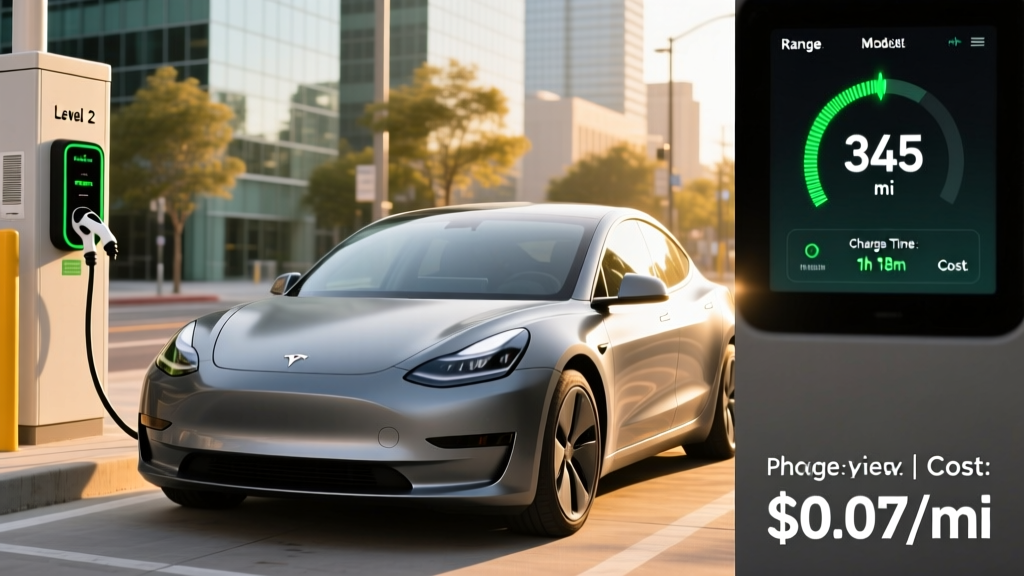
Charging speed is where Tesla's vertical integration still shows its teeth. The 2026 Model 3 Long Range AWD peaks at 250 kW on DC fast charge at a V3 or V4 Supercharger. In controlled testing with a preconditioned battery, the 10–80% charge takes approximately 25–28 minutes. The charge curve is aggressive early: you'll see 200+ kW sustained up to roughly 40% state of charge (SoC), then a gradual taper through 60%, and a steep taper above 80%. This is why Tesla's nav-based battery preconditioning matters — arriving at a Supercharger without preconditioning can add 10–15 minutes to your stop in cold weather.
| Level | Power | Speed (mi/hr added) | Notes |
|---|---|---|---|
| Level 1 (120V household) | ~1.4 kW | ~4–5 mi/hr | Emergency/trickle only |
| Level 2 (240V, 32A Mobile Connector) | 7.7 kW | ~30 mi/hr | Standard outlet adapter included |
| Level 2 (240V, 48A Wall Connector) | 11.5 kW | ~44 mi/hr | Requires hardwired 60A circuit |
| DC Fast (V3 Supercharger) | 250 kW peak | ~170 mi in 15 min | 10–80% in ~25–28 min |
| DC Fast (CCS adapter, 3rd-party) | ~150–250 kW | Varies by station | CCS adapter included with new vehicles |
Home charging is the backbone of daily ownership. A Tesla Wall Connector ($420 for the unit) installed on a 60-amp dedicated circuit adds roughly 44 miles of range per hour of charging — enough to fully replenish a Long Range battery in about 8–9 hours. Total installation cost ranges from $800–$2,000 depending on panel proximity and local permitting. If your electrical panel is at capacity, a panel upgrade to 200A can add $1,500–$3,000.
Tesla's NACS connector is now the industry standard, with Ford, GM, Rivian, and others adopting it. The Model 3 ships with native NACS — no adapter needed at Superchargers, and a CCS adapter is included for legacy Electrify America or EVgo stations.
Performance, Drivetrain, and Daily Drivability
The 2026 Model 3 lineup spans three trims with meaningfully different characters:
- RWD (Base): 283 hp, single rear motor, 0–60 mph in 5.8 seconds. Adequate for commuting, but the LFP battery's lower energy density means less cargo weight margin.
- Long Range AWD: 384 hp, dual motor all-wheel drive, 0–60 mph in 4.2 seconds. The volume seller and the best all-around value.
- Performance: 510 hp, dual motor with track-oriented tuning, 0–60 mph in 2.9 seconds. Includes high-performance brakes, 20" wheels, and lowered suspension.
The "Highland" refresh (introduced for 2024, carried into 2026) transformed the Model 3's ride quality. The previous generation's harshness over expansion joints is gone — replaced by frequency-selective dampers, acoustic glass, and ventilated front seats. It's now genuinely competitive with the BMW i4 and Mercedes EQB on refinement, while undercutting both on price.
Pricing, Tax Credits, and the Rent-vs-Buy Math
| Trim | Base MSRP | As-Tested (typical config) | §30D Credit Eligible? |
|---|---|---|---|
| RWD | $38,990 | $39,990 | Yes — up to $7,500* |
| Long Range AWD | $42,490 | $44,490 | Yes — up to $7,500* |
| Performance | $52,990 | $54,990 | Yes — up to $7,500* |
*Federal EV tax credit eligibility under IRS §30D requires: buyer AGI below $150K single / $300K joint; vehicle MSRP under $55,000 (sedans); battery components and critical minerals meeting North American sourcing thresholds that tighten annually. The credit can be transferred to the dealer at point of sale as an instant price reduction. Confirm eligibility at purchase — rules change yearly.
After the maximum $7,500 credit, the Model 3 RWD drops to roughly $31,490 net, and the Long Range AWD to $34,990 net. That positions it aggressively against the Hyundai Ioniq 6 ($42,400 before credit) and the Polestar 2 ($49,900 before credit).
This is where the Tesla rent program angle becomes relevant. Platforms like Turo, Hertz (which has added Teslas back to its fleet in select markets), and corporate short-lease programs let you drive a Model 3 for $80–$150/day or $800–$1,200/month. If you're uncertain about daily charging logistics, Supercharger reliability on your commute route, or whether the cabin ergonomics work for your family, a 2–4 week rental ($1,600–$4,000) is a far cheaper experiment than buying and absorbing first-year depreciation.
Interior, Cargo, and Technology
The Model 3's cabin remains minimalist by design. A single 15.4" touchscreen handles infotainment, climate, and vehicle settings — there is no instrument cluster, no head-up display, and turn signals are on the steering wheel (a polarizing choice carried over from the Highland refresh). Rear passengers get a dedicated 8" screen for climate and media.
| Measurement | Value |
|---|---|
| Cargo (rear trunk) | 21.0 cu ft |
| Cargo (front trunk/frunk) | 3.1 cu ft |
| Rear legroom | 35.2 in |
| Front headroom | 39.6 in |
| Curb weight (LR AWD) | 4,034 lbs |
Cargo capacity is competitive with the BMW i4 (which offers 16.6 cu ft trunk) but trails the Hyundai Ioniq 5's hatchback design (27.2 cu ft). If you regularly haul gear or a stroller, the Ioniq 5 or Model Y are more practical. The Model 3's trunk opening is a traditional sedan notchback — functional but not versatile.
On the tech front, Tesla's software remains the class benchmark: over-the-air updates, native trip planning with charger routing, a robust mobile app with remote climate and Sentry Mode cameras, and the best voice recognition in the segment (no phone pairing required for basic commands).
Driver Assistance: Autopilot, FSD, and SAE Level Reality
Standard Autopilot (included) provides adaptive cruise control and lane-centering on highways. It's competent in clear lane markings but can hunt in construction zones. Full Self-Driving (Supervised), an $8,000 add-on or $99/month subscription, adds automatic lane changes, traffic-light/stop-sign recognition, and city-street navigation assistance. As of 2026, FSD Supervised has improved substantially in urban environments but still requires intervention roughly every 10–30 miles in complex scenarios (unprotected left turns, ambiguous merge lanes, emergency vehicles).
Competing systems like GM's Super Cruise (hands-free on mapped highways) and Ford's BlueCruise offer a more relaxed hands-off experience in their limited operational domains, though with less geographic coverage than Tesla's vision-based approach. NHTSA continues to monitor Level 2 system incidents across all manufacturers.
Warranty, Battery Longevity, and Ownership Costs
Tesla's warranty structure is straightforward:
- Basic Vehicle: 4 years / 50,000 miles
- Battery & Drive Unit (RWD/LFP): 8 years / 100,000 miles, minimum 70% capacity retention
- Battery & Drive Unit (Long Range/Performance/NMC): 8 years / 120,000 miles, minimum 70% capacity retention
Real-world degradation data from fleet analytics shows NMC Model 3 packs losing roughly 8–12% capacity over 100,000 miles, with the steepest drop in the first 20,000 miles (3–5%) and then a gradual linear decline. LFP packs in the RWD model tolerate regular 100% charging (Tesla recommends it for LFP) and show similar long-term retention but with more variance in cold-weather range.
Insurance is the ownership cost that catches buyers off guard. Model 3 premiums average $2,200–$3,100/year depending on state, trim, and driver profile — roughly 30–50% higher than a comparable Toyota Camry. Tesla's own insurance product (available in most states) uses real-time driving data and can be 15–25% cheaper for clean-record drivers.
Who Should Buy (or Rent) the 2026 Model 3?
- You have home Level 2 charging access and commute 30–80 miles daily
- You value Supercharger network reliability for road trips
- You want segment-leading software and OTA improvements
- Your household fits the sedan form factor (2 adults + 2 kids max)
- You lack reliable home or workplace charging
- You need hatchback cargo versatility (consider Ioniq 5 or Model Y)
- You prefer traditional controls and a physical instrument cluster
- You want hands-free highway driving on mapped roads (consider GM Super Cruise vehicles)
- 363-mile EPA range (Long Range AWD) leads the segment
- Supercharger network is the most reliable DC fast-charging ecosystem
- 250 kW peak charging, 10–80% in ~25 min
- Class-leading software, app integration, and OTA updates
- Aggressive pricing after $7,500 federal credit
- No instrument cluster or HUD — all info on center screen
- Turn signals on steering wheel (not stalk) frustrate some drivers
- Rear legroom (35.2") is tight for tall passengers
- Insurance premiums 30–50% above segment average
- FSD ($8,000) still requires active supervision at all times
Frequently Asked Questions
Is there an official Tesla rent program in 2026?
Tesla does not operate its own rental service. However, you can rent Teslas through Turo (peer-to-peer), select Hertz locations, Enterprise Exotic Car Collection, and various corporate lease programs. Many buyers use a 2–4 week rental to evaluate daily charging logistics and cabin comfort before purchasing.
What is the real-world range of the 2026 Model 3 Long Range?
The EPA rates it at 363 miles. In real-world highway driving at 70–75 mph, expect 310–330 miles. In sub-freezing temperatures with cabin heat, plan for 250–275 miles. The base RWD model (LFP battery) is rated at 272 miles EPA and loses range more aggressively in cold weather.
How fast does the Model 3 charge at home and on road trips?
At home on a 48A Tesla Wall Connector (Level 2, 11.5 kW), you'll add about 44 miles of range per hour — a full charge in roughly 8–9 hours. On a V3 Supercharger (250 kW DC fast charge), 10–80% takes approximately 25–28 minutes with a preconditioned battery.
Does the 2026 Model 3 qualify for the $7,500 federal EV tax credit?
All Model 3 trims are currently eligible, but buyer eligibility depends on adjusted gross income (under $150K single / $300K joint), and the credit can be applied at point of sale. Battery sourcing requirements tighten annually — verify current eligibility on IRS.gov before purchase.
How does the Model 3 compare to the Hyundai Ioniq 6 or BMW i4?
The Ioniq 6 SE Long Range is slightly more efficient (140 MPGe) and offers a smoother ride, but its charging network access is less reliable than Tesla's Superchargers. The BMW i4 offers premium build quality and a traditional cabin layout but starts ~$10,000 higher and delivers only 109 MPGe. The Model 3 wins on total cost of ownership and charging infrastructure; the Ioniq 6 wins on comfort; the i4 wins on interior luxury.
Is Tesla's Full Self-Driving worth the $8,000 cost?
For most buyers, no. FSD Supervised is a Level 2 driver-assist system that still requires your full attention. The $99/month subscription is a lower-risk way to try it. Standard Autopilot (included) handles highway cruising competently. Only consider FSD if you regularly drive in stop-and-go urban traffic and want the system to manage lane changes and traffic signals — with the understanding that you remain the driver.
Sources: EPA Fuel Economy, IRS §30D Clean Vehicle Credit, NHTSA Automated Vehicle Safety, Tesla.com specifications (2026 model year).