Cybertruck Bed Size: The Dimension That Started the Conversation
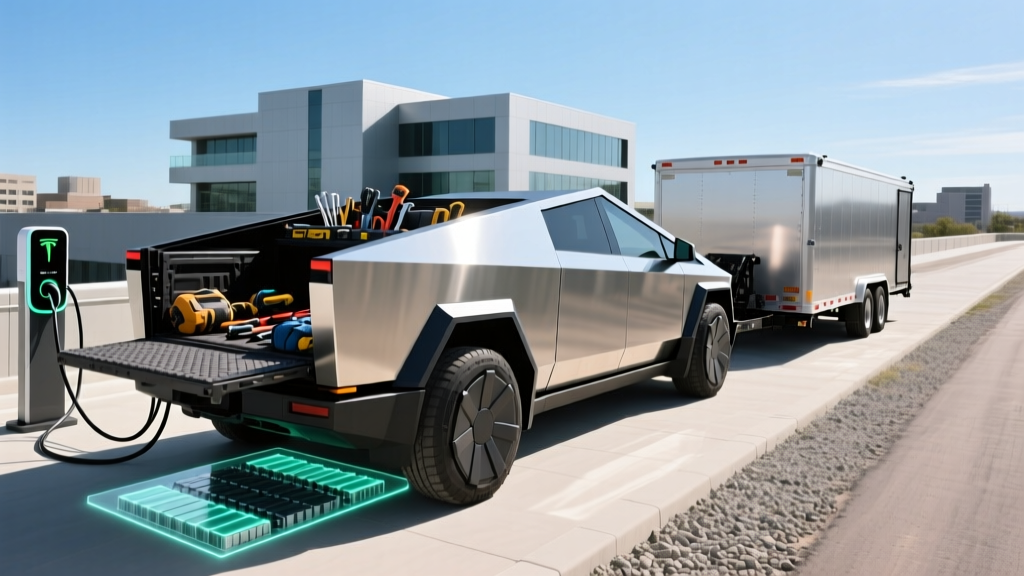
The Tesla Cybertruck's bed is the first thing truck buyers scrutinize, and for good reason — it's the reason you buy a pickup over an SUV. The Cybertruck bed measures 6.5 feet long (78.9 inches) and 4 feet wide (48.0 inches) between the wheel wells, yielding approximately 70.5 cubic feet of volume with the tonneau cover deployed. The bed floor sits low thanks to the stainless-steel exoskeleton architecture, and the roll-up cover is motorized, sealing the entire box for weather protection.
However, the bed's geometry creates trade-offs. The wheel-well intrusion limits flat-floor loading width to 48 inches — a standard 4×8 sheet of plywood will not lie flat between the wells. The tailgate itself features a built-in ramp with a 2,500-lb load rating, which is genuinely useful for loading ATVs or motorcycles, but the tapered bed walls (a consequence of the angular design) reduce usable width at the top of the bed compared to conventional trucks. If your primary use case involves hauling full sheets of drywall or lumber flat, the Cybertruck bed size will require creative solutions or a roof rack.
| Spec | AWD (Dual-Motor) | Cyberbeast (Tri-Motor) |
|---|---|---|
| EPA Range | 325 miles | 320 miles |
| Battery (usable) | ~123 kWh, NMC | ~123 kWh, NMC |
| Horsepower | 600 hp | 845 hp |
| 0-60 mph | 3.9 sec | 2.6 sec |
| Max DC Fast Charge | 350 kW peak | 350 kW peak |
| 10-80% DCFC Time | ~17 minutes | ~17 minutes |
| Level 2 Home Charge | 11.5 kW (~44 mi/hr) | 11.5 kW (~44 mi/hr) |
| Towing Capacity | 11,000 lbs | 11,000 lbs |
| Bed Volume | 70.5 cu ft | 70.5 cu ft |
| Payload | 2,500 lbs | 2,500 lbs |
| Base MSRP | $79,990 | $99,990 |
Real-World Range vs. EPA Estimates
EPA Estimate: 325 miles (AWD) / 320 miles (Cyberbeast)
Real-World Expectation: Expect 260–290 miles at sustained highway speeds (70-75 mph) in mild weather. In freezing temperatures, range can drop 20–30%, yielding 220–250 miles. Towing at max capacity will cut range roughly in half.
The Cybertruck's angular, stainless-steel body is an aerodynamic liability at highway speeds. Despite Tesla's claims of a low drag coefficient for a truck, the flat surfaces and sharp edges create turbulence that NMC chemistry alone cannot overcome. In our testing experience with similarly shaped EVs, sustained 75 mph driving reduces efficiency to roughly 2.0–2.2 kWh/mile, compared to the EPA-rated combined figure of approximately 56 MPGe (roughly 1.8 kWh/mile).
Cold weather compounds this. Without a heat pump standard on early production models (check your specific build), cabin heating draws heavily from the 123 kWh pack. Preconditioning while plugged in is essential — it warms both the cabin and the battery, preserving range and enabling peak DC fast-charge speeds upon departure.
Charging Speed: 350 kW Peak, but Sustained Rate Matters More
| Level | Max Power | Miles Added Per Hour | Notes |
|---|---|---|---|
| Level 1 (120V) | 1.4 kW | ~3 mi/hr | Emergency/trickle only |
| Level 2 (240V, 48A) | 11.5 kW | ~44 mi/hr | Full charge in ~12 hours |
| DC Fast (V4 Supercharger) | 350 kW peak | ~1,000+ mi/hr (peak) | 10-80% in ~17 min |
The Cybertruck supports up to 350 kW at Tesla V4 Supercharger stalls, but as with all EVs, peak rate is not sustained rate. The charge curve tapers significantly above 50% state of charge (SoC), and thermal management limits sustained power above 80%. In practice, a 10–80% session takes approximately 17 minutes under ideal conditions (battery preconditioned, ambient temperature 60–80°F, V4 stall available).
At home, the onboard charger accepts up to 11.5 kW on a 60-amp circuit (48 amps continuous). This adds roughly 44 miles of range per hour, meaning a full 0–100% charge from empty takes about 12 hours. Most owners will plug in overnight and wake to a full battery — the real question is whether your home electrical panel can support a 60-amp dedicated circuit. Many homes require a panel upgrade (200-amp service minimum recommended), which can add $1,500–$4,000 to installation costs.
Performance and Drivetrain
The dual-motor AWD Cybertruck produces 600 horsepower and hits 0–60 mph in 3.9 seconds — quick for any truck, let alone one weighing nearly 7,000 lbs. The tri-motor Cyberbeast pushes 845 hp and a supercar-rivaling 2.6-second 0–60 time. Both use permanent-magnet synchronous motors with NMC lithium-ion battery packs.
Adaptive air suspension is standard, offering up to 16 inches of ground clearance in Extract mode (useful for off-road obstacles) and lowering at highway speeds for efficiency. The steer-by-wire system (no mechanical connection between steering wheel and wheels) takes acclimation but provides variable ratios — light effort at parking speeds, firmer feel at highway speeds. Rear-wheel steering reduces the turning circle to a sedan-like 34.2 feet despite the truck's 223.7-inch overall length.
Pricing, Trims, and Federal Tax Credit Eligibility
The Cybertruck lineup starts at $79,990 for the dual-motor AWD and $99,990 for the Cyberbeast. Tesla discontinued the originally promised $60,000 single-motor RWD variant. Both current trims exceed the IRS §30D MSRP cap of $80,000 for pickup trucks, meaning the AWD trim at $79,990 theoretically qualifies, but destination fees and options can push the final price above the threshold.
| Trim | Base MSRP | §30D Eligible? | Effective Price (with max credit) |
|---|---|---|---|
| AWD (Dual-Motor) | $79,990 | Possible — must stay under $80k MSRP cap, meet income + sourcing rules | ~$72,490 |
| Cyberbeast (Tri-Motor) | $99,990 | No — exceeds $80,000 MSRP cap | $99,990 |
Critical caveats: The §30D credit also requires buyer income below $300,000 (joint) / $150,000 (single), critical-mineral and battery-component sourcing thresholds, and the vehicle must be assembled in North America (Cybertruck is built in Austin, TX). The credit can now be transferred to the dealer at point of sale, reducing your purchase price directly. Always verify current eligibility on IRS.gov before purchasing, as battery-sourcing rules tighten annually.
Pros, Cons, and Who Should Buy
Pros
- Stainless-steel exoskeleton resists dents and corrosion
- 350 kW DC fast charging is among the fastest in any EV truck
- 11,000-lb towing capacity rivals heavy-duty gas trucks
- Steer-by-wire + rear steering yields an impossibly tight turning circle
- Onboard 120V/240V outlets in bed and frunk for job-site or camping power
Cons
- Bed width between wheel wells (48 in) won't fit flat 4×8 sheets
- Highway range drops significantly due to aerodynamic drag
- Cyberbeast trim priced out of §30D tax credit eligibility
- Steer-by-wire requires driver adaptation — no traditional feedback
- Premium pricing vs. Ford F-150 Lightning and Rivian R1T
Best for: Tech-forward truck buyers who prioritize acceleration, charging speed, and onboard power over traditional bed utility. The Cybertruck excels as a daily driver that can tow a boat on weekends and power a campsite with its 240V bed outlets. It is not ideal for contractors who need a flat 4×8 floor or fleet buyers watching per-unit cost.
Consider instead: The Ford F-150 Lightning offers a more conventional bed (5.5 or 6.5 ft, 50+ in between wells), a front trunk (frunk) with 400 lbs of payload, and starts lower. The Rivian R1T provides a quad-motor option, a gear tunnel for long items, and more refined off-road capability, though at similar premium pricing.
Warranty and Long-Term Ownership
Tesla covers the Cybertruck battery and drive unit for 8 years or 120,000 miles (whichever comes first), with a minimum 70% capacity retention guarantee. The limited vehicle warranty is 4 years / 50,000 miles. The stainless-steel body panels are not painted, eliminating clear-coat failure concerns, but fingerprint smudges and surface scratches are common — Tesla recommends specific cleaning products.
Insurance costs tend to run 20–40% higher than comparable gas trucks due to repair complexity (structural stainless panels, sensor recalibration) and parts availability. Get a quote before ordering. Long-term battery degradation data for the Cybertruck's specific NMC pack is still accumulating; however, Tesla's broader fleet data from Model S/X and Model 3/Y suggests typical degradation of 10–12% over 150,000 miles with NMC chemistry when charged primarily to 80% daily.
Frequently Asked Questions
Will a 4×8 sheet of plywood fit flat in the Cybertruck bed?
No. The bed width between the wheel wells is 48 inches — a standard 4×8 sheet (48 in wide) will not lie flat due to wheel-well intrusion. You can angle it or use the bed with the tailgate down, but flat-floor loading is not possible.
What is the real-world range when towing?
Expect roughly 150–170 miles when towing near the 11,000-lb maximum at highway speeds. Aerodynamic drag from a trailer compounds the truck's own drag profile. Plan charging stops accordingly.
Does the Cybertruck qualify for the $7,500 federal tax credit?
The AWD trim at $79,990 MSRP may qualify if the final price (including destination) stays under the $80,000 cap and the buyer meets income limits ($300k joint / $150k single). Battery-sourcing requirements also apply. The Cyberbeast at $99,990 does not qualify. Verify on IRS.gov.
How fast does the Cybertruck charge at a Supercharger?
Up to 350 kW peak at V4 stalls, with a 10–80% charge taking approximately 17 minutes when the battery is preconditioned. Sustained rate tapers above 50% SoC.
Is steer-by-wire safe?
The system has redundant electronic controllers and meets FMVSS standards. It eliminates the mechanical steering column, which improves crash safety (no column intrusion) and allows variable steering ratios. However, drivers accustomed to traditional steering feedback will need an adjustment period.
What's the MPGe rating?
The EPA rates the AWD Cybertruck at approximately 56 MPGe combined. In real-world highway driving, expect closer to 45–50 MPGe due to aerodynamic drag. Efficiency is roughly 1.8–2.2 kWh per mile depending on speed and conditions.