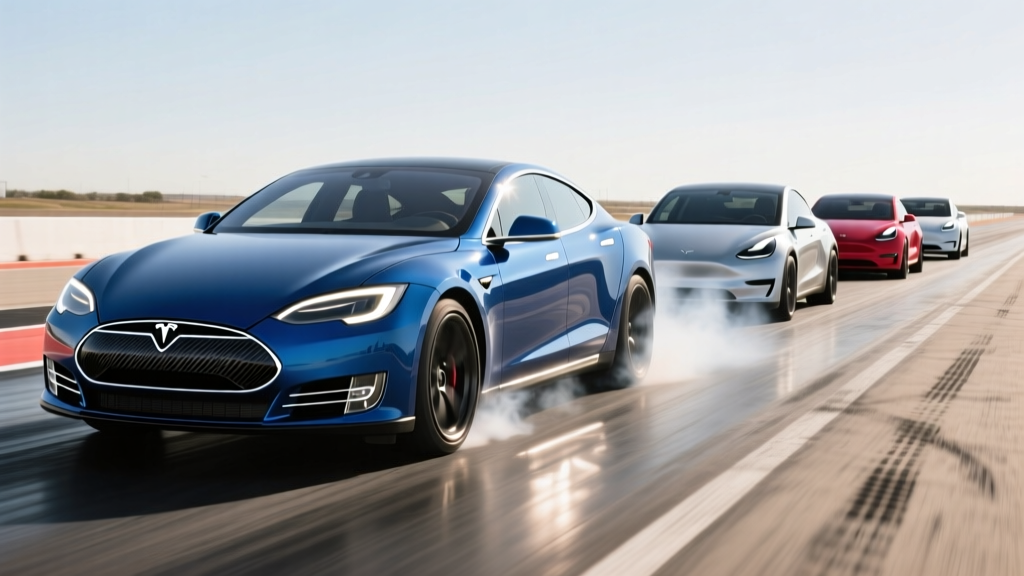
When enthusiasts search for a Tesla quarter mile time, they're usually chasing one number: the 9.23-second pass of the Model S Plaid. But Tesla's 2026 lineup spans a massive performance envelope, from the base Model 3's respectable mid-13-second run to the Plaid's supercar-rivaling sprint. This profile maps every current Tesla model's drag-strip performance against its daily-driver realities — range, charging speed, pricing, and federal tax credit eligibility.
2026 Tesla Performance Lineup: Quarter Mile & Core Specs
| Model / Trim | 0-60 mph | Quarter Mile | HP | Drivetrain | EPA Range | Battery (kWh) | Base MSRP |
|---|---|---|---|---|---|---|---|
| Model S Plaid | 1.99 s | 9.23 s @ 155 mph | 1,020 | Tri-Motor AWD | 396 mi | ~95 kWh (NMC) | $89,990 |
| Model S Long Range | 3.1 s | 11.1 s @ 130 mph | 670 | Dual-Motor AWD | 402 mi | ~95 kWh (NMC) | $74,990 |
| Model 3 Performance | 2.9 s | 11.0 s @ 130 mph | 510 | Dual-Motor AWD | 315 mi | ~75 kWh (NMC) | $52,990 |
| Model 3 Long Range AWD | 4.2 s | 12.8 s @ 117 mph | 384 | Dual-Motor AWD | 341 mi | ~75 kWh (NMC) | $45,990 |
| Model 3 RWD | 5.8 s | 14.2 s @ 103 mph | 271 | Rear-Wheel Drive | 272 mi | ~60 kWh (LFP) | $38,990 |
| Model Y Performance | 3.5 s | 11.7 s @ 125 mph | 480 | Dual-Motor AWD | 285 mi | ~75 kWh (NMC) | $52,990 |
| Model Y Long Range AWD | 4.8 s | 13.2 s @ 113 mph | 384 | Dual-Motor AWD | 320 mi | ~75 kWh (NMC) | $46,990 |
| Model X Plaid | 2.5 s | 9.85 s @ 150 mph | 1,020 | Tri-Motor AWD | 326 mi | ~95 kWh (NMC) | $94,990 |
| Model X Long Range | 3.8 s | 12.1 s @ 122 mph | 670 | Dual-Motor AWD | 348 mi | ~95 kWh (NMC) | $79,990 |
Quarter mile times reflect manufacturer data and independently verified drag-strip testing under optimal conditions (prepped surface, warm tires, low state of charge preconditioning disabled). Real-world street runs typically add 0.2–0.5 seconds due to surface and tire-temperature variables.
The King of the Strip: Model S Plaid Deep Dive
The Model S Plaid's 9.23-second quarter mile remains the benchmark for any production sedan — electric or internal-combustion. Tri-motor torque vectoring delivers 1,020 horsepower to all four wheels with a carbon-sleeve rotor design that sustains peak RPM without the power fade that plagued early tri-motor prototypes. On a prepped drag strip with drag radials, some owners have dipped into the high 8-second range, though Tesla's official 9.23-second claim uses street-legal Michelin Pilot Sport 4S tires.
What makes the Plaid's performance repeatable is Tesla's thermal management system. The octovalve heat pump and aggressive battery cooling allow 5–6 consecutive full-power launches before the system throttles output — something even the Porsche Taycan Turbo GT struggles to match without a cool-down lap.
EPA Estimate: 396 miles
Real-world highway (70 mph, 72°F): ~310–330 miles
Real-world highway (32°F, cold weather): ~250–275 miles
After repeated drag-strip launches: Expect 20–30 miles of range consumed per full-pass cycle (staging, burnout, pass, cool-down lap)
The Plaid's tri-motor drivetrain and performance tires carry an efficiency penalty. Expect 3.0–3.4 kWh/mile in mixed driving vs. the Long Range's 2.8 kWh/mile. Source: EPA fueleconomy.gov.
Charging Speed Across the 2026 Tesla Fleet
Performance means nothing if you're stranded at a slow charger. Tesla's Supercharger network remains the most reliable DC fast-charging ecosystem in the US, and the 2026 lineup supports V4 Supercharger stalls at up to 350 kW (where available). Here's what charging actually looks like:
| Model | Max DC Fast Charge | 10-80% DC Time | Level 2 Home Rate | Mi/Hr at 11.5 kW |
|---|---|---|---|---|
| Model S / X (all trims) | 250 kW | ~27 min | 11.5 kW (48A) | ~34 mi/hr |
| Model 3 (NMC trims) | 250 kW | ~25 min | 11.5 kW (48A) | ~44 mi/hr |
| Model 3 RWD (LFP) | 170 kW | ~30 min | 11.5 kW (48A) | ~44 mi/hr |
| Model Y (all trims) | 250 kW | ~25 min | 11.5 kW (48A) | ~40 mi/hr |
Charging-curve reality check: Tesla's peak kW rating applies only between roughly 10–35% state of charge. Above 50%, the curve tapers significantly — from 250 kW down to ~100 kW by 65%, and ~40 kW by 85%. A 10-80% session on a V3 Supercharger averages ~110 kW sustained, not the 250 kW peak. Plan road-trip stops around 15–20 minutes for optimal throughput, charging to 60–70% rather than waiting for 80%+.
For home charging, Tesla's Wall Connector at 48 amps (11.5 kW on a 60-amp circuit) replenishes any model overnight. Budget roughly $600–$1,200 for professional installation on an existing 200-amp panel. If your panel needs upgrading to support a 60-amp dedicated circuit, add $1,500–$3,000.
Pricing, Trims & Federal Tax Credit Eligibility
Tesla's pricing has shifted repeatedly, but as of early 2026, here is where the lineup stands — and critically, which models still qualify for the IRS §30D federal tax credit.
| Model / Trim | Base MSRP | §30D Credit | Effective Price |
|---|---|---|---|
| Model 3 RWD | $38,990 | $7,500 (if eligible) | ~$31,490 |
| Model 3 Long Range AWD | $45,990 | $7,500 (if eligible) | ~$38,490 |
| Model 3 Performance | $52,990 | $7,500 (if eligible) | ~$45,490 |
| Model Y Long Range AWD | $46,990 | $7,500 (if eligible) | ~$39,490 |
| Model Y Performance | $52,990 | $7,500 (if eligible) | ~$45,490 |
| Model S Long Range | $74,990 | $0 (over MSRP cap) | $74,990 |
| Model S Plaid | $89,990 | $0 (over MSRP cap) | $89,990 |
| Model X Long Range | $79,990 | $0 (over MSRP cap) | $79,990 |
| Model X Plaid | $94,990 | $0 (over MSRP cap) | $94,990 |
§30D eligibility rules (2026): The federal clean vehicle credit requires the buyer's adjusted gross income to fall below $150,000 (single), $225,000 (head of household), or $300,000 (joint). Sedans must have an MSRP under $55,000; SUVs, pickups, and vans under $80,000. The Model S and Model X exceed the $55,000 sedan cap and $80,000 SUV cap respectively, making them ineligible. Model 3 and Model Y trims at or below the cap qualify — provided the battery meets critical-mineral and component-sourcing requirements, which Tesla's US-built cells currently satisfy. The credit can be transferred to the dealer at point of sale as an immediate price reduction. Always verify current eligibility on fueleconomy.gov before purchasing, as sourcing rules tighten annually.
Efficiency, Cargo & Daily-Driver Practicality
Quarter mile bragging rights fade quickly when you're hauling groceries or commuting 80 miles round-trip. Here's how the performance models stack up in everyday usability:
Model 3 Performance: 23 cu ft trunk + ~3 cu ft frunk. Rear legroom is 35.2 inches — tight for tall adults on long trips. Efficiency: 119 MPGe combined / 28 kWh/100mi. At $0.14/kWh national average, that's roughly 4.0 cents per mile — about one-third the fuel cost of a comparable BMW M3.
Model Y Performance: 30 cu ft behind the second row, 72 cu ft with seats folded, plus a 4.1 cu ft frunk. Rear legroom: 41.6 inches. Efficiency: 111 MPGe combined / 30 kWh/100mi. The Model Y's crossover ride height and hatchback cargo area make it the most practical performance Tesla.
Model S Plaid: 25 cu ft trunk (liftback design aids loading), ~3 cu ft frunk. Rear legroom is generous at 40.5 inches. Efficiency: 116 MPGe combined / 29 kWh/100mi. Despite 1,020 hp, the Long Range Model S actually edges it out at 124 MPGe combined.
Model X Plaid: Up to 88 cu ft with both rows folded (5-seat config). Falcon-wing doors require 12+ inches of lateral clearance — a real constraint in tight garages. Efficiency: 101 MPGe combined / 33 kWh/100mi. The heaviest and least efficient Tesla in the lineup.
Battery Chemistry, Degradation & Warranty
Tesla uses two distinct battery chemistries across its 2026 lineup, and the choice affects longevity, charging habits, and performance consistency:
NMC (Nickel Manganese Cobalt): Found in all Long Range and Performance trims. Higher energy density enables longer range in a lighter pack. Tesla recommends daily charging to 80% for longevity, with 100% reserved for trips. Typical degradation: ~5–8% over the first 100,000 miles, then a slow linear decline. Tesla's battery warranty guarantees 70% capacity retention for 8 years / 120,000 miles (Model S/X) or 8 years / 100,000 miles (Model 3/Y).
LFP (Lithium Iron Phosphate): Used in the base Model 3 RWD. Lower energy density but far greater cycle life — Tesla recommends charging to 100% regularly, which simplifies daily use. LFP packs degrade more slowly (~3–5% over 100,000 miles) and tolerate heat better. The trade-off: lower peak charge rate (170 kW vs 250 kW) and reduced cold-weather range (expect 25–35% loss below freezing vs 20–30% for NMC).
For drag-strip use, NMC packs deliver more consistent full-power launches in cold conditions, while LFP's flatter voltage curve means less performance fade at low state of charge — a minor edge for repeat passes.
Autopilot, FSD & Tech Features
Every 2026 Tesla ships with basic Autopilot (traffic-aware cruise control + lane centering). Full Self-Driving (Supervised) remains a $8,000 add-on or $99/month subscription.
Despite the "Full Self-Driving" name, Tesla's FSD (Supervised) is an SAE Level 2 driver-assistance system. The driver must remain fully engaged, hands on or near the wheel, and eyes on the road at all times. It does NOT make the vehicle autonomous. Only Level 4 services like Waymo operate without a human driver — and only in geofenced areas. Tesla's FSD excels at highway lane changes and navigation-on-autopilot but requires constant supervision in construction zones, adverse weather, and unmapped intersections.
Beyond driver assists, the 2026 Tesla tech stack includes:
- 15.4-inch center touchscreen (Model 3/Y) or 17-inch tilting display (Model S/X)
- Rear-seat 8-inch touchscreen (Model S/X)
- Over-the-air updates that add features post-purchase
- Sentry Mode dashcam recording with cloud alerts
- Native NACS charge port — compatible with all Superchargers and a growing number of third-party networks now adopting the standard
- Gaming-capable hardware (AMD Ryzen in Model S/X; Intel Atom in Model 3/Y)
- Model S Plaid's 9.23s quarter mile is untouchable in its price class
- Supercharger network remains the gold standard for road-trip reliability
- OTA updates continuously improve performance and features
- NACS connector now the North American standard — future-proof
- Strongest real-world efficiency (kWh/100mi) among performance EVs
- Over-the-air drag-strip telemetry and launch analytics built in
- No Apple CarPlay or Android Auto — Tesla-only infotainment
- FSD (Supervised) remains Level 2 despite the name and $8K cost
- Model 3/Y minimalist interior lacks physical controls for climate/mirrors
- Model S/X pricing eliminates any federal tax credit eligibility
- Insurance premiums run 20–40% higher than comparable non-EV sedans
- Panel gap and build-quality inconsistencies still reported by owners
Who Should Buy Which Tesla?
Choose Model S Plaid if: Quarter mile time is your primary purchase driver, you need a four-door daily with supercar performance, and budget is above $90K with no tax-credit expectation.
Choose Model 3 Performance if: You want an 11.0-second quarter mile in a $52,990 package that still qualifies for the $7,500 federal credit — the best performance-per-dollar EV on the market.
Choose Model Y Performance if: You need family cargo space and rear-seat room alongside a sub-12-second quarter mile. The 3.5-second 0-60 is more than adequate for any real-world scenario.
Choose Model 3 RWD (LFP) if: Performance is secondary to value. At ~$31,490 after the tax credit, it's the cheapest way into the Tesla ecosystem with 272 miles of range and the lowest degradation risk.
Skip Tesla entirely if: You prioritize physical controls, want Apple CarPlay, need a truck bed, or live in an area with limited Supercharger coverage and no home-charging option.
Frequently Asked Questions
What is the fastest Tesla quarter mile time?
The Model S Plaid holds the record at 9.23 seconds at 155 mph in stock, street-tire configuration. On a prepped surface with drag radials, owners have reported high-8-second passes, though these are not factory-claimed figures.
How does the Model 3 Performance quarter mile compare to gas sports sedans?
At 11.0 seconds, the Model 3 Performance matches or beats the BMW M3 Competition (11.2s), Mercedes-AMG C63 S E Performance (11.1s), and Alfa Romeo Giulia Quadrifoglio (11.6s) — at roughly half the price of the German rivals.
Does launching a Tesla repeatedly damage the battery or motors?
Tesla's thermal management system protects against catastrophic damage, but repeated full-power launches accelerate battery degradation. Tesla's warranty covers defects and capacity loss below 70%, but excludes wear from abuse. Expect 1–2% additional degradation per 100 full-power launches based on owner telemetry data.
What is the real-world range of the Model S Plaid?
The EPA rates it at 396 miles, but real-world highway driving at 70 mph yields approximately 310–330 miles in moderate temperatures. In cold weather (below 32°F), expect 250–275 miles. Aggressive driving — including drag-strip use — can cut range by 40–50%.
Does the Tesla Model 3 qualify for the $7,500 federal tax credit?
Yes, all 2026 Model 3 trims fall under the $55,000 MSRP cap for sedans. Eligibility requires buyer AGI below $150K (single) / $300K (joint), and the vehicle must meet critical-mineral and battery-component sourcing requirements — which current US-built Tesla cells satisfy. The credit can be applied as a point-of-sale reduction. Verify at irs.gov before purchase.
Is the Model X Plaid's quarter mile time affected by its weight?
Yes. At approximately 5,100 lbs, the Model X Plaid is roughly 800 lbs heavier than the Model S Plaid, resulting in a 9.85-second quarter mile vs 9.23 seconds despite identical 1,020-hp tri-motor output. The weight penalty also shows in braking distances and tire wear.