The Quick Answer: Tesla Model 3 Range and Lifespan
When buyers ask "how many miles can a Tesla Model 3 last," they're usually asking two different questions: how far it drives on a single charge, and how long the vehicle survives before major components need replacement. The 2026 Tesla Model 3 lineup answers both convincingly, but the numbers depend heavily on which trim you choose and how you drive.
On a full charge, the 2026 Model 3 spans from an EPA-estimated 272 miles (RWD) up to 363 miles (Long Range AWD). Over its lifetime, Tesla's battery and drive unit warranty covers 8 years or 100,000–120,000 miles depending on trim, and real-world data suggests the pack can outlast those limits with manageable degradation. Below, we unpack every number that matters.
| Spec | RWD (Base) | Long Range AWD | Performance |
|---|---|---|---|
| EPA Range | 272 mi | 363 mi | 315 mi |
| Battery (usable) | ~60 kWh (LFP) | ~79 kWh (NMC) | ~79 kWh (NMC) |
| Drivetrain | Rear-Wheel Drive | Dual-Motor AWD | Dual-Motor AWD |
| Horsepower | 271 hp | ~350 hp | ~510 hp |
| 0–60 mph | 5.8 sec | 4.2 sec | 2.9 sec |
| MPGe (combined) | 132 MPGe | 131 MPGe | 116 MPGe |
| Efficiency | 25 kWh/100 mi | 25 kWh/100 mi | 29 kWh/100 mi |
| Base MSRP | $38,990 | $45,740 | $52,990 |
| Battery Warranty | 8 yr / 100,000 mi | 8 yr / 120,000 mi | 8 yr / 120,000 mi |
Real-World Range: What the EPA Sticker Doesn't Tell You
EPA range estimates are measured under controlled laboratory conditions that blend city and highway driving. In practice, your mileage shifts based on speed, temperature, elevation, and climate-control usage. The Model 3's efficiency is among the best in its class, but physics still applies.
- EPA sticker: 363 miles
- Mixed city/highway (65–70 mph, mild weather): ~320–340 miles
- Sustained highway (75–80 mph, 70°F): ~280–310 miles
- Cold weather highway (30°F, heater on): ~240–275 miles
- Extreme cold (below 15°F, short trips): ~210–250 miles
The RWD trim loses roughly 25–28% of its EPA range in sustained cold-weather highway driving. The Long Range AWD and Performance trims see similar percentage drops, though the larger battery provides a bigger absolute buffer.
Tesla's heat pump, standard on all 2026 Model 3 trims, recovers waste heat from the drivetrain to warm the cabin, reducing cold-weather range loss compared to older resistive-heater EVs. Preconditioning the battery while plugged in — a feature accessible through the Tesla app — further preserves range by bringing the pack to optimal temperature before departure.
According to fueleconomy.gov, the Model 3 Long Range AWD achieves 131 MPGe combined (25 kWh per 100 miles), placing it among the most efficient electric sedans on the market. That efficiency translates directly to lower charging costs and more usable miles from every kWh.
Battery Chemistry, Capacity, and Long-Term Degradation
The 2026 Model 3 uses two distinct battery chemistries, and understanding the difference is critical for projecting how many miles the car can last over its lifetime.
| Factor | LFP (RWD Trim) | NMC (Long Range / Performance) |
|---|---|---|
| Energy Density | Lower — heavier pack for same kWh | Higher — more range per pound |
| Charge to 100% Daily? | Yes — Tesla recommends periodic 100% charges | No — 80% daily, 100% for trips only |
| Cycle Life | 3,000+ cycles typical | 1,500–2,000 cycles typical |
| Cold-Weather Performance | Slightly more range loss in extreme cold | Better low-temp discharge characteristics |
| Degradation at 100k mi | ~5–8% estimated | ~8–12% estimated |
| Cobalt/Nickel Content | None — lower supply-chain risk | Contains nickel and cobalt |
Tesla's 2025 Impact Report and third-party fleet data from sources like Recurrent Auto show that Model 3 batteries retain approximately 85–90% of original capacity after 100,000 miles. The LFP pack in the RWD trim tends to degrade more slowly because the chemistry is inherently more stable, though it starts with less total range.
At 200,000 miles, a reasonable upper-bound projection for a well-maintained Model 3 is 80–88% retained capacity, depending on charging habits. Owners who primarily use Level 2 home charging and avoid frequent DC fast charging to 100% tend to see the best long-term State of Health (SoH) numbers.
Battery replacement cost remains a concern for high-mileage buyers. As of 2026, a Model 3 battery replacement through Tesla ranges from approximately $12,000 to $16,000 including labor, though most packs outlast the warranty period without needing full replacement. Module-level repairs can cost significantly less.
Charging Speed: DC Fast, Level 2, and Level 1
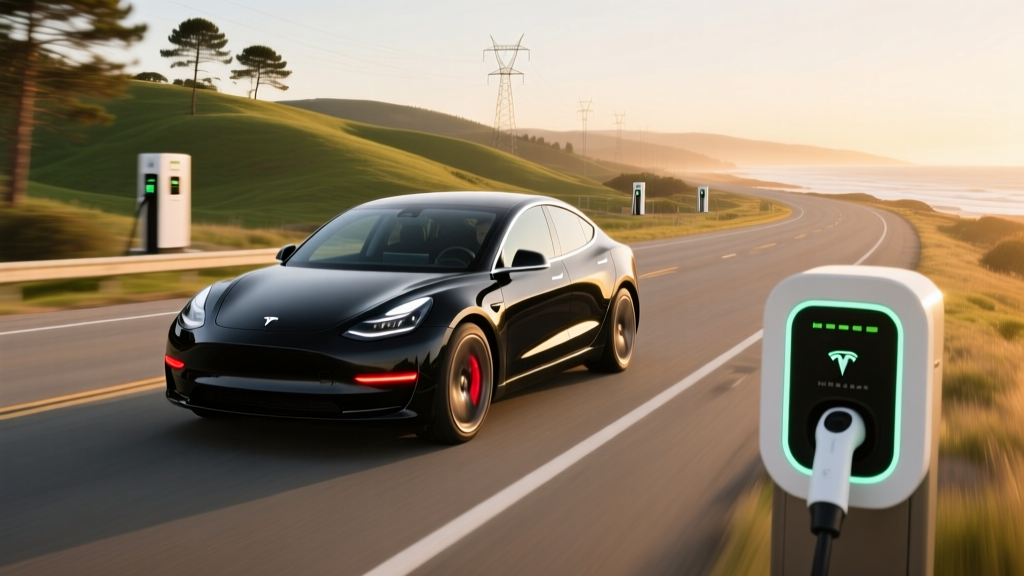
Charging speed determines how practical the Model 3 is for road trips and daily use. The 2026 Model 3 supports Tesla's NACS (North American Charging Standard) connector natively, granting access to the Supercharger network — currently the most reliable DC fast-charging infrastructure in the US.
| Charging Level | Power | Rate (mi/hr added) | Notes |
|---|---|---|---|
| Level 1 (120V household) | ~1.4 kW | ~3–5 mi/hr | Emergency/trickle only |
| Level 2 (240V home, 48A) | 11.5 kW | ~44 mi/hr | Full overnight charge in 7–9 hours |
| Level 2 (240V home, 32A) | 7.7 kW | ~30 mi/hr | Common with NEMA 14-50 outlet |
| DC Fast (Supercharger V3/V4) | Peak 250 kW | Up to ~175 mi in 15 min | 10–80% in ~25–30 min |
Understanding the charge curve: The Model 3's peak 250 kW DC fast-charge rate applies only at low states of charge (roughly 10–30% SoC) and when the battery is preconditioned. Above 50% SoC, the charge rate tapers progressively — by 80%, you're typically seeing 60–80 kW. This is why manufacturers quote 10–80% times rather than 0–100%.
For the Long Range AWD with its ~79 kWh pack, a 10–80% session at a V3 Supercharger takes approximately 25–30 minutes under ideal conditions. The RWD's smaller LFP pack charges to 80% slightly faster in absolute time (~22–26 minutes) due to less total energy needed, though its peak charge rate is somewhat lower.
At home, a Tesla Wall Connector on a 60-amp circuit delivers up to 11.5 kW (48 amps), adding roughly 44 miles of range per hour of charging. Most owners wake up to a full battery every morning. Installation costs for a home Level 2 setup typically run $500–$2,000 depending on panel capacity and wiring distance — a licensed electrician should evaluate your 200-amp panel before installation.
Performance, Interior Space, and Technology
The 2026 Model 3 "Highland" refresh carries over the redesigned architecture introduced for the 2024 model year, with improved NVH (noise, vibration, harshness), ventilated front seats, ambient lighting, and a rear touchscreen for passengers.
Performance by the Numbers
- RWD: 271 hp, 0–60 in 5.8 seconds — adequate for commuting and highway merging
- Long Range AWD: ~350 hp, 0–60 in 4.2 seconds — brisk and confident in all conditions
- Performance: ~510 hp, 0–60 in 2.9 seconds — sports-car territory with track-capable braking
All trims feature regenerative braking with one-pedal driving capability. The dual-motor AWD trims provide superior traction in rain and snow, with torque vectoring between front and rear axles.
Cargo and Passenger Space
- Rear legroom: 35.3 inches
- Front headroom: 40.3 inches
- Trunk (rear): 21.0 cu ft
- Frunk (front trunk): 3.1 cu ft
- Total cargo: 24.1 cu ft — competitive with compact sedans, less than hatchback rivals like the Hyundai Ioniq 5
Standout Tech
- 15.4-inch center touchscreen with navigation, streaming, and gaming
- 8.0-inch rear passenger display (climate, media, entertainment)
- Tesla Autopilot (SAE Level 2) — adaptive cruise + lane centering, standard
- Full Self-Driving (Supervised) — optional at ~$8,000 or $99/month; still requires active driver supervision
- Over-the-air updates that add features post-purchase
- Sentry Mode dashcam surveillance while parked
Tesla Autopilot and FSD (Supervised) are SAE Level 2 driver-assistance systems. The driver must remain engaged, hands on or near the wheel, and eyes on the road at all times. These systems do not make the Model 3 a self-driving car. Only Level 4 services like Waymo operate without a human driver — and those are geofenced robotaxis, not consumer vehicles.
Notable Drawbacks
- No physical turn-signal stalk — signals are button-activated on the steering wheel, a learning curve for new owners
- No Apple CarPlay or Android Auto — Tesla's proprietary interface only
- Rear visibility is limited; relies heavily on cameras
- Panel gap consistency has improved but still draws scrutiny vs. legacy luxury brands
- Insurance premiums tend to run 15–30% higher than comparable gas sedans
Pricing, Tax Credits, and Total Cost of Ownership
The 2026 Model 3 starts at $38,990 for the RWD trim before destination fees, making it one of the most affordable premium electric sedans. But the real cost question hinges on federal tax credit eligibility under IRS §30D.
| Trim | Base MSRP | As-Tested (typical) | §30D Credit Potential | Effective Price |
|---|---|---|---|---|
| RWD | $38,990 | $39,990 (w/ destination) | Up to $7,500* | ~$32,490* |
| Long Range AWD | $45,740 | $47,240 (w/ destination + paint) | Up to $7,500* | ~$39,740* |
| Performance | $52,990 | $54,990 (w/ destination + wheels) | Up to $7,500* | ~$47,490* |
*Credit eligibility depends on buyer income, battery sourcing, and critical-mineral requirements. See checklist below.
- MSRP cap: Sedans must be ≤ $55,000 — all Model 3 trims qualify on price
- Buyer income cap: Modified AGI ≤ $150,000 (single) / $300,000 (joint) / $225,000 (head of household)
- Battery sourcing: Critical minerals and battery components must meet phased-in domestic/free-trade sourcing thresholds — check IRS.gov for current-year eligible VINs
- Point-of-sale transfer: Eligible buyers can transfer the credit to the dealer at purchase, reducing the upfront price rather than waiting for a tax refund
- Final assembly: Must occur in North America — Model 3 is assembled in Fremont, CA ✓
Consult a tax professional to confirm your individual eligibility. Credit rules are subject to legislative change.
5-Year Cost of Ownership Snapshot
Compared to a similarly priced gas sedan (e.g., BMW 3 Series at ~$45,000), the Model 3 Long Range AWD typically saves $4,000–$7,000 over five years in fuel and maintenance, according to DOE eGallon-equivalent calculations. Electricity costs roughly $0.13–$0.18/kWh nationally (home charging), versus $3.50–$4.50/gallon for premium gasoline. The Model 3 has no oil changes, no spark plugs, and minimal brake wear thanks to regenerative braking.
Offsetting those savings: EV insurance premiums run higher, and the upfront purchase price (before credits) may exceed some gas alternatives. Depreciation on the Model 3 has stabilized but remains steeper than Toyota or Lexus sedans.
How the Model 3 Compares to Key Competitors
The Model 3's closest rivals in 2026 include the Hyundai Ioniq 6, BMW i4, and Polestar 2. Here's how they stack up on the metrics buyers care about most:
| Metric | Tesla Model 3 LR | Hyundai Ioniq 6 LR | BMW i4 eDrive40 | Polestar 2 LR |
|---|---|---|---|---|
| EPA Range | 363 mi | 361 mi | 307 mi | 320 mi |
| Base MSRP | $45,740 | $43,500 | $57,900 | $50,900 |
| Peak DC Charge | 250 kW | 235 kW | 205 kW | 205 kW |
| 10–80% DC Time | ~27 min | ~18 min | ~31 min | ~30 min |
| Charging Network | Tesla Supercharger (NACS) | CCS → NACS adapter avail. | CCS → NACS adapter avail. | CCS → NACS adapter avail. |
| Battery Warranty | 8 yr / 120k mi | 10 yr / 100k mi | 8 yr / 80k mi | 8 yr / 100k mi |
The Ioniq 6 matches the Model 3 on range and charges faster (thanks to its 800V architecture), but Tesla's Supercharger network remains the gold standard for road-trip reliability. The BMW i4 offers a more traditional luxury interior at a significant price premium. The Polestar 2 brings Scandinavian design and Google-based infotainment but trails on range and value.
Who the Tesla Model 3 Is Best For
- You want access to the Tesla Supercharger network for stress-free road trips
- You value over-the-air updates that improve the car after purchase
- You prioritize efficiency (kWh/100 mi) and low running costs
- You prefer a minimalist, tech-forward interior with best-in-class infotainment
- You want strong performance even in the base RWD trim
- You need hatchback cargo versatility (consider Ioniq 5 or Model Y)
- You want Apple CarPlay/Android Auto integration
- You prefer physical buttons and stalks over touchscreen controls
- You frequently tow — the Model 3 is not rated for towing
- You need three rows or family-hauling space
Best use cases: The Model 3 excels as a daily commuter, a tech-savvy professional's sedan, and a road-trip-capable EV for couples or small families. The RWD trim suits budget-conscious buyers who charge at home and drive under 50 miles daily. The Long Range AWD is the sweet spot for most buyers — maximum range, all-weather confidence, and strong value. The Performance trim targets driving enthusiasts who want supercar acceleration with zero emissions.
Pros and Cons at a Glance
- Class-leading efficiency (25 kWh/100 mi)
- Supercharger network reliability
- Up to 363 miles EPA range (Long Range)
- Over-the-air feature updates
- Strong safety ratings (NHTSA 5-star, IIHS Top Safety Pick+)
- Low maintenance costs vs. ICE sedans
- LFP option allows daily 100% charging without degradation concern
- No Apple CarPlay or Android Auto
- Button-based turn signals require adjustment
- Rear-seat space is tighter than some rivals
- Insurance costs above segment average
- FSD (Supervised) remains Level 2 — not autonomous
- Sedan trunk limits cargo versatility vs. crossovers
Frequently Asked Questions
What is the real-world range of the 2026 Tesla Model 3?
In mixed driving at moderate temperatures, expect 320–340 miles from the Long Range AWD (EPA: 363 mi). Sustained highway driving at 75+ mph drops this to roughly 280–310 miles. In cold weather below 30°F, plan for 240–275 miles. The RWD trim delivers roughly 75% of those figures due to its smaller battery.
How fast does the Model 3 charge at home and on the road?
At home on a 240V/48A Level 2 charger, the Model 3 adds approximately 44 miles of range per hour, fully charging overnight in 7–9 hours. On a Tesla V3/V4 Supercharger, it peaks at 250 kW and charges from 10–80% in about 25–30 minutes. Charge speed tapers significantly above 80% SoC to protect the battery.
How much does the 2026 Model 3 cost after the federal tax credit?
If you qualify for the full $7,500 §30D credit, the RWD trim drops to approximately $32,490 and the Long Range AWD to ~$39,740. Eligibility requires meeting income caps ($150k single / $300k joint), MSRP limits (all trims qualify), and battery-sourcing requirements. The credit can now be transferred at point of sale to reduce your purchase price directly.
Does the Tesla Model 3 qualify for the federal EV tax credit?
All 2026 Model 3 trims fall under the $55,000 sedan MSRP cap and are assembled in North America. However, the actual credit amount ($0, $3,750, or $7,500) depends on current-year battery critical-mineral and component sourcing rules published by the IRS. Check the official fueleconomy.gov tax credit page for the latest eligible VIN list.
How many total miles will a Model 3 battery last before replacement?
Based on fleet data and Tesla's own reporting, Model 3 batteries typically retain 85–90% capacity at 100,000 miles and 80–88% at 200,000 miles. The battery warranty guarantees at least 70% retention at 100,000 (RWD) or 120,000 miles (LR/Performance). Many packs exceed 200,000 miles before degradation becomes functionally limiting, though individual results depend on charging habits and climate.
Is the Model 3 worth buying over the Hyundai Ioniq 6 or BMW i4?
The Model 3 Long Range wins on Supercharger access, software ecosystem, and efficiency. The Ioniq 6 charges faster (800V architecture) and offers a longer warranty. The BMW i4 delivers a more traditional luxury experience at a higher price. If road-trip charging reliability is your top priority, Tesla's network advantage remains decisive in 2026.