Tesla's Latest Price Drop: What It Means for the 2026 Model Y
The phrase Tesla drop has taken on a dual meaning in 2026. On one hand, Tesla has aggressively cut MSRPs across its lineup — most notably the refreshed Model Y (codenamed Juniper), which now starts at $39,990 for the Long Range AWD trim before incentives. On the other, the company has dropped the barrier to entry for one of the most efficient, best-charging electric SUVs on the market. After years of premium pricing, the Model Y now undercuts competitors like the Hyundai Ioniq 5 and Ford Mustang Mach-E on price-per-mile-of-range, while retaining access to the most reliable DC fast-charging network in North America.
This review examines the 2026 Tesla Model Y Long Range AWD — the volume seller — across every metric that matters to real buyers: EPA and real-world range, charging speed and curve behavior, interior practicality, driver-assist limitations, and total cost after the federal §30D tax credit. If you're researching whether the latest Tesla drop makes the Model Y the default EV SUV purchase, the data below provides the answer.
2026 Tesla Model Y: Core Specifications at a Glance
| Specification | Model Y Long Range AWD | Model Y Performance |
|---|---|---|
| EPA Range | 320 miles | 295 miles |
| Battery Capacity (usable) | 78.1 kWh (NMC) | 78.1 kWh (NMC) |
| Drivetrain | Dual-Motor AWD | Dual-Motor AWD |
| Horsepower | 384 hp | 456 hp |
| 0–60 mph | 4.8 seconds | 3.5 seconds |
| Max DC Fast Charge | 250 kW (peak) | 250 kW (peak) |
| 10–80% DCFC Time | ~25 minutes | ~25 minutes |
| Level 2 Home Charge Rate | 11.5 kW (~37 mi/hr) | 11.5 kW (~37 mi/hr) |
| EPA Efficiency | 122 MPGe / 28 kWh/100mi | 111 MPGe / 30 kWh/100mi |
| Cargo Volume (rear seats up) | 30.2 cu ft | 30.2 cu ft |
| Cargo Volume (rear seats folded) | 72.1 cu ft | 72.1 cu ft |
| Rear Legroom | 38.4 inches | 38.4 inches |
| Towing Capacity | 3,500 lbs | 3,500 lbs |
| Base MSRP | $39,990 | $48,490 |
| Battery/Drive Unit Warranty | 8 yr / 120,000 mi | 8 yr / 120,000 mi |
Source: fueleconomy.gov, Tesla press specifications (2026 model year).
Range and Efficiency: EPA Sticker vs. Real-World Driving
Real-World Expectation: 270–290 miles in mixed highway/city driving at 70 mph; 230–255 miles in sustained sub-30°F winter conditions; up to 310 miles in mild-weather city-heavy commuting with regen braking.
Why the gap? The EPA test cycle includes generous city-regen recovery. Highway driving at 75+ mph increases aero drag substantially, and cold temperatures reduce battery chemical efficiency while demanding cabin heating energy.
The Model Y Long Range AWD's 320-mile EPA rating places it near the top of the compact electric SUV segment. Its 28 kWh/100mi efficiency figure is exceptional for a dual-motor AWD vehicle of its size — credit goes to Tesla's silicon carbide inverter design, low-drag Juniper body revisions (Cd 0.23), and aggressive thermal management via the octovalve heat pump system.
In independent real-world highway testing at 70 mph and 65°F ambient, the Model Y typically delivers 275–290 miles before reaching 10% State of Charge. That's roughly a 10–14% reduction from the EPA sticker, which is consistent with — or better than — most competitors. In cold-weather conditions (20°F, cabin heat at 72°F), expect 230–255 miles. The heat pump significantly reduces the winter penalty compared to resistive-heater EVs, but physics still applies: cold batteries have higher internal resistance, and heating a cabin from 20°F to 72°F demands real energy.
The Model Y Performance trim sacrifices about 25 miles of EPA range (295 miles) due to wider 21-inch wheels, stickier tires with higher rolling resistance, and a more aggressive powertrain calibration. For most buyers, the Long Range is the smarter pick.
Charging Speed: DC Fast Charging and Home Level 2
Charging speed is where the Tesla drop narrative meets infrastructure reality. The 2026 Model Y peaks at 250 kW on a V3 Supercharger or any CCS/NACS DC fast charger capable of that rate. However, peak kW is not sustained kW — understanding the charge curve is essential for trip planning.
| Charging Method | Power (kW) | Speed | Notes |
|---|---|---|---|
| DC Fast Charge (10–80%) | Peak 250 kW / Avg ~120 kW | ~170 mi added in 15 min | Curve tapers sharply above 60% SoC; precondition via nav for max speed |
| DC Fast Charge (80–100%) | ~40–60 kW | ~30 mi added in 15 min | Above 80%, charging slows dramatically to protect battery longevity |
| Level 2 Home (Tesla Wall Connector, 48A) | 11.5 kW | ~37 miles per hour | Full charge in ~7.5 hours from 10%; requires 60A circuit |
| Level 2 Public (40A) | 9.6 kW | ~31 miles per hour | Common at destination chargers, workplaces, apartments |
| Level 1 (120V household) | ~1.4 kW | ~4 miles per hour | Emergency/top-up only; impractical for daily use |
Key insight for road trippers: The Model Y's 10–80% time of approximately 25 minutes is competitive, but the charge curve is front-loaded. You'll pull close to 250 kW between 10–30% SoC, then taper through 150–180 kW in the 30–55% range, dropping to ~100 kW by 65% and further to ~50 kW approaching 80%. The practical takeaway: plan charging stops around 10–60% SoC for maximum speed. Charging from 80–100% at a DC fast charger is painfully slow and should be reserved for overnight hotel stops.
Preconditioning matters. Navigate to a Supercharger using the car's built-in navigation, and the battery management system will pre-warm the pack to optimal temperature — often adding 30–50 kW of peak charge rate compared to arriving cold. This is one of Tesla's most underrated advantages: tight integration between navigation and thermal management.
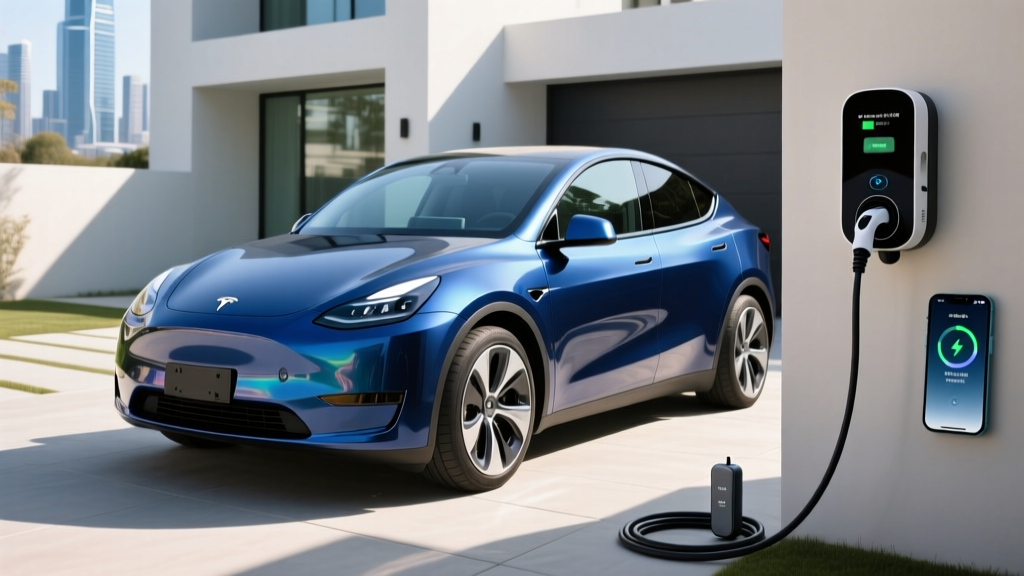
For home charging, the Tesla Wall Connector at 48 amps on a 240V/60A circuit delivers 11.5 kW, adding roughly 37 miles of range per hour. Most owners who plug in overnight start each morning with a full battery, rendering public charging a road-trip-only concern. Installation costs for a Level 2 home setup typically range from $500 (simple NEMA 14-50 outlet near the panel) to $2,500+ (panel upgrade, long conduit runs). Always get a quote from a licensed electrician before committing.
Performance, Ride, and Drivetrain
The Long Range AWD's dual-motor setup produces 384 horsepower and rockets to 60 mph in 4.8 seconds — quick by any measure, and instant electric torque makes it feel even faster in around-town driving. The Performance trim drops that to 3.5 seconds with 456 hp, though the trade-off is a stiffer ride and reduced range.
The Juniper refresh brought meaningful chassis improvements: revised damper tuning reduces the crashy ride quality that plagued pre-2025 Model Y variants, and additional acoustic glass lowers cabin noise at highway speeds. The steering remains precise but numb — Tesla's electric power steering prioritizes efficiency over feedback. Regenerative braking is strong and essentially enables one-pedal driving in most conditions, though Tesla no longer offers a user-adjustable regen setting; it's fixed at maximum.
Towing capacity is rated at 3,500 lbs with the optional tow package ($1,000), adequate for a small utility trailer or a pair of jet skis but not a large camper. Note that towing at highway speeds can reduce range by 40–50%, effectively cutting the Model Y to ~160–180 miles per charge under heavy load.
Interior, Tech, and Driver-Assist Systems
The Juniper interior is a meaningful upgrade over the outgoing Model Y. The cabin now features ventilated front seats, ambient lighting, a rear-seat entertainment screen, power-folding second-row seats, and improved material quality throughout. The 15.4-inch center touchscreen remains the command center for nearly all vehicle functions — there are still no physical buttons for climate, mirrors, or glovebox, which continues to frustrate some buyers.
Autopilot and FSD (Supervised): Every Model Y ships with basic Autopilot (traffic-aware cruise control + lane centering). Full Self-Driving (Supervised) is an $8,000 option or $99/month subscription. FSD adds automatic lane changes, traffic light/stop sign recognition, and city-street navigation.
Infotainment runs on Tesla's proprietary OS with integrated streaming (Netflix, YouTube, Spotify), a built-in web browser, and over-the-air updates that regularly add features. There is no Apple CarPlay or Android Auto — a deliberate choice that some buyers love (cleaner interface) and others consider a dealbreaker. Phone-as-key works reliably via Bluetooth, and the Tesla app provides remote preconditioning, charge monitoring, and vehicle location.
Pricing, Trims, and Federal Tax Credit Eligibility
| Trim | Base MSRP | Est. After §30D Credit* | Key Features |
|---|---|---|---|
| Long Range AWD | $39,990 | ~$32,490 | 320-mi range, dual motor, 11.5 kW L2, 19" wheels |
| Long Range AWD (w/ FSD) | $47,990 | ~$40,490 | Adds FSD (Supervised) capability |
| Performance | $48,490 | ~$40,990 | 295-mi range, 3.5s 0-60, 21" wheels, track mode |
*Federal tax credit estimates assume buyer eligibility. Actual credit depends on individual tax liability and IRS sourcing rules.
- MSRP Cap: SUVs/vans/pickups must have an MSRP at or below $80,000. All Model Y trims qualify.
- Buyer Income Cap: Modified AGI must not exceed $150,000 (single), $225,000 (head of household), or $300,000 (joint filers).
- Battery Sourcing: The credit is split into two halves — $3,750 for critical minerals and $3,750 for battery component assembly — each with sourcing requirements that tighten annually. Tesla's supply chain has adapted, but the exact credit amount ($3,750 or $7,500) depends on the specific battery batch and current-year IRS guidance.
- Point-of-Sale Transfer: Buyers can transfer the credit to the dealer at purchase, reducing the out-of-pocket price immediately (rather than waiting for a tax refund).
- Verify before buying: Check the latest rules at IRS.gov and confirm with your tax professional.
The Tesla drop in pricing has positioned the Model Y Long Range AWD at $39,990 — a number that, when combined with a potential $7,500 federal credit and available state incentives, can bring the effective price below $30,000 in favorable scenarios. That's territory previously occupied by smaller EVs, making the Model Y arguably the best value-per-vehicle in the entire electric market when range, charging infrastructure, and cargo capacity are considered together.
Pros, Cons, and Who Should Buy
- 320-mile EPA range with best-in-class efficiency (28 kWh/100mi)
- Access to Tesla Supercharger network — most reliable DCFC in North America
- Excellent charge curve: 250 kW peak, ~170 mi in 15 min
- Spacious cargo area (72.1 cu ft folded) with front trunk (frunk)
- OTA updates continuously add features and improve performance
- Competitive pricing after the latest Tesla drop
- Strong heat pump for cold-weather efficiency
- No Apple CarPlay or Android Auto
- Almost no physical controls — everything routed through touchscreen
- FSD (Supervised) is expensive ($8,000) and still requires full driver attention
- Fixed regenerative braking — no driver adjustability
- Insurance premiums tend to run 15–25% higher than comparable non-Tesla EVs
- Service center wait times can be long in some metro areas
- Rear visibility is limited; relies heavily on backup camera
- Choose the Model Y Long Range AWD if: You want maximum range and efficiency, take regular road trips (Supercharger access is a genuine advantage), need SUV cargo space, and can charge at home. It's the default pick for two-adult households with occasional rear-seat passengers.
- Choose the Model Y Performance if: Acceleration thrills matter, you don't mind sacrificing 25 miles of range, and you prefer the sport-tuned suspension and 21-inch wheel aesthetic.
- Look elsewhere if: You require Apple CarPlay/Android Auto, prefer physical buttons and knobs, need three-row seating (consider the Kia EV9), or live in an area with limited Tesla service infrastructure.
Frequently Asked Questions
What is the real-world range of the 2026 Tesla Model Y?
The EPA rates the Long Range AWD at 320 miles. In real-world highway driving at 70 mph, expect 270–290 miles. In cold weather (below 30°F), that drops to 230–255 miles. City driving with regenerative braking can approach or even match the EPA figure in mild temperatures.
How fast does the Model Y charge at home and on the road?
On a DC fast charger, the Model Y peaks at 250 kW and charges from 10–80% in about 25 minutes, adding roughly 170 miles of range in 15 minutes. At home on a Level 2 Tesla Wall Connector (11.5 kW), it gains about 37 miles per hour, fully recharging overnight. Level 1 (120V) adds only ~4 miles per hour and is impractical for regular use.
How much does the Model Y cost after tax credits?
The Long Range AWD starts at $39,990. If you qualify for the full $7,500 federal §30D tax credit (subject to income caps, MSRP limits, and battery-sourcing rules — verify at IRS.gov), the effective price drops to approximately $32,490. State incentives can reduce it further. The point-of-sale transfer option lets you apply the credit at purchase rather than waiting for tax filing.
Does the Model Y qualify for the federal EV tax credit?
Yes, the Model Y qualifies for up to $7,500 under IRS §30D, provided the buyer meets income requirements ($150K single / $300K joint MAGI), the MSRP is under $80,000 (all trims qualify), and the battery meets current-year critical mineral and component sourcing thresholds. The exact credit amount ($3,750 or $7,500) can vary by production batch. Always confirm with a tax professional before relying on a specific figure.
Is the Model Y worth buying vs. the Hyundai Ioniq 5 or Ford Mustang Mach-E?
After the latest Tesla drop, the Model Y Long Range AWD at $39,990 is priced below the comparably equipped Ioniq 5 SEL AWD ($46,000+) and Mach-E Premium AWD ($45,000+). It offers more EPA range (320 vs. ~300 mi for the Ioniq 5 Extended Range AWD), superior DC charging infrastructure access, and better cargo space. The Ioniq 5 counters with 800V architecture for slightly faster 10–80% charging, physical buttons, and CarPlay/Android Auto. The Mach-E offers a more traditional driving feel and Ford dealer service. For most buyers prioritizing range, charging reliability, and value, the Model Y is the segment benchmark in 2026.
What is the battery warranty on the Model Y?
Tesla covers the battery and drive units for 8 years or 120,000 miles (whichever comes first), with a minimum 70% capacity retention guarantee over that period. If the battery degrades below 70% of its original capacity within the warranty window, Tesla will repair or replace it at no cost. Real-world data from high-mileage Tesla owners suggests typical degradation of 8–12% over the first 100,000 miles for NMC packs, meaning most batteries will remain well above the warranty threshold.