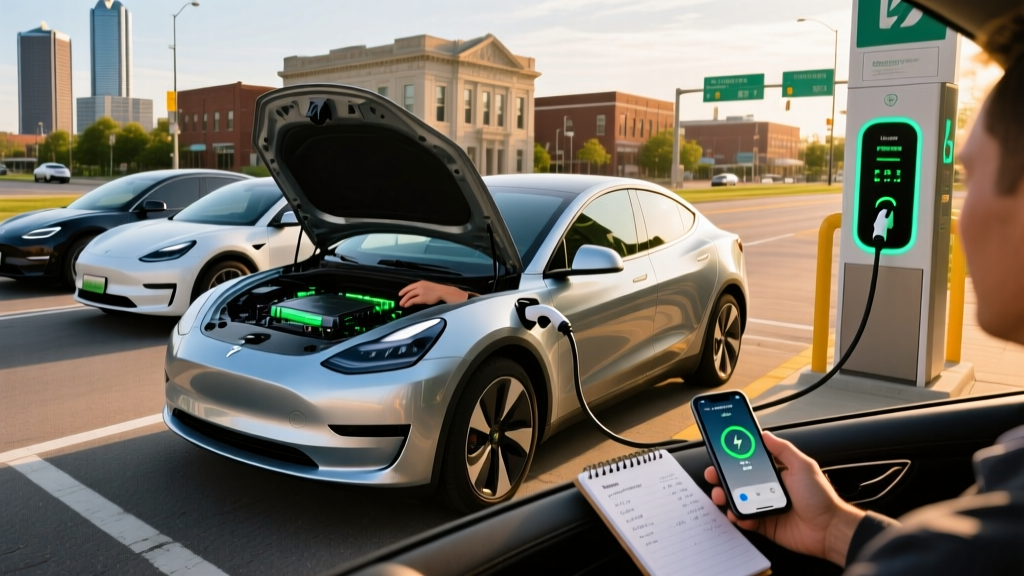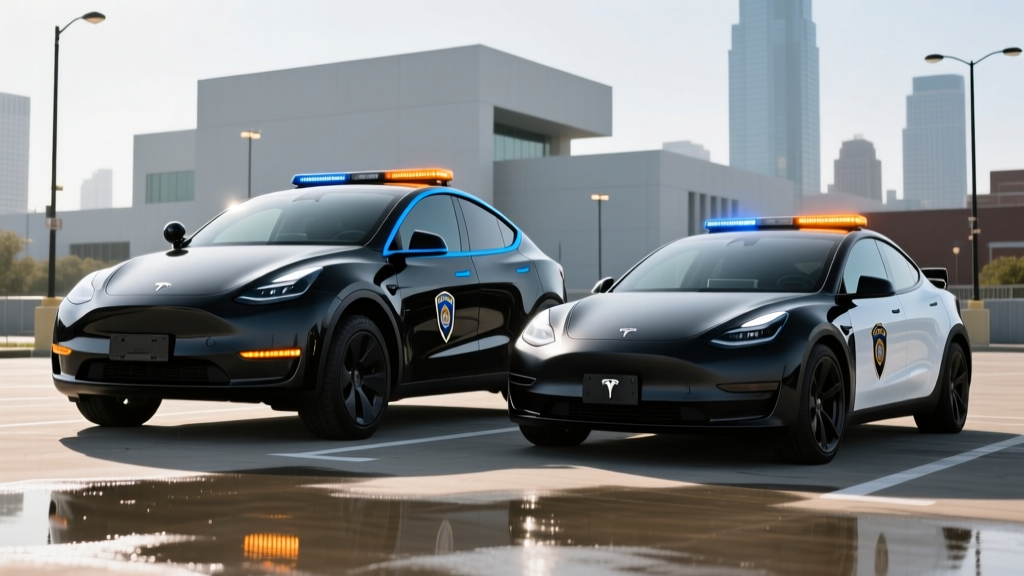
Law enforcement agencies across the United States have been quietly swapping their gas-guzzling Ford Explorers and Dodge Chargers for Tesla police vehicles. From the LAPD to small-town departments in Georgia and Michigan, the Tesla police fleet experiment has moved well beyond pilot programs. But does a consumer-grade electric sedan or crossover actually hold up to the rigors of shift work, idle-heavy patrols, and high-speed pursuits? This review evaluates the two Tesla models most commonly adopted by police departments — the 2026 Tesla Model Y Long Range AWD and the 2026 Tesla Model 3 Long Range AWD — through the lens of real-world fleet viability, charging logistics, range under patrol conditions, and total cost of ownership for municipal buyers.
Why Departments Are Adopting Tesla Police Vehicles
The economics of Tesla police cruisers are compelling on paper. A conventional police interceptor idles for hours during shifts, burning fuel at zero miles per gallon. The U.S. Department of Energy estimates that police vehicles idle between 30% and 60% of their operating time. An electric patrol car, by contrast, consumes minimal energy while stationary — running HVAC, radios, laptops, and light bars off the high-voltage traction battery with near-zero "idle" cost.
Early adopters like the Bargersville, Indiana Police Department (which began deploying Tesla Model 3s in 2022) reported fuel and maintenance savings exceeding $4,000 per vehicle per year. The Fremont, California PD — operating in Tesla's home city — has integrated Model Y units into patrol duty. By 2026, dozens of agencies have published fleet data confirming that Tesla police vehicles deliver meaningful operational savings, though not without trade-offs that fleet managers must understand before signing a purchase order.
Specs at a Glance: Model Y vs. Model 3 for Police Duty
| Specification | Model Y Long Range AWD | Model 3 Long Range AWD |
|---|---|---|
| EPA Range | 320 miles | 341 miles |
| Battery Capacity (usable) | ~75 kWh (NMC) | ~75 kWh (NMC) |
| Drivetrain | Dual-Motor AWD | Dual-Motor AWD |
| Horsepower | ~384 hp | ~384 hp |
| 0–60 mph | 4.8 seconds | 4.2 seconds |
| Top Speed | 135 mph | 145 mph |
| MPGe (combined) | 117 MPGe | 131 MPGe |
| Efficiency | 28 kWh/100 mi | 25 kWh/100 mi |
| Max DC Fast Charge | 250 kW | 250 kW |
| 10–80% DC Charge Time | ~27 minutes | ~27 minutes |
| Level 2 Home/Depot Rate | 11.5 kW (~44 mi/hr) | 11.5 kW (~48 mi/hr) |
| Cargo Volume (rear seats up) | 30.2 cu ft | 21.0 cu ft (trunk) |
| Cargo Volume (rear seats down) | 72.1 cu ft | N/A (sedan) |
| Rear Legroom | 41.6 in | 35.2 in |
| Base MSRP (2026) | $48,990 | $42,490 |
| Battery/Drive Unit Warranty | 8 yr / 120,000 mi | 8 yr / 120,000 mi |
| Basic Vehicle Warranty | 4 yr / 50,000 mi | 4 yr / 50,000 mi |
Real-World Range for Patrol and Pursuit Conditions
Highway patrol at 75–85 mph: Expect ~240–270 miles (Model Y) and ~260–290 miles (Model 3). Aerodynamic drag increases exponentially above 70 mph, and police light bars add further drag.
City patrol with frequent stops/starts: Regenerative braking partially offsets stop-and-go inefficiency, yielding ~280–310 miles (Model Y) and ~300–325 miles (Model 3).
Cold-weather impact (below 32°F): Lithium-ion batteries lose 15–30% range in freezing temperatures, compounded by cabin heating demands. Northern-climate departments should budget for 200–240 usable miles per charge in winter for the Model Y.
Idle/equipment drain: Running HVAC, onboard computers, radios, and light bars during stationary operations draws roughly 1–3 kW continuously — equivalent to losing 5–15 miles of range per hour of idle time.
For most urban and suburban patrol shifts covering 80–150 miles per day, these Tesla police vehicles complete a full shift with substantial battery remaining. Highway-heavy jurisdictions and cold-climate departments need to plan for mid-shift top-ups or deploy shorter patrol rotations.
Charging Logistics: Depot, Precinct, and Field Charging
| Charging Level | Power | Miles Added per Hour | Best Use Case |
|---|---|---|---|
| Level 1 (120V outlet) | ~1.4 kW | ~5 mi/hr | Emergency/trickle only |
| Level 2 (240V depot charger) | 11.5 kW | ~44–48 mi/hr | Overnight shift-end charging |
| DC Fast Charge (Tesla Supercharger) | Up to 250 kW | ~200+ mi in 15 min | Mid-shift rapid top-up |
| DC Fast Charge (3rd-party CCS via adapter) | Up to 150–250 kW | Varies by station | Backup / non-Tesla networks |
Charging infrastructure is the single largest barrier to Tesla police fleet adoption. Departments must install Level 2 chargers at precincts or fleet depots — typically $2,500–$7,000 per charging stall including the Tesla Wall Connector ($475) and electrical work. A fleet of 10 Tesla patrol vehicles requires a dedicated charging plan, potentially including a panel upgrade to 400A service for simultaneous multi-vehicle charging.
The 250 kW DC fast-charging capability on both models means a 10–80% charge in approximately 27 minutes at a Tesla Supercharger. However, the charge curve tapers significantly above 80% — a full 80–100% top-off can add another 20–25 minutes. Fleet managers should train officers to charge to 80% during breaks rather than seeking full charges, optimizing both time and long-term battery health.
As of 2026, Tesla's Supercharger network has opened to other manufacturers via NACS adoption, but Tesla police vehicles retain native plug-and-charge access with no adapter needed — a meaningful reliability advantage over CCS-equipped competitors requiring handshake protocols with Electrify America or EVgo stations.
Pursuit Performance and Handling
The Model 3 Long Range AWD hits 60 mph in 4.2 seconds with 384 horsepower and a top speed of 145 mph — figures that outpace most conventional police interceptors. The Model Y is slightly slower at 4.8 seconds to 60 and a 135 mph top speed, but still outperforms the Ford Police Interceptor Utility Hybrid (0–60 in ~7.5 seconds) in straight-line acceleration.
Instant electric torque provides immediate response in pursuit scenarios with no turbo lag or transmission shift delay. The low center of gravity (battery pack mounted under the floor) yields flat cornering and stable high-speed behavior. However, both vehicles carry significant weight — the Model Y LR AWD tips the scales at approximately 4,400 lbs — and tire wear under aggressive pursuit driving is a documented fleet maintenance concern.
One limitation: sustained high-speed pursuit (extended runs above 100 mph) drains the battery rapidly. Departments in jurisdictions where high-speed chases are common should evaluate whether a Tesla police vehicle can serve as a primary pursuit unit or should supplement a mixed fleet.
Technology, Upfitting, and Police-Specific Considerations
Tesla's minimalist interior presents both advantages and challenges for law enforcement upfitting:
- Infotainment: The 15.4-inch center touchscreen (Model Y refresh) handles navigation, fleet telematics, and could theoretically integrate with mobile data terminal (MDT) software, though most departments still mount a separate ruggedized laptop.
- Autopilot: Tesla's basic Autopilot is an SAE Level 2 driver-assistance system — adaptive cruise control and lane centering. It is not autonomous driving and the officer must remain fully engaged. FSD (Supervised) adds automated lane changes and intersection handling but remains Level 2. This can reduce fatigue on highway patrol but must never replace active driving.
- Over-the-air updates: Tesla pushes software updates wirelessly, which can improve functionality but also introduces unpredictability — a fleet manager's concern if an update changes UI behavior or disables a feature mid-deployment.
- Upfitting challenges: Traditional police upfitters (Whelen, Code 3, Setina) have developed Tesla-specific light bar mounts, siren integrations, and prisoner transport partitions. However, the panoramic glass roof on the Model Y limits roof-mounted equipment placement, and the lack of physical buttons means auxiliary controls must be added via aftermarket switch panels.
- Frunk and cargo: The Model Y's 30.2 cu ft rear cargo area plus a front trunk (frunk) accommodate gear, evidence kits, and tactical equipment more readily than the Model 3's 21 cu ft sedan trunk.
Pricing, Fleet Cost, and Federal Tax Credit Eligibility
| Cost Factor | Model Y Long Range AWD | Model 3 Long Range AWD |
|---|---|---|
| Base MSRP | $48,990 | $42,490 |
| FSD (Supervised) Add-On | $8,000 | $8,000 |
| Typical Police Upfit (lights, siren, cage, wrap) | $8,000–$15,000 | $8,000–$15,000 |
| Estimated Total per Unit | $57,000–$72,000 | $50,500–$65,500 |
Federal Tax Credit (§30D) for Government Fleets: The IRS §30D clean vehicle credit provides up to $7,500 for qualifying new EVs. However, the credit is structured for individual taxpayers with income caps ($300,000 joint / $150,000 single), MSRP caps ($55,000 for sedans, $80,000 for SUVs/vans/pickups), and battery critical-mineral and component sourcing requirements. Municipal and government fleet purchases typically do not qualify for §30D because government entities have no federal tax liability.
Instead, government fleets may benefit from the Commercial Clean Vehicle Credit (§45W), which provides up to $7,500 for qualified commercial clean vehicles placed in service by tax-exempt organizations — claimable as a direct payment ("direct pay") under the Inflation Reduction Act. Fleet procurement officers should consult their municipal finance department and reference current IRS guidance to confirm eligibility, as battery sourcing requirements tighten annually through 2032.
State and local incentives vary widely and may offer additional rebates for government fleet electrification. Check your state energy office or Alternative Fuels Data Center for jurisdiction-specific programs.
Total Cost of Ownership: Tesla Police Cruiser vs. Gas Interceptor
| Cost Category | Tesla Model Y LR AWD | Ford PIU Hybrid (Gas) |
|---|---|---|
| Purchase + Upfit | $62,000 | $52,000 |
| Fuel / Electricity | $4,500 | $18,000 |
| Maintenance (oil, brakes, filters) | $2,800 | $9,500 |
| Tires (higher wear on heavy EV) | $3,600 | $2,800 |
| Depot Charger Install (amortized) | $3,500 | $0 |
| 5-Year Total | $76,400 | $82,300 |
The Tesla police vehicle commands a higher upfront cost but delivers lower operating expenses. Break-even typically occurs around year 3–4 depending on local electricity rates, annual mileage, and gas prices. Regenerative braking dramatically extends brake pad life — a major maintenance savings for stop-heavy patrol driving. However, tire replacement costs run higher due to the vehicle's weight and instant torque delivery.
Pros and Cons of Tesla Police Vehicles
- 60–75% lower fuel/energy cost vs. gas interceptors
- Dramatically reduced brake wear (regen braking)
- Silent patrol capability for stealth operations
- Instant torque for rapid pursuit response
- Zero tailpipe emissions (municipal sustainability goals)
- Lower scheduled maintenance (no oil, spark plugs, transmission fluid)
- Extensive Supercharger network for field charging
- Higher upfront purchase + upfit cost
- Depot charging infrastructure investment required
- Range drops 15–30% in freezing temperatures
- Heavy vehicle accelerates tire wear
- Glass roof limits light bar mounting options (Model Y)
- Touchscreen-only UI can be distracting during driving
- Body repair costs and times higher than conventional cruisers
- Limited prisoner transport space vs. full-size SUV interceptors
Who Should Consider Tesla Police Vehicles?
- Your department operates in a mild-to-moderate climate
- Patrol shifts cover under 150 miles per day
- You can install depot Level 2 charging at precinct locations
- Sustainability mandates or grant programs incentivize fleet electrification
- Urban/suburban patrol is the primary use case (not extended rural highway pursuit)
- Your jurisdiction requires frequent 200+ mile shifts without mid-shift charging breaks
- You operate in extreme cold climates (consistent sub-20°F winters)
- You need heavy-duty prisoner transport or K-9 unit cargo space
- Your budget cannot absorb upfront charging infrastructure costs
Frequently Asked Questions
What is the real-world range of a Tesla police vehicle on patrol?
The EPA rates the 2026 Model Y LR AWD at 320 miles and the Model 3 LR AWD at 341 miles. In real-world patrol conditions — mixing city stops, highway runs, HVAC use, and equipment power draw — expect 240–310 miles depending on speed, climate, and idle time. Cold weather can reduce this to 200–240 miles.
How fast does a Tesla police cruiser charge at the depot?
On a Level 2 depot charger at 11.5 kW, a full charge from 10% takes approximately 6.5 hours — ideal for overnight between shifts. At a Tesla Supercharger (250 kW DC), 10–80% takes about 27 minutes, suitable for mid-shift breaks.
Do Tesla police vehicles qualify for the federal EV tax credit?
The §30D credit is designed for individual taxpayers and generally does not apply to government fleet purchases. However, the §45W Commercial Clean Vehicle Credit offers up to $7,500 via "direct pay" for tax-exempt government entities, subject to battery sourcing requirements. Consult IRS guidance and your municipal finance office.
Is a Tesla police car worth it vs. a Ford Police Interceptor Utility?
For urban/suburban departments with depot charging access, the Tesla Model Y offers lower 5-year total cost of ownership (~$76,400 vs. ~$82,300 for the Ford PIU Hybrid at 75,000 miles), faster acceleration, and dramatically lower fuel and brake maintenance costs. For departments needing maximum cargo space, extreme cold-weather range, or long rural patrols, the Ford PIU remains the pragmatic choice.
Can Tesla Autopilot be used during police patrol?
Autopilot is an SAE Level 2 driver-assist system offering adaptive cruise and lane centering. It can reduce officer fatigue on highway segments, but the driver must remain fully engaged and hands-on at all times. It is not self-driving and should never replace active officer control during patrol or pursuit.
What are the biggest maintenance savings with a Tesla police vehicle?
Eliminating oil changes, transmission fluid, spark plugs, and exhaust system repairs saves thousands over a vehicle's service life. Regenerative braking extends brake pad life by 2–3x compared to gas interceptors. However, tire costs are higher due to vehicle weight (~4,400 lbs for the Model Y), and collision repair costs remain elevated due to Tesla's aluminum and high-strength steel body construction.