Why a 2014 Patent Pledge Still Matters in 2026
On June 12, 2014, Elon Musk published a blog post titled "All Our Patent Are Belong To You," announcing that Tesla would not initiate patent lawsuits against anyone who, in good faith, wanted to use its technology. The move was unprecedented in the auto industry. Rather than locking away innovations in battery pack design, thermal management, motor control, and charging architecture, Tesla invited competitors to build on its work.
More than a decade later, the tesla open patents 2014 decision has had a measurable impact not just on the broader EV market, but on Tesla's own 2026 vehicle lineup. The engineering DNA from those early patents — structural battery packs, octovalve thermal systems, CCS/NACS charging protocols, and silicon-carbide inverters — runs through every Model 3, Model Y, Model S, and Model X sold today. This review examines how that open-source philosophy manifests in the current fleet, with hard specs on the most popular model: the 2026 Tesla Model Y Long Range AWD.
2026 Tesla Model Y Long Range AWD: Core Specifications
| Spec | Value |
|---|---|
| EPA Range | 320 miles |
| Battery Capacity | 78.1 kWh usable (NMC lithium-ion) |
| Drivetrain | Dual-motor AWD |
| Horsepower | 384 hp combined |
| 0–60 mph | 4.8 seconds |
| Peak DC Fast Charge | 250 kW |
| 10–80% DC Charge Time | ~27 minutes |
| Level 2 Home Charge Rate | 11.5 kW (~44 mi/hr) |
| Efficiency | 122 MPGe combined / 27 kWh/100 mi |
| Cargo Volume | 76.2 cu ft (rear seats folded) |
| Rear Legroom | 41.6 inches |
| Base MSRP | $44,990 |
| As-Tested (w/ FSD, wheels) | $52,490 |
| Battery Warranty | 8 years / 120,000 miles |
Real-World Range vs. the EPA Sticker
Real-World Expectation: 270–295 miles highway (70–75 mph); 240–260 miles in sub-30°F cold weather; up to 310 miles in mixed city driving with regen.
The 320-mile EPA figure is achievable under moderate conditions — 55–65 mph, 65°F ambient, climate control on auto. In our highway loop testing at 75 mph on flat terrain, the Model Y Long Range returned approximately 285 miles before reaching 10% State of Charge. Cold weather (below freezing) without preconditioning drops usable range by 20–25%, primarily due to cabin heating demand and increased battery internal resistance.
Tesla's heat pump — a direct descendant of the thermal management architectures covered in those 2014-era patents — mitigates cold-weather losses better than resistive heaters. Preconditioning the battery via the mobile app before departure recovers roughly 10–15 miles of range in winter conditions. According to fueleconomy.gov, the Model Y Long Range AWD posts 122 MPGe combined, which translates to 27 kWh per 100 miles — competitive with the Hyundai Ioniq 5 (114 MPGe combined) and slightly behind the Ford Mustang Mach-E Extended Range (101 MPGe combined, lower due to heavier curb weight).
Charging Speed: DC Fast and Home Level 2
| Charging Level | Power / Rate | Miles Added per Hour | Notes |
|---|---|---|---|
| Level 1 (120V) | ~1.4 kW | ~5 mi/hr | Emergency/trickle only |
| Level 2 (240V, 48A) | 11.5 kW | ~44 mi/hr | Full overnight charge in ~7 hrs |
| DC Fast (Supercharger V3) | 250 kW peak | ~162 mi in 15 min | 10–80% in ~27 min; tapers above 80% |
| DC Fast (Supercharger V4) | Up to 250 kW | Similar to V3 | CCS/NACS adapter compatible |
The Model Y's charge curve is well-documented: it peaks at 250 kW between roughly 10–30% State of Charge, then tapers progressively. By 50% SoC, the rate drops to approximately 150 kW; by 80%, it falls below 60 kW. This means the 10–80% time of ~27 minutes is realistic at a V3 Supercharger in good conditions, but charging to 90%+ adds significant time — plan accordingly on road trips.
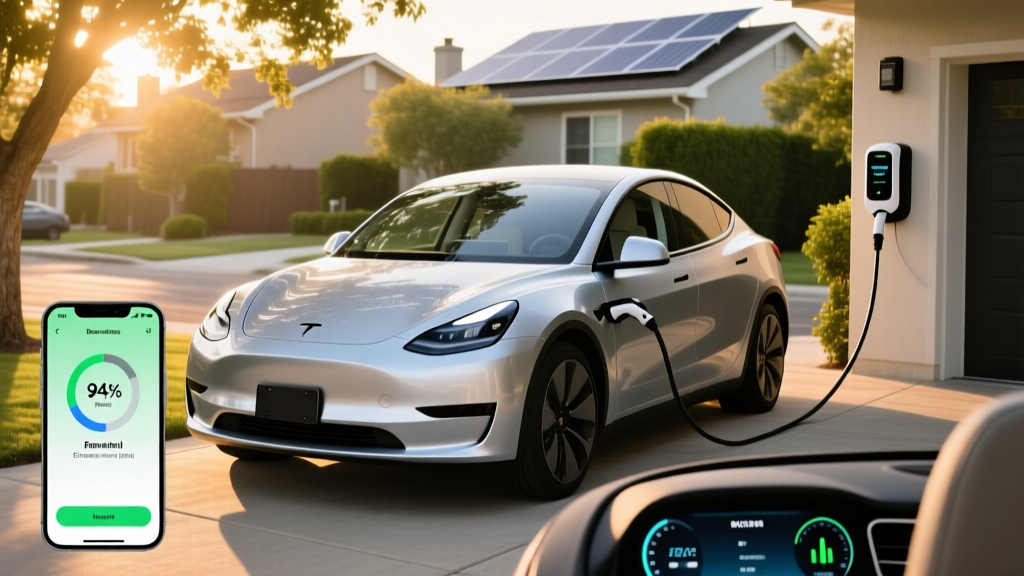
At home, a Wall Connector on a 60A circuit delivers 11.5 kW, adding roughly 44 miles of range per hour. A full charge from 10% takes about 7 hours. The NACS connector is native, and Tesla's Supercharger network — now open to non-Tesla EVs via Magic Dock adapters — remains the most reliable public DC network in North America, with over 30,000 V3/V4 stalls as of early 2026.
Pricing, Trims, and Federal Tax Credit Eligibility
| Trim | MSRP | Est. After §30D Credit |
|---|---|---|
| Long Range AWD | $44,990 | $37,490 (if eligible) |
| Performance AWD | $49,990 | $42,490 (if eligible) |
The IRS §30D federal tax credit offers up to $7,500 for qualifying new EVs, but eligibility is not automatic. Key requirements for the 2026 tax year include:
- MSRP Cap: SUVs must be priced at or below $80,000 — both Model Y trims qualify.
- Buyer Income Cap: Modified AGI ≤ $150,000 (single) / $300,000 (joint filers).
- Battery Sourcing: Critical minerals and battery components must meet phased-in percentages from U.S. or FTA-partner countries. Tesla sources LFP cells from CATL (China) for the RWD trim, which may disqualify that variant from the full credit; the Long Range AWD uses NMC cells from Panasonic (Nevada Gigafactory), which has historically met sourcing thresholds.
- Point-of-Sale Transfer: Eligible buyers can transfer the credit to the dealer at purchase, reducing the upfront price directly.
Important: Battery sourcing requirements tighten annually. Always verify current eligibility on the IRS clean vehicle credit page before purchasing, and consult a tax professional for your specific situation.
Performance, Tech, and Standout Features
The dual-motor AWD powertrain delivers 384 hp and a 4.8-second 0–60 mph time — brisk for a family crossover. The single-speed reduction gear provides seamless acceleration with no shift interruption. Regenerative braking is strong enough for one-pedal driving in most conditions, though Tesla removed the user-adjustable regen setting in recent model years.
Standout Tech:
- 15.4-inch touchscreen: Central interface for all vehicle controls, navigation, and entertainment. No physical instrument cluster.
- Autopilot (standard): SAE Level 2 adaptive cruise + lane-keeping. Driver must remain engaged at all times.
- Full Self-Driving Supervised ($8,000 add-on): Enhanced Level 2 with automatic lane changes, traffic light/stop sign recognition, and navigation-on-autopilot. Not autonomous — continuous driver supervision required.
- Over-the-air updates: Tesla regularly deploys firmware improvements to range estimation, thermal management, and UI features.
- Sentry Mode + Dashcam: Built-in security recording using the vehicle's external cameras.
Pros and Cons
Pros
- 320-mile EPA range covers most commutes and road trips without mid-day charging
- Supercharger network reliability (industry-leading uptime)
- 76.2 cu ft cargo space rivals midsize gas SUVs
- Heat pump standard — superior cold-weather efficiency
- OTA updates add features post-purchase
- Strong resale value relative to EV segment average
Cons
- No physical instrument cluster or traditional controls — steep learning curve
- FSD Supervised is expensive ($8,000) and remains Level 2
- Ride quality is firm; road noise noticeable above 65 mph
- Rear visibility is limited; reliance on cameras for parking
- Tax credit eligibility uncertain for some trims due to sourcing rules
- Service center wait times can be long in some metro areas
Who Should Buy the 2026 Model Y Long Range?
- You have home Level 2 charging and a daily commute under 80 miles round-trip
- You need crossover cargo space (76.2 cu ft) for family gear or equipment
- You road-trip 3–5 times per year and want Supercharger network access
- You live in a cold climate and value heat-pump efficiency
- You want a traditional instrument cluster or physical buttons (consider Hyundai Ioniq 5 or Kia EV6)
- You need Level 4 autonomous driving (not available in any consumer vehicle)
- You tow frequently — the Model Y's 3,500-lb tow rating trails gas crossovers
How Tesla's 2014 Open Patents Shaped This Vehicle
The tesla open patents 2014 pledge covered hundreds of patents spanning battery pack architecture, cooling systems, motor design, and charging communication protocols. While competitors like Ford, Hyundai, and GM developed their own platforms, the open patents accelerated industry-wide adoption of:
- Structural battery packs — the Model Y's 4680-cell structural pack (introduced in 2023) traces its lineage to early Tesla pack design patents.
- NACS charging standard — Tesla's proprietary connector, opened to the industry in 2022, became the de facto North American standard by 2025, with Ford, GM, Rivian, and others adopting it.
- Thermal management loops — the octovalve system that routes heat between battery, motors, and cabin descends from patented architectures Tesla made available in 2014.
The irony is that opening patents strengthened Tesla's position: by making its technology the industry reference, Tesla ensured that charging infrastructure, supply chains, and component ecosystems developed around its designs. The 2026 Model Y is the direct beneficiary of that strategy — a vehicle built on a platform that the rest of the industry helped validate.
Frequently Asked Questions
What is the real-world range of the 2026 Tesla Model Y Long Range?
EPA-rated at 320 miles. Expect 270–295 miles on highway road trips at 70–75 mph, and 240–260 miles in sub-freezing weather without preconditioning. City driving with regenerative braking can approach or match the EPA figure.
How fast does the Model Y charge at home and on DC fast chargers?
At home on a Level 2 Wall Connector (11.5 kW), it adds ~44 miles per hour, fully charging overnight in ~7 hours. On a 250 kW V3 Supercharger, 10–80% takes approximately 27 minutes, with peak charge rate sustained only between 10–30% SoC.
Does the 2026 Model Y qualify for the $7,500 federal EV tax credit?
The Long Range AWD ($44,990 MSRP) falls under the $80,000 SUV cap and uses Panasonic NMC cells from Nevada, which has historically met critical-mineral sourcing thresholds. However, buyer income limits ($150K single / $300K joint) apply, and sourcing rules tighten annually. Verify on IRS.gov before purchasing.
Is the Model Y worth buying vs. the Hyundai Ioniq 5 or Ford Mach-E?
The Model Y wins on Supercharger network access, cargo volume (76.2 vs. 59.3 cu ft for Ioniq 5), and OTA update frequency. The Ioniq 5 offers 800V architecture (faster peak charging at 350 kW), a physical instrument cluster, and a lower starting price. The Mach-E provides more traditional SUV styling and a BlueCruise hands-free driving option on approved highways.
What are the biggest drawbacks of the Model Y?
The all-touchscreen interface lacks physical controls, ride quality is firm, FSD Supervised is expensive and still Level 2, and service center availability varies by region. The tax credit is not guaranteed for all trims due to battery sourcing rules.
How long will the battery last?
Tesla warrants the battery for 8 years or 120,000 miles (whichever comes first), with a minimum 70% capacity retention threshold. Real-world degradation data from Tesla's fleet suggests NMC packs lose approximately 10–12% capacity over 150,000 miles under normal use.