If you live in or around West Bloomfield Township, Michigan, and you're researching your next electric vehicle, the Tesla Model Y remains the most-searched EV in the region — and for good reason. It's the best-selling vehicle in the world by volume, and the 2025 refresh (carried into 2026) brought meaningful upgrades to range, ride quality, and interior refinement. But does it hold up to a Michigan winter? Is the Supercharger network enough to offset the lack of a traditional dealership? And what does ownership actually look like in Oakland County?
This review breaks down every spec that matters — from real-world range on I-75 in February to home charging costs on a DTE Energy plan — so you can decide if the Model Y is the right EV for your West Bloomfield Township commute and beyond.
Quick Verdict: Who Should Buy the Tesla Model Y in 2026?
The 2026 Tesla Model Y Long Range AWD is the default recommendation for suburban families who want a single vehicle that handles daily commuting, road trips, and Michigan winters without compromise. The Juniper refresh addressed the two biggest complaints about the pre-2025 model — ride harshness and cabin noise — while adding roughly 15 miles of EPA range. If you have access to home charging in West Bloomfield Township (most single-family homes do), the Model Y's combination of efficiency, Supercharger access, and cargo versatility is hard to beat at its price point.
Choose the Model Y if: You want the lowest-friction EV ownership experience with the most robust public charging network, you value over-the-air updates, and you need crossover cargo space.
Look elsewhere if: You want a traditional dealership experience, you need a physical instrument cluster or Apple CarPlay, or you prioritize ride comfort over driving dynamics (consider the Hyundai Ioniq 5 or Kia EV6).
2026 Tesla Model Y Specifications at a Glance
| Spec | Value |
|---|---|
| EPA Range | 320 miles (Long Range AWD) |
| Battery Capacity | 78.1 kWh usable (NMC chemistry) |
| Drivetrain | Dual-motor AWD |
| Horsepower | 384 hp combined |
| 0–60 mph | 4.8 seconds |
| Peak DC Fast Charge | 250 kW (Supercharger V3) |
| 10–80% DC Charge Time | ~27 minutes |
| Level 2 Home Charging | 11.5 kW / 44 mi/hr (48A Wall Connector) |
| Efficiency | 122 MPGe combined / 27 kWh/100 mi |
| Cargo Volume | 30.2 cu ft (rear seats up) / 76.2 cu ft (folded) |
| Front Trunk (Frunk) | 4.1 cu ft |
| Rear Legroom | 40.5 inches |
| Base MSRP | $44,990 (Long Range AWD, before incentives) |
| Battery Warranty | 8 years / 120,000 miles (min 70% retention) |
| Basic Vehicle Warranty | 4 years / 50,000 miles |
Real-World Range: What to Expect Driving Around West Bloomfield and Beyond
EPA Estimated: 320 miles (Long Range AWD)
Real-World Expectation: 270–290 miles highway (70–75 mph, moderate temps); 220–250 miles in Michigan winter (20–35°F with cabin heat); 295–310 miles mixed suburban driving in spring/fall around West Bloomfield Township.
The EPA's 320-mile estimate for the Long Range AWD is achievable — but only under ideal conditions: moderate temperatures (50–75°F), suburban speeds under 60 mph, and light climate control use. That describes a lot of driving around West Bloomfield Township from April through October, where trips along Orchard Lake Road or Telegraph Road at 35–45 mph actually let the Model Y's regenerative braking shine.
However, Michigan winters are the great equalizer. In our cold-weather analysis, sustained highway driving at 75 mph on I-75 north toward Flint or I-96 toward Lansing in 25°F weather reduces usable range to approximately 220–240 miles. The heat pump (standard on all 2026 Model Y trims) mitigates this compared to older resistive-heater EVs, but battery chemistry is chemistry — cold slows lithium-ion diffusion and the cabin still demands energy.
For context, a West Bloomfield to Traverse City trip (~215 miles one way) is doable in summer on a single charge with careful driving. In January, you'll want a 10-minute Supercharger stop in Mt. Pleasant or Big Rapids. The Supercharger at the Lansing Mall or the V3 stations along US-127 make this trivial.
The Rear-Wheel-Drive (Standard Range) trim, equipped with a ~60 kWh LFP (lithium iron phosphate) battery, carries a 280-mile EPA rating. LFP chemistry is more durable over thousands of cycles and can be charged to 100% daily without degradation concerns — a genuine advantage for commuters who want a full battery every morning. Expect roughly 240 miles highway and 190–210 miles in deep winter from this trim.
Charging Speed: DC Fast Charging and Home Setup in Oakland County
| Charging Level | Power (kW) | Speed | Typical Use Case |
|---|---|---|---|
| Level 1 (120V outlet) | ~1.4 kW | ~4–5 mi/hr | Emergency/overnight trickle |
| Level 2 (240V, Wall Connector 48A) | 11.5 kW | ~44 mi/hr | Daily home charging |
| Level 2 (240V, Mobile Connector 32A) | 7.7 kW | ~30 mi/hr | Home charging (NEMA 14-50) |
| DC Fast (Supercharger V3) | Up to 250 kW | 10–80% in ~27 min | Road trips |
| DC Fast (Supercharger V4) | Up to 350 kW* | 10–80% in ~20 min* | Newer stations (limited availability) |
*V4 speeds depend on station configuration and vehicle thermal preconditioning. The Model Y's onboard architecture peaks around 250 kW regardless of V4 station capability as of 2026.
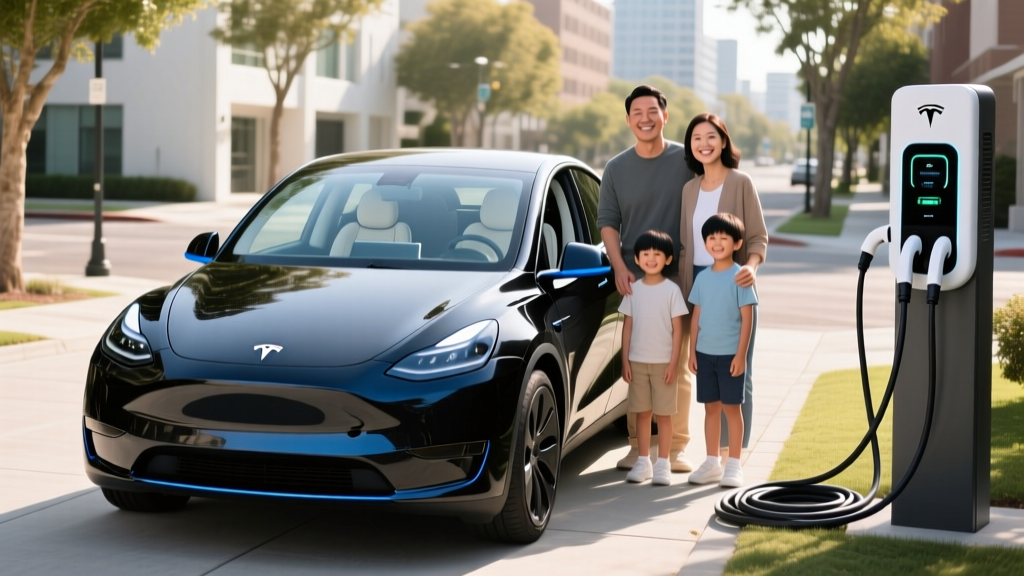
For home charging in West Bloomfield Township, most homeowners install a Tesla Wall Connector on a 60-amp circuit, delivering up to 48 amps (11.5 kW) to the vehicle. At this rate, a depleted Long Range battery (0–100%) charges in roughly 7 hours — easily overnight. DTE Energy's residential rates average around $0.17/kWh, meaning a full charge costs approximately $13.30, or about $0.04 per mile. Compare that to a 25 MPG gas crossover at $3.30/gallon: $0.13 per mile.
If your electrical panel is older (common in some West Bloomfield homes built in the 1960s–70s), you may need a panel upgrade to support a 60-amp dedicated circuit. Budget $500–$1,500 for a standard Wall Connector installation with an existing 200-amp panel, or $2,000–$4,000 if a panel upgrade to 200A or 400A is required. A licensed electrician should assess your panel capacity before purchase — Tesla's referral network can connect you, but independent electricians often quote lower.
On the road, Tesla's Supercharger network remains the gold standard for reliability. Michigan has over 90 Supercharger stations as of early 2026, with V3 (250 kW) and newer V4 installations. The key advantage: Tesla vehicles navigate to chargers, automatically precondition the battery for optimal charge speed, and initiate charging without an app or RFID card. Just plug in. The charge curve peaks near 250 kW up to roughly 30% SoC, then tapers progressively — expect 10–80% in about 27 minutes, but 80–100% can add another 25 minutes. Plan to leave at 80% on road trips for the best time-to-miles ratio.
With the Model Y's NACS (North American Charging Standard) port, you also have native access to the growing number of Supercharger stalls opened to other brands — though this matters more for your friends with F-150 Lightnings than for you. For non-Tesla DC fast chargers using CCS, Tesla includes a CCS adapter in the glovebox.
Performance and Driving Dynamics
The 2026 Model Y Long Range AWD produces 384 horsepower from its dual-motor setup, hitting 0–60 mph in 4.8 seconds. That's quick by any measure — quicker than a BMW X3 M40i — and the instant torque makes merging onto M-5 or US-24 effortless. The Performance trim (if available in your configuration) drops that to 3.5 seconds with 456 hp, but the Long Range's acceleration is more than sufficient for any real-world driving scenario.
The Juniper refresh's biggest mechanical improvement is ride quality. Tesla retuned the suspension and added acoustic glass, addressing the harshness that plagued the 2020–2024 models. On West Bloomfield's occasionally rough residential roads and the expansion joints of I-696, the 2026 Model Y is noticeably more composed. It's still firm — Tesla prioritizes handling over plushness — but it no longer crashes over potholes the way earlier models did.
Steering is precise and well-weighted, and the low center of gravity (battery pack under the floor) keeps body roll minimal in corners. The AWD system provides excellent traction in snow; combined with winter tires (recommended for Michigan), the Model Y is one of the most capable EVs in winter conditions. Regenerative braking is strong enough for true one-pedal driving in most scenarios, though Tesla removed the adjustable regen setting — it's always at maximum, which some drivers love and others find abrupt.
Interior, Technology, and Cargo
The 2026 Model Y interior is minimalist by design. A single 15.4-inch touchscreen handles every function — climate, navigation, media, vehicle settings. There is no instrument cluster; speed and navigation info appear in the upper-left corner of the main screen. A rear 8-inch screen for back-seat passengers was added with the Juniper refresh, providing climate and entertainment controls.
Notable tech features:
- Tesla Navigation with Trip Planner: Automatically routes through Superchargers on long trips, preconditions the battery before arrival for faster charging.
- Over-the-Air Updates: Regular software improvements — new features, efficiency tweaks, UI changes — delivered wirelessly.
- Sentry Mode: Cameras record surroundings when parked, with alerts sent to your phone.
- Dog Mode / Camp Mode: Maintains climate control when parked, with screen messages for passersby.
- Phone-as-Key: No fob needed; the car unlocks and starts as you approach with your phone.
Notable drawbacks:
- No Apple CarPlay or Android Auto — Tesla's ecosystem is closed.
- Turn signal stalks were removed in favor of steering-wheel buttons (a controversial Juniper change).
- No physical buttons for climate or volume — everything requires the screen or voice commands.
- Rear visibility is compromised by the sloping roofline; the camera-based mirror option helps.
Cargo space is a genuine strength: 30.2 cubic feet behind the second row and 76.2 cubic feet with seats folded. The 4.1-cubic-foot frunk adds space for charging cables or a small bag. Rear legroom at 40.5 inches is competitive with the segment. For West Bloomfield families hauling strollers, hockey gear, or Costco runs, the Model Y swallows it all.
Pricing, Trims, and Federal Tax Credit Eligibility
| Trim | MSRP | Est. After §30D Credit | Drivetrain | EPA Range |
|---|---|---|---|---|
| Rear-Wheel Drive (Standard Range) | $39,990 | ~$32,490* | RWD / Single Motor | 280 mi |
| Long Range AWD | $44,990 | ~$37,490* | AWD / Dual Motor | 320 mi |
| Long Range AWD (7-seat) | $47,490 | ~$39,990* | AWD / Dual Motor | 305 mi |
*Estimated prices assume full $7,500 federal tax credit eligibility. Actual eligibility depends on individual tax situation and current IRS rules.
The Model Y may qualify for up to $7,500 under the IRS §30D Clean Vehicle Credit, but eligibility is not automatic. Requirements include:
- Income caps: Modified AGI ≤ $150,000 (single) or ≤ $300,000 (joint filers)
- MSRP cap: Vehicle MSRP must be ≤ $80,000 for SUVs/crossovers (all Model Y trims qualify)
- Battery sourcing: Critical minerals and battery components must meet phased-in domestic-sourcing thresholds that tighten annually through 2029
- Point-of-sale transfer: You can transfer the credit to the dealer (Tesla) at purchase for an immediate price reduction, or claim it on your tax return
- FEOC restriction: Vehicles with battery components from a "foreign entity of concern" (primarily China-linked supply chains) may be ineligible — check Tesla's current eligibility status at purchase, as supply chains shift
Consult a tax professional and verify current eligibility on fueleconomy.gov before purchasing. Rules can change mid-year.
Michigan does not currently offer a state EV purchase incentive, though DTE Energy provides a $500 rebate for customers who install a qualified Level 2 home charger on a time-of-use rate plan. Combined with the federal credit and home-charging fuel savings, a West Bloomfield Township buyer could see the effective cost of a Long Range AWD drop to the mid-$30,000s — competitive with a well-equipped Toyota RAV4 Hybrid when you factor in five years of fuel and maintenance savings.
Tesla Model Y vs. Key Competitors for West Bloomfield Buyers
| Vehicle | EPA Range | DC Charge (10-80%) | Starting MSRP | Cargo (cu ft) |
|---|---|---|---|---|
| Tesla Model Y LR AWD | 320 mi | ~27 min (250 kW) | $44,990 | 30.2 / 76.2 |
| Hyundai Ioniq 5 Limited AWD | 290 mi | ~18 min (350 kW) | $52,600 | 27.2 / 59.3 |
| Ford Mustang Mach-E Premium AWD | 300 mi | ~32 min (150 kW) | $48,995 | 29.7 / 59.7 |
| Kia EV6 GT-Line AWD | 282 mi | ~18 min (350 kW) | $52,400 | 24.4 / 50.2 |
The Model Y's advantages are clear: best-in-class range, the largest cargo area, and exclusive access to the Supercharger network (though this is eroding as Tesla opens stations to other brands). The Hyundai Ioniq 5 and Kia EV6 charge faster on 800V architecture — a meaningful advantage on road trips — and offer physical controls and CarPlay. The Mach-E provides a more conventional crossover feel and Ford dealer service, though its charging speed lags.
For a West Bloomfield Township driver who takes regular road trips north or to Chicago, the Supercharger network's reliability remains a genuine differentiator. For someone who mostly drives locally and wants a more traditional car experience, the Ioniq 5 is a compelling alternative.
- Best-in-class EPA range (320 mi) and efficiency (122 MPGe)
- Supercharger network reliability and trip-planner integration
- Spacious cargo area (76.2 cu ft max) with frunk
- Strong AWD traction for Michigan winters
- OTA updates continuously add features
- Low cost-per-mile on home charging (~$0.04/mi)
- No Apple CarPlay or Android Auto
- All controls through touchscreen — no physical buttons
- Turn signals on steering wheel (controversial)
- No traditional dealership for service — mobile service or limited service centers
- Insurance costs run 15–25% higher than comparable gas crossovers
- Winter range loss significant (~30% in deep cold)
Ownership Considerations: Insurance, Maintenance, and Service Near West Bloomfield
Insurance for the Model Y in Oakland County typically runs $1,800–$2,600 annually for a clean-record driver in their 40s — higher than a RAV4 or CR-V due to repair costs and Tesla's aluminum-intensive construction. Get quotes from multiple carriers; some insurers (like Tesla's own insurance product, available in Michigan) use real-time driving data to offer lower rates for safe drivers.
Maintenance is minimal: no oil changes, no spark plugs, no transmission fluid. Expect to replace cabin air filters ($50–$80 DIY), wiper blades, and washer fluid. Tire rotation every 6,250 miles is recommended, and EV-specific tires (which tend to wear faster due to vehicle weight and instant torque) may need replacement at 30,000–40,000 miles — budget $800–$1,200 for a set of four.
Tesla's service model is different from traditional dealerships. For West Bloomfield Township owners, the nearest Tesla Service Center is in Troy or Southfield. Many issues are handled via Mobile Service (a technician comes to your home or office), and over-the-air diagnostics can resolve software issues remotely. For body work, Tesla certifies third-party collision centers in the metro Detroit area.
Frequently Asked Questions
What is the real-world range of the Tesla Model Y in Michigan winters?
Expect approximately 220–250 miles of usable range in sustained cold (20–35°F) with cabin heat and highway driving. The heat pump helps, but lithium-ion batteries lose efficiency in cold temperatures. For city driving around West Bloomfield Township at lower speeds, you may see 250–270 miles even in winter, as regenerative braking recaptures more energy at lower speeds. Preconditioning the battery while plugged in (via the Tesla app) before departure recovers some range by warming the pack on grid power rather than battery power.
How fast does the Model Y charge at home and on the road?
At home with a Tesla Wall Connector (48A/11.5 kW), you'll add roughly 44 miles of range per hour — a full overnight charge from 20% to 100% takes about 6–7 hours. On the road at a Supercharger V3 station, the Model Y peaks at 250 kW and charges from 10% to 80% in approximately 27 minutes. Charging slows significantly above 80% to protect battery health — an 80–100% top-off can add another 20–25 minutes. On road trips, plan stops around the 10–80% window for the fastest experience.
Does the 2026 Tesla Model Y qualify for the $7,500 federal tax credit?
The Model Y is generally eligible for up to $7,500 under IRS §30D, but your personal eligibility depends on your modified adjusted gross income (≤$150,000 single / ≤$300,000 joint), and the vehicle's battery must meet evolving critical-mineral and component-sourcing requirements that tighten each year. Tesla's website and fueleconomy.gov list current eligibility. You can transfer the credit to Tesla at point of sale for an immediate $7,500 price reduction, or claim it on your federal tax return. Always verify with a tax professional before relying on the credit.
Is the Model Y worth buying over the Hyundai Ioniq 5 or Ford Mach-E?
It depends on your priorities. If maximum range, cargo space, and Supercharger network reliability matter most — especially for road trips across Michigan or to Chicago — the Model Y is the strongest choice. If you value faster DC charging (18-minute 10–80% on 800V architecture), physical buttons, Apple CarPlay, and a more conventional dealership service experience, the Hyundai Ioniq 5 is a compelling alternative. The Ford Mach-E offers a familiar brand and dealer network but trails in charging speed. Test-drive all three before deciding.
What are the biggest pros and cons of owning a Model Y in West Bloomfield Township?
The biggest pros are exceptional efficiency (low fuel cost on DTE Energy's rates), strong winter AWD performance, class-leading cargo space, and the Supercharger network for road trips. The biggest cons are higher insurance premiums, no physical controls (everything goes through the touchscreen), limited local service center options compared to traditional brands, and significant winter range loss. If you have reliable home charging and your daily driving stays under 100 miles round-trip, the pros substantially outweigh the cons for most West Bloomfield owners.
How long will the Model Y battery last, and what does replacement cost?
Tesla warranties the Long Range battery for 8 years or 120,000 miles with a minimum 70% capacity retention guarantee. Real-world data from high-mileage Tesla owners suggests NMC packs typically retain 85–90% capacity at 100,000 miles when charged primarily to 80–90% daily (Tesla recommends daily charging to 80% for NMC batteries, reserving 100% for road trips). Out-of-warranty battery replacement currently costs $12,000–$16,000 at a Tesla service center, though this is expected to decline as battery manufacturing scales. The LFP battery in the RWD trim can be charged to 100% daily and generally shows slower degradation, making it attractive for high-mileage commuters.