The Tesla China Sales Decline: Context for US EV Shoppers
Headlines about a Tesla China sales decline in early 2026 have rattled investors and sparked debate about whether Tesla's core products still compete. But for US-based EV buyers, the real question isn't about Shanghai showroom foot traffic — it's whether Tesla's current US-market lineup still delivers the range, charging speed, and value you need. The answer, as always, lives in the numbers.
Tesla's China volume has faced pressure from aggressive domestic competitors like BYD, NIO, and Xiaomi, which now offer compelling EVs at lower price points with localized features. In Q1 2026, Tesla's China wholesale deliveries fell roughly 15% year-over-year according to Reuters reporting on CPCA data. But the US-market Model Y and Model 3 have received meaningful updates — including the "Juniper" refresh for the Model Y — that change the ownership calculus stateside.
Below, we profile the two Tesla models most US buyers consider, with exact EPA figures, real-world range expectations, charging data, and tax-credit eligibility so you can decide whether a Tesla still earns your garage space.
2026 Tesla Model Y (Juniper): Range, Battery, and Real-World Efficiency
The refreshed Model Y Long Range AWD remains Tesla's volume leader in the US. Here's what the 2026 model delivers on paper and on the road.
| Spec | Value |
|---|---|
| EPA Range | 320 miles |
| Battery (usable) | ~75 kWh, NMC chemistry |
| Drivetrain | Dual-motor AWD |
| Horsepower | 384 hp |
| 0-60 mph | 4.8 seconds |
| MPGe (combined) | 111 MPGe |
| Efficiency | 30 kWh/100 mi |
| Cargo (rear seats up) | 30.2 cu ft |
| Cargo (rear seats folded) | 72.1 cu ft |
| Rear Legroom | 38.2 in |
| Battery Warranty | 8 years / 120,000 miles |
| Base MSRP | $48,990 |
The Juniper refresh brought a stiffer body structure, retuned suspension, and improved acoustic glass — changes that marginally reduce efficiency at speed but meaningfully improve highway comfort. The NMC (nickel manganese cobalt) battery chemistry offers higher energy density than LFP, which is why the Long Range achieves its 320-mile EPA figure in a relatively compact pack.
Charging Speed: DC Fast Charge and Home Level 2
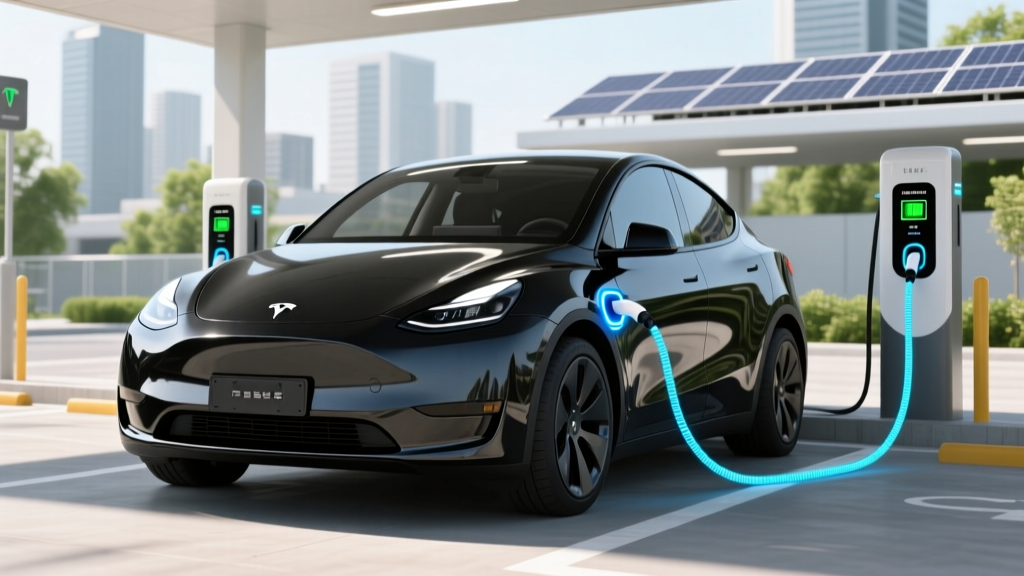
Charging remains a Tesla strong point, both because of the vehicle's architecture and the Supercharger network's reliability.
| Charging Level | Rate | Speed / Time |
|---|---|---|
| DC Fast Charge (peak) | 250 kW | 10–80% in ~25 minutes |
| DC Fast Charge (sustained avg.) | ~170 kW | Peak tapers above 50% SoC |
| Level 2 (240V / 48A) | 11.5 kW | ~37 miles of range per hour |
| Level 1 (120V / 12A) | ~1.4 kW | ~4 miles of range per hour |
The 250 kW peak is meaningful but not sustained. In real-world DC fast charging, the Model Y's charge curve tapers noticeably once you pass 50% State of Charge (SoC). The 10–80% time of approximately 25 minutes assumes you arrive at a V3 or V4 Supercharger with a preconditioned battery (the car does this automatically when you navigate to a charger). Without preconditioning — say, at a non-Tesla charger using the included NACS adapter — expect 10–80% closer to 30–35 minutes in cool weather.
At home, a Wall Connector on a 60-amp circuit delivers 11.5 kW, replenishing a full battery in roughly 7 hours. Most owners who charge overnight never need public DC fast charging for daily use.
2026 Tesla Model 3 Long Range: The Sedan Alternative
The Model 3 received its "Highland" refresh for the 2024 model year and carries forward into 2026 with minor software and packaging updates. It remains the more efficient and affordable entry point.
| Spec | Value |
|---|---|
| EPA Range | 341 miles |
| Battery (usable) | ~75 kWh, NMC |
| Drivetrain | Dual-motor AWD |
| Horsepower | 346 hp |
| 0-60 mph | 4.2 seconds |
| MPGe (combined) | 121 MPGe |
| Efficiency | 27 kWh/100 mi |
| Cargo (trunk + frunk) | 23.0 cu ft |
| Rear Legroom | 35.3 in |
| Battery Warranty | 8 years / 120,000 miles |
| Base MSRP | $42,490 |
The Model 3's lower curb weight and sleeker aerodynamic profile give it a 21-mile EPA advantage over the Model Y despite sharing a nearly identical battery pack. Real-world highway range lands around 280–300 miles in moderate weather, with similar 20–30% winter losses.
Where the Model 3 loses ground: rear-seat headroom is tighter (37.8 in vs. the Model Y's 39.7 in), cargo volume is significantly less, and the low-slung ride height makes ingress and egress harder for some buyers. If you regularly carry rear-seat passengers or bulky gear, the Model Y's crossover form factor justifies its price premium.
Federal Tax Credit: Does Tesla Still Qualify?
Tesla vehicles remain eligible for the IRS §30D federal tax credit, but eligibility is not universal. Here's what you need to know for 2026:
- MSRP caps: The Model Y qualifies as an SUV (MSRP cap: $80,000). The Model 3 qualifies as a sedan (MSRP cap: $55,000). Both base trims clear these thresholds comfortably.
- Buyer income caps: Modified adjusted gross income (MAGI) must not exceed $150,000 (single), $225,000 (head of household), or $300,000 (married filing jointly).
- Battery sourcing requirements: The full $7,500 credit requires meeting both critical-minerals and battery-component sourcing thresholds. Tesla's US-built vehicles have largely met these requirements since late 2024, but annual threshold increases mean you should verify current-year compliance on fueleconomy.gov before purchasing.
- Point-of-sale transfer: You can elect to transfer the credit to the dealer at purchase, reducing your out-of-pocket cost immediately rather than waiting for a tax refund.
| Model | Base MSRP | Est. Credit | Net Price (before state incentives) |
|---|---|---|---|
| Model 3 Long Range AWD | $42,490 | $7,500* | ~$34,990 |
| Model Y Long Range AWD | $48,990 | $7,500* | ~$41,490 |
*$7,500 credit assumes full §30D eligibility. Confirm sourcing compliance and income qualification with a tax professional before purchase. State incentives vary and are not reflected here.
Driver Assistance: Autopilot and FSD (Supervised)
Every Tesla ships with Basic Autopilot, which includes adaptive cruise control and lane-centering on marked highways. This is a SAE Level 2 system — it does not drive the car for you. You must keep your hands on the wheel and eyes on the road at all times.
Full Self-Driving (Supervised) adds automated lane changes, traffic-light and stop-sign recognition, and navigation-based highway on/off-ramp handling. As of 2026, FSD costs $8,000 as a one-time purchase or $99/month. Its value proposition depends heavily on your commute: it excels on long, monotonous highway stretches but still requires active supervision and occasional intervention in construction zones, unmapped intersections, and adverse weather.
How Tesla Stacks Up Against Key Competitors
The Tesla China sales decline partly reflects how competitive the EV market has become. US buyers now have credible alternatives at similar price points:
| Spec | Tesla Model Y LR | Hyundai Ioniq 5 Limited | Ford Mustang Mach-E ER AWD |
|---|---|---|---|
| EPA Range | 320 mi | 305 mi | 300 mi |
| Peak DC Charge | 250 kW | 238 kW | 150 kW |
| 10–80% Time | ~25 min | ~20 min | ~36 min |
| 0–60 mph | 4.8 sec | 5.1 sec | 5.6 sec |
| Cargo (seats up) | 30.2 cu ft | 27.2 cu ft | 29.7 cu ft |
| Base MSRP | $48,990 | $52,600 | $48,995 |
| Charging Network | NACS (Supercharger native) | NACS (adapter or 2025+) | NACS (adapter) |
Tesla's advantages remain its Supercharger network (now open to other brands via NACS adapters, but still the most reliable), strong efficiency (kWh/100mi), and over-the-air software updates that add features post-purchase. Where competitors close the gap or win: Hyundai's 800V architecture enables faster 10–80% charging, Ford offers a more conventional interior layout with physical controls, and both provide dealer-based service networks that some buyers prefer over Tesla's mobile-ranger model.
Pros and Cons at a Glance
- Class-leading efficiency (30 kWh/100mi for Model Y)
- Native NACS access to 250 kW Supercharger network — no adapter needed
- Over-the-air updates continuously add features
- Spacious cargo area with flat floor (72.1 cu ft in Model Y)
- Strong resale value relative to EV segment average
- Qualifies for full $7,500 §30D credit (verify sourcing annually)
- No physical controls — all functions routed through touchscreen
- Service wait times can stretch weeks in high-volume metro areas
- FSD (Supervised) is expensive and still requires full driver attention
- Rear-seat comfort improved with Juniper but still trails Hyundai/Kia rivals
- Panel gaps and paint quality remain inconsistent vs. legacy OEMs
- No Apple CarPlay or Android Auto integration
Who Should Buy a Tesla in 2026 — And Who Shouldn't
Buy a Tesla if: You want access to the most reliable DC fast-charging network without adapters, value efficiency and range per dollar, take regular road trips, and are comfortable with a touchscreen-centric interface. The Model Y suits families needing cargo versatility; the Model 3 suits commuters prioritizing range and a lower purchase price.
Look elsewhere if: You prefer dealer-based service with loaner vehicles, want physical buttons for climate and volume, need maximum rear-seat space for adult passengers, or find FSD's price unjustifiable for a Level 2 system. The Hyundai Ioniq 5 or Kia EV6 may better serve buyers who prioritize 800V fast-charging speed and a more traditional cabin layout.
Frequently Asked Questions
What is the real-world range of the 2026 Tesla Model Y?
The EPA rates the Model Y Long Range AWD at 320 miles. In real-world highway driving at 70–75 mph, expect 260–280 miles. In freezing weather, that figure drops to approximately 200–230 miles due to battery chemistry limitations and increased cabin-heating demand.
How fast does the Model Y charge at home and on the road?
On a 250 kW DC Supercharger, the Model Y charges from 10–80% in roughly 25 minutes with a preconditioned battery. At home on a Level 2 Wall Connector (11.5 kW), you'll add about 37 miles of range per hour, fully recharging overnight.
How much does a Tesla cost after the federal tax credit?
The Model 3 Long Range starts at $42,490 and drops to approximately $34,990 after the $7,500 §30D credit. The Model Y Long Range starts at $48,990 and nets around $41,490. Eligibility depends on buyer income, battery-sourcing compliance, and MSRP caps — verify on irs.gov before purchasing.
Does the Tesla Model Y qualify for the full $7,500 federal EV tax credit?
As of 2026, yes — the US-built Model Y meets the MSRP cap ($80,000 for SUVs), and Tesla has satisfied critical-mineral and battery-component sourcing thresholds. However, these thresholds increase annually, so confirm current-year eligibility at fueleconomy.gov and consult a tax professional regarding income limits.
Is Tesla still worth buying despite the China sales decline?
The China sales decline reflects intense local competition from BYD and Xiaomi, not fundamental product failure. For US buyers, the Model Y and Model 3 still offer top-tier efficiency, the strongest charging network, and competitive pricing after tax credits. Whether Tesla is the best choice depends on your priorities — if service accessibility and physical controls matter more than charging-network dominance, rivals like Hyundai and Ford deserve a test drive.
What is the battery warranty on the 2026 Model Y and Model 3?
Tesla covers the battery and drive unit for 8 years or 120,000 miles (whichever comes first) on Long Range models, with a minimum 70% capacity retention guarantee over that period. This is competitive with the industry standard of 8 years / 100,000 miles, and Tesla's additional 20,000 miles of coverage is a modest advantage.