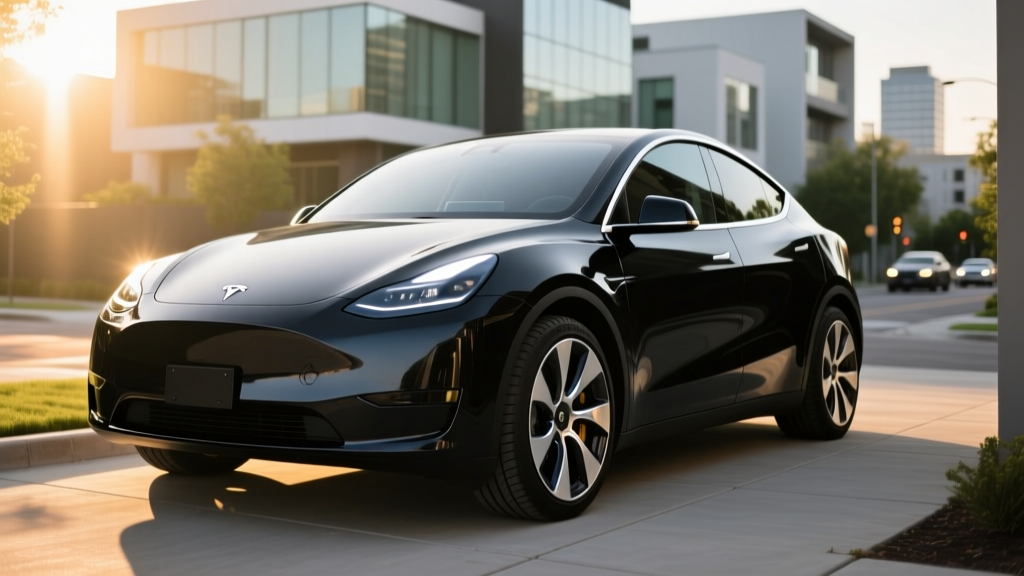
When shoppers search for the weight of Tesla Model Y, they're usually trying to answer a deeper question: how does nearly 4,400 pounds of battery and steel translate into real-world range, efficiency, tire wear, and daily drivability? The Model Y remains one of the best-selling electric vehicles in the United States, but its curb weight influences everything from EPA range estimates to braking distances to the cost of replacing tires. This review breaks down the 2026 Tesla Model Y lineup — Long Range, Performance, and the newly refreshed standard-range variant — with exact numbers on weight, battery chemistry, charging curves, and federal tax credit eligibility.
2026 Tesla Model Y Spec Sheet: Weight, Range, and Powertrain
| Spec | Long Range AWD | Performance AWD | Rear-Wheel Drive (Std Range) |
|---|---|---|---|
| Curb Weight | 4,398 lbs | 4,416 lbs | 4,134 lbs |
| EPA Range | 320 miles | 293 miles | 260 miles |
| Battery Capacity (usable) | ~75 kWh (NMC) | ~75 kWh (NMC) | ~60 kWh (LFP) |
| Drivetrain | Dual-Motor AWD | Dual-Motor AWD | Single-Motor RWD |
| Horsepower | 384 hp | 456 hp | 295 hp |
| 0–60 mph | 4.8 sec | 3.5 sec | 6.5 sec |
| MPGe (combined) | 122 MPGe | 111 MPGe | 128 MPGe |
| Efficiency | 28 kWh/100 mi | 30 kWh/100 mi | 26 kWh/100 mi |
| Base MSRP | $44,990 | $48,990 | $36,490 |
| Battery Warranty | 8 yr / 120,000 mi | 8 yr / 120,000 mi | 8 yr / 100,000 mi |
The Long Range AWD tips the scales at 4,398 pounds — roughly 300 pounds heavier than a comparably sized gas-powered crossover like the Toyota RAV4. That extra mass comes primarily from the 75 kWh nickel-manganese-cobalt (NMC) battery pack mounted low in the chassis. The Performance trim adds slightly more weight (4,416 lbs) due to larger wheels, performance brakes, and additional cooling hardware. The Rear-Wheel Drive standard-range model, which uses a lighter lithium iron phosphate (LFP) battery, drops to 4,134 lbs — a meaningful 264-pound reduction that improves efficiency to 128 MPGe combined.
How Weight Shapes Real-World Range
EPA Range vs. Reality: The Long Range AWD carries an EPA-estimated 320 miles, but expect ~265–285 miles on sustained highway driving at 70–75 mph. In freezing temperatures (below 32°F), plan for 20–30% range loss, bringing usable range down to roughly 220–250 miles before needing to charge. The lighter RWD model's 260-mile EPA rating translates to ~215–230 miles highway in mild weather.
Curb weight directly affects energy consumption, especially during stop-and-go city driving where the vehicle must repeatedly accelerate thousands of pounds from a standstill. Regenerative braking recovers some of that kinetic energy, but physics always wins: a heavier vehicle consumes more watt-hours per mile. The Model Y Long Range's 28 kWh/100 mi efficiency is competitive for its class, but the 4,398-pound mass means you'll see consumption climb to 32–34 kWh/100 mi in cold weather when cabin heating and battery preconditioning draw additional power.
The LFP-equipped RWD model benefits from a lower curb weight and Tesla's efficient single-motor drivetrain, achieving 26 kWh/100 mi — making it the most efficient trim despite having the smallest battery. Source: fueleconomy.gov.
Charging Speed: DC Fast, Level 2, and the Weight Factor
Heavier EVs with larger batteries take longer to charge at home, but Tesla's DC fast-charging architecture mitigates this on road trips. Here's what to expect across charging levels:
| Charging Level | Long Range AWD (75 kWh) | RWD Std Range (60 kWh) |
|---|---|---|
| Level 1 (120V, 12A) | ~3 mi/hr (1.4 kW) | ~3 mi/hr (1.4 kW) |
| Level 2 (240V, 48A) | ~32 mi/hr (11.5 kW) | ~32 mi/hr (11.5 kW) |
| DC Fast Charge (peak) | 250 kW (peak) | 170 kW (peak) |
| 10–80% DC Fast Charge | ~25 minutes | ~25 minutes |
| Sustained avg. 10–80% | ~140 kW | ~100 kW |
A critical detail many buyers miss: peak charge rate is not sustained charge rate. The Long Range Model Y peaks at 250 kW at a low state of charge (~10–15%), but the charge curve tapers significantly above 50% SoC, dropping to roughly 80–100 kW by the time you reach 70%. The 10–80% time of ~25 minutes is achieved at a V3 or V4 Tesla Supercharger; older V2 stations (150 kW max) will add 5–8 minutes to that window.
For home charging, a Level 2 wall connector at 48 amps adds roughly 32 miles of range per hour of charging — enough to fully replenish the Long Range overnight in about 9–10 hours. The heavier the battery pack, the more critical a dedicated 60-amp circuit becomes; we recommend consulting a licensed electrician to confirm your panel can support a continuous 48A load (which requires a 60A breaker per NEC derating rules).
Performance, Cargo, and Interior Practicality
The Model Y's weight isn't just a liability — the low-mounted battery gives it a center of gravity closer to a sedan than an SUV, which translates to confident cornering and minimal body roll. The Performance trim's 3.5-second 0–60 time is remarkable for a 4,416-pound vehicle, though that acceleration comes at the cost of 27 fewer miles of EPA range compared to the Long Range.
Cargo capacity: 30.2 cubic feet behind the second row, expanding to 72.1 cubic feet with the rear seats folded. The front trunk (frunk) adds 4.1 cubic feet — useful for charging cables and groceries. Rear legroom measures 41.6 inches, adequate for adults on long trips, though the panoramic glass roof reduces headroom slightly compared to competitors like the Hyundai Ioniq 5.
Towing: The Long Range and Performance trims are rated for 3,500 pounds when properly equipped — sufficient for a small trailer or pair of jet skis, but the added trailer weight will reduce range by 30–40% at highway speeds. The RWD model is not rated for towing.
Pricing, Trims, and Federal Tax Credit Eligibility
| Trim | Base MSRP | As-Tested (typical options) | Est. After §30D Credit* |
|---|---|---|---|
| Rear-Wheel Drive | $36,490 | $37,990 | ~$28,990 (if eligible) |
| Long Range AWD | $44,990 | $47,490 | ~$37,490 (if eligible) |
| Performance AWD | $48,990 | $51,990 | ~$41,990 (if eligible) |
*Federal tax credit estimates assume full $7,500 eligibility under IRS §30D. Actual credit depends on buyer income, battery sourcing, and MSRP caps. Consult a tax professional. Source: IRS.gov.
The §30D federal tax credit offers up to $7,500 for qualifying new EVs, but eligibility is layered:
- MSRP cap: SUVs must have a base MSRP at or below $80,000 — all Model Y trims qualify.
- Income cap: Modified adjusted gross income must not exceed $300,000 (joint filers), $225,000 (head of household), or $150,000 (single filers).
- Battery sourcing: The credit splits into two halves — $3,750 for critical minerals and $3,750 for battery component assembly, each with escalating domestic-content thresholds through 2026. Tesla's US-built battery packs generally meet these requirements, but always verify at the point of sale.
- Point-of-sale transfer: As of 2024, buyers can transfer the credit to the dealer for an immediate price reduction rather than waiting to claim it on their tax return.
Technology, Driver Assistance, and Drawbacks
The Model Y's 15.4-inch center touchscreen runs Tesla's proprietary infotainment OS — responsive and feature-rich, but notably lacking Apple CarPlay and Android Auto. Navigation, media, and vehicle controls all route through the screen, including the glovebox release and windshield wiper settings, which some drivers find distracting.
Autopilot comes standard and includes adaptive cruise control, lane-keeping, and automatic emergency braking. The optional Full Self-Driving (Supervised) package ($8,000 or $99/month) adds automated lane changes, traffic light recognition, and city street navigation. However, it is critical to understand:
SAE Level 2 — Not Self-Driving: Both Autopilot and FSD (Supervised) are SAE Level 2 driver-assistance systems. The driver must remain fully engaged, hands on or near the wheel, and eyes on the road at all times. Tesla's cabin camera monitors attention and will issue warnings and disengage the system if you look away. Only Level 4 services like Waymo operate without a human driver.
Pros
- Class-leading Supercharger network access (20,000+ V3/V4 stalls in North America)
- Strong efficiency (26–30 kWh/100 mi) for a crossover its size
- Over-the-air updates continuously add features post-purchase
- Spacious cargo area with practical frunk
- Competitive 0–60 performance across all trims
- Eligible for full $7,500 §30D credit (subject to buyer eligibility)
Cons
- No Apple CarPlay or Android Auto
- Firm ride quality, especially with 20- and 21-inch wheels
- Rear visibility compromised by sloping roofline and small rear window
- Insurance premiums 15–25% higher than comparable gas crossovers
- FSD package is expensive and remains a Level 2 assist system
- Minimal physical button controls — everything through the touchscreen
Model Y vs. Key Competitors: Is It Still the Default Choice?
The Model Y Long Range's 320-mile EPA range and $44,990 MSRP place it against strong rivals:
- Hyundai Ioniq 5 Long Range AWD: 290 miles EPA, ~$52,600 MSRP, 800V architecture enabling 10–80% in ~18 minutes at a 350 kW charger. Lighter at 4,650 lbs but faster-charging.
- Ford Mustang Mach-E Extended Range AWD: 305 miles EPA, ~$49,995 MSRP. Heavier at 4,800+ lbs, slightly less efficient, but offers CarPlay.
- Chevrolet Equinox EV RS AWD: 307 miles EPA, ~$41,400 MSRP. Best value proposition, though charging peaks at 150 kW.
The Model Y's decisive advantage remains Tesla's Supercharger network — consistently more reliable and more numerous than Electrify America, EVgo, or ChargePoint for cross-country travel. If your routine is 95% local commuting with occasional road trips, the Ioniq 5's faster charging and CarPlay support may outweigh the Supercharger benefit. If road-trip readiness is a priority, the Model Y is still the benchmark.
Who Should Buy the 2026 Tesla Model Y?
Choose the Model Y Long Range if: You need 300+ miles of EPA range, regularly take road trips where Supercharger access matters, and want a balance of performance and efficiency at a mainstream price point.
Choose the Model Y RWD if: Your commute is under 50 miles round-trip, you charge at home nightly, and you want the lowest entry price with LFP battery longevity benefits (LFP tolerates frequent 100% charging better than NMC).
Choose the Model Y Performance if: You prioritize acceleration and handling dynamics and accept 27 fewer miles of range and a firmer ride as trade-offs.
Look elsewhere if: You require Apple CarPlay, prefer physical button controls, or want hands-free Level 3+ highway driving (GM's Super Cruise on the Cadillac Lyriq offers this on mapped highways).
Frequently Asked Questions
What is the exact weight of the Tesla Model Y?
The 2026 Tesla Model Y Long Range AWD has a curb weight of 4,398 lbs. The Performance trim weighs 4,416 lbs, and the RWD standard-range model weighs 4,134 lbs. For comparison, the gasoline Toyota RAV4 AWD weighs approximately 3,615 lbs — making the Model Y roughly 800 lbs heavier, primarily due to the battery pack.
What is the real-world range of the Tesla Model Y?
The Long Range AWD is EPA-rated at 320 miles, but real-world highway driving at 70–75 mph typically yields 265–285 miles in mild weather. In freezing temperatures, expect 220–250 miles due to battery heating demands and reduced regenerative braking efficiency. The RWD model's 260-mile EPA rating drops to ~215–230 miles on the highway.
How fast does the Model Y charge at home and on the road?
At a V3/V4 Tesla Supercharger, the Long Range peaks at 250 kW and charges from 10–80% in approximately 25 minutes (sustained average ~140 kW). At home on a Level 2 wall connector (48A/240V), it adds about 32 miles of range per hour, fully charging in roughly 9–10 hours. The RWD model peaks at 170 kW on DC fast charge but achieves a similar 10–80% time (~25 min) due to its smaller battery.
Does the 2026 Tesla Model Y qualify for the $7,500 federal tax credit?
All Model Y trims fall under the $80,000 SUV MSRP cap for §30D eligibility. However, the buyer must also meet income limits ($150K single / $300K joint) and the vehicle must satisfy battery critical-mineral and component sourcing requirements, which Tesla's US-assembled packs generally meet. The credit can be transferred to the dealer at point of sale for an immediate price reduction. Always verify current eligibility at fueleconomy.gov and consult a tax professional.
Is the Tesla Model Y worth buying over the Hyundai Ioniq 5 or Ford Mach-E?
The Model Y wins on range (320 mi vs. 290–305 mi), Supercharger network reliability, and OTA update cadence. The Ioniq 5 wins on DC fast-charge speed (800V architecture), interior design, and CarPlay support. The Mach-E offers a more traditional driving feel and CarPlay but trails in efficiency. If Supercharger access and maximum range are your top priorities, the Model Y remains the default. If charging speed and smartphone integration matter more, the Ioniq 5 is the stronger pick.
How does the Model Y's weight affect tire wear and maintenance?
The Model Y's 4,400-lb curb weight accelerates tire wear compared to lighter vehicles — expect to replace tires every 25,000–35,000 miles rather than the 40,000–50,000 miles typical for gas crossovers. Tesla recommends rotating tires every 6,250 miles. Replacement cost for a set of four OEM-spec tires ranges from $900 to $1,400 depending on wheel size (19" to 21"). Brake pad life, however, is extended significantly by regenerative braking — many owners report 80,000+ miles on original pads.
What is the battery warranty on the 2026 Model Y?
Tesla covers the Long Range and Performance battery and drive unit for 8 years or 120,000 miles, whichever comes first, with a minimum 70% capacity retention guarantee. The RWD standard-range model is covered for 8 years or 100,000 miles with the same 70% threshold. Tesla's LFP batteries (RWD) historically show slower degradation than NMC packs, often retaining 90%+ capacity after 100,000 miles based on fleet data.