What Is the Tesla Giga Press, Exactly?
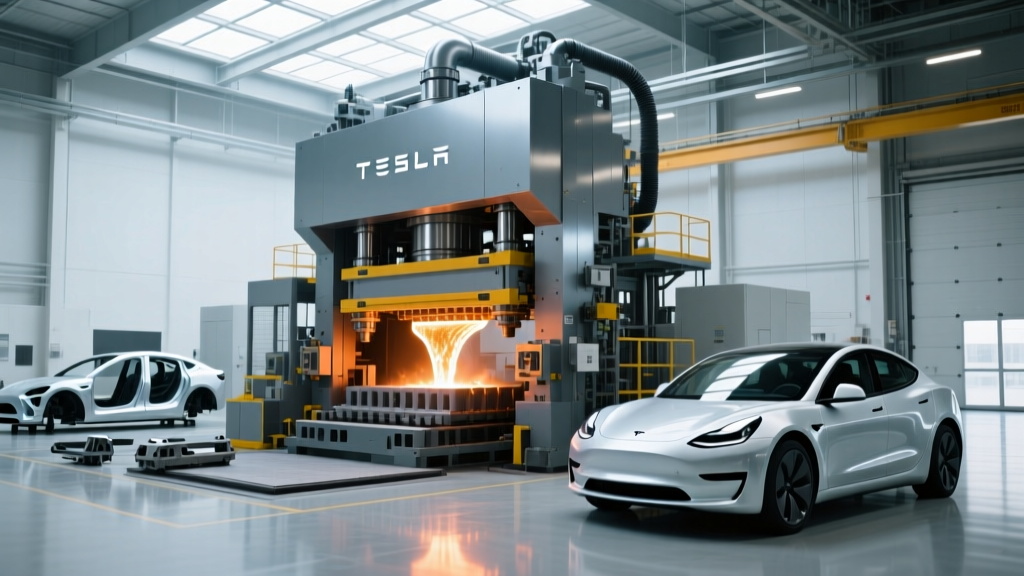
The term Tesla Giga Press doesn't refer to a car you can buy — it refers to the machine that's quietly reshaping how Teslas are built and, more importantly, how they're priced. The Giga Press is a series of ultra-high-tonnage die-casting machines, manufactured by Italy's Idra Group, that Tesla uses to cast massive single-piece aluminum underbodies for vehicles like the Model Y, Cybertruck, and the next-generation platform.
Traditional automotive body construction stamps, welds, and bonds together 70 to 100+ separate metal parts to form a vehicle's underbody. The Giga Press replaces that entire assembly with one or two large aluminum castings. The result: fewer robots on the assembly line, less factory floor space, lighter vehicle weight, and — critically for buyers — lower production cost that Tesla can pass through as price cuts or margin to fund R&D.
If you've noticed Tesla aggressively cutting prices on the Model Y and Model 3 over the past two years while competitors struggle to match, the Giga Press is a significant part of that equation. Let's break down what this manufacturing technology means for the EVs you can actually buy in 2026, with real specs from the vehicles it produces.
How Giga Press Casting Changes Tesla's Vehicle Lineup
As of early 2026, Tesla uses Giga Press mega-castings at multiple factories: Giga Texas (Austin), Giga Berlin (Grünheide), and Giga Shanghai. The technology is most visible in two vehicles currently on sale:
- Model Y (2025-refreshed "Juniper" platform): Single-piece rear underbody casting, reducing ~170 parts to 1.
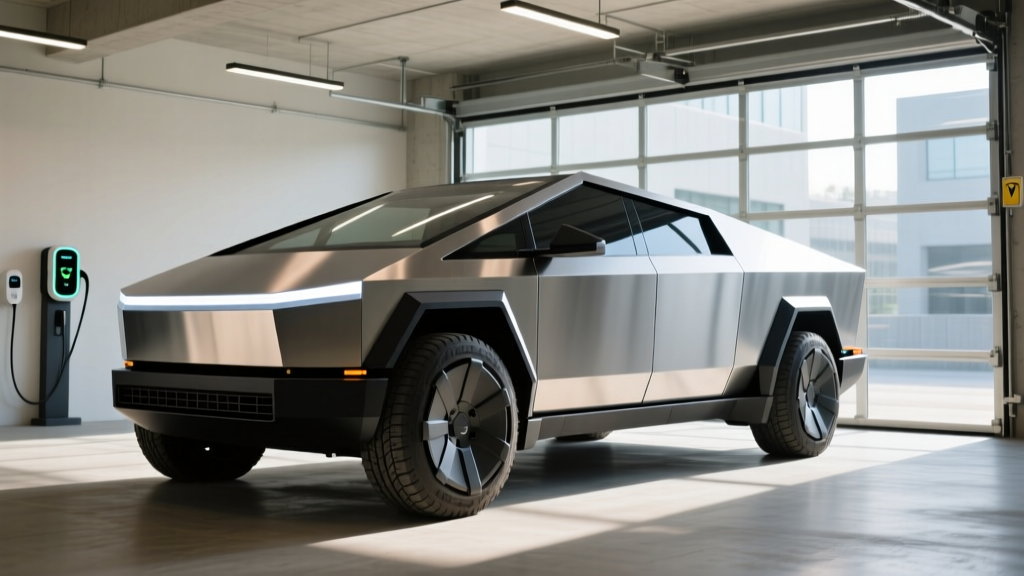
- Cybertruck: Uses massive castings for both front and rear underbodies, plus the exoskeleton's structural backbone relies on Giga Press aluminum and stainless-steel integration.
Tesla has also signaled that its next-generation compact vehicle (sometimes referred to as the "Model 2" or "Redwood" platform) will use even larger, more integrated castings — potentially combining the entire underbody into a single piece. That vehicle is announced but not yet on sale, so we'll focus on what you can buy today.
The downstream effects on buyers are tangible: lighter vehicles mean better efficiency (more miles per kWh), stiffer chassis mean better ride and handling, and lower production cost means more competitive pricing. Here's how that translates into the 2026 Model Y Long Range AWD — the highest-volume Giga Press beneficiary:
| Spec | Value |
|---|---|
| EPA Estimated Range | 320 miles |
| Battery Capacity | ~78.4 kWh usable (NMC chemistry) |
| Drivetrain | Dual-motor AWD |
| Horsepower | 384 hp combined |
| 0–60 mph | 4.8 seconds |
| Max DC Fast-Charge Rate | 250 kW peak |
| 10–80% DC Fast Charge | ~27 minutes |
| Level 2 Home Charging | 11.5 kW (~44 mi/hr) |
| Efficiency | 122 MPGe combined / 28 kWh/100 mi |
| Cargo Volume | 34.3 cu ft (rear seats up), 76.2 cu ft (folded) |
| Base MSRP | $44,990 |
| As-Tested (w/ FSD) | ~$52,990 |
| Battery Warranty | 8 years / 120,000 miles |
Real-World Range: What the EPA Sticker Doesn't Tell You
Real-World Highway (70–75 mph, moderate climate): ~265–285 miles
Real-World Cold Weather (below 30°F): ~220–250 miles
Mixed Commuter Driving: ~290–310 miles
The 2026 Model Y Long Range AWD carries an EPA-estimated 320 miles of range on its sticker. That figure is derived from a standardized lab test cycle that blends city and highway driving at moderate temperatures. In practice, range varies significantly based on how you drive and where you live.
Highway driving at sustained 70–75 mph pushes aerodynamic drag to the forefront — EVs are far less efficient at highway speed than in stop-and-go traffic (the opposite of gas cars, which benefit from steady cruising). Expect to see roughly 265–285 real highway miles before you need to charge.
Cold weather compounds the issue. Lithium-ion batteries lose capacity in low temperatures, and cabin heating draws substantial energy even with the Model Y's heat pump system. Owners in northern climates consistently report 220–250 miles of usable winter range. The Giga Press casting doesn't directly affect range in cold weather, but the weight savings it enables (the Juniper Model Y shed roughly 60 lbs vs. the pre-refresh model) marginally improves efficiency across all conditions.
Charging Speed: DC Fast Charging and Home Setup
The Model Y Long Range uses the Tesla NACS connector natively and accesses the full Supercharger network — now also open to Ford, Rivian, and other NACS-equipped EVs. Peak DC fast-charge rate is 250 kW, but as with all EVs, that peak is not sustained across the entire charge session.
| Charging Method | Power (kW) | Miles Added per Hour | Notes |
|---|---|---|---|
| Level 1 (120V outlet) | ~1.4 kW | ~5 mi/hr | Emergency/trickle only |
| Level 2 (240V, 48A home charger) | 11.5 kW | ~44 mi/hr | Full overnight charge in ~7 hrs |
| DC Fast (V3 Supercharger) | 250 kW peak | ~200 mi in 15 min | Tapers above 50%; 10–80% in ~27 min |
| DC Fast (V4 Supercharger) | 250+ kW peak | Comparable or slightly faster | Rolling out at select locations |
The charge curve matters. The Model Y pulls its peak 250 kW only between roughly 10–30% state of charge. From 50% onward, the rate tapers progressively — by 80%, you're typically seeing 40–60 kW. This is why the 10–80% time of ~27 minutes is a more useful metric than the peak kW number alone.
For home charging, Tesla's Wall Connector at 48 amps on a 60-amp circuit delivers 11.5 kW, adding about 44 miles per hour of charging. A full 0–100% session takes roughly 7 hours — perfectly suited for overnight charging. Expect to pay $500–$1,500 for a professional Level 2 installation depending on your electrical panel's capacity and the run distance from panel to garage.
Tax Credit Eligibility and Pricing Breakdown
The federal EV tax credit under IRS §30D is not a blanket $7,500 for every buyer. Eligibility depends on a matrix of requirements that shift with supply-chain rules. For the 2026 Model Y:
- MSRP cap: The Model Y qualifies as an SUV under IRS rules (due to its GVWR classification), so the MSRP cap is $80,000. The base Long Range at $44,990 clears this easily.
- Buyer income cap: Modified AGI must not exceed $150,000 (single), $225,000 (head of household), or $300,000 (married filing jointly).
- Battery sourcing: A percentage of critical minerals and battery components must be sourced from the U.S. or free-trade-agreement countries. Tesla has progressively shifted Model Y battery supply chains, but the exact credit amount (up to $3,750 for minerals + $3,750 for components = $7,500 max) varies by production batch and model year. Check the fueleconomy.gov tax credit lookup for the specific VIN you're considering.
- Point-of-sale transfer: As of 2024, you can transfer the credit to the dealer at purchase, reducing your out-of-pocket cost immediately rather than waiting for tax filing.
| Scenario | Amount |
|---|---|
| Base MSRP (Long Range AWD) | $44,990 |
| With full $7,500 §30D credit (if eligible) | ~$37,490 |
| With partial $3,750 credit | ~$41,240 |
| As-tested with FSD Supervised ($8,000 add-on) | ~$52,990 |
| Estimated state incentives (varies) | Check local programs |
Important: State and local incentives vary by jurisdiction. Consult your state's energy office or a tax professional for your specific situation. The figures above reflect federal rules only.
Performance, Tech, and What the Giga Press Enables
The Model Y's dual-motor AWD setup delivers 384 hp and a 4.8-second 0–60 mph time — brisk for a compact crossover and more than adequate for highway merging and passing. The Giga Press rear casting contributes to a stiffer rear subframe, which translates to more precise rear-end compliance over bumps and less flex during hard cornering. It's not a sports car, but it handles noticeably better than the pre-2025 Model Y.
On the tech front, the 2026 Model Y features:
- 15.4-inch center touchscreen running Tesla's latest UI with improved navigation and media integration.
- Autopilot (standard): Adaptive cruise control + lane-keeping assist. This is SAE Level 2 — you must keep your hands on the wheel and remain fully engaged at all times.
- FSD Supervised (optional, $8,000): Adds automated lane changes, traffic-light recognition, and city-street navigation. Still SAE Level 2 — not self-driving. The driver is legally responsible for the vehicle at all times.
- Over-the-air updates: Tesla continues to push firmware improvements to efficiency, charging curves, and feature additions post-purchase.
- Heat pump: Standard, reducing cold-weather range loss vs. resistive heating systems.
How Does It Compare to Key Competitors?
The Giga Press gives Tesla a manufacturing-cost advantage that competitors are still chasing. Here's how the Model Y Long Range stacks up against its closest rivals in 2026:
| Spec | Tesla Model Y LR AWD | Ford Mustang Mach-E ER AWD | Hyundai Ioniq 5 Long Range AWD |
|---|---|---|---|
| EPA Range | 320 mi | 312 mi | 290 mi |
| Battery (kWh) | ~78.4 (NMC) | ~91 (NMC) | ~77.4 (NMC) |
| Peak DC Charge | 250 kW | 150 kW | 238 kW |
| 10–80% Time | ~27 min | ~45 min | ~18 min |
| 0–60 mph | 4.8 sec | 5.1 sec | 5.0 sec |
| Base MSRP | $44,990 | $48,995 | $47,500 |
| Max §30D Credit | Up to $7,500 | Up to $7,500 | Up to $7,500 |
| Cargo (seats up) | 34.3 cu ft | 29.7 cu ft | 27.2 cu ft |
The Model Y's combination of range, cargo space, Supercharger network access, and price (especially after the tax credit) remains difficult to beat. The Ioniq 5 charges faster (18 minutes 10–80% on a 350 kW charger), and the Mach-E offers a more traditional car-like interior with physical controls. But the Giga Press-driven cost structure allows Tesla to price aggressively while maintaining margins — a structural advantage that's hard to replicate without similar casting investment.
Ford and Hyundai-Kia are investing in their own mega-casting programs, but production-scale deployment lags Tesla by 2–3 years. Volkswagen's Trinity platform also plans large castings. The gap is closing, but in 2026, Tesla still holds the manufacturing-cost edge in this segment.
Pros and Cons
- Class-leading cargo volume (34.3 cu ft) thanks in part to casting-integrated packaging
- Competitive base price with strong tax-credit-adjusted value
- Access to the Tesla Supercharger network — still the most reliable DC fast-charging ecosystem in North America
- Strong efficiency (122 MPGe combined) aided by weight savings from Giga Press castings
- Continuous OTA improvements post-purchase
- Stiffer chassis from single-piece casting improves ride quality
- Collision repair costs can be higher — a damaged mega-casting may require full replacement rather than section repair, potentially increasing insurance premiums
- Minimalist interior lacks physical climate and volume controls
- FSD Supervised remains expensive ($8,000) and is still Level 2, not autonomous
- No Apple CarPlay or Android Auto — Tesla's proprietary infotainment only
- DC fast-charging speed (250 kW peak) trails Hyundai-Kia's 800V architecture
Who Should Buy a Giga Press-Built Tesla?
The Model Y Long Range AWD is the pragmatic choice for a specific buyer profile:
- Daily commuters with home Level 2 charging who want low running costs and enough range to avoid mid-week charging.
- Small families who need genuine cargo versatility (strollers, groceries, road-trip luggage) without stepping up to a larger, more expensive vehicle.
- Road trippers who value Supercharger network reliability for cross-country travel — the network's uptime and billing simplicity still outperform third-party CCS networks in most regions.
- Cost-conscious EV buyers who want the best price-to-range ratio in the segment, especially after the federal tax credit.
It's less suited for buyers who prioritize a traditional luxury interior, want physical buttons, need the absolute fastest DC charging, or live in areas where Tesla service centers are distant (Tesla's mobile ranger network helps, but body repair after a collision still requires authorized facilities).
Frequently Asked Questions
Can I buy a "Tesla Giga Press" vehicle?
No. The Giga Press is a manufacturing machine, not a vehicle model. It's used to build the Model Y, Cybertruck, and upcoming Tesla platforms. You buy a Model Y or Cybertruck — those are the vehicles that benefit from Giga Press casting technology.
Does the Giga Press make the Model Y safer?
The single-piece casting increases torsional rigidity, which can improve crash-energy management. The 2026 Model Y earned a 5-Star Overall Safety Rating from NHTSA and a Top Safety Pick+ designation from IIHS. However, the trade-off is that a damaged mega-casting may be more expensive to repair than a multi-piece welded assembly, which can affect insurance costs.
How does Giga Press affect repair costs and insurance?
This is the most legitimate concern. If a rear collision damages the single-piece Giga Press casting, the entire unit may need replacement rather than localized repair. Some insurers have raised premiums on Giga Press-equipped vehicles for this reason. Before purchasing, get an insurance quote for your specific ZIP code and driving profile to avoid surprises.
Will Giga Press castings come to the Model 3?
The refreshed Model 3 ("Highland") uses a partial rear mega-casting at some factories, but adoption varies by production location. Tesla has not committed to full front-and-rear casting on the Model 3 platform the way it has on the Model Y and Cybertruck.
Does the Model Y still qualify for the federal EV tax credit in 2026?
Yes — the Model Y qualifies under the SUV MSRP cap ($80,000) and Tesla's U.S. manufacturing helps with domestic-assembly requirements. However, the exact credit amount (up to $7,500) depends on battery-sourcing and critical-minerals rules that the IRS updates periodically, as well as your personal income. Always verify eligibility on irs.gov or via the point-of-sale transfer process at purchase.
What's the real-world range of the Model Y in winter?
Expect 220–250 miles in sustained sub-freezing temperatures with cabin heating active. Preconditioning the battery while plugged in (using the Tesla app's scheduled departure feature) recovers some of this loss by warming the pack before you drive.