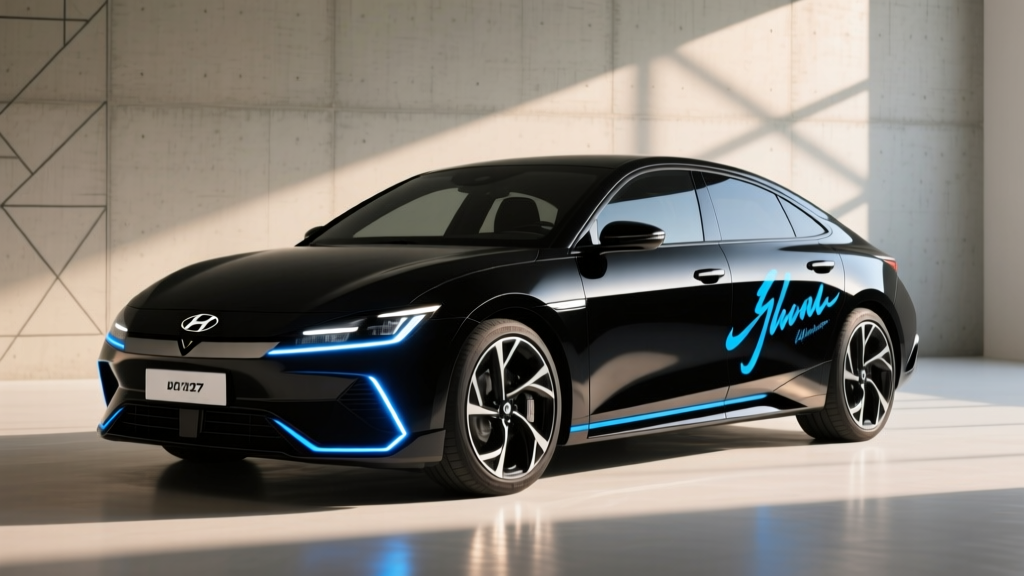
Hyundai's three-row electric flagship is getting its most potent and most opulent variant yet. The automaker has officially introduced the 2027 Hyundai Ioniq 9 Performance Calligraphy Black Ink — a top-tier trim that pairs the dual-motor all-wheel-drive powertrain with Hyundai's most luxurious interior package and a sinister, monochromatic Black Ink appearance treatment. While the vehicle won't reach dealerships until late 2026 as a 2027 model-year product, Hyundai has released preliminary specifications that let us evaluate exactly what buyers can expect in range, charging speed, performance, and pricing.
This preview breaks down every confirmed and estimated figure, contextualizes the Ioniq 9's place in the large electric SUV segment, and flags what you need to know about federal tax credit eligibility before you put down a deposit.
2027 Ioniq 9 Performance Calligraphy Black Ink: Key Specifications
Before we dig into the details, here's the at-a-glance spec sheet based on Hyundai's preliminary data and our projections from the existing Ioniq 9 platform. Final EPA certification figures may shift slightly before production begins.
| Attribute | Specification |
|---|---|
| EPA Range (est.) | 311 miles |
| Battery (usable) | 110.3 kWh, NMC (nickel-manganese-cobalt) |
| Drivetrain | Dual-motor AWD |
| Horsepower | 501 hp combined |
| 0–60 mph | 4.5 seconds (est.) |
| Peak DC Fast Charge | 350 kW (800V architecture) |
| 10–80% DC Charge Time | ~20 minutes (est.) |
| Level 2 Home Charge Rate | 10.9 kW (~30 mi/hr) |
| Efficiency | 85 MPGe combined (est.) |
| Seating | 6-passenger (2nd-row captain's chairs) |
| Cargo (behind 3rd row) | ~18 cu ft (est.) |
| Cargo (all rows folded) | ~80 cu ft (est.) |
| Base MSRP (est.) | $76,500 |
| Battery/Powertrain Warranty | 10 years / 100,000 miles |
Range, Efficiency, and Real-World Expectations
EPA Estimated: 311 miles
Real-World Highway (70–80 mph): Expect ~250–270 miles in moderate temperatures
Cold-Weather (below 32°F): Expect ~210–240 miles depending on cabin heating demands and whether the heat pump is active
City/Mixed Driving: Closer to EPA sticker, potentially 290–310 miles with strong regenerative braking capture
The Ioniq 9 Performance AWD's 110.3 kWh usable battery is one of the largest in the three-row EV SUV class, but it's also pushing a heavy vehicle — the dual-motor AWD configuration and Calligraphy-grade sound insulation add significant mass. Hyundai's E-GMP platform is inherently efficient thanks to its 800-volt architecture, which reduces resistive losses in the powertrain, but physics still governs: a 5,500+ lb SUV with 501 hp on tap will consume more electrons per mile than a lighter sedan.
The estimated 85 MPGe combined translates to roughly 39–41 kWh per 100 miles. For context, the Rivian R1S Dual-Motor Large Pack returns 73 MPGe combined, while the Kia EV9 GT-Line AWD (which shares the E-GMP platform but is smaller) achieves 85 MPGe. The Ioniq 9's efficiency is competitive for its size and power class.
If your commute is under 60 miles round-trip with access to home charging, the 311-mile range provides ample buffer. Road-trippers should plan charging stops around the 230–250 mile mark to keep the battery in its fastest charging zone (10–80% SoC) and avoid the steep charge-curve taper above 80%.
Charging Speed: DC Fast Charging and Home Level 2
This is where the Ioniq 9's 800V E-GMP platform earns its keep. Hyundai has confirmed that the Ioniq 9 supports peak DC fast charging at up to 350 kW — the same ceiling as the Ioniq 5 and Ioniq 6, but with a larger battery to fill.
| Charging Level | Power / Rate | Miles Added per Hour | Notes |
|---|---|---|---|
| Level 1 (120V outlet) | ~1.4 kW | ~3–4 mi/hr | Emergency/trickle only; 0–100% takes 3+ days |
| Level 2 (240V home) | 10.9 kW | ~30 mi/hr | Full 0–100% in ~10.5 hours; overnight-ready |
| DC Fast (350 kW peak) | Up to 350 kW | ~900+ mi/hr (peak) | 10–80% in ~20 min; tapers significantly above 80% |
| DC Fast (150 kW station) | ~150 kW sustained | ~400 mi/hr | 10–80% in ~35 min; more common station speed |
Charging curve reality: The "350 kW peak" figure is just that — a peak. In practice, the Ioniq 9 will sustain its highest charge rates between roughly 10% and 45% state of charge. Expect the rate to taper to ~200 kW by 60% SoC, and drop below 100 kW once you pass 80%. This is normal for NMC chemistry and thermal management protecting battery longevity. If you're road-tripping, charging from 10% to 80% is the sweet spot — pushing past 80% adds time with diminishing range returns.
For home charging, a 48-amp Level 2 wallbox on a 60-amp circuit delivers the full 10.9 kW. That means plugging in at 10 PM with a near-empty battery gives you a full charge by 8:30 AM. Professional installation of a home Level 2 charger typically runs $800–$2,000 depending on panel capacity and conduit distance — consult a licensed electrician to confirm your home's 200-amp panel can support the circuit.
Hyundai includes an NACS (North American Charging Standard) port on the Ioniq 9, giving native access to Tesla Supercharger stalls (now open to non-Tesla EVs) without an adapter. CCS1 compatibility is maintained via the included adapter for Electrify America, EVgo, and other legacy networks.
Performance: 501 Horsepower in a Three-Row Cruiser
The Performance designation isn't just marketing. The Ioniq 9 Performance AWD pairs a front motor producing approximately 214 hp with a rear motor generating roughly 287 hp, for a combined system output of 501 horsepower and an estimated 516 lb-ft of torque. Hyundai estimates a 0–60 mph time of 4.5 seconds — genuinely quick for a vehicle that can seat six adults and their luggage.
Drive modes include Eco, Normal, Sport, and a customizable setting that lets you independently tune steering weight, throttle response, and regenerative braking intensity. The regenerative braking system offers four levels (0–3) selectable via steering-wheel paddles, with Level 3 approaching one-pedal driving in city traffic — though it does not come to a complete hold without brake application.
Towing capacity is estimated at 4,500 pounds when properly equipped, adequate for a small boat trailer or a lightweight camping trailer but not class-leading. The Rivian R1S, for comparison, is rated for up to 7,700 pounds.
Interior, Tech, and the Black Ink Treatment
The Calligraphy trim sits at the apex of Hyundai's luxury hierarchy, and the Black Ink package adds a cohesive dark aesthetic inside and out. Exterior highlights include gloss black 21-inch alloy wheels, black chrome grille accents, darkened badging, and a unique matte-black lower body cladding. The result is a monochromatic, stealth-luxury look that differentiates the Ioniq 9 from the chrome-heavy Palisade Calligraphy.
Inside the Black Ink cabin, you'll find:
- Nappa leather seats in obsidian black with contrast grey stitching
- Heated, ventilated, and massaging front seats with 14-way power adjustment
- Heated and ventilated second-row captain's chairs with power recline
- Dual 12.3-inch curved displays running Hyundai's latest infotainment with wireless Apple CarPlay and Android Auto
- Head-up display with augmented-reality navigation overlay
- Meridian premium audio system (14 speakers)
- Digital Side Mirrors (camera-based, where permitted by NHTSA regulation)
- Ambient lighting with 64 color options
- Center-console mounted fingerprint authentication for driver profile loading
Driver assistance is comprehensive. Hyundai's Highway Driving Assist 2 (HDA 2) provides adaptive cruise control with stop-and-go, lane centering, and automatic lane-change initiation when the driver signals with the turn indicator. This is an SAE Level 2 system — meaning the driver must remain fully attentive with hands on the wheel. It is not autonomous driving. Hyundai's Remote Smart Parking Assist allows the vehicle to pull in and out of tight spaces via key fob while the driver stands outside.
HDA 2 is an SAE Level 2 driver-assist system. It does not replace an attentive driver. You must keep your hands on the steering wheel and eyes on the road at all times. The system may disengage in construction zones, faded lane markings, heavy rain, or sharp highway curves. Always be prepared to take immediate control.
Pricing, Trims, and Federal Tax Credit Eligibility
The 2027 Ioniq 9 lineup spans multiple trims, but the Performance Calligraphy Black Ink sits at the top. Here's the estimated pricing structure:
| Trim | Drivetrain | Est. MSRP |
|---|---|---|
| SE Standard Range | RWD | $55,500 |
| SEL | RWD / AWD | $59,500 – $63,500 |
| Limited | AWD | $67,000 |
| Performance Calligraphy | AWD | $73,500 |
| Performance Calligraphy Black Ink | AWD | $76,500 |
Federal tax credit eligibility is complex at this price point. Under current IRS §30D rules, the Ioniq 9 Performance Calligraphy Black Ink faces several potential hurdles:
- MSRP Cap: SUVs must have an MSRP at or below $80,000 to qualify. At an estimated $76,500, the Black Ink trim clears this threshold — but destination charges and dealer-installed options could push it over. Confirm the final MSRP on the window sticker.
- Buyer Income Cap: Modified adjusted gross income must not exceed $150,000 (single), $225,000 (head of household), or $300,000 (joint). If your income exceeds these limits, you are ineligible regardless of the vehicle.
- Battery Sourcing Requirements: The credit is split into two halves — $3,750 for critical minerals and $3,750 for battery component sourcing. Hyundai has been actively shifting battery supply chains to comply, but specific cell sourcing for the Ioniq 9's 110.3 kWh pack must be confirmed at time of purchase. The fueleconomy.gov tax credit tool will list eligible configurations once EPA-certified.
- Point-of-Sale Transfer: You can transfer the credit to the dealer at purchase to reduce the sale price directly, rather than waiting to claim it on your tax return. This effectively lowers your out-of-pocket cost at delivery.
Always verify current eligibility on IRS.gov and consult a tax professional before relying on the credit in your purchase budget. Rules can and do change.
How It Stacks Up: Ioniq 9 vs. the Competition
The three-row electric SUV segment has grown crowded. Here's how the Ioniq 9 Performance Calligraphy Black Ink compares against its most direct rivals on the metrics buyers actually care about:
| Vehicle | EPA Range | Peak DC kW | 10–80% Time | 0–60 mph | Est. MSRP |
|---|---|---|---|---|---|
| 2027 Ioniq 9 Perf. Calligraphy Black Ink | 311 mi | 350 kW | ~20 min | 4.5 sec | $76,500 |
| 2026 Kia EV9 GT-Line AWD | 270 mi | 236 kW | ~24 min | 4.9 sec | $73,900 |
| 2026 Rivian R1S Dual-Motor Max Pack | 410 mi | 200 kW | ~35 min | 4.5 sec | $99,000 |
| 2026 Tesla Model X Long Range | 335 mi | 250 kW | ~25 min | 3.8 sec | $82,000 |
- You want the fastest DC charging in the segment (350 kW peak is class-leading)
- You value a traditional luxury interior with physical climate controls and premium materials
- You want 10-year/100,000-mile battery warranty coverage
- You need NACS native access to Superchargers without adapters
- Maximum range is your top priority (Rivian R1S Max Pack offers 410 mi)
- You need 7,000+ lb towing capacity
- You prefer Tesla's Supercharger network integration and OTA update cadence
- Third-row space for adults is critical (Model X and R1S offer more generous third rows)
Pros, Cons, and Who Should Buy
- 350 kW peak charging — fastest in the three-row EV SUV class
- 501 hp provides effortless highway passing and confident merging
- Calligraphy Black Ink interior materials rival European luxury marques
- NACS native + CCS adapter covers virtually all public charging networks
- 10-year/100,000-mile battery and powertrain warranty is best-in-class
- HDA 2 is among the most refined Level 2 systems available
- 311-mile EPA range trails Rivian R1S Max Pack by ~100 miles
- Estimated $76,500 MSRP is near the $80,000 §30D tax credit cap — options could disqualify
- Third row is best suited for children or short trips; adults will find it snug
- 4,500-lb towing capacity is modest for the segment
- 21-inch Black Ink wheels may reduce real-world range vs. smaller wheel options
- Digital side mirrors (where permitted) take acclimation and may frustrate some drivers
Who this EV suits best: The Ioniq 9 Performance Calligraphy Black Ink is built for affluent families and professionals who want a daily-drivable three-row electric SUV with genuine luxury credentials and road-trip charging speed that minimizes downtime. If you regularly drive 200+ mile highway stretches, the 350 kW charging capability means you'll spend less time at chargers than in any rival. It's less ideal for those who need maximum range (look to Rivian), maximum towing (Rivian again), or the lowest possible entry price (the Ioniq 9 SE Standard Range starts far lower).
Frequently Asked Questions
What is the real-world range of the 2027 Ioniq 9 Performance Calligraphy Black Ink?
The EPA-estimated range is 311 miles. In real-world highway driving at 70–80 mph in moderate temperatures, expect 250–270 miles. In cold weather below freezing, that drops to approximately 210–240 miles due to battery resistance and cabin heating demands. The Ioniq 9's heat pump helps mitigate cold-weather losses compared to EVs without one.
How fast does it charge at home and on the road?
At home on a 240V Level 2 charger (10.9 kW), the Ioniq 9 adds roughly 30 miles of range per hour, with a full charge taking about 10.5 hours. On a 350 kW DC fast charger, it charges from 10% to 80% in approximately 20 minutes. On the more common 150 kW chargers found along many highway corridors, expect 10–80% in about 35 minutes.
Does the 2027 Ioniq 9 qualify for the $7,500 federal EV tax credit?
It potentially qualifies for up to $7,500 under IRS §30D, but eligibility depends on three factors: the vehicle's final MSRP must stay at or below $80,000 (SUV cap), the buyer's modified adjusted gross income must fall within limits ($300,000 joint / $150,000 single), and the battery's critical mineral and component sourcing must meet annual thresholds. Check IRS.gov and the fueleconomy.gov credit tool closer to the on-sale date for confirmed eligibility.
Is the Ioniq 9 worth buying over the Kia EV9 or Tesla Model X?
The Ioniq 9 outperforms the Kia EV9 on range (311 vs. 270 mi), charging speed (350 vs. 236 kW peak), and interior luxury, though at a higher price. Against the Tesla Model X, the Ioniq 9 offers a more conventional and premium interior, better warranty coverage, and faster peak charging, but trails on EPA range (311 vs. 335 mi) and 0–60 time (4.5 vs. 3.8 sec). The right choice depends on whether you prioritize charging speed and luxury (Ioniq 9), range and performance (Model X), or value (EV9).
What battery chemistry does the Ioniq 9 use?
The Ioniq 9 uses NMC (nickel-manganese-cobalt) lithium-ion cells. NMC offers higher energy density than LFP (lithium iron phosphate), which is why it's used in long-range, high-performance applications. The trade-off is that NMC cells degrade slightly faster than LFP over thousands of cycles and require more careful thermal management. Hyundai backs the pack with a 10-year/100,000-mile warranty guaranteeing minimum 70% capacity retention.
When will the 2027 Ioniq 9 Performance Calligraphy Black Ink be available?
Hyundai has announced the model but has not confirmed an exact on-sale date. Based on typical model-year cadences, expect dealer arrivals in late 2026 as a 2027 model-year vehicle. Reservations may open in mid-2026. All specifications discussed here are preliminary and subject to final EPA certification.