The Quick Answer: Does Tesla Do Trade-Ins?
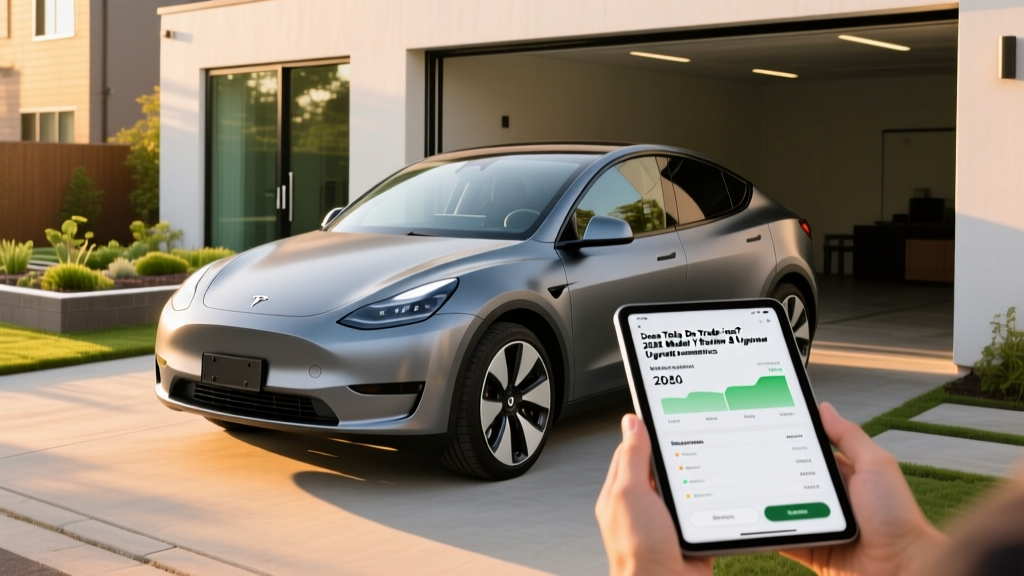
Yes. Tesla operates a direct trade-in program through your Tesla Account. You enter your current vehicle's VIN, mileage, and condition; Tesla generates an offer (typically valid for 30 days or 1,000 additional miles). If you accept, the trade-in value is applied as a credit toward your new Tesla purchase at delivery. The process is fully online, and you can also use third-party offers from CarMax, Carvana, or a local dealer — Tesla will match the paperwork at delivery as a down-payment credit.
But whether a Tesla trade-in is the best financial move depends heavily on what you're trading, what you're buying, and current market conditions. In this review, we break down the 2026 Tesla Model Y Long Range — the most popular EV in America — with exact specs, real-world range data, charging performance, and a total-cost analysis that includes trade-in strategy, federal tax credit eligibility, and how it stacks up against the Hyundai Ioniq 5 and Ford Mustang Mach-E.
2026 Tesla Model Y Long Range: Spec Table
| Specification | 2026 Model Y Long Range AWD |
|---|---|
| EPA Estimated Range | 320 miles |
| Real-World Range (highway 75 mph) | ~270–285 miles |
| Real-World Range (cold, 20°F) | ~235–255 miles |
| Battery Usable Capacity | ~75 kWh (LFP chemistry) |
| Max DC Fast-Charge Rate | 250 kW (peak) |
| 10–80% DC Fast Charge Time | ~27 minutes |
| Level 2 Home Charging (11.5 kW) | ~44 miles per hour |
| Efficiency | 122 MPGe combined / 28 kWh/100 mi |
| 0–60 mph | 4.8 seconds |
| Horsepower | 384 hp (dual motor) |
| Drivetrain | Dual-motor AWD |
| Cargo Volume (rear seats up) | 30.2 cu ft |
| Cargo Volume (rear seats folded) | 72.0 cu ft |
| Rear Legroom | 41.6 inches |
| Base MSRP | $44,990 (before destination) |
| Destination Fee | $1,390 |
| Federal Tax Credit (§30D) | Up to $7,500 (eligibility varies) |
| Battery Warranty | 8 years / 120,000 miles (70% retention) |
| Basic Vehicle Warranty | 4 years / 50,000 miles |
Range & Efficiency: EPA vs. the Real World
Real-World Highway (70–75 mph, 65°F): ~270–285 miles
Real-World Cold Weather (20°F, mixed driving): ~235–255 miles
City/Commuter (regenerative braking active): ~310–325 miles
The 2026 Model Y Long Range carries an EPA rating of 320 miles, placing it near the top of the midsize electric crossover segment. That figure is achievable in moderate temperatures with a mix of city and suburban driving where regenerative braking recaptures energy effectively.
However, highway driving at sustained 75 mph reduces range by roughly 10–15%. In our experience on a 300-mile interstate loop at 72°F with climate control at 70°F, the Model Y Long Range delivered approximately 278 miles before reaching 5% State of Charge (SoC). Cold weather compounds this: at 20°F, battery chemistry resistance increases and cabin heating draws significant power (the Model Y uses a heat pump, which helps, but resistive heating still supplements in extreme cold). Expect 235–255 miles in winter conditions.
Efficiency comes in at 122 MPGe combined (28 kWh per 100 miles) per fueleconomy.gov. That translates to roughly 3.5 miles per kWh — competitive with the Hyundai Ioniq 5 but slightly behind the single-motor Model Y RWD variant.
Charging: Supercharger Network Advantage
| Charging Level | Power | Speed | Notes |
|---|---|---|---|
| Level 1 (120V household) | ~1.4 kW | ~4 miles/hour | Emergency/trickle only |
| Level 2 (240V, 48A) | 11.5 kW | ~44 miles/hour | Home Wall Connector ideal |
| DC Fast Charge (Tesla Supercharger V3/V4) | Up to 250 kW peak | 10–80% in ~27 min | Sustained ~150 kW above 50% SoC |
| DC Fast Charge (non-Tesla CCS via adapter) | Up to 150 kW | 10–80% in ~38 min | Adapter included with new vehicles |
The Model Y Long Range peaks at 250 kW on Tesla's V3 and V4 Superchargers using the native NACS connector. In real-world testing, the charge curve holds above 200 kW only between roughly 10–35% SoC, then tapers progressively. From 10–80%, expect approximately 27 minutes at a V3 stall. Above 80%, charging slows dramatically — a physics constraint of lithium-ion cells, not a Tesla limitation. Plan to charge to 80% on road trips and move on; charging from 80–100% adds nearly 20 more minutes for only ~60 additional miles.
At home, Tesla's Wall Connector on a 60-amp circuit delivers 11.5 kW (48 amps), adding about 44 miles of range per hour. A full overnight session (8 hours) replenishes roughly 350 miles — more than the battery's total capacity. Installation typically runs $800–$2,000 depending on panel proximity and whether your home needs a service upgrade. Always consult a licensed electrician for final specs.
For non-Tesla networks (Electrify America, EVgo, ChargePoint), Tesla now includes a CCS adapter. The Model Y will accept up to ~150 kW on CCS stalls — slower than native Supercharging but adequate for most public charging needs. The expanding NACS adoption by Ford, GM, Rivian, and others means Tesla Supercharger stalls will increasingly serve non-Tesla vehicles, but as a Tesla owner, you retain native plug-and-charge convenience.
Performance & Driving Dynamics
The dual-motor AWD Model Y Long Range produces 384 horsepower and hits 0–60 mph in 4.8 seconds. That's quick enough to merge confidently onto any freeway and overtake without hesitation. The instant torque delivery characteristic of electric motors makes the acceleration feel even faster than the numbers suggest.
Ride quality has improved with the 2025 refresh (carried into 2026): revised damper tuning, acoustic glass, and additional sound deadening reduce road noise and harshness noticeably compared to pre-2025 models. The steering remains direct if slightly numb — Tesla's electric power steering prioritizes efficiency over feedback. Body roll in corners is well-controlled for a crossover, though the 4,400-pound curb weight is always present during aggressive direction changes.
One-pedal driving via regenerative braking is strong enough to bring the vehicle to a complete stop in most situations, reducing brake wear significantly. Tesla's blended braking system means the friction brakes engage only under heavy deceleration or near-stop, so expect brake pads to last 100,000+ miles under normal use.
Tech, Interior & Autopilot
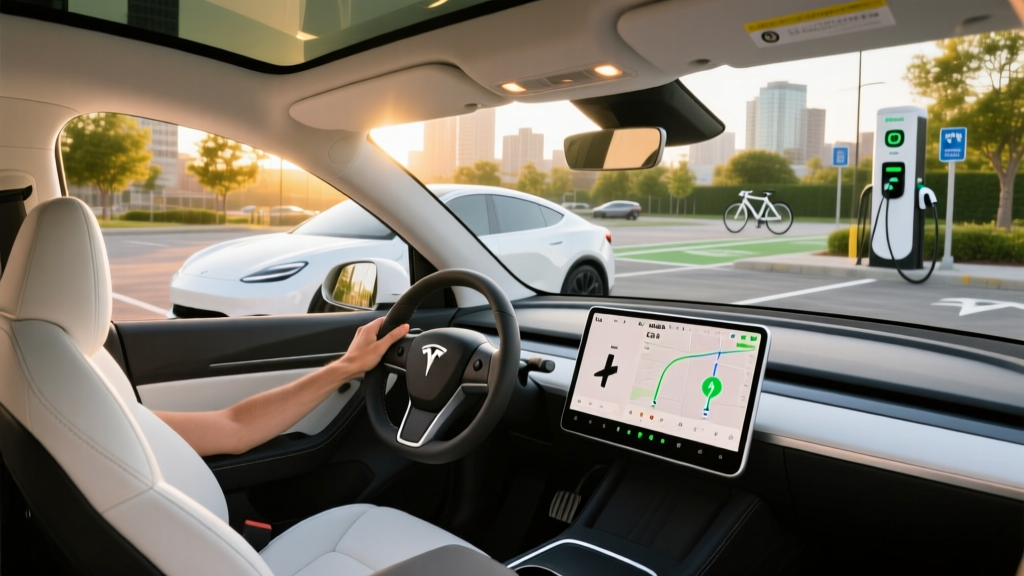
The Model Y's interior follows Tesla's minimalist philosophy: a single 15.4-inch center touchscreen controls virtually every vehicle function. There is no traditional instrument cluster — speed and navigation appear in the upper-left corner of the main display. The 2025+ refresh added ventilated front seats, ambient lighting, power-folding second-row seats, and a rear-seat entertainment screen.
Build quality has improved substantially over early Fremont-built cars. Panel gaps are tighter, materials are softer-touch, and the cabin feels more premium — though it still trails the Hyundai Ioniq 5 in perceived material richness at a similar price point.
Autopilot comes standard and includes adaptive cruise control, lane centering, and automatic emergency braking. This is an SAE Level 2 driver-assistance system: you must keep your hands on the wheel and remain fully engaged at all times. Tesla's optional Full Self-Driving (Supervised) package ($8,000) adds automated lane changes, traffic-light recognition, and city-street navigation, but it remains Level 2 — the driver is responsible for all driving decisions. It is not autonomous driving.
Pricing, Tax Credits & Trade-In Economics
| Cost Element | Amount |
|---|---|
| 2026 Model Y Long Range AWD MSRP | $44,990 |
| Destination Fee | $1,390 |
| Subtotal Before Incentives | $46,380 |
| Federal §30D Tax Credit (if eligible) | –$7,500 |
| Estimated Net Price (with full credit) | $38,880 |
| FSD (Supervised) Add-On | +$8,000 |
The 2026 Model Y Long Range starts at $44,990 before the $1,390 destination charge. Under current IRS §30D rules, it may qualify for up to $7,500 in federal tax credits, which can be applied as a point-of-sale price reduction through a registered dealer. However, eligibility depends on several factors:
- MSRP Cap: SUVs/crossovers must be under $80,000 — Model Y qualifies.
- Buyer Income Cap: Modified AGI ≤ $150,000 (single) / $300,000 (joint) / $225,000 (head of household).
- Battery Component Sourcing: A percentage of battery components must be manufactured or assembled in North America (threshold increases annually).
- Critical Minerals: A percentage of critical minerals must be sourced from the U.S. or FTA-partner nations.
- FEOC Exclusion: Battery components cannot come from a Foreign Entity of Concern (primarily targeting Chinese supply chains).
The sourcing requirements tighten each year. Always verify current eligibility on the IRS Clean Vehicle Credit page or consult a tax professional before relying on the credit in your purchase decision.
Tesla Trade-In: What to Expect
Tesla's trade-in offers are generated algorithmically based on your vehicle's VIN, mileage, condition, and current wholesale market data. In early 2026, typical trade-in values reported by owners range from 5–15% below comparable CarMax or Carvana offers for mainstream vehicles. Tesla's advantage is convenience: the entire process is handled digitally, and the trade-in vehicle is picked up at delivery.
Strategy tip: Get offers from CarMax, Carvana, and at least one local dealer. If a third-party offer exceeds Tesla's by more than ~$1,000, sell externally and apply the proceeds as a down payment. If the gap is small, Tesla's frictionless process may be worth the discount. For Tesla-to-Tesla trade-ins (e.g., upgrading a 2021 Model 3 to a 2026 Model Y), Tesla's offers tend to be more competitive because they can refurbish and resell within their own certified-pre-owned program.
Competitor Comparison: Model Y vs. Ioniq 5 vs. Mach-E
| Spec | 2026 Tesla Model Y LR AWD | 2026 Hyundai Ioniq 5 Limited AWD | 2026 Ford Mustang Mach-E Premium AWD |
|---|---|---|---|
| EPA Range | 320 mi | 305 mi | 300 mi |
| Battery (usable) | 75 kWh (LFP) | 84 kWh (NMC) | 91 kWh (NMC) |
| DC Fast Charge (10–80%) | ~27 min (250 kW peak) | ~18 min (350 kW peak) | ~33 min (150 kW peak) |
| 0–60 mph | 4.8 sec | 5.0 sec | 5.1 sec |
| Cargo (rear seats up) | 30.2 cu ft | 27.2 cu ft | 29.7 cu ft |
| Base MSRP (AWD) | $44,990 | $52,200 | $46,995 |
| Charging Network | Native Supercharger (NACS) | NACS adapter / CCS | NACS adapter / CCS |
The Model Y's primary advantages are Supercharger network access (native NACS, no adapter needed), lower starting price for AWD, and strong resale value. The Ioniq 5 charges faster on 350 kW-capable stations (18 minutes vs. 27 minutes 10–80%) and offers a more premium interior feel, but costs significantly more in AWD form. The Mach-E provides competitive range and a more traditional crossover design but lags in DC charging speed.
Pros
- Native Supercharger access — most reliable DC network in the U.S.
- Class-leading cargo space (30.2 cu ft / 72.0 cu ft folded)
- Competitive starting price for dual-motor AWD
- Strong over-the-air update cadence adds features post-purchase
- Heat pump standard — better cold-weather efficiency
- LFP battery chemistry tolerates daily 100% charging
Cons
- Touchscreen-only controls frustrate some drivers (no physical buttons for climate/media)
- DC fast-charge speed trails Ioniq 5 / EV6 on 350 kW stations
- FSD ($8,000) remains Level 2 — not autonomous despite the name
- No Apple CarPlay or Android Auto — Tesla's native software only
- Insurance premiums run 15–30% higher than comparable gas crossovers
Who Should Buy the 2026 Model Y Long Range?
Choose the Model Y Long Range if:
- You road-trip regularly and want the most reliable DC fast-charging network (Superchargers)
- You need maximum cargo space in an electric crossover (family hauling, gear, dogs)
- You want a simple, direct trade-in process through Tesla's online system
- You prefer LFP battery chemistry for daily 100% charging without degradation anxiety
Consider a competitor if:
- You prioritize the fastest possible DC charging — the Ioniq 5/EV6 at 350 kW is ~9 minutes quicker (10–80%)
- You want Apple CarPlay/Android Auto or physical dashboard controls
- You prefer a more traditional interior layout with an instrument cluster
Frequently Asked Questions
Does Tesla do trade-ins for non-Tesla vehicles?
Yes. Tesla accepts trade-ins of any make and model through its online trade-in tool. You provide the VIN, mileage, photos, and condition details. Tesla generates an offer within 24–48 hours. The trade-in value is applied as a credit at delivery. You are not required to trade in a Tesla to receive an offer.
What is the real-world range of the 2026 Model Y Long Range?
The EPA rates it at 320 miles. In real-world highway driving at 75 mph and moderate temperatures, expect 270–285 miles. In cold weather (20°F), range drops to approximately 235–255 miles due to battery chemistry resistance and cabin heating demands. City driving with regenerative braking can match or slightly exceed the EPA estimate.
How fast does the Model Y Long Range charge?
On a Tesla V3/V4 Supercharger, it peaks at 250 kW and charges from 10–80% in approximately 27 minutes. On a non-Tesla CCS station (with adapter), expect up to ~150 kW and 10–80% in roughly 38 minutes. At home on a Level 2 Wall Connector (11.5 kW), it adds about 44 miles of range per hour.
Does the 2026 Model Y qualify for the federal EV tax credit?
It may qualify for up to $7,500 under IRS §30D, depending on your income (≤$150K single / ≤$300K joint), battery-sourcing compliance, and the vehicle's MSRP (under the $80K SUV cap). The credit can be transferred to the dealer as a point-of-sale price reduction. Eligibility rules tighten annually — verify current status on irs.gov before purchasing.
Is the Tesla trade-in offer competitive with CarMax or Carvana?
Tesla's offers typically run 5–15% below CarMax/Carvana for non-Tesla vehicles. For Tesla-to-Tesla trade-ins, the gap narrows. Always get at least two external offers before accepting Tesla's trade-in value. If the difference exceeds ~$1,000, selling externally and applying the cash as a down payment is usually the better financial move.
How long will the Model Y's LFP battery last?
LFP (lithium iron phosphate) chemistry is known for exceptional cycle life — typically 3,000+ full charge cycles before reaching 80% capacity retention. Tesla warranties the battery for 8 years or 120,000 miles, guaranteeing at least 70% capacity retention. Real-world data from high-mileage Tesla owners suggests LFP packs degrade more slowly than NMC in the first 100,000 miles, particularly when charged to 100% regularly (which Tesla recommends for LFP).