Quick Verdict: The Hertz Tesla Model Y Rental as a Test Drive
If you've rented a Tesla Model Y through Hertz — or you're considering one as a rolling test drive before committing to a purchase — you're experiencing one of the most popular electric SUVs on the road. The Model Y Long Range AWD remains Tesla's volume seller for good reason: strong range, access to the Supercharger network, and class-leading efficiency. But rental units often come in base trims with heavy mileage, and the ownership calculus in 2026 is more nuanced than the brochure suggests.
This review covers the exact specs, real-world range, charging behavior, pricing, and tax-credit eligibility of the current Model Y Long Range AWD — the variant most commonly found in Hertz fleets — so you can decide whether to convert that rental experience into a purchase.
Range, Battery, and Real-World Efficiency
| Spec | Model Y Long Range AWD (2025–2026) |
|---|---|
| EPA Range | 310 miles |
| Battery (usable) | ~75 kWh, NMC (nickel manganese cobalt) |
| EPA Efficiency | 122 MPGe combined / 27 kWh/100 mi |
| Drivetrain | Dual-motor AWD |
| 0–60 mph | 4.8 seconds |
| Horsepower | ~384 hp combined |
The Model Y Long Range uses an NMC (nickel manganese cobalt) battery pack — Tesla has shifted some Standard Range variants to LFP (lithium iron phosphate) chemistry, but the Long Range AWD retains NMC for its higher energy density. NMC packs offer better range per kilogram but are more sensitive to sustained 100% state-of-charge storage; Tesla recommends daily charging to 80–90% and only charging to 100% before long trips.
Charging Speed: DC Fast, Level 2, and the Supercharger Advantage
| Charging Level | Power / Rate | Time / Miles Added |
|---|---|---|
| DC Fast Charge (V3 Supercharger) | Peak 250 kW | 10–80% in ~27 minutes |
| DC Fast Charge (non-Tesla 150 kW) | Peak 150 kW (CCS via adapter or NACS-equipped stations) | 10–80% in ~38 minutes |
| Level 2 (Tesla Wall Connector, 48A) | 11.5 kW | ~44 miles of range per hour |
| Level 2 (public 7.2 kW station) | 7.2 kW | ~28 miles of range per hour |
| Level 1 (120V household outlet) | ~1.4 kW | ~3–4 miles of range per hour |
Tesla's peak 250 kW DC fast-charge rate is achievable only on V3 Superchargers and requires the battery to be preconditioned (the car does this automatically when you navigate to a Supercharger). The charge curve tapers significantly above 80% — going from 80% to 100% can take nearly as long as 10% to 80%. For road trips, plan your stops around the 10–80% window to minimize downtime.
Home charging with a Tesla Wall Connector on a 60-amp circuit (48 amps continuous) delivers 11.5 kW — enough to fully replenish the 75 kWh battery in roughly 7–8 hours overnight. Most Hertz rental locations do not offer charging, so if you're renting, plan around Supercharger stops during your trip.
Pricing, Trims, and Federal Tax Credit Eligibility
| Trim | Base MSRP | Federal Tax Credit (§30D) | Effective Price |
|---|---|---|---|
| Model Y Long Range AWD | $44,990 | Up to $7,500 (if eligible) | ~$37,490 |
| Model Y Performance | $49,990 | Up to $7,500 (if eligible) | ~$42,490 |
The IRS §30D federal tax credit offers up to $7,500 for qualifying new EVs, but eligibility is not automatic. Key requirements for 2025–2026:
- MSRP cap: SUVs must have an MSRP at or below $80,000 (Model Y qualifies)
- Buyer income cap: Modified AGI ≤ $300,000 (joint) / $225,000 (head of household) / $150,000 (single)
- Battery sourcing: A percentage of critical minerals and battery components must be sourced from the U.S. or FTA-partner countries — Tesla's U.S.-built packs partially qualify, but the exact credit amount ($3,750 or $7,500) depends on current-year sourcing thresholds
- Point-of-sale transfer: Eligible buyers can transfer the credit to the dealer at purchase, reducing the out-of-pocket price immediately
Hertz rental note: Used Model Ys from Hertz's fleet sell-off programs can qualify for the separate used-EV credit (up to $4,000 or 30% of the sale price, whichever is lower) under §25E, with lower income caps ($150,000 joint / $75,000 single). Fleet vehicles tend to have higher mileage and accelerated depreciation, which can make them strong used-EV credit candidates.
Interior, Cargo, and Tech Features
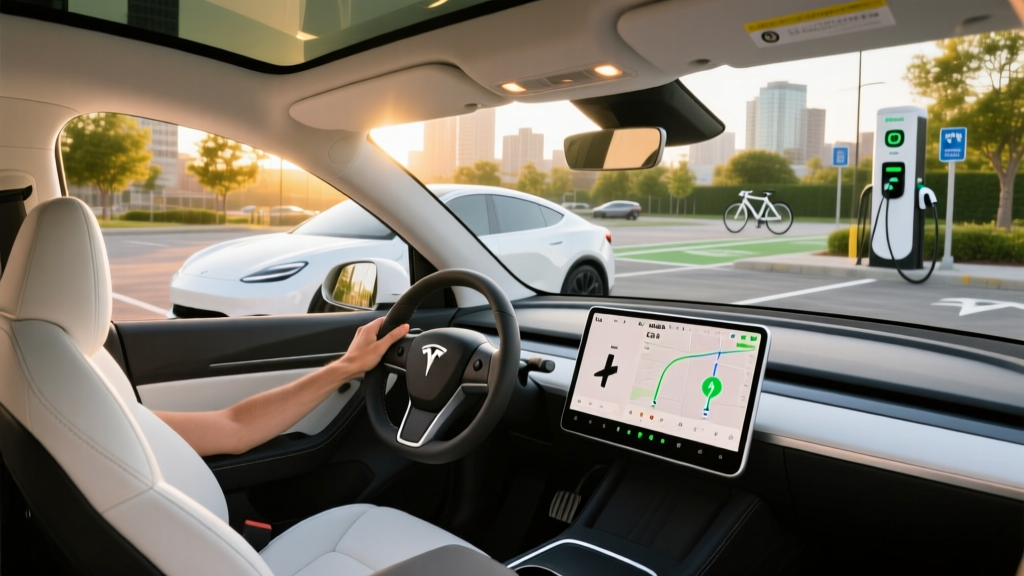
The Model Y's cabin is minimalist by design — a 15.4-inch touchscreen handles nearly all vehicle controls, navigation, media, and climate. There are no physical gauges or button clusters. This polarizes buyers: some love the clean aesthetic, others find it distracting for basic adjustments like wiper speed or mirror positioning.
Cargo space: 30.2 cu ft behind the second row, expanding to 72.1 cu ft with the rear seats folded. A front trunk (frunk) adds 4.1 cu ft — useful for charging cables or a small bag. Rear legroom measures 41.6 inches, adequate for adults on longer trips.
Notable tech:
- Autopilot (standard): SAE Level 2 driver-assist with adaptive cruise control and lane centering. The driver must remain engaged at all times — this is not self-driving.
- Full Self-Driving (Supervised) ($8,000 option): Adds automatic lane changes, intersection handling, and parking assist. Still SAE Level 2 — full attention required.
- Sentry Mode: Cameras record surroundings when parked, triggered by proximity or impact.
- Over-the-air updates: Tesla regularly pushes software improvements, new features, and UI refinements.
- Heat pump: Standard on all current Model Y variants, improving cold-weather efficiency by ~20–30% compared to resistive heating.
Ownership Costs, Warranty, and Longevity
| Category | Detail |
|---|---|
| Basic Warranty | 4 years / 50,000 miles |
| Battery & Drive Unit Warranty | 8 years / 120,000 miles (retains ≥70% capacity) |
| Estimated Annual Insurance | $2,200–$3,100 (varies by state, age, driving record) |
| Home Charging Cost (national avg. $0.16/kWh) | ~$12 for a full 75 kWh charge / ~$0.04 per mile |
| Supercharger Cost (avg. $0.30–$0.40/kWh) | ~$22–$30 for a full charge / ~$0.08–$0.10 per mile |
Tesla's 8-year/120,000-mile battery warranty guarantees the pack will retain at least 70% of its original capacity. Real-world degradation data from fleet operators (including Hertz) suggests NMC packs lose roughly 5–8% capacity over the first 100,000 miles, with degradation slowing significantly after the initial break-in period. A Model Y with 40,000–60,000 miles from a Hertz sell-off should still have 92–95% of its original battery health — well within warranty coverage.
Insurance is the ownership pain point: the Model Y costs 25–40% more to insure than a comparable gas-powered SUV, driven by high repair costs for collision damage (especially the aluminum body and integrated battery structure). Get quotes before purchasing.
Pros and Cons
Pros
- 310-mile EPA range with strong real-world highway usability
- 250 kW peak DC charging on the mature Supercharger network
- Class-leading efficiency (122 MPGe combined)
- Spacious cargo area (72.1 cu ft max) with a usable frunk
- Over-the-air updates continuously add features
- Heat pump standard — better cold-weather performance
Cons
- Minimalist interior forces all controls through the touchscreen
- Insurance premiums significantly higher than gas SUVs
- Ride quality is firm, especially on 20-inch wheels
- No Apple CarPlay or Android Auto — Tesla's ecosystem only
- FSD (Supervised) is expensive ($8,000) and still Level 2
- Hertz fleet units may have higher-than-average wear
Who Should Buy the Model Y (and Who Shouldn't)
Best for: Daily commuters with home charging access, small families needing cargo flexibility, and road-trippers who value Supercharger network reliability. If your Hertz rental felt natural — the one-pedal driving, the touchscreen workflow, the Supercharger stops — the Model Y translates well to ownership.
Consider alternatives if: You need three rows of seating (Kia EV9, Rivian R1S), prefer physical buttons and Apple CarPlay (Hyundai Ioniq 5, Ford Mustang Mach-E), or tow frequently (Model Y's 3,500-lb tow rating is adequate for light trailers but trails the F-150 Lightning and R1T).
Frequently Asked Questions
What is the real-world range of the Tesla Model Y Long Range?
The EPA estimates 310 miles, but real-world highway driving at 70–75 mph typically yields 260–280 miles. Cold weather (below freezing) can reduce range to 220–250 miles. City driving with frequent regenerative braking can match or slightly exceed the EPA figure.
How fast does the Model Y charge at home and on road trips?
On a V3 Supercharger, the Model Y peaks at 250 kW and charges from 10–80% in approximately 27 minutes. At home with a Tesla Wall Connector (11.5 kW), a full charge takes about 7–8 hours — easily overnight. On a standard 120V outlet, expect only 3–4 miles of range per hour.
Does the Tesla Model Y qualify for the $7,500 federal tax credit?
The Model Y Long Range AWD ($44,990 MSRP) is below the $80,000 SUV cap. However, the full $7,500 credit depends on battery-sourcing requirements that change annually, plus buyer income limits ($300,000 joint / $150,000 single). Check the IRS clean vehicle credit page for current-year eligibility. Consult a tax professional for your specific situation.
Is a Hertz rental Model Y a good way to test before buying?
Yes, with caveats. A multi-day rental lets you experience daily charging logistics, Supercharger stops, and the touchscreen-only interface. However, Hertz fleet units are typically base-trim Long Range AWD models without FSD, so you won't experience the optional driver-assist features. Also, rental units accumulate miles quickly — a 1-year-old Hertz Model Y may have 30,000–50,000 miles.
Is the Model Y worth buying over the Hyundai Ioniq 5 or Ford Mach-E?
The Model Y wins on efficiency (122 MPGe vs. 114 MPGe for the Ioniq 5 AWD), Supercharger network access, and cargo space. The Ioniq 5 charges faster on non-Tesla DC networks (up to 350 kW peak, 10–80% in ~18 min) and offers Apple CarPlay. The Mach-E offers a more conventional interior with physical controls. All three are strong — the choice depends on whether you prioritize Tesla's ecosystem or prefer a more traditional cabin layout.
What should I check on a used Hertz Model Y before buying?
Request the battery health report from Tesla's service menu (Settings → Software → Battery Health). Check tire wear (EVs are heavier and wear tires faster), inspect the undercarriage for curb rash on the battery skid plate, and verify that the 8-year/120,000-mile battery warranty transfers with the vehicle (it does, per Tesla's policy). Also check the cabin air filter and HVAC performance — high-mileage fleet vehicles may need early replacement.