Quick Verdict: Cadillac's Entry-Level Electric Luxury Crossover
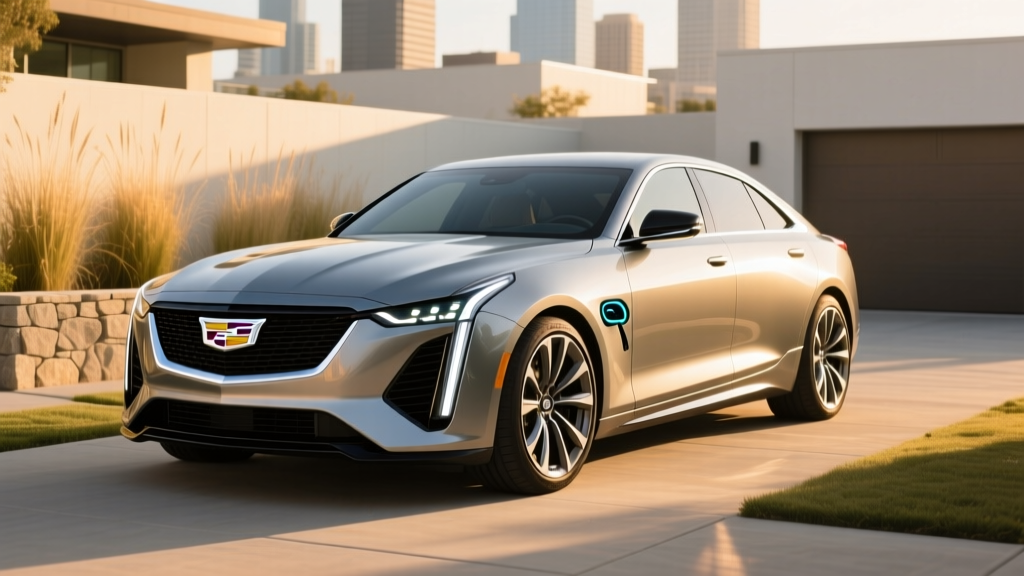
The 2025 Cadillac Optiq arrives as GM's most accessible luxury electric vehicle, slotting below the Lyriq in both size and price while sharing the proven Ultium platform. With an EPA-estimated range north of 300 miles, a 102 kWh NMC battery, and starting pricing around $54,000, the Optiq targets buyers who want the Cadillac badge and refined ride quality without stepping up to the larger Lyriq or competing German offerings. It's a compelling urban luxury commuter with solid road-trip capability — though DC fast-charging speeds lag behind the class leaders.
| Spec | Value |
|---|---|
| EPA Range (est.) | ~303 miles (Luxury AWD) |
| Battery Capacity | 102 kWh usable, NMC chemistry |
| Drivetrain | Dual-motor AWD |
| Horsepower | ~340 hp (est.) |
| 0-60 mph | ~5.5 seconds (est.) |
| Max DC Fast Charge | ~150 kW peak |
| 10-80% DC Charge Time | ~33 minutes |
| Level 2 Home Charge Rate | 11.5 kW (AC) |
| EPA Efficiency (est.) | ~89 MPGe combined |
| Base MSRP | ~$54,000 (Luxury trim) |
| Battery Warranty | 8 years / 100,000 miles |
Range & Efficiency: EPA Numbers Meet Real-World Reality
The 2025 Cadillac Optiq is expected to deliver an EPA-estimated range of approximately 303 miles in its dual-motor AWD configuration, drawing from a 102 kWh usable Ultium battery pack with NMC (nickel manganese cobalt) chemistry. This positions the Optiq squarely in the competitive mid-range for luxury compact electric crossovers — roughly matching the BMW iX xDrive50 and trailing the Tesla Model Y Long Range's 330+ mile rating.
EPA Sticker: ~303 miles
Highway (70-80 mph sustained): Expect ~240-265 miles. Aerodynamic drag hits crossovers hard at speed.
Cold Weather (below 32°F): Plan for ~210-250 miles. NMC batteries lose 15-25% capacity in freezing temps without consistent preconditioning.
Mixed commuter driving: ~280-300 miles is achievable with regenerative braking and moderate climate use.
The Optiq's heat pump (standard on Ultium vehicles) helps mitigate cold-weather HVAC energy draw, but battery chemistry physics still apply. Preconditioning the battery while plugged in before departure is essential for maximizing both range and charge speed in cold conditions.
Efficiency is estimated at approximately 89 MPGe combined (~34 kWh/100 miles), which is respectable for a luxury AWD crossover in this weight class. For context, that translates to roughly $0.10-$0.14 per mile depending on your local electricity rate — dramatically cheaper than a comparable gas-powered Cadillac XT4 at current fuel prices.
Charging Speed: Home & DC Fast-Charging Breakdown
Charging is where the Optiq reveals both its practicality and its primary competitive weakness. The Ultium platform supports DC fast charging at up to approximately 150 kW peak — adequate but noticeably slower than the 200-250 kW peaks offered by Hyundai/Kia's E-GMP platform or Tesla's latest architecture.
| Charge Level | Power | Speed | Notes |
|---|---|---|---|
| Level 1 (120V) | ~1.4 kW | ~4 miles/hour | Emergency/top-up only |
| Level 2 (240V, home) | 11.5 kW | ~34 miles/hour | Full charge in ~9 hours |
| DC Fast Charge | ~150 kW peak | 10-80% in ~33 min | Peak rate not sustained; tapers above 60% SoC |
The charging curve reality: Like all EVs, the Optiq won't sustain its 150 kW peak for the full session. Expect peak rates from roughly 10-40% State of Charge (SoC), with a progressive taper through 60% and a steep drop above 80%. This is why the 10-80% metric matters more than peak kW figures — and why a ~33-minute 10-80% session means a typical road-trip stop adds about 200 miles of range.
The Optiq uses the CCS1 connector standard. GM has announced NACS (Tesla Supercharger) adapter availability, and future model years will likely ship with native NACS ports. For now, CCS1 gives access to Electrify America, EVgo, and ChargePoint DC networks — though reliability on those networks remains a known pain point compared to Tesla's Supercharger ecosystem. Per Cadillac's charging resources, the vehicle's navigation system includes charge-station routing and battery preconditioning for optimal arrival temperature.
Home charging setup: The 11.5 kW onboard charger means a 48-amp Level 2 home station (hardwired, 60-amp circuit) will deliver the full charge rate. Budget $800-$2,500 for a quality Level 2 station plus professional installation by a licensed electrician, depending on your panel capacity and run length. A 200-amp electrical panel is typically sufficient, but older homes may need a panel upgrade ($1,500-$3,000+).
Performance & Driving Dynamics
The 2025 Optiq launches with a dual-motor all-wheel-drive powertrain producing an estimated 340 horsepower and approximately 325 lb-ft of torque. The 0-60 mph sprint is estimated at around 5.5 seconds — brisk enough for confident highway merging and passing, though not in the sub-4-second territory of performance-oriented rivals like the BMW iX M60 or Tesla Model Y Performance.
Where the Optiq aims to differentiate is ride quality. Cadillac's tuning priority has historically favored comfort over sportiness, and the Ultium platform's low center of gravity (battery pack under the floor) should deliver composed, quiet cruising. Expect adaptive damping on higher trims and Cadillac's signature isolated front and rear subframes for reduced noise and vibration transmission.
Regenerative braking offers multiple levels, including a one-pedal driving mode that can bring the vehicle to a complete stop without touching the brake pedal in most city driving scenarios. This is a feature new EV owners consistently cite as transformative once they adjust to it.
Interior, Cargo & Technology
The Optiq's cabin carries forward Cadillac's latest design language — a curved 33-inch LED display spanning the instrument cluster and infotainment screen, running Google Built-In (Google Maps, Google Assistant, Play Store). Wireless Apple CarPlay and Android Auto are standard.
Dimensions & Space:
- Cargo (behind rear seats): ~26 cu ft (est.)
- Cargo (rear seats folded): ~55 cu ft (est.)
- Front headroom: ~40 inches
- Rear legroom: ~38 inches
- Frunk (front trunk): Not expected — Ultium crossovers have typically omitted front storage
Cargo capacity is competitive with the compact luxury crossover segment but falls short of the Tesla Model Y's class-leading ~76 cu ft with seats folded. For two-adult households with occasional hauling needs, the Optiq is sufficient; families regularly loading strollers, sports gear, or luggage for four may find it tight.
Driver Assistance: The Optiq comes equipped with Cadillac's Super Cruise on compatible trims — a hands-free driving system on pre-mapped divided highways. Super Cruise is an SAE Level 2 system, meaning the driver must remain attentive and ready to take over at any time. It uses a driver-monitoring camera to ensure eyes-on-road compliance. This is not autonomous driving (Level 4) — it's an advanced highway assist that excels on long Interstate stretches but requires full driver engagement on surface streets and unmapped roads.
Super Cruise is a driver-assistance system, not self-driving. You must remain alert, keep your eyes on the road, and be prepared to steer or brake instantly. Cadillac's driver-monitoring system enforces this. For context, only Waymo and Zoox robotaxi services currently operate at Level 4 (no driver required) in limited geofenced areas.
Pricing, Trims & Federal Tax Credit Eligibility
The 2025 Cadillac Optiq is expected to start at approximately $54,000 MSRP for the Luxury trim, with a Sport trim and potentially a Premium Luxury trim pushing the range to $58,000-$62,000 depending on options. This positions it as the most affordable new Cadillac EV and undercuts the Lyriq by roughly $4,000-$6,000.
| Trim | Est. MSRP | After §30D Credit | Est. Monthly Lease (36 mo) |
|---|---|---|---|
| Luxury AWD | ~$54,000 | ~$46,500* | ~$550-$650 |
| Sport AWD | ~$58,000 | ~$50,500* | ~$620-$720 |
| Premium Luxury AWD | ~$62,000 | ~$54,500* | ~$700-$800 |
*Assumes full $7,500 federal credit eligibility. Actual credit depends on battery sourcing, buyer income, and MSRP caps per IRS §30D rules. Point-of-sale transfer available at participating dealers.
- MSRP Cap: SUVs/crossovers must be under $80,000 — Optiq qualifies ✓
- Buyer Income Cap: AGI must not exceed $150,000 (single), $225,000 (head of household), or $300,000 (joint) — check your tax situation
- Battery Sourcing: Critical minerals and battery component requirements phase in annually. GM's Ultium batteries have faced partial sourcing challenges — the Optiq may qualify for the full $7,500 or the partial $3,750 depending on model-year sourcing compliance
- Point-of-Sale Transfer: Eligible buyers can transfer the credit to the dealer at purchase, reducing the purchase price upfront rather than waiting for a tax refund
- Lease Loophole: Leased EVs may qualify for the $7,500 commercial credit (§45W) regardless of sourcing/income caps — the leasing company claims the credit and may pass savings through as a reduced lease payment
Always verify current eligibility on IRS.gov and consult a tax professional before purchasing. Rules change annually and are subject to interpretation.
Ownership Costs & Warranty
Cadillac backs the Optiq's battery and electric powertrain with an 8-year/100,000-mile warranty, covering defects and capacity loss below a specified threshold (typically 60-70% of original capacity). The bumper-to-bumper limited warranty covers 4 years/50,000 miles, which is standard for the luxury segment but trails Hyundai/Genesis's 5-year/60,000-mile coverage.
Total Cost of Ownership Considerations:
- Electricity vs. fuel savings: At $0.13/kWh national average and 34 kWh/100 mi, the Optiq costs roughly $4.42 per 100 miles to fuel — versus ~$12-$14 for a gas crossover at 25 MPG and $3.50/gallon. Annual savings of $1,000-$1,500 are realistic for 12,000-mile/year drivers.
- Maintenance: No oil changes, no transmission fluid, fewer brake replacements (regen braking reduces pad wear). Expect $200-$400/year in maintenance vs. $800-$1,200 for a gas equivalent.
- Insurance: EV insurance premiums run 15-25% higher than comparable gas vehicles on average. Get quotes before purchasing — luxury EV insurance can be $2,000-$3,000/year depending on your profile and location.
- Depreciation: EV depreciation has been volatile. Luxury EVs have seen steeper drops than mainstream models. Factor in 40-55% depreciation over 5 years as a conservative estimate.
Pros & Cons: The Honest Assessment
Pros
- 303-mile EPA range eliminates daily range anxiety for most drivers
- Quiet, refined ride quality expected from Cadillac's luxury tuning
- Super Cruise hands-free highway driving is among the best Level 2 systems available
- Google Built-In infotainment with native Google Maps and Assistant
- Competitive starting price for a luxury-branded EV with this range
- Low running costs vs. gas-powered luxury crossovers
- Strong 8-year/100,000-mile battery warranty
Cons
- 150 kW DC fast-charging peak lags behind Hyundai/Kia (240 kW), Tesla (250 kW), and Porsche (270 kW)
- No front trunk (frunk) — missed cargo opportunity
- Cargo space (~55 cu ft max) trails segment leaders like Model Y (~76 cu ft)
- CCS1 connector requires adapter for Tesla Supercharger access
- Full tax credit eligibility uncertain due to battery sourcing rules
- Limited public charging reliability on non-Tesla networks
- Insurance premiums likely higher than gas equivalents
Who Should Buy the 2025 Cadillac Optiq?
- You want a luxury-badged electric crossover under $60,000 with 300+ mile range
- Your driving is primarily urban/suburban commuting with occasional road trips under 250 miles
- You have access to reliable home Level 2 charging
- You value ride comfort and cabin quietness over sporty handling
- You want hands-free highway driving (Super Cruise) for long commutes
- You regularly road-trip 400+ miles and need the fastest possible DC charging (consider Hyundai Ioniq 5 or Tesla Model Y)
- You need maximum cargo space for family hauling (Tesla Model Y, Kia EV9)
- You want the lowest total cost of ownership regardless of badge (Tesla Model Y, Hyundai Ioniq 5)
- You lack home charging access and rely entirely on public fast charging — slower charge rates will frustrate you
Frequently Asked Questions
What is the real-world range of the 2025 Cadillac Optiq?
The EPA estimates approximately 303 miles for the AWD configuration. In real-world driving, expect 240-265 miles at sustained highway speeds (70-80 mph), 210-250 miles in freezing weather, and up to 280-300 miles in mixed city/suburban driving with moderate climate control use. Preconditioning the battery while plugged in helps maximize range in cold conditions.
How fast does the Optiq charge at home and on the road?
At home on a Level 2 (240V, 48-amp) charger, the Optiq charges at 11.5 kW, adding roughly 34 miles of range per hour — a full charge takes about 9 hours overnight. On DC fast chargers, it peaks at approximately 150 kW, reaching 10-80% in about 33 minutes. This is adequate but slower than competitors like the Hyundai Ioniq 5 (240 kW peak, 10-80% in ~18 minutes).
Does the 2025 Cadillac Optiq qualify for the $7,500 federal EV tax credit?
It likely qualifies for at least a partial credit, but full $7,500 eligibility depends on battery-sourcing compliance under IRS §30D rules, which tighten annually. The Optiq's MSRP (under $80,000) meets the SUV cap, and most buyers will fall within income limits. However, GM's Ultium battery sourcing has been partially non-compliant in prior model years. Verify current eligibility on IRS.gov or ask your dealer for the latest credit determination. Leasing may bypass sourcing requirements via the §45W commercial credit.
How much does the Optiq cost after incentives?
The base Luxury trim starts around $54,000 MSRP. With the full $7,500 federal tax credit (if eligible), the effective price drops to approximately $46,500. State and local incentives (which vary significantly by jurisdiction — check your state's energy office or fueleconomy.gov) may reduce the cost further by $1,000-$5,000 depending on where you live. Always confirm incentive availability before purchase.
Is the Optiq worth buying vs. the Tesla Model Y or BMW iX?
It depends on your priorities. The Optiq offers traditional luxury ride comfort, Super Cruise, and a more conventional dealership experience at a competitive price. The Tesla Model Y wins on range (330+ miles), charging speed (250 kW Supercharger network), cargo space (76 cu ft), and software ecosystem — but lacks the luxury ride refinement and has no traditional dealer support. The BMW iX offers superior DC charging (200 kW) and driving dynamics but starts significantly higher ($85,000+). If luxury comfort and hands-free highway cruising matter most, the Optiq earns serious consideration. If charging speed and cargo space are paramount, the Model Y or Ioniq 5 are stronger picks.
What connector does the Optiq use, and can I charge at Tesla Superchargers?
The 2025 Optiq ships with a CCS1 charge port. GM has indicated NACS adapter availability for Supercharger access, though adapter timelines and compatibility details should be confirmed with your dealer. Future model years are expected to adopt the NACS port natively. For now, CCS1 provides access to Electrify America, EVgo, and other non-Tesla DC networks.