Tesla Model Y Towing: What 3,500 Pounds Actually Means for EV Owners
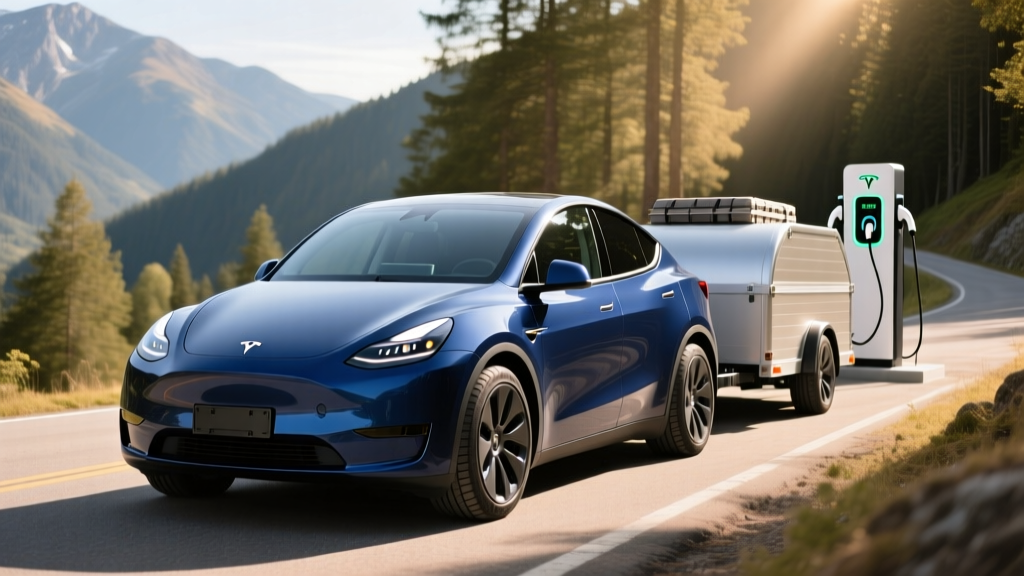
The Tesla Model Y remains one of the best-selling electric vehicles in the United States, and for good reason: it blends crossover practicality with sports-sedan acceleration and access to the most reliable DC fast-charging network in North America. But for buyers who need to pull a small camper, utility trailer, or pair of jet skis, the critical question is whether the Tesla Model Y tow capacity holds up in the real world — and what happens to range when you hook up a trailer.
For the 2026 model year, Tesla offers the Model Y in Long Range AWD and Performance trims, both featuring dual-motor all-wheel drive and an estimated 3,500-pound maximum towing capacity when properly equipped with the factory tow hitch. Below, we break down every number that matters — from real-world range degradation under load to charging curves and federal tax credit eligibility — so you can decide whether the Model Y is the right tow-capable EV for your needs.
2026 Tesla Model Y Core Specifications
| Specification | Long Range AWD | Performance |
|---|---|---|
| EPA Estimated Range | 320 miles | 295 miles |
| Battery Capacity (usable) | ~78 kWh (NMC) | ~78 kWh (NMC) |
| Drivetrain | Dual-Motor AWD | Dual-Motor AWD |
| Horsepower | ~384 hp | ~456 hp |
| 0-60 mph | 4.8 seconds | 3.3 seconds |
| Max Tow Capacity | 3,500 lbs | 3,500 lbs |
| Max DC Fast Charge Rate | 250 kW (peak) | 250 kW (peak) |
| 10-80% DC Fast Charge | ~27 minutes | ~27 minutes |
| Level 2 Home Charging | 11.5 kW (~44 mi/hr) | 11.5 kW (~44 mi/hr) |
| EPA Efficiency | 117 MPGe (28 kWh/100mi) | 111 MPGe (30 kWh/100mi) |
| Cargo Volume (rear seats up) | 30.2 cu ft | 30.2 cu ft |
| Cargo Volume (rear seats folded) | 72.1 cu ft | 72.1 cu ft |
| Base MSRP (before destination) | $47,990 | $52,490 |
| Battery & Drive Unit Warranty | 8 yr / 120,000 mi | 8 yr / 120,000 mi |
Sources: EPA Fueleconomy.gov, Tesla Model Y official specs. Prices and specs reflect 2026 model year and are subject to change.
Real-World Range: Unloaded vs. Towing
The Long Range AWD carries an EPA estimate of 320 miles. In real-world mixed driving at moderate temperatures (60-75°F), expect approximately 280-300 miles before needing to charge. Sustained highway driving at 75+ mph reduces range to roughly 260-280 miles. In cold weather (below 32°F), plan for 220-260 miles of usable range due to cabin heating demands and increased battery resistance.
Towing is where the Model Y's range story changes dramatically. When pulling a trailer near the 3,500-pound maximum capacity, aerodynamic drag and rolling resistance increase substantially. Based on real-world owner reports and independent testing with similarly sized electric crossovers, expect the following range reductions:
- Light trailer (1,000-1,500 lbs, low profile): ~25-30% range reduction → ~195-225 miles effective range
- Medium trailer (2,000-2,500 lbs, box camper): ~35-45% range reduction → ~160-195 miles effective range
- Max capacity (3,000-3,500 lbs, large camper): ~45-55% range reduction → ~130-170 miles effective range
These numbers assume flat terrain and moderate speeds (55-65 mph). Mountainous routes or sustained 70+ mph highway speeds will compress range further. The Model Y's regenerative braking helps recover energy on downhill grades when towing, but it cannot overcome the physics of moving thousands of additional pounds through the air.
The battery pack uses NMC (nickel manganese cobalt) chemistry, which offers higher energy density than LFP (lithium iron phosphate) cells. This gives the Model Y its strong range figure in a relatively compact pack. However, NMC batteries benefit from daily charge limits of 80-90% for longevity — meaning your daily usable range is closer to 250-280 miles unloaded. Tesla's battery management system includes a robust bottom buffer to protect against deep discharge degradation.
Charging Speeds: Home, Destination, and DC Fast Charging
| Charging Level | Power (kW) | Miles of Range Added per Hour | Typical Use Case |
|---|---|---|---|
| Level 1 (120V household) | ~1.4 kW | ~5-6 mi/hr | Emergency / overnight trickle |
| Level 2 (240V, 32A Mobile Connector) | ~7.7 kW | ~30 mi/hr | Standard home outlet |
| Level 2 (240V, 48A Wall Connector) | 11.5 kW | ~44 mi/hr | Optimal home charging |
| DC Fast (Tesla Supercharger V3) | Up to 250 kW (peak) | ~1,000+ mi/hr (peak) | Road trips |
| DC Fast (CCS adapter at 3rd-party) | Up to ~150-250 kW | Varies by station | Non-Tesla networks |
Understanding the difference between kW (kilowatts, the rate of power delivery) and kWh (kilowatt-hours, the total energy stored in the battery) is essential. The Model Y's ~78 kWh battery is the "tank size." A 250 kW Supercharger is the "pump speed" — but that peak rate is not sustained for the entire session.
The charging curve reality: At a V3 Supercharger, the Model Y Long Range peaks near 250 kW only at low states of charge (roughly 5-20% SoC). From 10-80%, the session averages closer to 120-140 kW and takes approximately 27 minutes. Above 80%, charging slows dramatically to protect battery health — going from 80-100% can take an additional 25-30 minutes. For road trips, the optimal strategy is to charge from 10-80% and drive on.
For home charging, Tesla's Wall Connector at 48 amps delivers 11.5 kW, adding roughly 44 miles of range per hour. A full charge from 10% to 90% overnight takes approximately 6-7 hours. Most owners who charge nightly at home rarely need to visit a public charger except on road trips.
The Model Y uses the NACS (North American Charging Standard) connector natively. With Tesla opening its Supercharger network to other EVs and providing a CCS adapter for Model Y owners, you can access Electrify America, EVgo, and other CCS stations when traveling through areas with limited Supercharger coverage.
Towing-Specific Features and Limitations
Tesla offers a factory-installed tow hitch with a 1.25-inch receiver on the Model Y, rated for 3,500 pounds of towing capacity and 350 pounds of tongue weight. The hitch is a $1,000 option at the time of purchase (aftermarket options exist but may affect warranty coverage).
When the tow hitch is equipped and a trailer is connected, the Model Y's software activates Tow Mode, which adjusts:
- Regenerative braking strength to account for trailer momentum
- Stability control algorithms for trailer sway mitigation
- Range estimation to factor in trailer load
- Rear camera display for hitch alignment
What the Model Y can realistically tow:
- Small teardrop campers (1,000-2,000 lbs) — excellent match, minimal range penalty
- Pop-up tent campers (1,500-2,500 lbs) — manageable, expect ~180-220 mi range
- Light utility/boat trailers (1,000-3,000 lbs) — suitable for short-to-medium hauls
- Large travel trailers (3,000+ lbs) — technically possible but range drops below 170 mi, making long trips impractical
Supercharger stations are designed for passenger vehicles — most do not offer pull-through lanes for vehicles with trailers. You may need to unhook the trailer before charging at many stations. Plan your route using tools like A Better Routeplanner (ABRP) with trailer parameters, and verify station layout before committing to a charging stop.
Pricing, Trims, and Federal Tax Credit Eligibility
| Trim | Base MSRP | Destination | Total Before Incentives | Est. After §30D Credit |
|---|---|---|---|---|
| Long Range AWD | $47,990 | $1,390 | $49,380 | ~$41,880* |
| Performance | $52,490 | $1,390 | $53,880 | ~$46,380* |
*Tax credit estimates assume full $7,500 eligibility. Actual credit depends on individual tax liability, income limits, and battery sourcing requirements. See details below.
The federal §30D EV tax credit offers up to $7,500 for qualifying new EV purchases, but eligibility involves several moving targets. As of the 2026 tax year, key requirements include:
- MSRP cap: SUVs/crossovers must have an MSRP at or below $80,000 (both Model Y trims qualify)
- Buyer income cap: Modified adjusted gross income must not exceed $150,000 (single), $225,000 (head of household), or $300,000 (joint filers)
- Battery sourcing: A percentage of critical minerals and battery components must be sourced from the U.S. or free-trade-agreement countries — this requirement tightens annually and can reduce or eliminate the credit for vehicles with non-compliant supply chains
- Point-of-sale transfer: Buyers can elect to transfer the credit to the dealer at purchase, reducing the upfront price rather than waiting for a tax refund
Because battery sourcing rules change and Tesla's supply chain evolves, the exact credit amount available for a specific Model Y build can shift. Always verify current eligibility at IRS.gov or consult a tax professional before finalizing your purchase.
Interior, Tech, and Daily Livability
The Model Y's minimalist interior centers on a 15.4-inch touchscreen that handles nearly all vehicle functions — climate, navigation, media, and vehicle settings. There is no traditional instrument cluster; speed and navigation appear on the main display. The 2026 refresh (codenamed "Juniper") brought improved cabin materials, ventilated front seats, ambient lighting, a rear-seat entertainment screen, and power-folding second-row seats.
Cargo and passenger space:
- 30.2 cu ft behind the second row (72.1 cu ft with seats folded)
- 4.1 cu ft front trunk (frunk) for charging cables or small bags
- 41.6 inches rear legroom — competitive with midsize crossovers
- Available 7-seat configuration (third row best suited for children)
Driver assistance: Every Model Y includes Tesla's Basic Autopilot (adaptive cruise control, lane centering, automatic emergency braking). Full Self-Driving (Supervised) is available as an $8,000 option or $99/month subscription, adding automated lane changes, traffic light recognition, and city street navigation.
Despite the "Full Self-Driving" name, Tesla's FSD (Supervised) is an SAE Level 2 driver-assistance system. The driver must remain fully attentive, keep hands on the wheel, and be prepared to take over at any moment. It is not an autonomous driving system. Only Level 4 services like Waymo operate without a human driver — and those are limited to specific geofenced areas.
Pros and Cons at a Glance
- 3,500-lb tow capacity covers most light trailers and campers
- Access to 6,000+ Tesla Superchargers across North America
- Class-leading 250 kW peak DC fast-charge speed
- Spacious 30.2 cu ft cargo area with flat load floor
- Over-the-air updates continuously improve the vehicle
- Strong 8-year/120,000-mile battery warranty
- Dual-motor AWD provides confident traction in rain and snow
- Towing near max capacity cuts range by 45-55%
- Few Superchargers offer pull-through trailer lanes
- Minimalist interior lacks physical buttons for climate/media
- No Apple CarPlay or Android Auto integration
- FSD (Supervised) is expensive and requires constant attention
- Firm ride quality on rough pavement (especially Performance trim)
- Insurance costs above segment average
How the Model Y Compares to Key Rivals for Towing
The Model Y's 3,500-lb tow rating is competitive among electric crossovers, but alternatives exist depending on your priorities:
- Ford Mustang Mach-E: Not rated for towing — eliminated from this comparison.
- Hyundai Ioniq 5: Rated up to 2,300 lbs (with tow package) — lower capacity but strong 800V charging architecture.
- Kia EV6: Rated up to 2,700 lbs — slightly less capacity, similar efficiency.
- Volkswagen ID.4 (AWD): Rated up to 2,700 lbs — softer ride, less range.
- Rivian R1S (Dual-Motor): Rated up to 7,700 lbs — far more capable for heavy towing but starts above $75,000.
- Ford F-150 Lightning: Rated up to 10,000 lbs — the truck alternative if towing is your primary need.
For buyers who need to tow 3,000-3,500 lbs and prioritize efficiency, charging infrastructure, and daily drivability over raw tow capacity, the Model Y occupies a strong middle ground. If you regularly tow above 4,000 lbs, a dedicated electric truck like the F-150 Lightning or Rivian R1T is the more practical choice.
Frequently Asked Questions
What is the real-world range of the Tesla Model Y when not towing?
The Long Range AWD carries an EPA estimate of 320 miles. In real-world mixed driving, owners typically see 280-300 miles. Highway-only driving at 75 mph drops that to roughly 260-280 miles, and cold weather (below freezing) can reduce range to 220-260 miles depending on cabin heating use and whether the battery is preconditioned.
How fast does the Model Y charge at home and on the road?
At home with a Tesla Wall Connector (48A/240V), the Model Y charges at 11.5 kW, adding about 44 miles of range per hour — a full overnight session covers most daily needs. On the road, a V3 Supercharger delivers up to 250 kW peak, completing a 10-80% session in approximately 27 minutes. Charging slows significantly above 80% to protect battery health.
How much does the Model Y cost after the federal tax credit?
The Long Range AWD starts at $49,380 including destination. If you qualify for the full $7,500 §30D credit, the effective price drops to approximately $41,880. Eligibility depends on your income (caps at $150K single / $300K joint), the vehicle's MSRP (must be under $80K for SUVs — both trims qualify), and current battery sourcing requirements. Always verify at IRS.gov before purchasing.
Is the Model Y worth buying vs. the competition for towing?
If you tow 1,500-3,000 lbs occasionally and want an efficient daily driver with the best charging network, the Model Y is hard to beat. Its 3,500-lb rating covers most small campers and utility trailers. However, if you regularly tow near the maximum capacity on long trips, the 45-55% range reduction makes dedicated electric trucks (F-150 Lightning, Rivian R1T) more practical despite their higher price.
Does the Tesla Model Y qualify for the federal EV tax credit in 2026?
Both the Long Range AWD and Performance trims fall under the $80,000 MSRP cap for SUVs, making them potentially eligible for up to $7,500 under IRS §30D. However, the credit is subject to buyer income limits, battery critical-mineral sourcing requirements (which tighten yearly), and your personal tax liability. The credit can be transferred at the point of sale to reduce your purchase price directly. Consult IRS.gov or a tax professional for your specific situation.
Can I install an aftermarket tow hitch on the Model Y?
Yes, aftermarket hitches are available, but using a non-Tesla hitch may affect warranty coverage for related drivetrain or electrical issues. The factory hitch ($1,000) includes Tow Mode software integration and is the recommended path for buyers who plan to tow regularly.