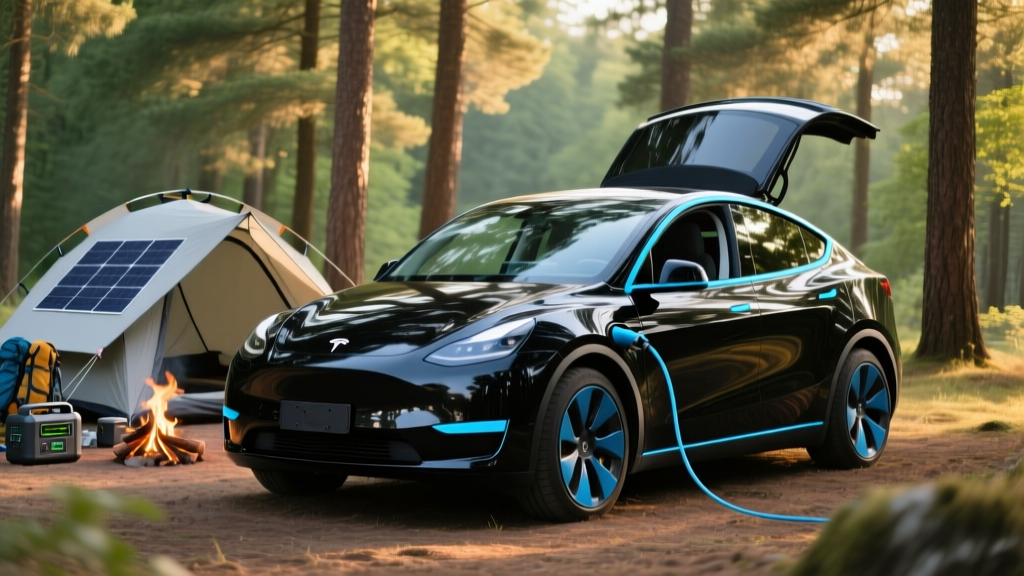
The Tesla Model Y has become one of the most popular electric vehicles for outdoor enthusiasts, and for good reason: its combination of long range, fast charging, and cavernous cargo space makes it a surprisingly capable platform for tent-based camping trips. But search for "Tesla Model Y tent" and you'll find a mix of rooftop tents, tailgate tents, and owners simply wondering whether this crossover can actually support a weekend in the backcountry. This review breaks down the 2026 Tesla Model Y's real-world range, charging infrastructure access, Camp Mode functionality, and practical camping utility to answer that question with hard data.
2026 Tesla Model Y: Quick Specs at a Glance
| Specification | Long Range AWD | Performance | RWD (Standard) |
|---|---|---|---|
| EPA Range | 320 miles | 295 miles | 302 miles |
| Battery (usable) | ~75 kWh (NMC) | ~75 kWh (NMC) | ~60 kWh (LFP) |
| Peak DC Fast Charge | 250 kW | 250 kW | 170 kW |
| 10–80% DC Charge Time | ~27 min | ~27 min | ~35 min |
| Level 2 Home Charging | 11.5 kW (~44 mi/hr) | 11.5 kW (~44 mi/hr) | 7.6 kW (~30 mi/hr) |
| 0–60 mph | 4.8 sec | 3.5 sec | 6.6 sec |
| Horsepower | 384 hp | 456 hp | 295 hp |
| Drivetrain | Dual-Motor AWD | Dual-Motor AWD | RWD |
| MPGe (combined) | 117 MPGe | 111 MPGe | 123 MPGe |
| Efficiency | 28 kWh/100mi | 30 kWh/100mi | 26 kWh/100mi |
| Base MSRP | $48,990 | $53,990 | $44,990 |
| Battery Warranty | 8 yr / 120,000 mi | 8 yr / 120,000 mi | 8 yr / 100,000 mi |
Real-World Range: What to Expect on the Trail
The Model Y's efficiency is genuinely class-leading. At 28 kWh per 100 miles (Long Range), it squeezes more distance out of each kilowatt-hour than nearly any competing electric SUV. This matters enormously when you're driving to dispersed campsites far from charging infrastructure. According to EPA data on fueleconomy.gov, the Long Range AWD achieves 117 MPGe combined — a figure that translates to lower charging costs and fewer stops on long road trips.
For tent camping specifically, the range picture is nuanced. Most established campgrounds in the western U.S. sit within 150–200 miles of a major metro area with Supercharger access. The real challenge is the "last mile" — the 20–60 mile stretch of forest service road between the last charger and your campsite. Here, the Model Y's efficiency works in your favor: a 40-mile round trip on dirt roads at moderate speeds consumes roughly 12–15 kWh, or about 50 miles of range equivalent. You can comfortably reach most national forest and BLM camping areas without range stress.
Charging Speed and Infrastructure for Camping Trips
| Charging Level | Power | Miles Added Per Hour | Best For |
|---|---|---|---|
| Level 1 (120V outlet) | ~1.4 kW | ~5 miles/hr | Emergency top-up at campground |
| Level 2 (240V home/outlet) | 7.6–11.5 kW | 30–44 miles/hr | Overnight charging at home or RV park |
| DC Fast (Supercharger V3) | Up to 250 kW | ~1,000+ mi/hr (peak) | Road-trip pit stops, 10–80% in ~27 min |
Tesla's Supercharger network remains the gold standard for road-trip charging, with over 6,000 V3/V4 stalls across North America. For camping trips, this means you can typically charge to 80% in about 27 minutes (Long Range) at a Supercharger near your route, then drive the remaining distance to your campsite.
The critical detail most reviews miss is charge-curve taper. The Model Y Long Range peaks at 250 kW only between roughly 10–30% state of charge. From 30–60%, it sustains around 150–180 kW. Above 60%, it drops further to 80–100 kW, and above 80%, charging slows dramatically to protect the NMC battery. This means a 10–80% charge takes about 27 minutes, but 10–95% takes closer to 45–50 minutes. For camping trips, charge to 80% at the last Supercharger before your campsite — the extra time to reach 90%+ is rarely worth the wait.
At the campsite itself, charging options are limited but not zero. Many RV parks and some established campgrounds offer 240V NEMA 14-50 outlets. With Tesla's Mobile Connector (included), you can pull up to 30 amps from a 14-50 outlet, adding roughly 25–30 miles of range per hour — enough to fully recharge overnight. Some tent campers also carry a 120V adapter as an emergency measure, though at ~5 miles per hour, it's strictly a trickle charge for maintaining state of charge, not recovering meaningful range.
Camp Mode, Cargo Space, and Tent Setup Practicality
Tesla's Camp Mode is the feature that transforms the Model Y from a commuter into a legitimate camping platform. When activated, it maintains cabin climate control, keeps USB ports powered, and allows the touchscreen to stream media — all while the vehicle is parked. Power consumption in Camp Mode typically runs 1–2% of battery per hour in mild weather (60–75°F), rising to 3–5% per hour in cold conditions (20–35°F) when the heat pump works harder.
With a 75 kWh usable battery (Long Range), that translates to roughly 35–50 hours of continuous climate control in moderate temperatures — more than enough for a full weekend trip without depleting your driving range to dangerous levels.
The cargo dimensions are where the Model Y truly shines for tent campers:
- Cargo volume (rear seats folded): 76 cubic feet
- Cargo volume (rear seats up): 30 cubic feet
- Frunk (front trunk): 4.1 cubic feet
- Rear legroom: 41.6 inches
- Max cargo length (seats folded): ~72 inches (6 feet flat)
A standard two-person dome tent, sleeping bags, camp stove, cooler, and gear will occupy roughly 25–35 cubic feet — leaving you room to spare with the rear seats upright. For larger groups or extended trips, folding the 60/40 split rear seats opens the full 76 cubic feet, enough to fit rooftop cargo boxes, multiple tents, and serious overlanding gear.
Regarding actual tent compatibility: the Model Y works well with several aftermarket tent solutions. Tailgate tents (like those from Naptime or similar brands) attach to the open liftgate and create a sheltered vestibule connected to the cargo area. Rooftop tents are possible but require careful attention to the Model Y's dynamic roof load limit of approximately 165 pounds — including the rack hardware. Always verify with the rack manufacturer that the combined weight of tent + occupants stays within Tesla's published roof-load specifications. Many owners opt for ground tents and use the Model Y's Camp Mode to keep the cabin as a climate-controlled retreat during inclement weather or for gear storage.
Pricing, Tax Credits, and Total Trip Cost
| Trim | Base MSRP | Est. Federal Credit (§30D) | Effective Price |
|---|---|---|---|
| RWD (Standard) | $44,990 | Up to $7,500* | ~$37,490 |
| Long Range AWD | $48,990 | Up to $7,500* | ~$41,490 |
| Performance | $53,990 | Up to $7,500* | ~$46,490 |
*Federal EV tax credit eligibility under IRS §30D depends on multiple factors: buyer AGI limits ($150K single / $300K joint), vehicle MSRP caps ($80K for SUVs), battery critical-mineral and component sourcing requirements, and point-of-sale transfer availability. Tesla's eligibility has shifted as battery sourcing rules tighten. Always verify current status at IRS.gov or with a tax professional before purchasing.
For camping-specific cost analysis, consider the "fuel" math: at a national average of $0.16/kWh for home charging and $0.30–$0.40/kWh at public DC fast chargers, a 300-mile round trip to a campsite costs roughly $13–$18 on home-charged electricity or $25–$38 using Superchargers. Compare that to a similar gas SUV averaging 24 MPG at $3.40/gallon: that same trip would cost $42–$45 in fuel alone. Over a season of 8–10 camping trips, the savings compound meaningfully.
Tesla also offers the Powerwall and solar ecosystem for home charging, and the Model Y's vehicle-to-load (V2L) capability is limited — unlike some competitors, Tesla does not natively support using the traction battery to power external AC devices without aftermarket adapters. This is a notable gap for campers who want to run laptops, lights, or small appliances from the car's battery.
Autopilot, FSD, and Highway Driving to the Campsite
For the long highway stretches to remote campgrounds, Tesla's Autopilot (standard) provides adaptive cruise control and lane-centering that significantly reduces fatigue on 3–5 hour drives. The optional FSD (Supervised) package adds more sophisticated highway lane changes, navigation-based routing, and stop-light recognition — useful on the mixed highway-and-rural-road routes to most camping destinations.
One practical advantage: Tesla's navigation system integrates Supercharger stops automatically and preconditions the battery before arrival at a charger. Battery preconditioning warms the pack to optimal temperature, which can shave 5–10 minutes off your charging session — meaningful when you're trying to reach a campsite before dark.
Pros and Cons for Tent Camping
✓ Pros
- Class-leading 320-mile EPA range reaches remote campsites
- Camp Mode provides 35+ hours of climate control
- 76 cu-ft cargo with seats folded fits extensive gear
- Supercharger network covers most camping corridors
- Low "fuel" cost vs. gas SUVs ($13–18 per 300-mi trip)
- Frunk adds secure, weatherproof storage for valuables
- AWD traction handles forest service roads confidently
✗ Cons
- No native V2L to power camp appliances from battery
- 165-lb dynamic roof load limits rooftop tent options
- Ground clearance (6.6 in) is modest for rough trails
- No spare tire — tire repair kit only
- Cold weather cuts range 20–30%, affecting winter camping
- Rural campground charging infrastructure remains sparse
- Touchscreen-only controls can be frustrating with dirty hands
Who Should Buy the Model Y for Camping?
- You camp at established sites within 200 miles of Supercharger corridors
- You prioritize range and efficiency over extreme off-road capability
- You want a daily-driver EV that doubles as a weekend adventure vehicle
- You camp in mild-to-warm seasons (spring through fall)
- You value low per-trip energy costs over off-grid independence
- You need serious off-road ground clearance (consider Rivian R1S or a PHEV like the Jeep Wrangler 4xe)
- You frequently camp in deep winter conditions where 30% range loss is unacceptable
- You need V2L/V2H capability to power campsite appliances
- You tow heavy trailers (Model Y towing is rated to only 3,500 lbs)
Frequently Asked Questions
Can you sleep inside a Tesla Model Y instead of using a tent?
Yes. With the rear seats folded flat, the Model Y provides roughly 72 inches of length — enough for most adults to sleep diagonally or with a slight knee bend. Many owners use inflatable camping mattresses designed specifically for the Model Y's cargo dimensions. Camp Mode maintains climate control throughout the night, using approximately 5–10% of battery over 8 hours in moderate weather.
Does the Tesla Model Y qualify for the $7,500 federal tax credit in 2026?
Eligibility under IRS §30D depends on current battery-sourcing and critical-mineral requirements, buyer income caps ($150K single / $225K head-of-household / $300K joint), and the $80K SUV MSRP cap. All Model Y trims fall under the MSRP cap, but battery component sourcing rules have tightened. Check fueleconomy.gov's credit lookup tool for the latest per-trim eligibility before purchasing.
How far can the Model Y really go on a camping trip with gear and passengers?
With a full load (4 passengers, 200+ lbs of camping gear, roof cargo box adding drag), expect the Long Range AWD to deliver approximately 240–270 miles in mixed highway and back-road driving at 65–70 mph. Roof-mounted cargo or tent hardware increases aerodynamic drag substantially at highway speeds, which is the single biggest efficiency killer in an EV. Remove roof accessories for the highway portion and install them at the campsite when possible.
What tire does the Model Y use, and is the lack of a spare a problem for camping?
The Model Y ships with either all-season or performance tires depending on trim and wheel option (19" Gemini, 20" Induction, or 21" Überturbine). There is no spare tire — Tesla includes a tire repair kit (sealant and compressor). For camping on forest service roads with sharp rocks or debris, many owners carry a compact spare or an additional tire repair kit. The Model Y's tire pressure monitoring system (TPMS) provides early warning of slow leaks, which helps prevent being stranded.
Is the Model Y better for camping than the Ford Mustang Mach-E or Hyundai Ioniq 5?
For tent camping specifically, the Model Y holds advantages in cargo volume (76 vs. 60–65 cu-ft in competitors), Supercharger network density, and Camp Mode's climate-control integration. The Ioniq 5 charges faster (10–80% in ~18 minutes on 350 kW chargers) and offers V2L capability. The Mach-E offers competitive range but less cargo space. Your priority — range, cargo, charging speed, or V2L — determines the best fit.