When Tesla pushed software version 2025.20.3 to its fleet in mid-2025, the release notes were characteristically terse, but the changes underneath—specifically to how the car's eight-camera vision suite processes data—were substantial. For owners and prospective buyers of the 2026 Model 3 and Model Y, understanding what the Tesla camera updates 2025.20.3 actually changed is critical, because unlike a traditional automaker's mid-cycle refresh, Tesla's hardware stays the same while its capability evolves over the air.
This profile examines the current state of Tesla's vision system post-2025.20.3, anchors it to the concrete specs of the 2026 Model 3 Long Range AWD (the volume seller), and explains how software-driven camera improvements translate into real-world range, charging, ownership cost, and driver-assist behavior.
Why Tesla Camera Updates 2025.20.3 Matter for 2026 Buyers
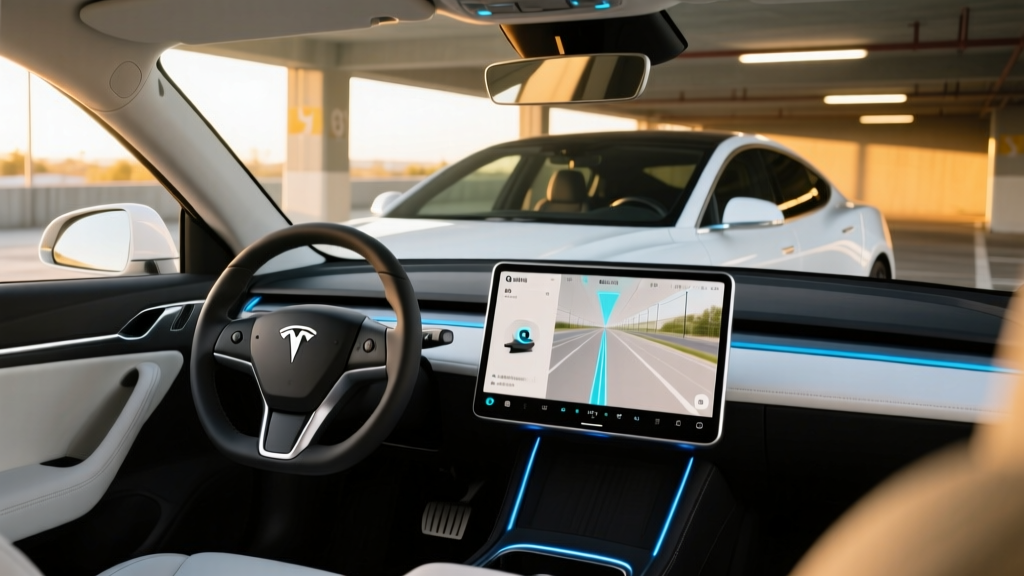
Tesla's entire ADAS stack—Autopilot, Enhanced Autopilot, and Full Self-Driving (Supervised)—relies on a camera-only architecture it calls Tesla Vision. Since removing radar and ultrasonic sensors beginning in 2021–2022, every incremental gain in object detection, lane-keeping, and intersection handling has come from neural-network improvements fed by the same eight exterior cameras.
The 2025.20.3 update refined three areas, according to owner telemetry reports and Tesla's release communications:
- High-occupancy vehicle (HOV) lane detection — more reliable recognition of painted diamond markings at speed.
- Low-light pedestrian classification — improved confidence scores in dusk and unlit suburban scenarios.
- Camera-calibration convergence — new vehicles and replacement-camera installs now calibrate in roughly 10–15 miles of driving versus 20–40 miles in prior builds.
2026 Model 3 Long Range AWD: Spec Table
Because camera updates ride on top of the vehicle's physical platform, the relevant baseline is the current 2026 Model 3 Long Range AWD—the trim most buyers cross-shop against the Hyundai Ioniq 6, BMW i4, and Polestar 2.
| Spec | Value |
|---|---|
| EPA Range | 363 miles |
| Battery (usable) | ~75 kWh, NMC (LG M50-based pack) |
| Drivetrain | Dual-motor AWD |
| Horsepower | 346 hp combined |
| 0–60 mph | 4.2 seconds |
| Efficiency | 132 MPGe / 25 kWh/100 mi |
| Max DC Fast Charge | 250 kW (V3 Supercharger) |
| 10–80% DC Time | ~27 minutes (preconditioned) |
| Level 2 Home Rate | 11.5 kW / ~44 mi/hr on 48A Wall Connector |
| Cargo Volume | 23 cu ft trunk + 3 cu ft frunk |
| Rear Legroom | 35.3 inches |
| Battery Warranty | 8 years / 120,000 miles, ≥70% retention |
| Base MSRP (2026) | $47,740 (before destination) |
Source: fueleconomy.gov, Tesla.com 2026 Model 3 specs.
Real-World Range vs. EPA Sticker
The camera updates themselves have a small but measurable effect on efficiency: smoother lane-centering and earlier regen anticipation in FSD (Supervised) reduce unnecessary acceleration pulses, which owner logs suggest has nudged highway efficiency up roughly 1–2% on long trips. Not headline-worthy, but real.
Charging Speed and Network Reality
Tesla's 250 kW V3 Supercharger peak is well-documented, but peak is not sustained. A typical charge curve on a preconditioned Long Range pack:
- 10–30% SoC: ~240–250 kW
- 30–55% SoC: ~180–210 kW
- 55–80% SoC: ~90–120 kW tapering
- 80–100% SoC: under 40 kW (avoid unless necessary)
Home charging on a Tesla Wall Connector at 48 amps (11.5 kW) adds roughly 44 miles per hour, meaning an overnight 8-hour session replenishes about 350 miles—more than enough for any daily commute. Owners on a standard 240V/32A dryer-style circuit see closer to 30 mi/hr.
Tesla's NACS connector is now the de facto North American standard, with Ford, GM, Rivian, and Volvo all adopting it through 2025–2026. For a 2026 buyer, this means Supercharger network access is a Tesla-native advantage that competitors are only now matching.
Pricing, Trims, and Federal Tax Credit Eligibility
| Trim | MSRP | §30D Credit Potential | Effective Price |
|---|---|---|---|
| Model 3 RWD | $39,740 | Up to $7,500 | ~$32,240 |
| Model 3 Long Range AWD | $47,740 | Up to $7,500 | ~$40,240 |
| Model 3 Performance | $54,740 | Up to $7,500 | ~$47,240 |
§30D eligibility is not automatic. Per IRS rules, buyers must meet:
- Income caps: MAGI ≤ $150,000 single / $300,000 married filing jointly
- MSRP cap: Sedans ≤ $55,000 (Model 3 qualifies; Model S does not)
- Battery sourcing: Critical minerals and battery components must meet phased-in percentages from U.S./FTA partners — Tesla's U.S.-assembled packs have generally met these thresholds, but annual rule tightening means verification at point of sale is essential
- Point-of-sale transfer: Buyers can apply the credit as a down-payment reduction at the dealer rather than waiting for tax-time refund
Always confirm eligibility with your tax professional before signing, as the credit is non-refundable and phase-out rules apply.
Driver-Assist Tech: Autopilot, FSD (Supervised), and the Camera Stack
Every 2026 Tesla ships with Basic Autopilot (lane centering + traffic-aware cruise) standard. Enhanced Autopilot ($6,000) adds auto lane-change, Navigate on Autopilot, and Smart Summon. FSD (Supervised) ($8,000 or $99/month) adds traffic-light/stop-sign control and city-street autosteer.
The 2025.20.3 camera updates sharpened FSD's weakest edges: dusk pedestrian detection and HOV-lane compliance. For daily commuters on well-marked routes, the system is measurably more confident than in 2024 builds. For complex urban driving, human intervention remains frequent.
Pros and Cons
- Class-leading efficiency (132 MPGe)
- Supercharger network reliability
- OTA software improvements (e.g., 2025.20.3) add value post-purchase
- Strong §30D credit eligibility on most trims
- Spacious frunk + trunk combo (26 cu ft total)
- No ultrasonic sensors — park-assist purely vision-based, occasionally hesitant
- Minimalist interior polarizes; no physical stalks on refreshed Model 3
- FSD (Supervised) is expensive and still Level 2
- Insurance premiums often 15–25% above segment average
- Panel gaps and service-center wait times remain inconsistent
Who the 2026 Model 3 Suits Best
Choose the Model 3 Long Range if: You commute 40+ miles daily, have home Level 2 charging, want the lowest cost-per-mile in the premium EV sedan segment, and value continuous software improvement.
Look elsewhere if: You need a true self-driving experience (no Level 2 system delivers this), you regularly carry four adults on long trips (rear seat is tighter than Model Y), or you prefer physical controls and a traditional instrument cluster.
Frequently Asked Questions
What exactly did Tesla camera updates 2025.20.3 change?
Primarily improved HOV-lane marking recognition, better low-light pedestrian classification, and faster camera recalibration after service. These are neural-net refinements applied to the existing eight-camera hardware — no new sensors were added.
Does the 2026 Model 3 qualify for the $7,500 federal tax credit?
Most buyers will qualify, provided they meet IRS income caps ($150k single / $300k joint), purchase a sedan under the $55k MSRP cap, and the specific vehicle's battery meets critical-mineral and component sourcing thresholds for the current tax year. Confirm at point of sale.
How fast does the Model 3 charge at home and on the road?
On a V3 Supercharger, peak 250 kW with a 10–80% session in about 27 minutes when preconditioned. At home on a 48A Tesla Wall Connector (11.5 kW), expect ~44 miles of range per hour of charging.
Is FSD (Supervised) worth the $8,000 upgrade?
For most buyers, no. Basic Autopilot handles highway commuting well. FSD's city-street capability remains a supervised Level 2 system that requires constant attention. Consider it only if you enjoy beta tech and drive complex urban routes daily.
Real-world range in winter?
Expect 240–270 miles from the Long Range AWD in sub-freezing temperatures, primarily due to cabin heating demand and reduced battery efficiency. Preconditioning while plugged in recovers roughly 10–15% of that loss.
Is it worth buying over the Hyundai Ioniq 6 or BMW i4?
For efficiency and charging-network access, Tesla wins. For interior materials and dealership service familiarity, BMW and Hyundai have an edge. The Ioniq 6 SE offers comparable range (361 mi EPA) at a lower MSRP and often qualifies for the same credit — cross-shop both before deciding.
Additional sources: NHTSA Automated Vehicles Safety, IIHS 2026 Model 3 ratings.