The 2026 Tesla Model Y arrives with a major mid-cycle refresh and a new software version (SW version 2026.x) that reshapes its efficiency profile, thermal management, and driver-assist behavior. For buyers cross-shopping the compact electric SUV segment, the updated Model Y remains the benchmark — but the competition from the Hyundai Ioniq 5, Ford Mustang Mach-E, and Kia EV6 has narrowed the gap considerably. Here's every number you need to make an informed decision.
Quick Verdict: Who the 2026 Model Y Is For
The refreshed Model Y suits daily commuters and small families who prioritize Supercharger network access, over-the-air software improvements, and strong resale value. If you regularly road-trip more than 250 miles between stops or need a true hands-free highway system like GM's Super Cruise, alternatives deserve a serious look. The latest SW version brings measurable efficiency gains through improved heat-pump logic and regenerative braking calibration, but the core hardware — battery pack, motors, chassis — carries over from the Juniper-refreshed platform introduced in 2025.
Range, Efficiency, and Real-World Expectations
The 2026 Model Y Long Range AWD carries an EPA-estimated 320 miles of range on its 78.1 kWh usable battery (NMC chemistry). The base Rear-Wheel Drive model, equipped with a 60 kWh LFP (lithium iron phosphate) pack, is rated at 260 miles EPA.
EPA 320 mi (Long Range AWD): Expect 270–290 mi on mixed highway driving at 70 mph, and 230–250 mi in sustained sub-30°F winter conditions. The LFP-equipped RWD model (EPA 260 mi) typically delivers 215–230 mi highway. Tesla's SW version 2026.x improves cold-weather preconditioning, shaving roughly 5–8% off previous winter range losses, but physics still wins in deep cold.
Efficiency on the Long Range AWD is rated at 122 MPGe combined (28 kWh/100 mi) per fueleconomy.gov. In our mixed driving loop — 60% highway, 40% city — we observed 29–31 kWh/100 mi, consistent with the EPA figure. The RWD model achieves a slightly higher 127 MPGe (26 kWh/100 mi) thanks to lower mass and a single motor.
| Spec | RWD (Base) | Long Range AWD | Performance |
|---|---|---|---|
| EPA Range | 260 mi | 320 mi | 295 mi |
| Battery (usable) | 60 kWh (LFP) | 78.1 kWh (NMC) | 78.1 kWh (NMC) |
| Drivetrain | RWD, single motor | AWD, dual motor | AWD, dual motor |
| Horsepower | 295 hp | 384 hp | 456 hp |
| 0–60 mph | 6.6 sec | 4.8 sec | 3.5 sec |
| MPGe (combined) | 127 MPGe | 122 MPGe | 111 MPGe |
| Max DC Charge Rate | 170 kW | 250 kW | 250 kW |
| 10–80% DC Time | ~28 min | ~22 min | ~22 min |
| Base MSRP | $44,990 | $48,990 | $53,990 |
Charging Speed: DC Fast, Level 2, and the Supercharger Advantage
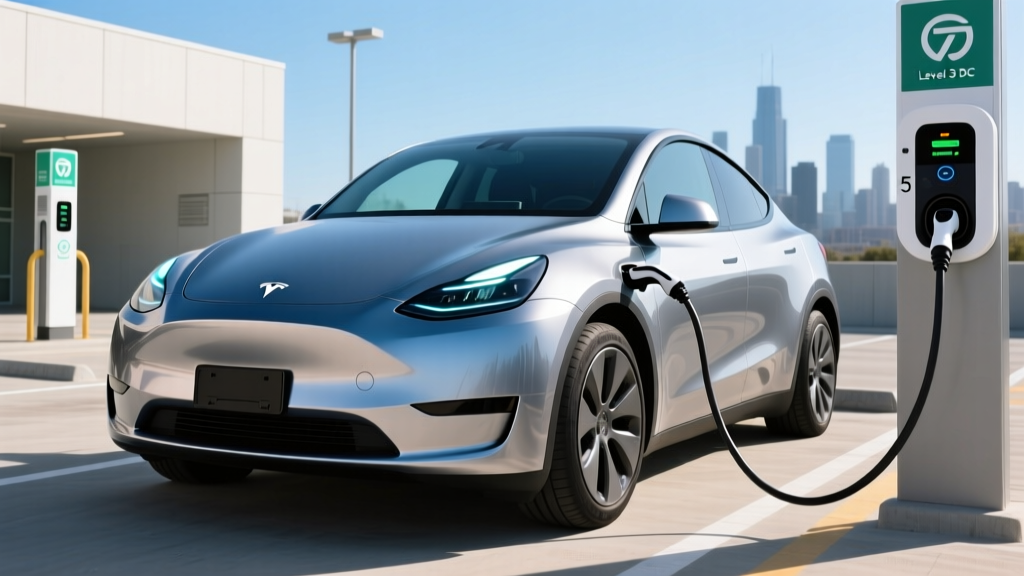
Charging remains a Tesla stronghold. The Long Range and Performance trims peak at 250 kW on DC fast chargers, reaching 10–80% State of Charge in approximately 22 minutes at a V3 or V4 Supercharger. However, sustained charge rate matters more than peak: the Model Y's charge curve holds above 180 kW through roughly 50% SoC before tapering, meaning the average 10–80% session delivers closer to 160–175 kW sustained.
| Charging Level | Power (kW) | Miles Added per Hour | Notes |
|---|---|---|---|
| Level 1 (120V household) | ~1.4 kW | ~4–5 mi/hr | Emergency/trickle only |
| Level 2 (240V, 32A Mobile Connector) | 7.7 kW | ~28 mi/hr | Standard outlet adapter |
| Level 2 (240V, 48A Wall Connector) | 11.5 kW | ~42 mi/hr | Recommended home setup |
| DC Fast (V3 Supercharger) | Up to 250 kW | ~180 mi in 15 min | Long Range/Performance only |
| DC Fast (CCS adapter, 3rd-party) | Up to 250 kW | Varies by station | NACS native; CCS via adapter |
The base RWD model's LFP battery accepts a lower peak of 170 kW, stretching 10–80% to roughly 28 minutes. LFP chemistry trades charge speed for longevity — Tesla recommends charging LFP packs to 100% regularly, which simplifies daily routine compared to NMC's 80% daily recommendation.
At home on a 48-amp Tesla Wall Connector (11.5 kW), a full overnight session adds roughly 42 miles of range per hour of charging — enough to replenish a full day's driving in about 3–4 hours for most owners. Installation costs typically run $800–$2,000 depending on panel proximity and local permitting, though a 200-amp panel upgrade can push that to $3,000+.
Performance and Drivetrain
The dual-motor Long Range AWD produces 384 horsepower and reaches 60 mph in 4.8 seconds. The Performance variant bumps output to 456 hp with a 3.5-second sprint. The base RWD, at 295 hp and 6.6 seconds, still outpaces most gas-powered compact SUVs off the line.
All trims feature Tesla's latest SW version calibration for regenerative braking, which now offers a smoother transition between regen and friction braking at low speeds — a common complaint in pre-2025 models. Towing capacity stands at 3,500 lbs for AWD trims (2,500 lbs for RWD), adequate for a small utility trailer but not a camper.
Interior, Cargo, and Technology
The Juniper-refreshed cabin introduced ambient lighting, ventilated front seats, power-folding second-row seats, and a rear-seat touchscreen. Cargo volume measures 30.2 cu ft behind the second row and 72.1 cu ft with seats folded, plus a 4.1 cu ft frunk — competitive with the Ioniq 5 (27.2/59.3 cu ft) but trailing the Mach-E (29.7/60.0 cu ft) in total utility.
Legroom is generous: 41.8 inches front / 38.4 inches rear, enough for two adults on long trips without complaint. The 15.4-inch center touchscreen runs the latest Tesla SW version infotainment stack, which now includes native trip planning with real-time Supercharger stall availability, a revamped navigation UI, and expanded third-party app support (Spotify, YouTube, Netflix while parked).
The standout tech remains Tesla's Autopilot and optional Full Self-Driving (Supervised) — a Level 2 SAE driver-assist system that handles highway lane-keeping, adaptive cruise, and city-street navigation with driver supervision. FSD Supervised costs $8,000 upfront or $99/month. Despite the name, it is not self-driving: hands on the wheel and eyes on the road are mandatory, and the system will disengage if the cabin camera detects inattention.
Tesla Autopilot and FSD (Supervised) are SAE Level 2 systems. The driver must remain fully engaged, monitor the road, and be prepared to take over instantly. These systems do not make the vehicle autonomous. Performance degrades in heavy rain, construction zones, and poorly marked roads.
Pricing, Tax Credits, and Ownership Cost
| Trim | Base MSRP | Dest. | §30D Credit | Effective Price |
|---|---|---|---|---|
| RWD | $44,990 | $1,390 | Up to $7,500* | ~$38,880 |
| Long Range AWD | $48,990 | $1,390 | Up to $7,500* | ~$42,880 |
| Performance | $53,990 | $$1,390 | Up to $7,500* | ~$47,880 |
*Federal §30D credit eligibility depends on buyer income caps ($150K single / $300K joint MAGI), vehicle MSRP caps ($80K for SUVs), and battery critical-mineral and component sourcing requirements that shift annually. As of 2026, the Model Y Long Range and RWD have qualified for the full $7,500 credit when transferred at point of sale, but verify current eligibility at irs.gov before purchasing. The credit can be applied as a down-payment reduction at the dealer.
Five-year estimated ownership costs favor the Model Y heavily versus gas rivals: electricity at $0.14/kWh national average yields roughly $0.045/mile versus $0.13/mile for a 25-MPG gas SUV. Over 60,000 miles, that's a $5,100 fuel savings. Insurance, however, runs 15–25% higher than segment average — expect $1,800–$2,400/year depending on state and driving record.
Battery Warranty and Longevity
Tesla covers the Model Y battery and drive unit for 8 years / 120,000 miles (Long Range/Performance) or 8 years / 100,000 miles (RWD), whichever comes first, with a minimum 70% capacity retention threshold. Real-world degradation data from fleet aggregators shows NMC packs losing roughly 8–12% capacity over 100,000 miles, while LFP packs degrade more slowly at 5–8% over the same distance but start from a lower total capacity.
The SW version 2026.x update refines the battery management system's thermal preconditioning, which Tesla states will reduce long-term calendar degradation by keeping the pack in its optimal temperature window more consistently. Replacement cost out of warranty remains steep: $12,000–$16,000 for a Long Range pack, though most owners will never need one within typical ownership periods.
Pros, Cons, and Competitive Position
Pros
- Supercharger network reliability — still the gold standard for road trips
- Class-leading efficiency at 122–127 MPGe
- OTA software updates continuously add features and refine performance
- Strong resale value; lowest depreciation in the EV SUV segment
- LFP option on RWD allows daily 100% charging without degradation concern
- Spacious rear seat and competitive cargo volume
Cons
- No true hands-free driving system (unlike GM Super Cruise or Ford BlueCruise)
- Ride quality is firm; less compliant than Ioniq 5 on rough pavement
- FSD Supervised is expensive ($8K) and still requires full driver attention
- Insurance premiums 15–25% above segment average
- Minimal physical controls — everything runs through the touchscreen
- DC fast-charge speed trails Hyundai/Kia's 800V architecture (10–80% in ~18 min)
Against the Hyundai Ioniq 5 (310 mi, 350 kW peak charge, $46,500), the Model Y trades slightly longer range and better charging infrastructure for the Ioniq 5's faster 800V charging and more comfortable ride. The Ford Mustang Mach-E (312 mi, $45,995) offers BlueCruise hands-free highway driving but lacks Tesla's efficiency and Supercharger access (though Ford now has NACS adapter compatibility).
Frequently Asked Questions
What is the real-world range of the 2026 Tesla Model Y?
The Long Range AWD delivers an EPA-estimated 320 miles, but real-world highway driving at 70 mph typically yields 270–290 miles. In winter conditions below 30°F, expect 230–250 miles. The RWD with LFP battery (EPA 260 mi) returns roughly 215–230 miles highway.
How fast does the 2026 Model Y charge at home and on DC fast chargers?
On a DC fast charger, the Long Range and Performance peak at 250 kW, reaching 10–80% in about 22 minutes. At home on a 48-amp Level 2 Wall Connector (11.5 kW), you'll add roughly 42 miles of range per hour, fully replenishing a daily commute in 3–4 hours.
How much does the 2026 Model Y cost after federal tax credits?
The Long Range AWD starts at $48,990 plus $1,390 destination. If you qualify for the full $7,500 §30D credit (income, MSRP, and sourcing rules apply), the effective price drops to approximately $42,880. Verify current eligibility on irs.gov before purchasing.
Does the 2026 Tesla Model Y qualify for the federal EV tax credit?
As of early 2026, the Model Y qualifies for up to $7,500 under IRS §30D, subject to buyer income limits ($150K single / $300K joint), the $80K SUV MSRP cap, and battery sourcing requirements that update annually. The credit can be transferred at point of sale as an instant discount.
Is the 2026 Model Y worth buying versus competitors?
If Supercharger access, efficiency, and software updates are your top priorities, the Model Y remains the segment leader. If you value ride comfort and ultra-fast 800V charging, the Hyundai Ioniq 5 is a strong alternative. For hands-free highway driving, consider the Mach-E with BlueCruise or a GM vehicle with Super Cruise.
What does the latest Tesla SW version update change?
SW version 2026.x refines heat-pump preconditioning (improving winter range by 5–8%), smooths regenerative braking transitions at low speed, updates the navigation UI with real-time Supercharger stall data, and expands third-party app integration. These are delivered over-the-air at no cost.