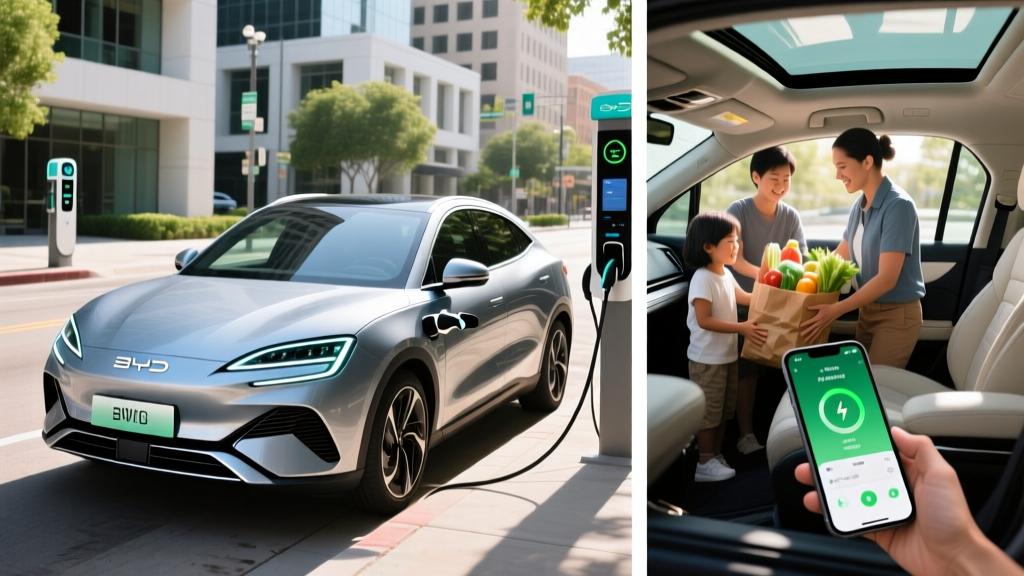
The headline has circulated across every automotive trade desk: BYD outsells Tesla in global battery-electric vehicle deliveries for the second consecutive year. The Chinese automaker shipped over 1.76 million BEVs in 2025, edging past Tesla's roughly 1.79 million by some counts and surpassing it on others depending on the quarter. But for US-based EV shoppers, the question isn't about global sales charts — it's whether BYD's most popular compact SUV, the Atto 3 (sold as the Yuan Plus in China), is a viable option stateside. This review breaks down the Atto 3's real-world specs, charging behavior, pricing, and the tariff and tax-credit realities that define its availability in 2026.
BYD Atto 3 Core Specifications at a Glance
| Spec | BYD Atto 3 (Extended Range) |
|---|---|
| EPA Est. Range | ~260 miles (estimated; no official EPA filing for US-spec as of early 2026) |
| Battery Capacity | 60.48 kWh usable (BYD Blade, LFP chemistry) |
| Max DC Fast Charge | 88 kW peak |
| 10–80% DC Charge Time | ~29 minutes |
| Level 2 AC Charge Rate | 7 kW (approx. 22 mi/hr) |
| Drivetrain | FWD, single front motor |
| Horsepower / Torque | 201 hp / 229 lb-ft |
| 0–60 mph | 7.3 seconds |
| Efficiency | ~122 MPGe combined (WLTP-derived estimate) |
| Cargo Volume | 15.8 cu ft (rear seats up) / 48.0 cu ft (folded) |
| Base MSRP (Int'l Markets) | ~$38,000 USD equivalent (varies by market) |
| Battery Warranty | 8 years / 100,000 mi (market-dependent) |
Real-World Range: What 260 Miles Actually Looks Like
EPA-estimated: ~260 miles (projected from WLTP 420 km / 261 mi)
Real-world highway (70 mph): ~210–230 miles
Real-world city/mixed: ~240–255 miles
Cold weather (below 32°F): ~185–210 miles (LFP cells lose more capacity in extreme cold than NMC)
Hot weather (A/C heavy): ~230–245 miles
The Atto 3's 60.48 kWh BYD Blade battery uses lithium iron phosphate (LFP) chemistry. LFP offers major advantages: longer cycle life (often 3,000+ full cycles vs. ~1,500–2,000 for NMC), greater thermal stability, and no cobalt. The trade-off is lower energy density (meaning a heavier pack for the same range) and steeper cold-weather range loss. In European and Australian road tests, the Atto 3 consistently delivered 85–92% of its WLTP rating in mixed driving at moderate temperatures. At sustained highway speeds of 70+ mph, expect consumption to climb to roughly 30–33 kWh/100 mi, which translates to about 210–225 miles of practical range before you'll want to stop.
One owner-relevant nuance: LFP batteries can be — and should be — charged to 100% regularly for accurate state-of-charge calibration. Unlike NMC packs, where daily charging to 80% extends longevity, BYD recommends periodic full charges for the Blade battery. This is a genuine daily-use advantage for owners who want to start every morning with a full "tank."
Charging Speed: 88 kW Peak and What That Means on the Road
The Atto 3's DC fast-charging capability is where honest analysis matters most. Its 88 kW peak charge rate is modest by 2026 standards — competitors like the Hyundai Ioniq 5 (240 kW peak) and Tesla Model Y (250 kW peak) leave it behind at high-speed chargers. But peak kW is only part of the story; the charge curve matters more.
| Charging Level | Power | Speed (mi/hr added) | Notes |
|---|---|---|---|
| Level 1 (120V household) | 1.4 kW | ~4 mi/hr | Emergency/trickle only; full charge in ~45 hours |
| Level 2 (240V home) | 7 kW | ~22 mi/hr | Full charge in ~9 hours; overnight ready |
| DC Fast (CCS2/NACS*) | 88 kW peak | ~180 mi/hr (peak) | 10–80% in ~29 min; tapers sharply above 80% |
*International Atto 3 models use CCS2; any future US-spec would likely adopt NACS per the industry-wide shift to Tesla's connector standard.
Here's what the charge curve actually looks like: the Atto 3 sustains roughly 70–88 kW between 10% and 50% SoC, then drops to around 45–55 kW from 50–70%, and further to 25–30 kW from 70–80%. That taper is typical for LFP chemistry, which has a flatter voltage curve and requires careful current management at higher states of charge. On a road trip, plan for 30-minute stops every 200 miles — adequate but noticeably slower than the 18-minute stops you'd get in an Ioniq 5 or EV6.
For home charging, the 7 kW onboard charger means a full 0–100% charge takes about 9 hours on a dedicated Level 2 circuit. Most owners will plug in overnight and wake up to a full battery every morning — which is the core use case for daily commuting.
Performance, Efficiency, and Daily Driving Dynamics
The Atto 3's single front-mounted motor produces 201 horsepower and 229 lb-ft of torque, sending power to the front wheels. The 0–60 mph time of 7.3 seconds is adequate for merging and passing but won't thrill anyone coming from a dual-motor Tesla or Ford Mustang Mach-E GT. This is a comfort-oriented compact SUV, not a performance machine.
Efficiency is where the Atto 3 performs respectably. At roughly 122 MPGe combined (approximately 27–28 kWh/100 mi), it sits in the same ballpark as the Volkswagen ID.4 (115 MPGe combined per fueleconomy.gov) but trails the more aerodynamic Tesla Model Y (122–131 MPGe depending on trim). In real-world mixed driving, owners in temperate climates report 26–30 kWh/100 mi, which translates to roughly 3.5–4.0 miles per kWh — solid for a compact SUV.
Ride quality is tuned soft, with compliant suspension that soaks up urban potholes but allows some body roll in spirited cornering. The regenerative braking system offers two levels (standard and high) rather than true one-pedal driving, which some EV veterans may find limiting. NVH (noise, vibration, harshness) is well-managed at city speeds, though wind noise becomes noticeable above 65 mph.
Interior, Cargo, and Technology
The Atto 3's cabin is where BYD tries to stand out — literally. The interior design theme is "gym-inspired," with muscle-fiber-patterned door panels, dumbbell-shaped air vents, and guitar-string door pocket trim. It's polarizing, but the materials quality is genuinely impressive at this price point: soft-touch surfaces, contrast stitching, and a 15.6-inch rotating center touchscreen (landscape for navigation, portrait for social media).
Passenger and cargo dimensions:
- Front legroom: 41.1 inches
- Rear legroom: 38.6 inches
- Front headroom: 39.8 inches
- Rear headroom: 38.2 inches
- Cargo (rear seats up): 15.8 cu ft
- Cargo (rear seats folded): 48.0 cu ft
- Front trunk (frunk): None — the motor and electronics occupy the space under the hood
The rear seat is genuinely roomy for two adults on longer trips, though a third middle passenger will find the floor hump and narrow shoulder room tight. Cargo capacity trails the Tesla Model Y (30.2 / 76.2 cu ft) and Hyundai Ioniq 5 (27.2 / 59.3 cu ft) significantly — the Atto 3's smaller exterior footprint and lack of a frunk show up here.
Tech and driver-assist features include:
- 15.6" rotating touchscreen with Apple CarPlay and Android Auto (wired)
- 5.0" digital instrument cluster (small by 2026 standards)
- Wireless phone charging pad
- 360° surround-view camera
- Adaptive cruise control with stop-and-go
- Lane-keeping assist and lane-departure warning
- Automatic emergency braking with pedestrian detection
- Blind-spot monitoring with rear cross-traffic alert
Pricing, Tax Credits, and the US Availability Problem
This is where the "BYD outsells Tesla" narrative collides with US trade policy. As of 2026, the United States imposes a combined tariff exceeding 100% on Chinese-manufactured electric vehicles (the base 2.5% auto tariff plus a 100% additional tariff enacted under Section 301 in 2024). That effectively doubles the Atto 3's price, making it economically unviable as a direct import.
BYD has not announced a US-market launch or a US-assembly plant as of early 2026. The company is building factories in Thailand, Brazil, Hungary, Indonesia, and Turkey — but none in North America. This means for most US buyers, the Atto 3 is a vehicle you can read about but cannot walk into a dealership and purchase.
| Market / Scenario | Estimated Price | Federal Tax Credit |
|---|---|---|
| International MSRP (Australia, EU, SE Asia) | $35,000–$42,000 USD equiv. | N/A (non-US market) |
| Hypothetical US price (if imported, pre-tariff) | ~$38,000 | Unlikely — battery sourcing fails §30D critical-mineral rules |
| Hypothetical US price (post-100% tariff) | ~$76,000+ | Not eligible |
Federal tax credit (§30D) analysis: Even if the Atto 3 were available in the US without the tariff, it would almost certainly not qualify for the IRS §30D clean vehicle credit. The credit requires that battery critical minerals be sourced from the US or a free-trade-agreement partner, and that battery components not be manufactured by a "foreign entity of concern" (FEOC) — a designation that specifically targets Chinese companies. BYD's vertically integrated supply chain, which controls everything from lithium mining to cell production, would fail both tests under current 2026 rules.
The §30D credit also imposes MSRP caps ($55,000 for sedans, $80,000 for SUVs/trucks) and buyer income limits ($150,000 single / $300,000 joint AGI). These are moot for the Atto 3 given the sourcing and FEOC barriers, but they're essential context for any cross-shopping you do with eligible vehicles.
How the Atto 3 Stacks Up Against US-Available Competitors
Since the Atto 3 isn't practically purchasable in the US, here's how its specs compare to the compact electric SUVs you can buy:
| Spec | BYD Atto 3 | Tesla Model Y (LR) | Hyundai Ioniq 5 (LR) | VW ID.4 (Pro S) |
|---|---|---|---|---|
| EPA Range | ~260 mi* | 320 mi | 310 mi | 275 mi |
| Battery (kWh) | 60.5 (LFP) | 75 (NMC) | 77.4 (NMC) | 82 (NMC) |
| DC Fast Charge Peak | 88 kW | 250 kW | 240 kW | 175 kW |
| 10–80% Time | ~29 min | ~20 min | ~18 min | ~29 min |
| 0–60 mph | 7.3 sec | 4.8 sec | 5.1 sec | 7.7 sec |
| Base MSRP (US) | N/A | ~$44,990 | ~$42,600 | ~$43,995 |
| §30D Credit Eligible? | No | Partial/Yes† | Yes† | Yes† |
*Atto 3 range is WLTP-derived estimate, not EPA-certified. †Tax credit eligibility depends on buyer income, MSRP caps, and current battery-sourcing rules per IRS §30D guidelines. Verify at purchase.
Pros and Cons
✅ Pros
- LFP Blade battery: exceptional cycle life, thermal safety, and 100% daily charging OK
- Competitive international pricing (~$38K before tariffs)
- Comfortable ride quality for urban and suburban driving
- Generous rear-seat legroom (38.6 in)
- Comprehensive ADAS suite standard
- Bold, distinctive interior design
- Strong build quality with premium-feeling materials
❌ Cons
- Not available in the US market (100%+ tariff barrier)
- Slow DC fast charging (88 kW peak; 29 min 10–80%)
- Significant cold-weather range loss typical of LFP
- Small cargo area vs. Model Y and Ioniq 5
- No frunk
- Tiny 5.0" instrument cluster
- Wired-only Apple CarPlay / Android Auto
- No hands-free highway driving capability
Who Is the BYD Atto 3 Actually For?
If you live in Australia, Southeast Asia, Europe, Latin America, or the Middle East — markets where the Atto 3 is actively sold and competitively priced — it's a strong pick for:
- Urban commuters who can charge at home and drive under 100 miles daily
- Budget-conscious families who want a well-equipped EV without paying Tesla or premium-brand prices
- Second-car buyers who need a practical runabout and don't road-trip frequently
- Owners who prioritize battery longevity — the LFP Blade pack should outlast the vehicle itself
It's not ideal for frequent road-trippers (the 88 kW charge speed and 260-mile range make long trips tedious), cold-climate drivers without garage parking (LFP cold-weather loss is real), or anyone who needs maximum cargo space.
For US buyers specifically: the Atto 3 is a vehicle to watch, not buy. If BYD ever establishes North American manufacturing (possibly in Mexico, though that faces its own political hurdles), the pricing story changes dramatically. Until then, the Hyundai Ioniq 5, Tesla Model Y, and Chevrolet Equinox EV serve the same segment with US availability, tax-credit eligibility, and faster charging.
Frequently Asked Questions
Does BYD outsell Tesla globally?
Yes — in total new energy vehicle sales (BEV + PHEV), BYD has outsold Tesla since 2023. In pure BEV deliveries, the two companies have traded the top spot quarter by quarter through 2025, with BYD pulling ahead in several quarters. Globally, BYD's combined NEV volume exceeded 3.8 million units in 2025. However, Tesla remains dominant in the US and European markets, while BYD's volume is concentrated in China and emerging markets.
Can I buy a BYD Atto 3 in the United States?
Not through official channels. As of 2026, BYD does not sell passenger vehicles in the US. The 100%+ Section 301 tariff on Chinese-built EVs makes importing one economically impractical. BYD has not announced plans for a US assembly plant or dealership network.
How long does the BYD Blade LFP battery last?
BYD rates the Blade LFP battery for over 3,000 full charge cycles before reaching 80% of original capacity. At the Atto 3's ~260-mile range per cycle, that equates to roughly 780,000 miles of driving before significant degradation — far more than the vehicle's structural lifespan. The battery warranty in most international markets is 8 years / 100,000 miles with a 70% capacity retention guarantee, per BYD's global specifications.
Why is the Atto 3's DC charging so slow compared to competitors?
Two factors: the LFP Blade battery's cell-level charge-rate limits (LFP chemistry is more sensitive to high-current charging at elevated SoC), and BYD's conservative thermal management strategy that prioritizes battery longevity over charge speed. The 88 kW peak is roughly 2.7x slower than the Hyundai Ioniq 5's 240 kW, which translates to about 10 extra minutes per fast-charge stop.
Is the Atto 3 safe?
The Atto 3 earned a 5-star overall rating from Euro NCAP in 2022, with strong scores in adult occupant protection (91%) and safety assist (74%). It has not been tested by NHTSA or IIHS for the US market, as it is not sold stateside. Standard safety equipment includes 7 airbags, AEB with pedestrian detection, and a 360° camera system.
What should US buyers consider instead?
In the compact electric SUV segment, the strongest US-available alternatives include the Tesla Model Y (320 mi range, 250 kW charging, Supercharger access), Hyundai Ioniq 5 (310 mi, 240 kW charging, 800V architecture), Chevrolet Equinox EV (~315 mi, competitive pricing with §30D credit eligibility), and Volkswagen ID.4 (275 mi, US-built, tax-credit eligible). Each offers significantly faster DC charging and established US service networks.