Quick Answer: Is the 2027 Toyota Highlander Electric SUV Available Now?
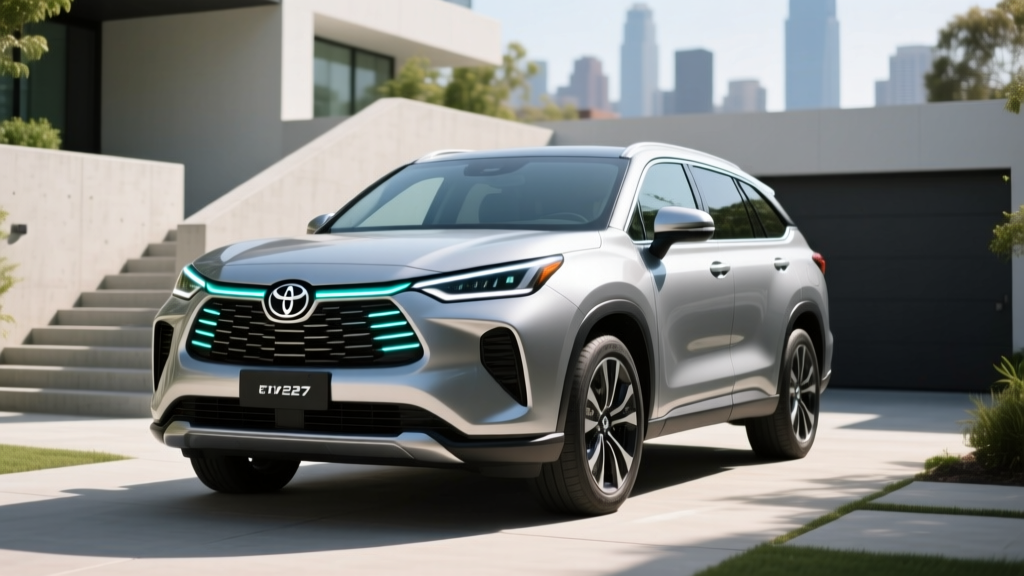
No. As of early 2026, Toyota has not officially released or opened reservations for a 2027 Toyota Highlander electric SUV. Toyota has confirmed an electric three-row SUV is in development — widely expected to carry the Highlander nameplate — but final specifications, pricing, and on-sale dates remain unannounced. Based on Toyota's current EV roadmap and industry reporting, a battery-electric Highlander is most likely to arrive as a 2027 or 2028 model-year vehicle, potentially going on sale in late 2026 or 2027. Until Toyota publishes official specs, every number cited in this guide is an informed estimate based on the bZ platform, the current bZ4X architecture, and competitive three-row EV benchmarks. Treat all figures as preliminary.
What We Know About Toyota's Electric Three-Row SUV Plans
Toyota has been slower than competitors like Hyundai, Kia, and Ford to bring a mainstream electric SUV to market, but the company has committed to launching 30 battery-electric vehicles globally by 2030. The bZ4X, Toyota's first dedicated BEV, launched for the 2023 model year with an EPA-estimated 252 miles of range (FWD) and a 71.4 kWh battery. However, the bZ4X is a compact crossover — far smaller than what Highlander buyers need.
For a three-row family hauler, Toyota will need a larger platform. Industry analysts expect the electric Highlander to ride on an extended version of Toyota's e-TNGA architecture or a next-generation modular EV skateboard. The closest comparable in Toyota's announced lineup is the bZ Large SUV concept, unveiled in early 2023, which previewed a three-row electric SUV sized similarly to the current gas Highlander.
Here is what we can reasonably project based on platform constraints, competitive positioning, and Toyota's historical approach to conservative range estimates:
| Specification | Estimated Figure | Basis |
|---|---|---|
| Battery Capacity | ~90-100 kWh (usable) | Comparable to Kia EV9 (99.8 kWh), Hyundai Ioniq 9 |
| EPA Range | ~270-310 miles | Based on 3.0-3.3 mi/kWh efficiency for large SUVs |
| Peak DC Fast Charge Rate | ~180-250 kW | bZ4X peaks at ~150 kW; next-gen expected faster |
| 10-80% DC Charge Time | ~25-35 minutes | Dependent on charge curve and preconditioning |
| Level 2 Charge Rate | ~11 kW (estimated) | Standard for 3-row EVs; ~8-9 hours for full charge |
| Horsepower | ~300-400 hp (AWD dual motor) | Competitive with EV9 GT-Line (379 hp) |
| 0-60 mph | ~5.5-7.0 seconds | Varies by FWD/AWD and motor config |
| Seating | 7 or 8 passengers | Standard for segment |
| Estimated Base MSRP | $45,000 - $52,000 | Positioned below EV9 ($54,900 base) but above bZ4X ($43,070) |
| Battery/Powertrain Warranty | 8 years / 100,000 miles | Toyota's current hybrid battery warranty standard |
Important caveat: Toyota has historically been conservative with range estimates. The bZ4X's EPA rating came in lower than some competitors with similar battery sizes, partly due to Toyota's testing methodology and emphasis on battery longevity over maximum range. An electric Highlander could follow the same pattern — real-world highway range may land closer to 240-270 miles even if the EPA sticker reads higher.
Electric Highlander vs. Gas Highlander: Cost and Efficiency Comparison
The current 2025 Toyota Highlander gas model achieves an EPA-estimated 24 MPG combined (FWD) with a starting MSRP around $39,070. The Highlander Hybrid bumps that to 35 MPG combined at a ~$40,970 starting price. How would an electric version stack up on operating costs?
| Metric | Gas Highlander (24 MPG) | Highlander Hybrid (35 MPG) | Electric Highlander (Est. 3.1 mi/kWh) |
|---|---|---|---|
| Annual Miles | 15,000 | 15,000 | 15,000 |
| Fuel/Energy Used | 625 gallons | 429 gallons | 4,839 kWh |
| Cost per Unit | $3.40/gal (avg) | $3.40/gal (avg) | $0.14/kWh (home avg) |
| Annual Fuel/Energy Cost | $2,125 | $1,458 | $678 |
| Annual Maintenance (est.) | ~$650 | ~$600 | ~$350 |
| Total Annual Operating Cost | ~$2,775 | ~$2,058 | ~$1,028 |
Source: Energy costs based on AAA national average gas prices and EIA residential electricity rates as of early 2026. Actual costs vary significantly by state, driving habits, and electricity provider. EV drivers using public DC fast charging exclusively will pay $0.30-$0.55/kWh, raising annual energy costs to $1,450-$2,660.
The electric Highlander would save roughly $1,000-$1,750 per year in operating costs compared to the gas version — assuming consistent home Level 2 charging at residential electricity rates. Over a typical 7-year ownership period, that translates to $7,000-$12,250 in fuel and maintenance savings. However, the higher upfront purchase price (estimated $6,000-$13,000 more than the gas model) and potentially higher insurance premiums (EVs average 15-25% more to insure) eat into those savings substantially in the early years.
Real-World Ownership: What First-Time EV Buyers Must Consider
If you've never owned an EV, the transition involves more than swapping gas stations for charging plugs. Here are the practical realities that spec sheets don't always convey:
Home Charging Access Is Non-Negotiable for Most Owners
Over 80% of EV charging happens at home. If you can install a Level 2 (240V) home charger — ideally a 48-amp unit on a 60-amp circuit — daily EV ownership is effortless. You plug in at night and wake up to a full battery every morning. But if you live in an apartment, condo, or street-parking situation without dedicated charging access, an electric Highlander becomes significantly less practical.
Home charger installation costs: Expect $800-$2,500 for a quality Level 2 unit (ChargePoint Home Flex, Emporia Level 2, or Wallbox Pulsar Plus) plus $500-$2,000 for electrician labor and permits. If your home's electrical panel needs an upgrade from 100A to 200A service, add $1,500-$3,500. Total installation: $1,300-$8,000 depending on your home's existing electrical infrastructure.
Charging Speed Isn't Just About Peak kW
When Toyota (or any automaker) advertises a peak DC fast-charge rate — say 250 kW — that number represents the maximum rate at a specific state of charge, typically between 10-30% SoC with a preconditioned battery. The actual charging curve tapers significantly:
- 10-30% SoC: Near peak rate (~200-250 kW)
- 30-60% SoC: Moderate rate (~150-180 kW)
- 60-80% SoC: Reduced rate (~80-120 kW)
- 80-100% SoC: Trickle rate (~20-40 kW) — never fast-charge past 80% on road trips
This is why the 10-80% charge time is the most useful real-world metric. For a ~95 kWh battery charging at an estimated average of ~140 kW across that window, expect roughly 30-35 minutes at a capable 350 kW station. At older 50-150 kW stations common in rural areas, plan for 45-70 minutes.
Cold Weather Cuts Range by 20-35%
Lithium-ion batteries lose efficiency in cold temperatures, and cabin heating in winter draws significant energy. If the electric Highlander achieves a 300-mile EPA rating, expect 200-240 miles of real range in sustained sub-30°F driving. A heat pump (which Toyota included on the bZ4X) mitigates this somewhat, but the loss is unavoidable physics. If you live in the upper Midwest, Northeast, or Mountain West, plan your road-trip expectations accordingly.
Federal Tax Credit Eligibility: What the §30D Rules Mean for Buyers
The IRS §30D federal tax credit offers up to $7,500 for qualifying new EV purchases, but eligibility is layered with requirements that change annually. For a 2027 model-year vehicle, these are the key rules to track:
- MSRP Cap: SUVs and trucks must have an MSRP at or below $80,000 to qualify. A base Highlander EV should clear this easily; a fully loaded Platinum or Limited trim might push close to the cap.
- Buyer Income Limits: Modified adjusted gross income (MAGI) must not exceed $150,000 (single), $225,000 (head of household), or $300,000 (married filing jointly).
- Battery Sourcing Requirements: A percentage of critical minerals and battery components must be sourced from the U.S. or free-trade-agreement countries. This threshold increases annually and has disqualified several competitors in recent years.
- Point-of-Sale Transfer: As of 2024, buyers can transfer the credit to the dealer at purchase, reducing the purchase price directly rather than waiting for a tax refund. This option is expected to continue for 2027.
- North American Assembly: The vehicle must be assembled in North America. Toyota's U.S. plants (Kentucky, Indiana, Texas, Alabama) make this likely for a Highlander EV, but it must be confirmed at launch.
Bottom line: Do not assume you'll receive the full $7,500. Battery-sourcing rules are the most volatile factor — consult the fueleconomy.gov tax credit tool when the vehicle launches to verify eligibility for your specific trim and purchase date. A tax professional can confirm income eligibility.
How the Electric Highlander Stacks Up Against Current 3-Row EVs
By the time a Highlander EV reaches showrooms, it will face established competition. Here's how it might compare to current segment leaders:
| Vehicle | EPA Range | Battery (kWh) | Peak DC kW | 10-80% Time | Starting MSRP |
|---|---|---|---|---|---|
| Kia EV9 (2025) | 270-304 mi | 99.8 | 210 kW | ~24 min | $54,900 |
| Hyundai Ioniq 9 (2026) | ~300+ mi (est.) | 110.3 | ~240 kW | ~22 min | ~$52,000 |
| VW ID. Buzz (2025) | 234 mi | 91 | 170 kW | ~26 min | $59,995 |
| Tesla Model X (2025) | 311-348 mi | 100 | 250 kW | ~20 min | $79,990 |
| Toyota Highlander EV (Est.) | ~270-310 mi | ~90-100 | ~180-250 kW | ~25-35 min | ~$45,000-$52,000 |
Toyota's likely competitive advantage: brand trust, dealer network, and resale value. Toyota consistently leads in long-term reliability rankings and commands strong resale value — factors that matter to family SUV buyers who plan to keep their vehicles 7-10 years. The trade-off may be slower DC charging speeds and slightly lower range than Korean competitors, consistent with Toyota's conservative battery-management philosophy that prioritizes longevity over maximum performance.
Decision Framework: Should You Wait for the Electric Highlander?
Wait for the 2027 Toyota Highlander Electric SUV if:
- You currently own a gas Highlander and want to stay in the Toyota ecosystem with a familiar size and layout
- You have reliable home Level 2 charging access (garage or driveway with 240V outlet)
- Your daily driving is under 60 miles round-trip, with occasional 200-250 mile road trips
- You value long-term reliability and Toyota's dealer service network over cutting-edge EV tech
- You're not in a rush — you can wait 12-18 months for the vehicle to arrive and early reviews to settle
- You live in a region with mild winters or have a second vehicle for long winter road trips
Buy a Current Three-Row EV Now if:
- You need an electric SUV within the next 3-6 months
- You want access to the Tesla Supercharger network (Kia EV9 and Hyundai Ioniq 9 now include NACS adapters or native NACS ports)
- You frequently drive routes longer than 250 miles and need proven fast-charging infrastructure today
- You want to lock in current §30D tax credit eligibility before sourcing rules potentially tighten further
Choose the Highlander Hybrid Instead if:
- You lack home charging access and rely on street parking or apartment living
- You regularly tow more than 3,500 lbs (EV towing range loss is severe — expect 40-50% range reduction)
- You frequently drive in extreme cold (below 10°F) for extended distances
- You want the lowest upfront cost and don't mind paying more in fuel over time
- You live in a rural area with sparse DC fast-charging infrastructure
Common Misconceptions About the Electric Highlander — and the Facts
| Myth | Fact |
|---|---|
| "It will have 400+ miles of range like a Tesla." | Unlikely. A 3-row SUV with a ~95 kWh battery realistically achieves 270-310 miles EPA. Tesla's Model X reaches 348 miles partly due to a 100 kWh pack and superior aerodynamics. Toyota's conservative battery management typically yields lower EPA numbers than competitors. |
| "I can charge it at any public charger." | Connector type matters. Toyota's bZ4X uses CCS1. If the Highlander EV follows suit, you'll need a NACS adapter for Tesla Superchargers (which now welcome non-Tesla EVs with adapters). Confirm connector type at launch. |
| "The battery will need replacing in 5 years." | Modern EV batteries are designed to last 15-20 years with 70-80% capacity retention. Toyota's hybrid battery warranty (8 yr/100k mi) sets a precedent. Degradation averages 1-2% per year for NMC chemistry with proper care (avoiding frequent 100% charges and DC fast charging). |
| "It will qualify for the full $7,500 tax credit." | Not guaranteed. Battery-sourcing and critical-mineral requirements under §30D have disqualified multiple vehicles. Eligibility depends on the specific supply chain Toyota establishes for the Highlander EV's battery cells and modules. Check fueleconomy.gov at launch. |
| "It charges as fast as competitors." | The bZ4X's ~150 kW peak charge rate was criticized as slow for its class. Toyota has signaled improvements for next-gen models, but whether the Highlander EV reaches 250+ kW remains unconfirmed. If it peaks at 180-200 kW, 10-80% times will be 5-10 minutes slower than the Kia EV9. |
5-Year Total Cost of Ownership Estimate
| Cost Category | Gas Highlander (Base) | Electric Highlander (Est.) |
|---|---|---|
| Purchase Price (MSRP) | $39,070 | $48,000 (est.) |
| Federal Tax Credit | $0 | Up to -$7,500 (if eligible) |
| Effective Purchase Price | $39,070 | $40,500 (est.) |
| Fuel / Energy (5 years) | $10,625 | $3,390 (home charging) |
| Maintenance (5 years) | $3,250 | $1,750 |
| Insurance (5 years, est.) | $7,500 | $9,375 (+25%) |
| Home Charger Install | $0 | $2,500 (avg) |
| 5-Year Total | $60,445 | $57,515 |
| Estimated Resale Value (Year 5) | -$20,000 | -$22,000 (est.) |
| Net 5-Year Cost | $40,445 | $35,515 |
Assumptions: $3.40/gal gas, $0.14/kWh electricity, 15,000 mi/year, 70% home / 30% public charging mix for EV. Insurance estimates based on industry EV premium averages. Resale values are rough projections — EV depreciation curves are still stabilizing as the market matures. Your actual numbers will vary by state, utility rate, driving pattern, and insurance provider.
The electric Highlander could break even with the gas version within 4-5 years for buyers who qualify for the tax credit and charge primarily at home. Without the credit, or if you rely heavily on expensive public DC fast charging, the payback period extends to 6-8 years or may not materialize at all before resale.
Frequently Asked Questions
When will the 2027 Toyota Highlander electric SUV be available to order?
Toyota has not announced an official on-sale date. Based on the company's EV rollout timeline and the bZ Large SUV concept preview, industry observers expect a reveal in mid-to-late 2026 with deliveries beginning in late 2026 or early 2027 as a 2027 model-year vehicle. Reservations, if offered, would likely open 3-6 months before deliveries.
Will the electric Highlander have a frunk (front trunk)?
Most dedicated EV platforms include a frunk since there's no engine bay. The bZ4X has a small frunk on AWD models. A three-row electric SUV on a similar platform would likely offer 1-3 cubic feet of front storage — enough for charging cables and small items, but not a major cargo area.
What battery chemistry will it use — LFP or NMC?
This is unconfirmed. Toyota's bZ4X uses NMC (nickel manganese cobalt) lithium-ion cells supplied by Panasonic and CATL. NMC offers higher energy density (more range per kg), which matters for a heavy three-row SUV. LFP (lithium iron phosphate) is cheaper and more durable but heavier — it's used in some Tesla Model Y and Ford Mustang Mach-E trims. Toyota may offer LFP on a base trim and NMC on higher trims, but this is speculation until official specs are released.
Will it support NACS (Tesla's charging connector)?
Toyota has not confirmed connector details for future models. The bZ4X launched with CCS1. However, most major automakers — including Ford, GM, Hyundai, Kia, and Rivian — have committed to adopting NACS for North American models starting in 2025-2026. It is highly probable (but not guaranteed) that a 2027 Highlander EV would ship with a native NACS port or include a CCS-to-NACS adapter for Supercharger access.
How will towing capacity compare to the gas Highlander?
The gas Highlander tows up to 5,000 lbs. Electric SUVs can technically produce massive torque for towing, but range loss while towing is severe — expect a 40-50% reduction. If the electric Highlander achieves 300 miles EPA, plan for 150-180 miles of range when towing a 4,000-lb trailer. For frequent towing, the Highlander Hybrid (35 MPG, 3,500-lb tow rating, no range penalty) may remain the more practical choice.