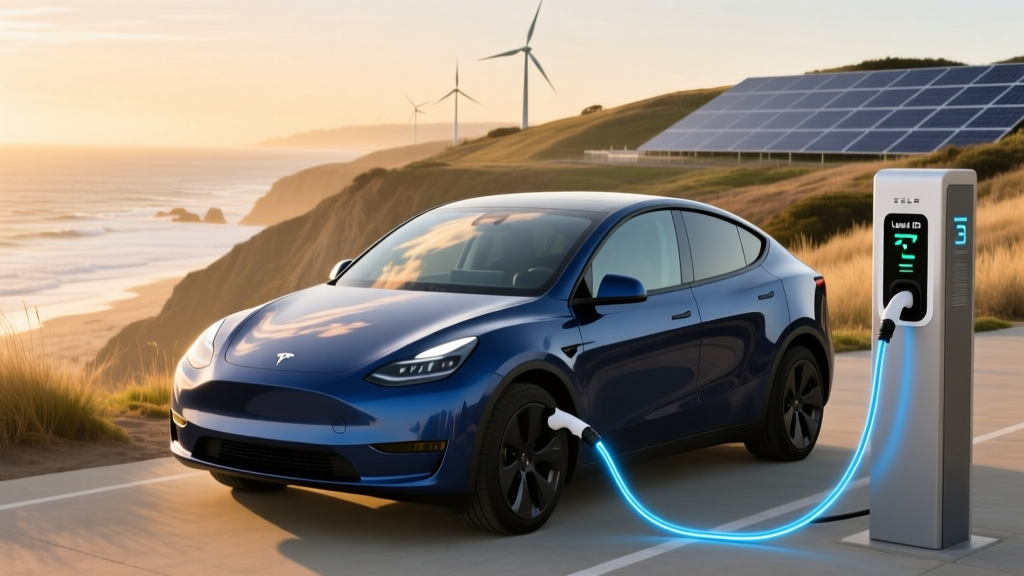
Tesla has always positioned itself as more than a car company. Its stated mission — to accelerate the world's transition to sustainable energy — shapes every product decision, from battery chemistry to the Supercharger network. But for buyers in 2026, the question isn't philosophical; it's practical. Does the 2026 Tesla Model Y Long Range AWD actually deliver on the promise of everyday, affordable, zero-tailpipe-emission driving? We put the numbers to the test.
The refreshed Model Y (internally dubbed "Juniper") arrived for the 2025 model year with a redesigned interior, ambient lighting, ventilated seats, a rear touchscreen, and a revised suspension. For 2026, Tesla continues the lineup with minor software and efficiency tweaks. It remains the best-selling EV in the United States and the benchmark against which every electric crossover is measured.
Quick Verdict: Does the Model Y Still Lead the Pack?
The 2026 Model Y Long Range AWD earns a strong recommendation for buyers who prioritize Supercharger network access, strong efficiency, and a proven software ecosystem. Its 310-mile EPA range and 250 kW peak DC fast-charging remain competitive, though rivals like the Hyundai Ioniq 5 and Chevrolet Equinox EV have closed the gap in interior space and ride comfort. The Model Y's minimalist cabin, firm ride, and panel-gap inconsistency are real trade-offs. If your driving includes regular road trips and you value the broadest public charging network in North America, the Model Y is still the default choice.
| Spec | Value |
|---|---|
| EPA Range | 310 miles |
| Battery (usable) | ~78.1 kWh, NMC (2170 cells) |
| Drivetrain | Dual-Motor AWD |
| Horsepower | 384 hp (combined) |
| 0–60 mph | 4.8 seconds |
| Peak DC Fast Charge | 250 kW (CCS via NACS adapter or native NACS) |
| 10–80% DC Charge Time | ~25 minutes |
| Level 2 Home Charge Rate | 11.5 kW (~44 mi/hr) |
| MPGe (combined) | 111 MPGe |
| Energy Consumption | 28 kWh/100 mi |
| Cargo (rear seats up) | 30.2 cu ft |
| Cargo (rear seats folded) | 72.0 cu ft |
| Rear Legroom | 38.4 in |
| Battery Warranty | 8 years / 120,000 miles (70% retention) |
| Base MSRP | $47,990 (before destination) |
Range and Efficiency: EPA Sticker vs. Real-World Miles
Real-World Expectation: 260–290 miles on mixed highway/city driving in moderate temperatures. Expect 220–250 miles in sustained cold weather (below 30°F) or at highway speeds above 75 mph. In ideal city conditions with mild weather and regen braking, some owners report exceeding 310 miles.
The Model Y Long Range AWD's 111 MPGe combined rating (per fueleconomy.gov) translates to 28 kWh per 100 miles — one of the most efficient figures in the mid-size electric crossover segment. Tesla's heat pump, standard on all 2026 trims, significantly reduces cabin-heating energy draw in cold weather compared to resistive heaters, partially offsetting the range loss that all EVs experience in winter.
On a 280-mile highway loop at 72 mph in 55°F weather, independent testers have recorded approximately 275 miles of usable range before reaching 5% State of Charge. Push speeds to 80 mph and that figure drops closer to 250 miles. Cold weather (20°F) with cabin heating can reduce range by 20–30%, bringing effective range to roughly 220–250 miles. Preconditioning the battery while plugged in — a feature Tesla's app makes straightforward — mitigates some of this loss and is critical for maximizing DC fast-charge speed in winter.
Charging Speed: DC Fast, Level 2, and the Supercharger Advantage
Tesla's charging ecosystem remains its strongest competitive moat. The 2026 Model Y supports:
| Charging Level | Power / Rate | Miles Added per Hour | Notes |
|---|---|---|---|
| Level 1 (120V) | ~1.4 kW | ~4–5 mi/hr | Emergency/top-up only |
| Level 2 (240V, 48A) | 11.5 kW | ~44 mi/hr | Full charge in ~8 hours |
| DC Fast (NACS Supercharger) | Peak 250 kW | ~162 mi in 15 min | 10–80% in ~25 min |
| DC Fast (CCS station w/ adapter) | Up to 250 kW | Varies by station | Non-Tesla networks accessible |
The 250 kW peak charge rate applies primarily at V3 and V4 Tesla Superchargers. However, as with all EVs, the charge curve tapers significantly above 80% State of Charge. The 10–80% sprint takes roughly 25 minutes under ideal conditions (battery preconditioned, warm ambient temperature). A 5–95% session will take closer to 45 minutes due to the steep taper above 80% and the slow ramp below 10%.
With Tesla opening its Supercharger network to non-Tesla EVs (via NACS), the network has expanded, but Model Y owners still benefit from native integration: automatic billing, battery preconditioning navigation, and real-time stall availability in the car's navigation. For road-trippers, this seamless experience is a tangible advantage over CCS-based rivals, even as the broader NACS adoption in 2026 has improved third-party charging.
For home charging, a Wall Connector on a 60-amp circuit delivers the full 11.5 kW (48A), adding roughly 44 miles of range per hour. A full overnight charge from 20% to 100% takes about 7–8 hours. Tesla includes a Mobile Connector with the vehicle, which can handle Level 1 (120V) or Level 2 (240V with a NEMA 14-50 adapter), though dedicated Wall Connector installation is recommended for daily use. Expect a licensed electrician to charge $500–$2,000 for a 240V/60A circuit installation depending on panel proximity and local permitting.
Performance and Driving Dynamics
The dual-motor AWD powertrain delivers 384 combined horsepower and a 4.8-second 0–60 mph time — quick enough to merge onto any freeway with confidence and pass without drama. The instant torque delivery, characteristic of all EVs, makes the Model Y feel quicker than the stopwatch suggests in everyday driving.
The Juniper refresh brought a revised suspension tuning that softens the ride compared to the pre-2025 Model Y, though it remains firmer than competitors like the Hyundai Ioniq 5 or Ford Mustang Mach-E. Road noise is well-managed at city speeds but becomes noticeable above 70 mph. The steering is precise and well-weighted, and the low center of gravity (from the under-floor battery pack) keeps body roll minimal in corners.
Regenerative braking offers two modes: Standard (strong regen enabling near one-pedal driving) and a reduced setting. Unlike some competitors, Tesla does not offer a fully adjustable regen slider, but the Standard mode is aggressive enough that most drivers adapt to one-pedal operation within a few days.
Interior, Cargo, and Technology
The 2026 Model Y's cabin reflects the Juniper redesign: an ambient light bar wraps the dashboard, ventilated front seats are now standard on Long Range, and a second 8-inch touchscreen serves rear passengers for climate and entertainment control. The 15.4-inch front touchscreen runs Tesla's proprietary infotainment system, which includes Netflix, YouTube, and Arcade streaming while parked, plus a capable navigation system with real-time Supercharger routing.
Cargo space measures 30.2 cubic feet behind the second row and 72.0 cubic feet with the 60/40 split rear seats folded. The front trunk (frunk) adds 4.1 cubic feet for charging cables or a small bag. Rear legroom is 38.4 inches — adequate for adults but less generous than the Ioniq 5's 41.7 inches. Three adults across the rear bench is tight on longer trips.
On the technology front, Tesla's Autopilot comes standard and includes Traffic-Aware Cruise Control and Autosteer (lane centering). Full Self-Driving (Supervised) — a $8,000 option or $99/month subscription — adds features like automatic lane changes, traffic light and stop sign recognition, and Navigate on Autopilot. It is critical to understand that FSD (Supervised) is an SAE Level 2 system, meaning the driver must remain fully engaged and hands on the wheel at all times. It is not autonomous driving.
Tesla Autopilot and FSD (Supervised) require continuous driver supervision. The vehicle can steer, accelerate, and brake under certain conditions, but the driver is responsible for all driving decisions. This is fundamentally different from Level 4 robotaxi services like Waymo, which operate without a human driver in geofenced areas.
Pricing, Trims, and Federal Tax Credit Eligibility
The 2026 Model Y lineup starts with the Long Range RWD at approximately $44,990, followed by the Long Range AWD reviewed here at $47,990, and the Performance trim at $52,990 (all before the $1,390 destination fee). Tesla's direct-to-consumer model eliminates dealer markups but also means no negotiation — the listed price is the price.
| Trim | Base MSRP | Est. After §30D Credit* | Eligibility Notes |
|---|---|---|---|
| Long Range RWD | $44,990 | ~$37,490 | Subject to income, sourcing rules |
| Long Range AWD | $47,990 | ~$40,490 | Subject to income, sourcing rules |
| Performance AWD | $52,990 | ~$45,490 | Subject to income, sourcing rules |
*Federal §30D credit eligibility depends on buyer income caps ($150K single / $300K joint AGI), vehicle MSRP caps ($80K for SUVs), battery critical-mineral and component sourcing requirements, and final IRS assembly/sourcing determinations. The credit can now be transferred to the dealer at point of sale for an immediate price reduction. Consult IRS.gov §30D guidelines and a tax professional before purchasing.
Tesla's battery sourcing and final assembly have been subject to evolving IRS interpretations under the Inflation Reduction Act. As of early 2026, certain Model Y configurations have qualified for the full $7,500 credit, but Tesla's own website and the IRS eligible-vehicle list should be checked at time of purchase, as battery component and critical-mineral sourcing requirements tighten annually. The point-of-sale transfer option, available since January 2024, means qualified buyers can apply the credit as an instant discount rather than waiting for a tax refund.
Warranty and Long-Term Battery Outlook
Tesla covers the Model Y's battery and drive unit for 8 years or 120,000 miles (whichever comes first) with a guaranteed minimum 70% capacity retention. The basic vehicle limited warranty is 4 years or 50,000 miles. These terms are competitive but not class-leading — Hyundai offers 10 years/100,000 miles on its battery.
Real-world degradation data from Tesla's fleet indicates that NMC batteries in the Model Y typically lose 5–8% capacity over the first 50,000 miles, then degrade more slowly. Owners who regularly charge to 80–90% (rather than 100%) and avoid frequent DC fast charging tend to see better long-term retention. Tesla's battery management system (BMS) includes a buffer that protects the cells from extreme states, and the thermal management system actively cools or heats the pack during charging and driving.
Out-of-warranty battery replacement remains a significant expense — typically $12,000–$16,000 for a Model Y pack in 2026. However, the rate of complete battery failure is low; most degradation concerns involve gradual capacity loss rather than catastrophic failure.
Who Is the 2026 Model Y Best For?
- You take regular road trips and want seamless access to the Supercharger network
- You value over-the-air software updates and a mature EV ecosystem
- You want strong efficiency (28 kWh/100 mi) that keeps charging costs low
- You need a practical family crossover with adequate cargo and decent rear space
- Ride comfort and cabin quietness are top priorities (consider Ioniq 5 or Mach-E)
- You need maximum rear-seat legroom for tall passengers regularly
- You prefer physical buttons and a traditional instrument cluster
- You want the longest possible warranty coverage (Hyundai/Kia offer 10-yr battery)
Pros, Cons, and the Competition
- Class-leading Supercharger network integration
- Excellent efficiency (111 MPGe / 28 kWh/100 mi)
- Strong 0–60 performance (4.8 sec) for the class
- Over-the-air updates continuously add features
- Spacious cargo area with flat load floor
- Heat pump standard for cold-weather efficiency
- Firm ride quality on rough pavement
- No physical buttons — all controls via touchscreen
- Rear seat legroom trails key competitors
- Panel-gap quality inconsistent between vehicles
- FSD (Supervised) costs extra and remains Level 2
- No Apple CarPlay or Android Auto support
Against the Hyundai Ioniq 5 (310-mi range, 800V architecture for faster 10–80% charging at compatible stations, more spacious rear seat), the Model Y trades interior comfort for charging-network convenience and software depth. Against the Ford Mustang Mach-E (extended-range: ~312 mi EPA, more engaging steering feel), the Model Y wins on cargo space and Supercharger access. The Chevrolet Equinox EV undercuts on price (starting ~$33K) but trails on performance and charging speed.
Frequently Asked Questions
What is the real-world range of the 2026 Tesla Model Y?
The EPA rates the Long Range AWD at 310 miles. In real-world mixed driving at moderate temperatures, expect 260–290 miles. Highway driving at 75+ mph reduces this to roughly 250–270 miles, and cold weather below 30°F can drop effective range to 220–250 miles.
How fast does the Model Y charge at home and on the road?
On a Level 2 home charger (240V, 48A), the Model Y charges at 11.5 kW, adding about 44 miles of range per hour — a full charge takes roughly 8 hours. On a Tesla V3/V4 Supercharger, it peaks at 250 kW and charges from 10–80% in approximately 25 minutes, though the charge curve tapers significantly above 80%.
Does the 2026 Model Y qualify for the $7,500 federal EV tax credit?
Certain Model Y configurations have qualified under IRS §30D rules, but eligibility depends on battery component sourcing, critical-mineral requirements, buyer income caps ($150K single / $300K joint), and the $80K MSRP cap for SUVs. The credit can be transferred at point of sale. Always verify current eligibility on IRS.gov before purchasing, as sourcing rules tighten annually.
Is the Tesla Model Y worth buying over competitors in 2026?
If Supercharger network access, strong efficiency, and a proven software ecosystem are your priorities, yes. If you value a softer ride, more rear-seat space, or physical controls, the Hyundai Ioniq 5 or Ford Mustang Mach-E are compelling alternatives. The Model Y remains the segment benchmark, but the gap has narrowed.
What are the biggest drawbacks of the Model Y?
The firm ride, absence of physical buttons, below-average rear legroom for the class, inconsistent panel gaps, and lack of Apple CarPlay/Android Auto are the most commonly cited complaints. FSD remains a Level 2 system despite its name and costs $8,000 extra.
How long will the Model Y battery last?
Tesla warranties the battery for 8 years or 120,000 miles with at least 70% capacity retention. Fleet data suggests typical NMC degradation of 5–8% over the first 50,000 miles, with slower loss thereafter. Most owners report usable battery life well beyond 150,000 miles with proper charging habits (avoiding frequent 100% charges and excessive DC fast charging).
Tesla's mission for sustainable energy is ultimately measured in products that people actually want to drive every day. The 2026 Model Y Long Range AWD, with its 310-mile range, 250-kW charging, and access to the most reliable public charging network in North America, makes a compelling case that sustainable transportation doesn't require compromise — just informed choices about where it still falls short.