Tesla Model Y Safety Ratings: What the Crash Tests Show
The Tesla Model Y remains one of the best-selling electric vehicles in the United States, and a major reason buyers gravitate toward it is its strong crash-test performance. For the current generation, NHTSA awarded the Model Y a 5-Star Overall Safety Rating across all trim levels and drivetrain configurations. That top score applies to frontal crash, side crash, and rollover resistance alike.
On the IIHS side, the Model Y has historically earned Top Safety Pick+ honors, with "Good" ratings across the moderate overlap front, side, and roof-strength tests. The Insurance Institute for Highway Safety evaluates headlight performance, crash-avoidance tech, and LATCH ease-of-use for child seats — areas where Tesla's minimalist approach sometimes costs it points compared to legacy automakers with more traditional control layouts.
2026 Model Y Spec Table: Range, Battery, Charging, and Price
| Spec | Long Range AWD | Performance AWD |
|---|---|---|
| EPA Range | ~320 mi | ~285 mi |
| Battery Capacity | ~78 kWh usable, NMC | ~78 kWh usable, NMC |
| Peak DC Fast Charge | 250 kW | 250 kW |
| 10–80% DC Time | ~25 min | ~25 min |
| Level 2 Home Charge | 11.5 kW / ~44 mi/hr | 11.5 kW / ~44 mi/hr |
| 0–60 mph | 4.8 sec | 3.5 sec |
| Horsepower | ~384 hp | ~456 hp |
| Drivetrain | Dual-Motor AWD | Dual-Motor AWD |
| Efficiency | ~122 MPGe / 28 kWh/100mi | ~111 MPGe / 30 kWh/100mi |
| Base MSRP | ~$44,990 | ~$51,490 |
| Battery Warranty | 8 yr / 120,000 mi | 8 yr / 120,000 mi |
Real-World Range vs. the EPA Sticker
Tesla's thermal management system — which includes a heat pump on current Model Y variants — helps mitigate cold-weather losses compared to older EVs without heat pumps. The heat pump scavenges waste heat from the powertrain and cabin to warm the battery, reducing the energy penalty that plagues resistive-heater EVs in winter. Even so, buyers in northern climates should plan for a meaningful range reduction from December through February and size their charging habits accordingly.
City and suburban driving, where regenerative braking recovers energy at stoplights, tends to track closer to the EPA figure — and in mild climates, some owners report exceeding 300 miles on a mixed city/suburban cycle. The key variable is speed: energy consumption rises sharply above 65 mph due to aerodynamic drag, which is why highway-only road trips consistently undershoot the sticker.
Charging Speed: DC Fast, Level 2, and the Charge Curve
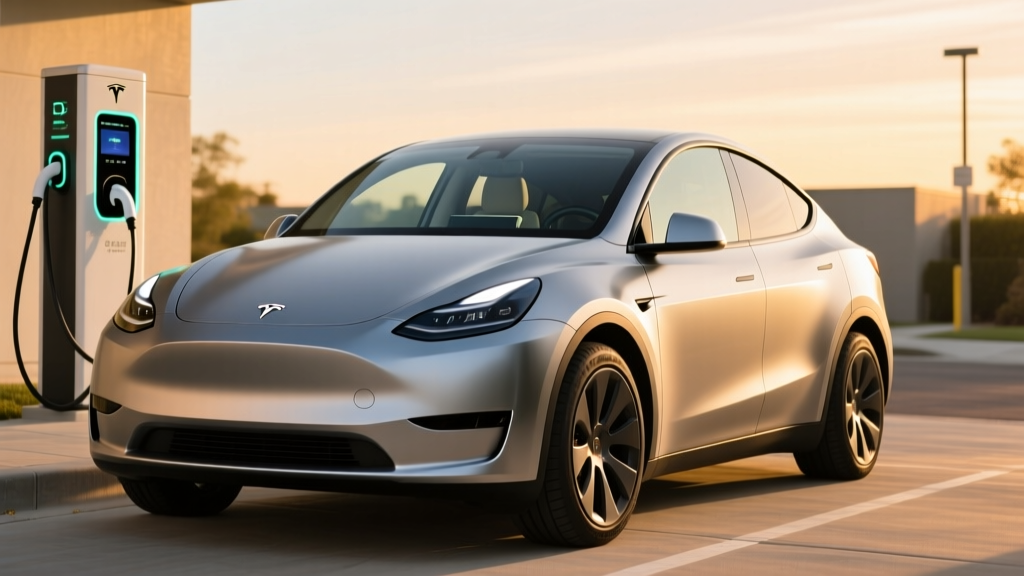
The Model Y supports a peak DC fast-charge rate of 250 kW at Tesla V3 Superchargers and compatible CCS/NACS third-party stations. At that peak rate, the car can add roughly 200 miles of range in 15 minutes — but peak rate is not sustained rate. The charging curve tapers significantly above 60% state of charge (SoC), and especially above 80%, where thermal protection and cell-balancing slow the flow of electrons. A 10–80% session takes approximately 25 minutes under optimal conditions (preconditioned battery, warm ambient temperature). Expect 30–35 minutes if arriving with a cold battery in winter, since the car must first warm the pack before accepting peak current.
For home charging, the Model Y accepts up to 11.5 kW on Level 2 (48 amps on a 60-amp circuit). That translates to roughly 44 miles of range per hour of charging, or a full overnight replenishment from near-empty in about 7–8 hours. Tesla's Wall Connector is a popular choice, though any J1772/NACS-compatible Level 2 station at 48 amps will deliver the same rate.
| Charging Level | Power (kW) | Miles Added per Hour | Typical Use Case |
|---|---|---|---|
| Level 1 (120V) | ~1.4 kW | ~5 mi/hr | Emergency / trickle |
| Level 2 (240V, 48A) | 11.5 kW | ~44 mi/hr | Daily home charging |
| DC Fast (V3 Supercharger) | Up to 250 kW | ~1,000+ mi/hr (peak) | Road trips, 10–80% in ~25 min |
A note on preconditioning: when you navigate to a Supercharger in the Tesla app or in-car navigation, the car begins warming the battery en route so it can accept maximum charge current upon arrival. Skipping preconditioning — for instance, by driving to a charger without entering it as a nav destination — can add 5–10 minutes to your session in cold weather.
Pricing, Trims, and Federal Tax Credit Eligibility
The 2026 Model Y lineup is streamlined into two main trims: Long Range AWD starting around $44,990 and Performance AWD at approximately $51,490 (prices before destination fees and options). Tesla periodically adjusts pricing, so check the configurator for the latest figures.
Federal tax credit eligibility under IRS §30D is the most common buyer question, and the answer depends on several moving targets:
- MSRP Cap: SUVs (which the Model Y is classified as) must have an MSRP at or below $80,000. Both trims clear this bar easily.
- Income Cap: Modified adjusted gross income must not exceed $150,000 (single), $225,000 (head of household), or $300,000 (joint filers).
- Battery Sourcing: Critical minerals and battery components must meet phased-in domestic-content and free-trade-agreement thresholds that tighten each year. Tesla has worked to shift supply chains, but eligibility can change mid-year. Always verify on fueleconomy.gov before purchasing.
- Point-of-Sale Transfer: Eligible buyers can transfer the credit to the dealer at purchase, reducing the out-of-pocket price rather than waiting for a tax refund.
If all criteria are met, the credit can be up to $7,500 — bringing the effective Long Range price to approximately $37,490. But "up to" is the operative phrase: partial credits ($3,750) apply if only one of the two sourcing requirements (critical minerals or battery components) is satisfied.
Interior, Cargo, and Daily Practicality
The Model Y's crossover form factor is its practicality ace. Cargo volume behind the second row measures approximately 30.2 cubic feet, expanding to roughly 72.1 cu ft with the rear seats folded — competitive with a Toyota RAV4 or Honda CR-V. The rear hatch opening is wide and low, making it easy to load strollers, groceries, or camping gear.
Front legroom is generous at around 41.8 inches, while rear legroom comes in at approximately 39.4 inches — adequate for adults on longer trips, though the slightly upright seat cushion and panoramic glass roof can make taller rear passengers wish for more thigh support. The minimalist interior means virtually everything routes through the 15.4-inch center touchscreen: climate controls, glovebox release, mirror adjustment, and even the windshield wipers. This is a love-it-or-hate-it design choice that rewards tech-forward users but frustrates those who prefer physical knobs.
Notable tech includes over-the-air software updates that periodically add features, a robust mobile app with remote preconditioning and charging monitoring, and Tesla's Supercharger network — still the most reliable and geographically comprehensive DC fast-charging infrastructure in North America. The Model Y now ships with the NACS (North American Charging Standard) port natively, which is becoming the industry standard adopted by Ford, GM, Rivian, and others.
Who the Model Y Suits Best — and Who Should Look Elsewhere
For the road-trip use case, the Supercharger network remains Tesla's strongest moat. While Electrify America, EVgo, and ChargePoint have expanded significantly, Tesla's stations still post higher uptime percentages and faster plug-to-charge workflows. If your driving is 80% highway commuting and 20% weekend getaways, the Model Y's combination of efficiency (~28 kWh/100 mi) and 250 kW peak charging makes it one of the least-stressful EVs to own long-distance.
Pros and Cons at a Glance
Pros
- Top NHTSA 5-Star safety rating
- Access to Tesla Supercharger network (NACS native)
- Class-leading efficiency (~122 MPGe)
- Strong OTA update cadence adds features post-purchase
- Spacious cargo area with flat load floor
- Heat pump standard for cold-weather efficiency
Cons
- No physical buttons — all controls via touchscreen
- Rear visibility limited by sloping roofline
- FSD (Supervised) requires $8,000 add-on, still Level 2
- Ride quality firm on rough pavement
- No third-row option
- Tax-credit sourcing rules may limit eligibility
Frequently Asked Questions
What is the real-world range of the Tesla Model Y?
The EPA rates the Long Range AWD at approximately 320 miles. Real-world highway driving at 70+ mph typically yields 265–285 miles. Cold weather (below freezing) can reduce that to 210–240 miles. City driving with regenerative braking tracks closer to the EPA estimate.
How fast does the Model Y charge at home and on the road?
At home on a 240V/48A Level 2 charger, the Model Y adds roughly 44 miles of range per hour (11.5 kW). On a DC fast charger (V3 Supercharger at 250 kW peak), a 10–80% session takes about 25 minutes with a preconditioned battery, adding roughly 200 miles in 15 minutes at peak rate.
How much does the Model Y cost after tax credits?
The Long Range AWD starts around $44,990. If you qualify for the full $7,500 federal credit under §30D (meeting income, MSRP, and battery-sourcing requirements), the effective price drops to approximately $37,490. Partial credit of $3,750 may apply if only one sourcing threshold is met. State incentives vary — check your local DMV or energy office.
Is the Model Y worth buying versus competitors like the Ford Mustang Mach-E or Hyundai Ioniq 5?
The Model Y wins on charging infrastructure access (Superchargers), efficiency, and cargo space. The Ioniq 5 charges faster at compatible 800V stations (10–80% in ~18 min) and offers a more conventional interior. The Mach-E provides a more engaging driving feel and traditional controls. If Supercharger reliability is your top priority, the Model Y still leads; if you prefer physical buttons or a plusher ride, test-drive the alternatives.
Does the Tesla Model Y qualify for the federal EV tax credit?
It can, but eligibility is not automatic. The Model Y's MSRP is well under the $80,000 SUV cap. You must also meet income thresholds ($150K single / $300K joint) and the vehicle's battery must satisfy critical-mineral and component-sourcing rules that tighten annually. Verify current eligibility on fueleconomy.gov before finalizing your purchase, as supply-chain shifts can change qualification status mid-year.