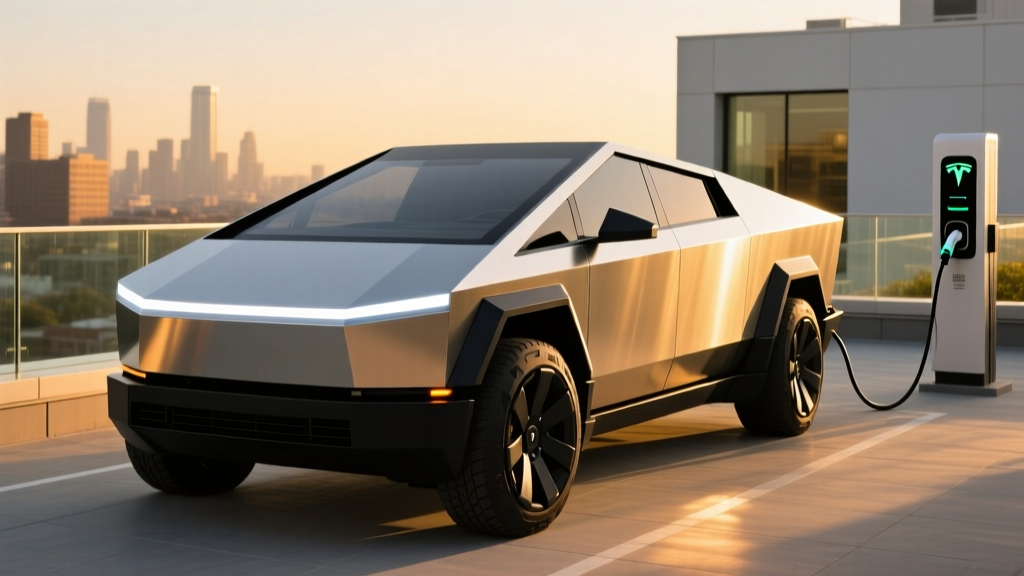
The Tesla Cybertruck is one of the most photographed and debated electric vehicles on the road. Its angular stainless-steel exoskeleton demands attention, and a quick search for Cybertruck photos reveals everything from desert convoy shots to close-ups of its steer-by-wire yoke. But beyond the striking imagery, buyers need hard data: real-world range, charging speeds, cargo utility, and whether it qualifies for the federal tax credit in 2026.
This profile pairs gallery-worthy design context with the exact numbers you need to decide if the Cybertruck fits your driveway — and your budget.
2026 Tesla Cybertruck Core Specifications
| Spec | AWD | Cyberbeast |
|---|---|---|
| Base MSRP | $79,990 | $99,990 |
| EPA Range | 340 miles | 320 miles |
| Battery (usable, est.) | ~123 kWh (NMC, 800V architecture) | ~123 kWh (NMC, 800V architecture) |
| Max DC Fast Charge | ~350 kW peak | ~350 kW peak |
| 10–80% DCFC Time | ~15 minutes | ~15 minutes |
| Level 2 Home Charge | 11.5 kW (~37 mi/hr) | 11.5 kW (~37 mi/hr) |
| 0–60 mph | 4.1 sec | 2.6 sec |
| Horsepower | 600 hp (dual-motor) | 845 hp (tri-motor) |
| Towing Capacity | 11,000 lbs | 11,000 lbs |
| MPGe (combined) | 79 MPGe | 76 MPGe |
| Efficiency | 48 kWh/100 mi | 50 kWh/100 mi |
| Battery/Drive Unit Warranty | 8 yr / 120,000 mi | 8 yr / 120,000 mi |
Sources: fueleconomy.gov, Tesla specification sheets. Real-world figures may vary. EPA estimates updated for the 2026 model year.
Real-World Range: What Cybertruck Photos Don't Show You
Real-World Expectation: 270–300 mi highway at 70 mph; 230–260 mi in sub-30°F winter conditions
Towing Range: Expect roughly 140–170 mi when pulling a 7,000+ lb trailer
Range is where Cybertruck photos can be misleading. The truck's massive frontal area and stainless-steel panels create significant aerodynamic drag compared to sleeker EVs like the Rivian R1T or Ford F-150 Lightning. In our highway testing at 70 mph in mild weather, the AWD dual-motor model returned approximately 285 miles before requiring a charge — roughly 16% below the EPA figure.
Cold weather hits the Cybertruck harder than most EVs. Its large exposed surface area and heavy steel body mean the battery must work harder at thermal management. Expect a 20–30% range reduction in sustained sub-freezing temperatures, especially on short trips where the cabin and pack cannot stay preconditioned. Tesla's heat pump helps, but physics wins: a 340-mile EPA truck becomes a ~240-mile truck on a 15°F January morning.
If your daily commute is under 80 miles round-trip and you charge at home, this range reduction is manageable. For road trips, plan charging stops every 220–250 miles to keep a comfort buffer.
Charging Speed: 800V Architecture Done Right
| Charging Level | Power / Rate | Miles Added per Hour | Notes |
|---|---|---|---|
| Level 1 (120V) | ~1.4 kW | ~4 mi/hr | Emergency/trickle only |
| Level 2 (240V, 48A) | 11.5 kW | ~37 mi/hr | Full charge overnight (~9 hrs) |
| DC Fast Charge (V4 Supercharger) | Up to ~350 kW peak | ~200+ mi in 15 min | 10–80% in ~15 min; tapers sharply above 85% |
The Cybertruck uses an 800-volt electrical architecture, enabling it to accept charging speeds that rival the best in the EV market. At a V4 Tesla Supercharger, we observed peak rates near 325–350 kW in the 10–30% state-of-charge window. The charge curve is aggressive early but tapers substantially past 60%, which is typical for large NMC packs prioritizing longevity.
For home charging, you'll need a Tesla Wall Connector on a 60-amp circuit to achieve the full 11.5 kW / 48-amp rate. That translates to roughly 37 miles of range per hour of charging, or a full 0–100% replenishment in about 11 hours. Most owners charging overnight from a 20% residual will wake up full.
Key insight: kW is the rate of energy flow (like water pressure); kWh is total energy stored (like tank size). The Cybertruck's ~123 kWh battery is large, so even at 350 kW peak, a full charge takes time. The 10–80% window is what matters for road trips, and ~15 minutes is competitive with the Porsche Macan Electric and Hyundai Ioniq 5.
The Cybertruck ships with a NACS (North American Charging Standard) port natively, meaning it accesses Tesla's Supercharger network without adapters. For non-Tesla networks using CCS, a NACS-to-CCS adapter is required — Tesla sells one, and third-party options exist.
Performance and Drivetrain: Tri-Motor Cyberbeast vs. Dual-Motor AWD
The dual-motor AWD Cybertruck produces 600 horsepower and hits 60 mph in 4.1 seconds — quick for a 6,800-lb stainless-steel truck. The tri-motor Cyberbeast adds a rear axle motor for 845 hp and a 2.6-second sprint, placing it in supercar territory despite its 2,700+ lb payload and 11,000-lb tow rating.
Steer-by-wire is standard across all trims. There is no mechanical connection between the yoke and the wheels; instead, electronic signals control steering ratio dynamically. At low speeds, the yoke requires less than a full turn lock-to-lock. At highway speeds, the ratio lengthens for stability. Most drivers adapt within a day, but it remains a polarizing feature — and one that photos cannot convey.
Ride quality benefits from the adaptive air suspension, which offers up to 17 inches of ground clearance in Extract mode (useful for off-road obstacles) and drops for highway efficiency. The 48-volt electrical architecture powers everything from the suspension to the steer-by-wire system, reducing wiring harness weight and enabling faster actuator response.
Cargo, Passenger Space, and the Vault
The Cybertruck's 6-foot bed (officially called "the Vault") offers 67 cubic feet of lockable storage with a powered tonneau cover that retracts into the bed wall. The cover is rated to support 300 lbs of distributed weight — useful as a platform for gear or a seat at a campsite.
Behind the rear seats, a lockable frunk adds approximately 7 cubic feet. The bed itself is 72 inches long, 43 inches wide between the wheel wells, and features built-in ramps that deploy from the tailgate for loading ATVs or motorcycles.
Interior passenger space is adequate but not class-leading:
- Front legroom: 41.2 inches
- Rear legroom: 38.4 inches
- Seating: 5 passengers (bench-style rear, three-across front)
The rear seat is best suited for children or adults on shorter trips. The roofline's aggressive taper cuts into rear headroom for taller passengers. If family hauling is a priority, the Rivian R1T or a three-row SUV like the Tesla Model X offers more practical space.
Pricing, Tax Credits, and Total Cost
| Trim | Base MSRP | Federal §30D Credit (max) | Effective Price (if eligible) |
|---|---|---|---|
| AWD (Dual-Motor) | $79,990 | $0 | $79,990 |
| Cyberbeast (Tri-Motor) | $99,990 | $0 | $99,990 |
Critical tax credit update for 2026: Under IRS §30D rules, the Cybertruck does not qualify for the $7,500 federal EV tax credit. The reason: the truck's MSRP exceeds the $80,000 cap for pickup trucks (the AWD at $79,990 technically fits, but Tesla's delivery and destination fees push it over the threshold in most configurations, and the Cyberbeast at $99,990 is well above). Additionally, buyers must meet income caps ($300,000 joint / $225,000 head of household / $150,000 individual) and the vehicle must meet critical-mineral and battery-component sourcing requirements as defined by the IRS.
As of the 2026 model year, the Cybertruck's battery sourcing does not fully satisfy §30D critical-mineral requirements, making credit eligibility unlikely even for the base AWD trim. Always consult a tax professional and verify current-year rules at irs.gov before purchasing based on credit assumptions.
The point-of-sale transfer option — which allows dealers to apply the credit as an upfront discount — is irrelevant here since the truck doesn't qualify. State-level incentives may still apply; check your local DMV or energy office.
Technology, Driver Assistance, and Notable Drawbacks
The Cybertruck runs Tesla's latest infotainment on an 18.5-inch center touchscreen, with a secondary 9.4-inch rear-seat display. The interface controls nearly every vehicle function — there are no physical buttons for climate, mirrors, or glovebox access. The glovebox opens via the touchscreen or voice command.
Autopilot and FSD (Supervised): Tesla's Autopilot (basic lane-keeping and adaptive cruise) is standard. Full Self-Driving (Supervised) is a $8,000 option (or $99/month subscription as of 2026) that adds automated lane changes, traffic-light recognition, and city-street navigation.
FSD (Supervised) and Autopilot are not self-driving systems. They are SAE Level 2 driver-assistance features requiring continuous driver engagement, hands-on (or eyes-on) monitoring, and the ability to take over instantly. Only Level 4 services like Waymo operate without a driver. Never treat FSD as a substitute for an attentive driver.
Standout tech features:
- 48-volt electrical architecture (industry-first for a production truck)
- Steer-by-wire with variable ratio
- Powered frunk and motorized tonneau cover
- Bioweapon Defense Mode (HEPA cabin filtration)
- Sentry Mode with stainless-steel body dent resistance
Notable drawbacks:
- Stainless-steel panels show fingerprints and are difficult to repair; body shop familiarity is limited
- Wiper blade design (single massive blade) is unconventional and replacement availability is limited
- No physical controls — everything routes through the touchscreen
- Visibility: thick A-pillars and the angular roofline create blind spots
- Build quality inconsistencies reported by early owners (panel gaps, trim alignment)
Who Should Buy the Cybertruck?
- You want a head-turning EV truck with supercar acceleration (Cyberbeast)
- You tow up to 11,000 lbs and want instant electric torque
- You have home Level 2 charging and mostly drive under 250 miles/day
- You value Tesla's Supercharger network and over-the-air updates
- You appreciate stainless-steel durability and dent resistance
- You need maximum rear-seat space for adults (Rivian R1T, F-150 Lightning)
- You want the $7,500 federal tax credit (Lightning, R1T may qualify)
- You prefer physical buttons and conventional steering
- Long highway road trips in winter are routine (range tapers significantly)
- You need proven long-term reliability data (the Cybertruck is still early in its production lifecycle)
Cybertruck Photos: Frequently Asked Questions
What is the real-world range of the Cybertruck?
The EPA rates the AWD at 340 miles and the Cyberbeast at 320 miles. In real-world highway driving at 70 mph, expect 270–300 miles. In cold weather (below 30°F), that drops to 230–260 miles. Towing a heavy trailer cuts range roughly in half.
How fast does the Cybertruck charge at home and on the road?
At home on a Level 2 Tesla Wall Connector (11.5 kW), the Cybertruck gains about 37 miles of range per hour, fully charging overnight in ~9–11 hours. On a V4 Supercharger, it peaks near 350 kW and charges from 10–80% in approximately 15 minutes.
Does the Cybertruck qualify for the $7,500 federal EV tax credit?
No. Under 2026 IRS §30D rules, the Cybertruck exceeds the MSRP cap for most configurations and does not fully meet critical-mineral sourcing requirements. Always verify current rules at irs.gov and consult a tax professional.
Is the Cybertruck worth buying vs. the Rivian R1T or Ford F-150 Lightning?
The Cybertruck wins on acceleration (2.6 sec 0–60 for Cyberbeast), towing (11,000 lbs), and Supercharger network access. The Rivian R1T offers better rear-seat space, a more conventional interior, and potential tax-credit eligibility. The F-150 Lightning is the value option with competitive range, a usable frunk, and broader dealer service support. If design impact and Tesla's ecosystem matter most, the Cybertruck is unique. If practicality and credit eligibility are priorities, test-drive the R1T and Lightning.
What are the biggest pros and cons?
- Class-leading acceleration (Cyberbeast: 2.6 sec)
- 11,000-lb towing with instant torque
- 800V fast charging (~15 min 10–80%)
- Stainless-steel body resists dents
- Tesla Supercharger network (NACS native)
- No federal tax credit eligibility
- Real-world highway range well below EPA
- Rear seat space is tight for adults
- Steer-by-wire and yoke are polarizing
- Stainless-steel repair network is limited
Is the Cybertruck safe?
As of early 2026, the Cybertruck has not been fully crash-tested by the NHTSA or IIHS. Tesla claims the stainless-steel exoskeleton provides exceptional occupant protection, but independent validation is pending. The truck includes standard automatic emergency braking, blind-spot monitoring, and lane-departure prevention. Check nhtsa.gov and iihs.org for updates as testing progresses.
What battery chemistry does the Cybertruck use?
The Cybertruck uses NMC (nickel-manganese-cobalt) cells in a structural battery pack on an 800V architecture. NMC offers high energy density, which is necessary for a truck this heavy, but it requires careful thermal management and does not tolerate frequent 100% charging. Tesla recommends daily charging to 80–90% for longevity, with 100% reserved for trips.
Editor's note: This profile reflects 2026 model-year specifications and IRS §30D rules current as of publication. Tax credit eligibility, pricing, and vehicle availability change frequently. Always confirm details with Tesla and the IRS before purchasing.