Quick Verdict: The Road-Trip Benchmark
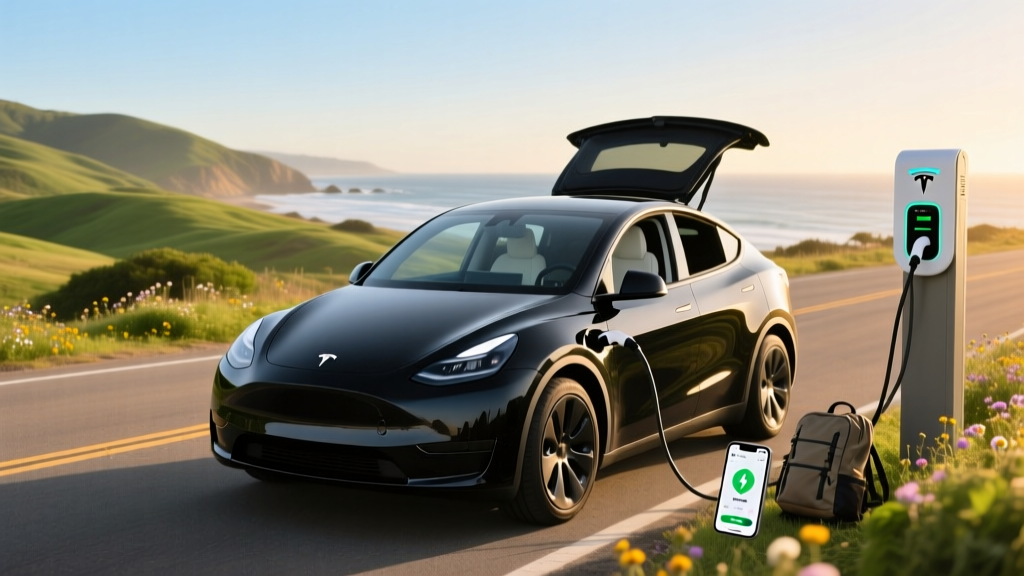
The Tesla Model Y remains the best-selling electric vehicle in the United States for good reason: no other EV in its price bracket pairs 300+ miles of EPA range with access to the most reliable DC fast-charging network in North America. For buyers evaluating a Tesla Model Y road trip as a primary use case — cross-country drives, national-park loops, or weekend getaways 200+ miles from home — the Long Range AWD trim delivers the strongest balance of efficiency, cargo space, and charging speed. The Performance trim sacrifices roughly 15 miles of range for a 3.5-second 0-60 time, while the base Rear-Wheel Drive (LFP battery) keeps the entry price below $45,000 before incentives but limits DC fast-charge speed and cold-weather usability.
EPA Range vs. Real-World Expectation
Long Range AWD: EPA 320 miles. Expect ~270–290 miles on a highway road trip at 70–75 mph in mild weather. In freezing temperatures (below 32°F), plan for 220–250 miles between charges due to cabin heating and battery thermal losses. The heat pump standard on all 2026 Model Y trims mitigates some cold-weather penalty compared to older EVs without one.
Spec Table: 2026 Tesla Model Y Trims at a Glance
| Spec | Long Range AWD | Performance AWD | Rear-Wheel Drive |
|---|---|---|---|
| EPA Range | 320 mi | 303 mi | 260 mi |
| Battery (usable) | ~75 kWh (NMC) | ~75 kWh (NMC) | ~57.5 kWh (LFP) |
| Drivetrain | Dual-Motor AWD | Dual-Motor AWD | Single-Motor RWD |
| Horsepower | 384 hp | 456 hp | 295 hp |
| 0-60 mph | 4.8 sec | 3.5 sec | 6.6 sec |
| Peak DC Fast Charge | 250 kW | 250 kW | 170 kW |
| 10-80% DC Charge | ~25 min | ~25 min | ~35 min |
| Level 2 Home Charge | 11.5 kW (~44 mi/hr) | 11.5 kW (~44 mi/hr) | 11.5 kW (~44 mi/hr) |
| MPGe (combined) | 117 MPGe | 111 MPGe | 123 MPGe |
| kWh / 100 mi | 29 | 30 | 27 |
| Base MSRP | $48,990 | $53,990 | $44,990 |
| Battery Warranty | 8 yr / 120,000 mi | 8 yr / 120,000 mi | 8 yr / 100,000 mi |
Source: fueleconomy.gov, Tesla.com. Prices reflect 2026 model year before destination fee and incentives.
Charging on a Road Trip: Supercharger Speeds and Curve Reality
The single biggest advantage the Model Y holds over competitors on long drives is access to Tesla's Supercharger network — over 6,500 stations and 65,000+ stalls across North America as of early 2026, with industry-leading uptime (typically 97–99% stall availability). With the adoption of the NACS (North American Charging Standard) connector, the Model Y charges natively at Superchargers without an adapter.
DC Fast-Charging Curve: What the Peak kW Number Doesn't Tell You
Tesla advertises a peak charge rate of 250 kW on the Long Range and Performance trims. That peak is real but brief — it applies only between roughly 10% and 25% State of Charge (SoC) when the battery is preconditioned (warmed to optimal temperature via the car's navigation-routed preconditioning). Here's the realistic charging profile on a V3 Supercharger (250 kW stall):
- 10–30% SoC: 200–250 kW (fastest segment)
- 30–50% SoC: 150–180 kW (sustained taper begins)
- 50–80% SoC: 80–120 kW (noticeable slowdown)
- 80–100% SoC: 30–50 kW (very slow — avoid charging past 80% on road trips)
On a typical road-trip stop, you'll arrive at 10–15% SoC and charge to 70–80%, adding roughly 180–220 miles in 20–25 minutes. This is the sweet spot that Tesla's trip planner automatically targets.
| Charging Method | Power (kW) | Miles Added per Hour | Typical Use Case |
|---|---|---|---|
| Level 1 (120V outlet) | 1.2–1.4 kW | 3–5 mi/hr | Emergency / overnight trickle |
| Level 2 (240V home) | 11.5 kW | ~44 mi/hr | Daily home charging |
| DC Fast (V3 Supercharger) | Up to 250 kW | ~700 mi/hr (peak) | Road-trip stops |
| DC Fast (CCS adapter at EA) | Up to 150–350 kW | Varies by stall | Non-Tesla network backup |
With a CCS adapter (sold separately by Tesla for ~$250), the Model Y can also use Electrify America, EVgo, and ChargePoint DC fast chargers. Reliability on these networks has improved but still trails Supercharger consistency. For road trips through rural corridors, the Supercharger advantage is not marginal — it's decisive.
Real-World Road-Trip Efficiency: What You'll Actually See
The EPA rates the Long Range AWD at 117 MPGe combined (29 kWh/100 mi). But road-trip efficiency depends heavily on speed, elevation, temperature, and climate control usage. Based on aggregated owner data and long-distance drive reports:
- 65 mph, flat terrain, 70°F: ~26–28 kWh/100 mi — close to EPA, yielding ~280–300 real miles
- 75 mph, flat terrain, 70°F: ~30–32 kWh/100 mi — yielding ~240–260 real miles
- 75 mph, mountain passes (net elevation gain): ~34–38 kWh/100 mi uphill; regen recovers significant energy on descents
- 65 mph, 20°F with cabin heat: ~33–36 kWh/100 mi — yielding ~210–240 real miles
The Model Y's heat pump (standard since 2021) is a meaningful advantage over older EVs using resistive heating. It cuts cold-weather energy draw for cabin heating by roughly 30–40%, preserving range in winter conditions. For road trips through mountain-west or northern-tier states in shoulder seasons, this matters.
Cargo, Comfort, and Cabin Practicality
The Model Y's hatchback crossover form factor makes it one of the most cargo-capable EVs in its class. With the second row upright, you get 30.2 cu ft of cargo space behind the rear seats. Fold the rear seats flat and capacity expands to 72.1 cu ft — enough for camping gear, two large suitcases per passenger, or a week's worth of family luggage. The front trunk (frunk) adds another 4.1 cu ft, useful for charging cables and small bags.
Passenger dimensions are generous for a compact crossover:
- Front legroom: 41.8 inches
- Rear legroom: 37.7 inches (adequate for adults on long drives)
- Front headroom: 41.0 inches (panoramic glass roof creates an airy feel but no shade — bring sunglasses)
Ride quality on 2026 models has improved with updated suspension tuning, though the Model Y still leans firm compared to the Hyundai Ioniq 5 or Ford Mustang Mach-E. Road noise at highway speeds is moderate — noticeable but not fatiguing on a six-hour drive. The 15.4-inch center touchscreen handles navigation, media, and vehicle controls; there are no physical buttons for climate or volume, which some road-trippers find distracting.
Pricing, Trims, and Federal Tax Credit Eligibility
| Trim | Base MSRP | Destination | Est. §30D Credit | Effective Price |
|---|---|---|---|---|
| Rear-Wheel Drive | $44,990 | $1,390 | Up to $7,500* | ~$38,880 |
| Long Range AWD | $48,990 | $1,390 | Up to $7,500* | ~$42,880 |
| Performance AWD | $53,990 | $1,390 | Up to $7,500* | ~$47,880 |
*Federal §30D credit eligibility depends on buyer income, battery sourcing, and MSRP caps. See IRS rules below.
Does the 2026 Model Y Qualify for the $7,500 Federal Tax Credit?
All three Model Y trims fall under the IRS §30D SUV MSRP cap of $80,000, so they clear the vehicle-price threshold. However, the full $7,500 credit splits into two $3,750 halves with separate requirements:
- $3,750 — Battery Components: A percentage of battery components must be manufactured or assembled in North America. Tesla's Fremont and Austin-built Model Y batteries have progressively met increasing thresholds under the Inflation Reduction Act.
- $3,750 — Critical Minerals: A percentage of critical minerals in the battery must be sourced from the U.S. or a free-trade-agreement partner. This requirement tightens annually through 2027.
Buyer income caps also apply: modified adjusted gross income (AGI) must not exceed $150,000 (single), $225,000 (head of household), or $300,000 (joint filers). Eligible buyers can transfer the credit to the dealer at the point of sale for an instant price reduction — no need to wait until tax filing. Always verify current-year eligibility on IRS.gov before purchasing, as battery-sourcing rules update annually.
Driver Assistance on Long Drives: Autopilot and FSD Supervised
SAE Automation Level: Level 2
Tesla's Autopilot and Full Self-Driving (Supervised) are Level 2 driver-assistance systems. The driver must remain fully attentive, keep hands on the wheel, and be prepared to take over at any moment. These systems do NOT make the Model Y self-driving.
For road trips, basic Autopilot (included standard) provides adaptive cruise control and lane-centering that reduces fatigue on long interstate stretches. It's competent and predictable, though lane changes require manual input.
FSD (Supervised), a $8,000 option (or $99/month subscription as of 2026), adds automatic lane changes, on/off-ramp navigation, and traffic-light/stop-sign recognition. On well-marked highways, it performs smoothly and reduces mental workload. In construction zones, faded lane markings, or complex interchanges, it can hesitate or make unexpected decisions — driver vigilance remains essential. FSD does not yet handle unpaved roads, severe weather, or unmapped routes reliably.
What Autopilot/FSD Will NOT Do:
- Navigate construction zones with shifted lanes reliably
- Drive in heavy snow, fog, or torrential rain without disengaging
- Stop for emergency vehicles consistently (improving but not guaranteed)
- Replace an attentive driver — NHTSA continues to investigate Tesla Autopilot-involved incidents
Pros and Cons for Road-Trip Buyers
Pros
- Supercharger network: most reliable, fastest DC charging infrastructure in North America
- 320-mile EPA range (Long Range) minimizes charging stops on 300–500 mi trips
- Best-in-class cargo capacity for an electric crossover (72.1 cu ft seats-folded)
- Heat pump preserves winter range better than resistive-heating competitors
- Over-the-air updates continuously add features and refine efficiency
- Trip planner automatically routes through Superchargers with preconditioning
Cons
- No physical buttons — all climate/media controls via touchscreen
- Firm ride quality on rough pavement compared to Ioniq 5 or Mach-E
- Panoramic glass roof has no retractable shade — cabin heat soak in summer
- FSD ($8,000) is expensive and still requires full driver supervision
- RWD trim's LFP battery loses more range in extreme cold vs NMC
- Rear visibility limited by thick C-pillars and small rear window
How the Model Y Stacks Up Against Key Competitors
For road-trip-focused buyers cross-shopping the Model Y, three competitors warrant attention:
- Hyundai Ioniq 5: EPA 303 mi (Long Range AWD), 800V architecture enables 10-80% in ~18 min on 350 kW chargers. But IONNA (the Hyundai/GM/Kia joint charging venture) is still building out — Supercharger access remains a Tesla advantage in 2026.
- Ford Mustang Mach-E: EPA 312 mi (Extended Range AWD), BlueCruise hands-free driving on mapped highways. Uses CCS connector; can access some Superchargers with adapter, but native NACS won't arrive until the 2025+ refresh models.
- Chevrolet Equinox EV: EPA 319 mi (3RS AWD), starting ~$43,000. Good value but charging speeds peak at 190 kW — slower road-trip stops.
Choose the Tesla Model Y if: You prioritize charging-network reliability above all else, take frequent road trips through areas with sparse non-Tesla DC chargers, and value cargo capacity.
Choose the Hyundai Ioniq 5 if: You want the fastest possible DC charging (800V architecture), prefer physical controls, and drive primarily in metro areas with growing IONNA/Electrify America coverage.
Choose the Ford Mustang Mach-E if: You want hands-free highway driving via BlueCruise (Level 2, eyes-off on approved routes) and prefer a more traditional crossover driving feel.
Ownership Costs: Warranty, Efficiency, and the Five-Year Picture
Tesla covers the Model Y's battery and drive unit for 8 years / 120,000 miles (Long Range and Performance) or 8 years / 100,000 miles (RWD), with a minimum 70% capacity retention guarantee during that period. The limited vehicle warranty is 4 years / 50,000 miles — typical for the segment.
Charging costs on road trips vary. At Superchargers, pricing averages $0.28–$0.38 per kWh in most U.S. markets (higher in California and urban centers). A Long Range Model Y charging from 10–80% (~53 kWh) costs roughly $15–$20 per stop. For a 1,000-mile round trip requiring three fast-charge stops, budget approximately $50–$65 in charging — roughly half the cost of gasoline for a 25-MPG crossover at $3.40/gallon.
Home charging at the national average of $0.16/kWh costs about $4.60 per 100 miles for the Long Range AWD — a significant daily-driver savings over gasoline.
Frequently Asked Questions
What is the real-world range of the Tesla Model Y on a highway road trip?
The Long Range AWD delivers approximately 270–290 miles at 70–75 mph in mild weather (55–80°F). At higher speeds (80+ mph) or in freezing temperatures, expect 220–250 miles. The onboard trip planner is generally accurate within 5–10% when routing through Superchargers.
How fast does the Model Y charge at home and on the road?
At home on a 240V Level 2 charger (48A circuit), the Model Y charges at 11.5 kW, adding about 44 miles of range per hour — a full overnight charge from 20% to 100% takes roughly 7 hours. On a V3 Supercharger, the Long Range and Performance trims charge from 10–80% in approximately 25 minutes when preconditioned. The RWD trim peaks at 170 kW and takes ~35 minutes for the same session.
How much does the Tesla Model Y cost after federal tax credits?
If you qualify for the full $7,500 §30D credit (income within caps, battery sourcing requirements met), the effective price starts at approximately $38,880 for the RWD, $42,880 for the Long Range, and $47,880 for the Performance. The credit can be transferred to the dealer at point of sale for an instant discount. Verify current-year eligibility at IRS.gov as sourcing rules tighten annually.
Is the Model Y worth buying vs. the Ioniq 5 or Mach-E for road trips?
For road trips specifically, the Model Y's Supercharger access remains the strongest differentiator in 2026. If your routes pass through well-covered Supercharger corridors, the Model Y is the lowest-stress option. If you primarily drive in metro areas with robust Electrify America or IONNA coverage, the Ioniq 5's faster 800V charging is compelling. The Mach-E's BlueCruise offers a hands-free advantage on mapped interstates that Tesla's Level 2 Autopilot doesn't match.
Does the Tesla Model Y qualify for the federal EV tax credit in 2026?
Yes — all trims fall under the $80,000 MSRP cap for SUVs. However, the full $7,500 depends on meeting both battery-component and critical-minerals sourcing thresholds (which tighten yearly), plus buyer income limits ($150K single / $300K joint). Check the latest eligibility list on fueleconomy.gov before purchasing.
Can I tow with the Model Y on a road trip?
The Model Y is rated to tow up to 3,500 pounds (with the optional tow hitch). However, towing a small trailer or camper will reduce range by 30–50% depending on weight and aerodynamics. Plan Supercharger stops every 130–180 miles when towing.
What's the best Model Y trim for road trips?
The Long Range AWD offers the best combination of range (320 mi EPA), dual-motor AWD traction for varied weather, and 250 kW charging speed. The RWD saves ~$4,000 upfront but sacrifices 60 miles of range, AWD, and 80 kW of peak charging speed — meaningful trade-offs for frequent road-trippers.