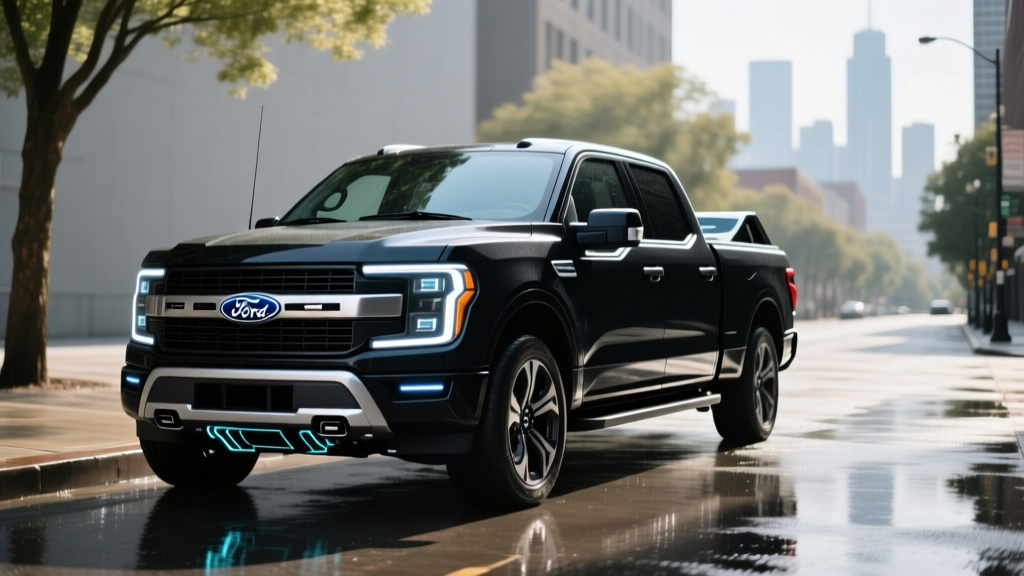
Ford has confirmed it is developing an extended-range electric vehicle (EREV) variant of its F-150 Lightning, a powertrain configuration that pairs a battery-electric drivetrain with a gasoline generator to eliminate range anxiety while preserving the instant torque and quiet operation EV truck owners expect. The announcement, part of Ford's broader electrification strategy update, positions the F-150 Lightning EREV as a bridge product for truck buyers who want electric driving most of the time but need the security of onboard fuel for long hauls, remote job sites, and heavy towing.
As of early 2026, Ford has not released final production specifications, pricing, or an on-sale date for the F-150 Lightning EREV. What follows is a detailed analysis of what Ford has disclosed, what we can project based on the current BEV Lightning platform and comparable EREV architectures, and what this truck needs to deliver to compete against the Chevrolet Silverado EV, Rivian R1T, and the Ram 1500 REV and Ramcharger.
What Is an EREV and Why Is Ford Building One?
An extended-range electric vehicle (EREV) is fundamentally different from a plug-in hybrid (PHEV). In a PHEV, the gasoline engine can directly drive the wheels alongside the electric motor. In an EREV, the wheels are always driven by the electric motor. The gasoline engine exists solely as a generator — it charges the battery or feeds electricity directly to the motor when the battery depletes. This means the driving experience remains fully electric: linear torque delivery, regenerative braking, one-pedal capability, and zero tailpipe emissions while operating on battery charge.
Ford's decision to pursue an EREV F-150 reflects market data. BEV truck adoption has been slower than sedan and SUV electrification, largely because truck buyers demand reliable long-distance range, heavy towing capability, and access to fuel in remote areas where DC fast chargers remain scarce. The Ram 1500 Ramcharger — which uses a similar series-hybrid EREV architecture with a 3.6L V6 generator — has generated significant buyer interest, validating the concept. Ford's EREV Lightning aims to compete directly in this emerging segment.
Projected Battery, Range, and Efficiency
The current BEV F-150 Lightning offers two battery options: a 98 kWh usable Standard Range pack (NMC chemistry, EPA-estimated 240 miles) and a 131 kWh usable Extended Range pack (NMC, EPA 320 miles). The EREV variant will almost certainly use a smaller battery than the Extended Range BEV, since the onboard generator eliminates the need for a massive pack to guarantee total range.
Based on Ford's disclosures and the architecture of competing EREVs, we project the F-150 Lightning EREV will feature:
| Specification | Projected / Estimated | Basis |
|---|---|---|
| Battery Capacity (usable) | 60–85 kWh (NMC) | Smaller than BEV Extended Range; comparable to Ramcharger's 92 kWh |
| Battery-Only Electric Range | 150–200 miles (EPA est.) | Ramcharger targets 145 mi electric-only |
| Total Range (battery + fuel) | 600–700+ miles | Generator + fuel tank extends range significantly |
| Onboard Generator | Gasoline (likely turbo 4-cyl or V6) | Ford has not confirmed displacement |
| Drivetrain | Dual-motor AWD | Standard on most Lightning trims |
| Horsepower | ~500–580 hp (electric motors) | Comparable to current Lightning Extended Range |
| 0–60 mph | ~4.5–5.5 seconds (est.) | Weight penalty from generator offsets slightly |
Charging Speed and Home Charging
Because the EREV's battery will be smaller than the BEV Lightning's Extended Range pack, DC fast charging times should be competitive — potentially faster in absolute terms, since there are fewer kWh to replenish. The current BEV Lightning Extended Range peaks at approximately 150 kW on a DC fast charger, reaching 10–80% in about 41 minutes. A smaller EREV pack charging at similar or slightly higher peak rates could hit 10–80% in roughly 25–35 minutes.
| Charging Level | Projected Rate | Estimated Time / Notes |
|---|---|---|
| Level 1 (120V household) | ~1.4 kW (~3 mi/hr) | Emergency/trickle only; full charge in 50+ hours |
| Level 2 (240V, 48A) | ~11.5 kW (~20–25 mi/hr) | Overnight home charge in ~7–9 hours |
| DC Fast Charge (peak) | ~150–170 kW (est.) | 10–80% in ~25–35 minutes (projected) |
A critical advantage of the EREV architecture: if you arrive at a broken or occupied DC fast charger on a road trip, you simply keep driving on generator power. You are never stranded waiting for a functioning stall. This is the single biggest practical differentiator versus a pure BEV truck for buyers in rural areas or those who tow frequently through charging-desert corridors.
For home charging, the EREV's smaller battery is actually an asset. A 70 kWh pack charged at 11.5 kW (Level 2, 48-amp circuit) requires roughly 6–7 hours from empty — easily achievable overnight on a standard NACS or J1772 home wall connector without requiring a 200-amp panel upgrade in most homes.
Pricing, Trims, and Federal Tax Credit Outlook
Ford has not announced pricing for the F-150 Lightning EREV. However, we can establish a reasonable bracket. The 2025 F-150 Lightning BEV starts at approximately $54,995 (Pro trim, Standard Range) and climbs to over $95,000 for a fully loaded Platinum Extended Range. The EREV variant, with its smaller battery but added generator hardware, will likely slot between the Standard Range and Extended Range BEV in price — roughly $55,000–$75,000 depending on trim.
| Trim (Projected) | Estimated MSRP | §30D Credit Eligibility |
|---|---|---|
| Pro / XLT (base) | $55,000–$62,000 | Likely eligible (under $80,000 truck MSRP cap) — subject to battery sourcing and buyer income limits |
| Lariat | $65,000–$72,000 | Likely eligible — same caveats |
| Platinum / King Ranch | $75,000–$85,000 | May exceed $80,000 truck cap on high trims — verify at purchase |
The IRS §30D clean vehicle credit offers up to $7,500 for qualifying new EVs and EREVs, but eligibility hinges on several factors that change frequently:
- MSRP cap: Trucks, vans, and SUVs must have an MSRP at or below $80,000.
- Buyer income cap: Modified adjusted gross income must not exceed $300,000 (joint), $225,000 (head of household), or $150,000 (single).
- Battery sourcing: The battery's critical minerals and components must meet phased-in domestic-content and free-trade-agreement thresholds that tighten annually through 2029.
- Point-of-sale transfer: As of 2024+, qualifying buyers can transfer the credit to the dealer for an immediate price reduction rather than waiting to claim it on their tax return.
Critical caveat: Because the EREV's battery is smaller, its critical-mineral and component sourcing may differ from the BEV Lightning. Whether the EREV qualifies for the full $7,500, a partial $3,750, or no credit at all will depend on Ford's supply chain at the time of production. Always verify current eligibility on fueleconomy.gov before purchasing.
Performance, Towing, and Capability
The current BEV F-150 Lightning Extended Range produces 580 horsepower and 775 lb-ft of torque from its dual-motor AWD powertrain, achieving a 0–60 mph time of approximately 3.8 seconds and a maximum towing capacity of 10,000 pounds (with the Max Trailer Tow Package). The EREV variant should deliver similar electric-motor output, though the added weight of the onboard generator and fuel system may modestly affect acceleration and efficiency.
The more interesting question is how the generator affects sustained towing performance. When towing 8,000–10,000 pounds, a pure BEV truck's range drops dramatically — often by 40–50%. The BEV Lightning towing a heavy trailer might see real-world range fall from 320 miles to 160–180 miles. With the EREV, once the battery depletes, the generator must produce enough continuous electrical power to sustain highway towing speeds. If Ford sizes the generator adequately (likely 100+ kW output), the EREV could maintain highway towing indefinitely — limited only by fuel stops, just like a conventional gas truck. This would be a transformative advantage for buyers who tow regularly.
Ford's Pro Power Onboard system — which turns the Lightning into a mobile generator with up to 9.6 kW of exportable power — should carry over to the EREV and may even be enhanced, since the onboard gasoline generator provides a secondary power source for job-site electricity without depleting the traction battery.
Interior, Cargo, and Technology
The EREV will inherit the current Lightning's interior architecture, which is among the most practical in the full-size truck segment:
- Mega Power Frunk: 14.1 cubic feet of lockable, weather-sealed front trunk space — a hallmark of the Lightning platform made possible by the absence of a conventional engine. The EREV's generator will be mounted elsewhere (likely under the bed or rear cabin area), so the frunk should be preserved.
- Bed length: 5.5-foot bed (SuperCrew cab), with a maximum payload projected at 1,800–2,200 lbs.
- Rear-seat legroom: Approximately 43.6 inches, matching the SuperCrew F-150 cabin.
- Infotainment: SYNC 4A with a 12-inch touchscreen standard, 15.5-inch portrait screen on Lariat and above; wireless Apple CarPlay and Android Auto.
- Driver assistance: Ford BlueCruise (hands-free highway driving on approved divided highways) — this is an SAE Level 2 system requiring the driver to remain attentive and ready to take over at all times. It is not self-driving.
How It Compares: EREV vs. BEV vs. Competitors
The F-150 Lightning EREV enters a segment with several established and incoming players. Here's how it stacks up on paper against the key alternatives:
| Attribute | F-150 Lightning BEV (Ext. Range) | F-150 Lightning EREV (Projected) | Ram 1500 Ramcharger | Chevrolet Silverado EV (4WT) |
|---|---|---|---|---|
| Powertrain | BEV (dual-motor AWD) | EREV (dual-motor + generator) | EREV (dual-motor + 3.6L V6) | BEV (dual-motor AWD) |
| EPA Electric Range | 320 mi | ~150–200 mi (est.) | 145 mi (est.) | ~460 mi (4WT est.) |
| Total Range | 320 mi | 600–700+ mi | ~690 mi | 460 mi |
| Max Tow Capacity | 10,000 lbs | ~10,000 lbs (est.) | 14,000 lbs | 10,000 lbs (est.) |
| Starting MSRP | ~$54,995 | ~$55,000–$62,000 (est.) | ~$60,000 (est.) | ~$55,000 (est.) |
The EREV's closest rival is the Ram 1500 Ramcharger, which uses a 92 kWh battery and a 3.6L Pentastar V6 as its onboard generator. The Ramcharger targets 145 miles of electric-only range and approximately 690 miles of total range. Ford's EREV will need to match or exceed these figures while leveraging the Lightning's established platform, SuperCrew cab practicality, and Pro Power Onboard ecosystem to win buyer loyalty.
Pros, Cons, and Who Should Wait for the EREV
✓ Projected Advantages
- 600+ miles total range eliminates charging-desert anxiety
- Electric-only commuting (150–200 mi) covers most daily driving
- Sustained towing without range cliff — generator provides continuous power
- Pro Power Onboard for job-site electricity
- Smaller battery = faster home charging, potentially lower replacement cost
- F-150 platform familiarity — parts, service, dealer network
✗ Potential Drawbacks
- Gasoline generator requires oil changes, fuel-system maintenance
- Lower electric-only range than BEV Lightning Extended Range
- Added weight and complexity vs. pure BEV
- Generator noise when activated (unfamiliar to BEV owners)
- Tailpipe emissions when running on generator — not zero-emission
- Tax credit eligibility uncertain — depends on battery sourcing at launch
- Not yet available — production timeline unconfirmed
- Truck buyers in rural areas with limited DC fast-charging infrastructure who want electric daily driving but need gas-station convenience for long trips.
- Heavy towers who are frustrated by the 40–50% range loss BEV trucks experience under load and need reliable long-distance towing without route-planning around chargers.
- Fleet and commercial operators who need job-site power (Pro Power Onboard) and cannot risk downtime from charging delays.
- Current F-150 owners curious about electrification but unwilling to commit to a pure BEV until charging infrastructure matures.
Warranty and Long-Term Ownership
The current BEV F-150 Lightning carries Ford's standard EV warranty: 8 years / 100,000 miles for the high-voltage battery pack (with a capacity-retention threshold typically set at 70% state of health) and 8 years / 100,000 miles for electric powertrain components. The EREV should carry similar battery and electric-motor coverage.
However, the EREV introduces a component the BEV does not have: the gasoline generator engine. This engine will likely fall under Ford's standard powertrain warranty of 5 years / 60,000 miles, though Ford may extend it given the generator's critical role. Buyers should confirm the generator warranty at purchase, as it represents a maintenance item (oil changes, spark plugs, fuel filter) that pure BEV owners never deal with.
The smaller battery in the EREV is a long-term ownership positive. If the battery eventually needs replacement outside warranty, a 70 kWh pack will cost significantly less to replace than the BEV Lightning's 131 kWh Extended Range pack. Current EV battery replacement costs range from $100–$150 per kWh at the pack level, suggesting a potential replacement cost of roughly $7,000–$10,500 for the EREV versus $13,000–$19,500+ for the BEV Extended Range.
Frequently Asked Questions
What is the real-world electric-only range of the F-150 Lightning EREV?
Based on projected EPA estimates of 150–200 miles, real-world electric-only range will likely be 130–150 miles at highway speeds (70+ mph) and 100–120 miles in cold weather below 30°F. City driving with regenerative braking may approach or slightly exceed the EPA estimate. Once the gasoline generator activates, total range extends to 600+ miles.
How fast does the F-150 Lightning EREV charge?
Projected DC fast charging peaks at approximately 150–170 kW, with a 10–80% session taking roughly 25–35 minutes. Home Level 2 charging at 11.5 kW (48 amps, 240V) should fully replenish the smaller battery in approximately 7–9 hours overnight. These figures are estimates pending Ford's official specifications.
Does the F-150 Lightning EREV qualify for the federal EV tax credit?
EREVs are eligible for the IRS §30D credit, but qualification depends on MSRP (must be ≤$80,000 for trucks), buyer income limits, and battery-component and critical-mineral sourcing requirements. Lower trims (Pro, XLT) are likely to qualify; high-end trims may exceed the MSRP cap. Always verify on fueleconomy.gov at the time of purchase. Consult a tax professional for personal eligibility.
Is the F-150 Lightning EREV worth buying over the BEV Lightning or Ramcharger?
If you commute under 100 miles daily, have home charging, and rarely tow long distances, the BEV Lightning Extended Range (320-mile EPA range) remains the simpler, lower-maintenance choice. If you regularly tow, drive in areas with sparse charging infrastructure, or need 600+ mile range without route-planning, the EREV is the stronger option. The Ramcharger is the EREV's direct rival — the decision will come down to platform preference (F-150 vs. Ram 1500), pricing, and which offers better tax-credit eligibility at launch.
When will the F-150 Lightning EREV be available?
Ford has confirmed EREV development but has not announced a specific on-sale date as of early 2026. Industry analysts project a potential late-2026 or 2027 model-year launch. Ford has not opened reservations. Monitor Ford's official channels for updates.
Does the EREV still have the Lightning's front trunk (frunk)?
Based on Ford's architecture disclosures, the EREV's generator is expected to be mounted outside the front-axle area, preserving the Mega Power Frunk (14.1 cu ft). This is a key differentiator versus conventional trucks and should carry over, though final packaging confirmation is pending.