Quick Verdict: Still the EV Benchmark in 2026
The 2026 Tesla Model Y remains the default choice for buyers entering the electric-vehicle market. With up to 320 miles of EPA-estimated range, access to the industry's most reliable Supercharger network, and a starting price that undercuts most rivals after incentives, it sets the bar for the compact electric SUV segment. For buyers researching the current Tesla referral program, ordering through an existing owner's referral link can unlock credits toward accessories, Supercharging, or future purchases — though the exact rewards rotate quarterly and should be verified on Tesla's site before ordering.
This review covers the 2026 Model Y Long Range AWD and Performance trims with exact specs, real-world range expectations, charging curves, and ownership economics you won't find in marketing brochures.
2026 Tesla Model Y: Core Specifications at a Glance
| Spec | Long Range AWD | Performance |
|---|---|---|
| EPA Range | 320 mi | 295 mi |
| Battery (usable) | ~78 kWh, NMC | ~78 kWh, NMC |
| Drivetrain | Dual-Motor AWD | Dual-Motor AWD |
| Horsepower | 384 hp | 456 hp |
| 0–60 mph | 4.8 sec | 3.5 sec |
| Peak DC Charge Rate | 250 kW | 250 kW |
| 10–80% DC Fast Charge | ~25 min | ~25 min |
| Level 2 Home Charge | 11.5 kW (~44 mi/hr) | 11.5 kW (~44 mi/hr) |
| MPGe (combined) | 122 MPGe | 111 MPGe |
| Efficiency | 28 kWh/100 mi | 30 kWh/100 mi |
| Cargo (rear seats up) | 30.2 cu ft | 30.2 cu ft |
| Cargo (seats folded) | 72.1 cu ft | 72.1 cu ft |
| Rear Legroom | 38.4 in | 38.4 in |
| Base MSRP | $48,990 | $53,990 |
| Battery Warranty | 8 yr / 120,000 mi | 8 yr / 120,000 mi |
Source: fueleconomy.gov, Tesla specifications. Figures reflect 2026 model year.
Range: EPA Sticker vs. Real-World Reality
Real-World Expectation: ~270–290 mi highway at 70 mph; ~240–260 mi in freezing temps with cabin heat; ~300+ mi in mild city driving with regen.
Tesla's 320-mile EPA estimate is achievable in mixed suburban driving at moderate speeds with temperate weather. On a 70-mph highway road trip, expect to use roughly 300–310 Wh/mi, which nets around 270 miles before hitting a comfortable 10% buffer. In sub-30°F weather without preconditioning, range can drop 15–25% due to battery resistance and cabin heating demands. The Model Y's standard heat pump significantly mitigates this compared to older resistive-heater EVs, but physics still wins in deep cold.
For daily commuting under 80 miles round-trip, most owners charge to 80% (roughly 256 miles) and never think about range. Road-trippers will appreciate that Superchargers are spaced roughly every 150–180 miles on major US corridors, meaning you rarely need to charge above 80% anyway — which preserves long-term battery health.
Charging Speed: DC Fast, Level 2, and the Curve Reality
| Charging Method | Max Power | Speed | Notes |
|---|---|---|---|
| DC Fast (V3/V4 Supercharger) | 250 kW peak | 10–80% in ~25 min | Peak only below 30% SoC; tapers sharply above 60% |
| DC Fast (CCS adapter, 3rd-party) | Up to 150–180 kW typical | 10–80% in ~32 min | Depends on Electrify America / EVgo station output |
| Level 2 (Tesla Wall Connector, 48A) | 11.5 kW | ~44 mi/hr, full in ~8 hr | Requires 60A circuit; overnight charge for most owners |
| Level 2 (Mobile Connector, 32A) | 7.7 kW | ~30 mi/hr, full in ~11 hr | NEMA 14-50 outlet minimum |
| Level 1 (120V household) | ~1.4 kW | ~4 mi/hr | Emergency/trickle only |
The Model Y's 250 kW peak DC rate is impressive on paper, but the charge curve matters more. You'll see 250 kW only between roughly 5–25% State of Charge. From 25–50%, it holds around 170–200 kW. Above 60%, it drops to under 100 kW, and above 80% it falls below 50 kW. This is why Tesla's navigation always targets arrival at Superchargers with 10–15% SoC — it puts you at the steepest part of the curve.
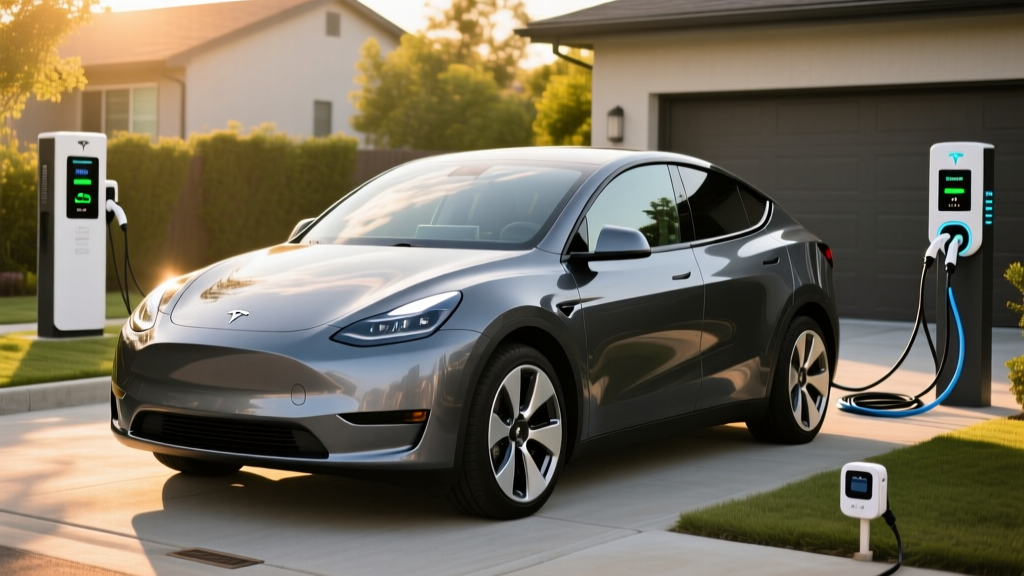
At home, the Tesla Wall Connector on a 60-amp breaker delivers 48 amps (11.5 kW), adding roughly 44 miles of range per hour of charging. Most owners plug in overnight and wake up full. If your home electrical panel is maxed out, a licensed electrician may recommend a panel upgrade ($1,500–$3,000) before installing a 60A circuit — budget for this when planning your setup.
Performance and Driving Dynamics
The Long Range AWD's 384 hp and 4.8-second 0–60 time make it quicker than most gas-powered compact SUVs, while the Performance trim's 456 hp and 3.5-second sprint puts it in sports-car territory. Both trims feature dual-motor all-wheel drive with independent torque control front and rear, providing confident traction in rain and light snow.
Ride quality improved with the 2025 refresh — the updated suspension tuning reduces the harshness over expansion joints that plagued earlier Model Ys. The steering remains quick but artificially weighted; enthusiasts may prefer the feedback in a Ford Mustang Mach-E or Porsche Macan EV. Cabin noise is well-controlled at highway speeds, a notable upgrade from pre-2024 models.
Tech, Interior, and Driver Assistance
The Model Y's 15.4-inch center touchscreen handles everything — navigation, media, climate, glovebox release, and even windshield wiper settings. There is no instrument cluster; speed and navigation appear in the upper-left corner of the main display. The 2026 model continues with the rear-seat 8-inch touchscreen for passengers, ventilated front seats, and power-folding second row.
Autopilot comes standard and includes Traffic-Aware Cruise Control and Autosteer (lane centering). This is a SAE Level 2 system — you must keep your hands on the wheel and eyes on the road at all times. Full Self-Driving (Supervised) remains an $8,000 option (or $99/month subscription) and adds automatic lane changes, traffic-light recognition, and city-street navigation. Despite the name, FSD is still Level 2 and requires active driver supervision; it is not a self-driving system.
Pricing, Trims, and Federal Tax Credit Eligibility
| Trim | Base MSRP | Est. After §30D Credit* | Destination |
|---|---|---|---|
| Long Range AWD | $48,990 | $41,490 | $1,390 |
| Performance | $53,990 | $46,490 | $1,390 |
*Assumes full $7,500 §30D credit eligibility. Verify at irs.gov — rules change frequently.
Under current IRS §30D rules, the Model Y qualifies for up to $7,500 in federal tax credit, which can be transferred to the dealer at point of sale as an instant price reduction. However, eligibility depends on three factors:
- MSRP Cap: SUVs must be under $80,000 — both Model Y trims clear this easily.
- Buyer Income Cap: Modified AGI must not exceed $150,000 (single), $225,000 (head of household), or $300,000 (joint).
- Battery Sourcing: Critical minerals and battery components must meet escalating domestic-content thresholds. Tesla's US-built battery cells have historically met these requirements, but always confirm the specific VIN's eligibility on the IRS qualified-vehicle list before purchasing.
The Current Tesla Referral Program: What It Offers
The current Tesla referral program allows new buyers to use an existing Tesla owner's referral link when ordering. As of early 2026, the program typically provides:
- For the buyer: Credits (often $500–$1,000 equivalent) applicable toward accessories, Supercharging miles, or service in the Tesla app.
- For the referrer: Tesla credits redeemable toward vehicle accessories, Supercharging, or in some cases, applied toward a future vehicle purchase or lease.
Tesla adjusts referral rewards periodically — sometimes offering enhanced incentives during end-of-quarter pushes. Always check the referral link's terms at checkout, as the exact dollar value and eligible products change. The referral credit is applied separately from and in addition to any federal or state incentives.
Efficiency and Ownership Costs
At 122 MPGe combined (Long Range AWD), the Model Y is one of the most efficient electric SUVs on the market, translating to roughly 28 kWh per 100 miles. At the US average electricity rate of $0.17/kWh, that's approximately $4.76 per 100 miles — compared to roughly $12.50 for a 28-MPG gas SUV at $3.50/gallon.
Over 5 years and 75,000 miles, home-charging a Model Y costs roughly $3,570 in electricity versus $9,375 in gasoline for a comparable gas SUV — a savings of around $5,800 before factoring in the EV's reduced maintenance (no oil changes, fewer brake replacements thanks to regenerative braking).
Pros, Cons, and Who Should Buy
- Class-leading Supercharger network reliability
- 320-mile EPA range covers most road trips comfortably
- Excellent efficiency (28 kWh/100 mi)
- Over-the-air updates add features post-purchase
- Spacious cargo area (72.1 cu ft seats folded)
- Qualifies for up to $7,500 federal tax credit
- No physical controls — everything through touchscreen
- FSD ($8,000) remains Level 2, not autonomous
- 250 kW peak charge rate trails Hyundai/Kia's 350 kW
- Insurance premiums often 20–30% higher than gas equivalents
- Minimal steering feedback for enthusiasts
- CCS adapter required for non-Tesla DC chargers
Best for: Daily commuters with home charging access, small families needing cargo versatility, and road-trippers who value Supercharger reliability. The Long Range AWD is the sweet-spot trim for most buyers.
Consider alternatives if: You need 350 kW ultra-fast charging (Hyundai Ioniq 5 / Kia EV6), prefer physical buttons (Ford Mustang Mach-E), or need three-row seating (Kia EV9).
Frequently Asked Questions
What is the real-world range of the 2026 Tesla Model Y?
The EPA rates the Long Range AWD at 320 miles. In real-world highway driving at 70 mph, expect 270–290 miles. In freezing weather, plan for 240–260 miles. City driving with regenerative braking can exceed the EPA estimate.
How fast does the Model Y charge at home and on the road?
On a V3/V4 Supercharger, it peaks at 250 kW and charges 10–80% in about 25 minutes. At home on a Tesla Wall Connector (48A/11.5 kW), it adds roughly 44 miles per hour, fully charging overnight in about 8 hours.
Does the 2026 Model Y qualify for the $7,500 federal tax credit?
Yes, if you meet IRS §30D income caps ($150K single / $300K joint), and the vehicle's battery sourcing meets current-year critical-mineral and component requirements. The credit can be transferred at point of sale for an instant price reduction. Always verify your specific VIN on the IRS qualified-vehicle list.
How does the current Tesla referral program work?
Order through an existing Tesla owner's referral link. The buyer typically receives credits ($500–$1,000 equivalent) for accessories, Supercharging, or service. The referrer also earns credits. Exact rewards rotate — confirm at checkout.
Is the Model Y worth buying over competitors like the Ioniq 5 or Mach-E?
The Model Y wins on range, efficiency, Supercharger access, and cargo space. The Ioniq 5 charges faster (350 kW capable) and has a more distinctive design. The Mach-E offers a more traditional interior with physical controls. For most buyers prioritizing total ownership simplicity, the Model Y remains the default.
What is the battery warranty?
Tesla covers the Model Y battery and drive unit for 8 years or 120,000 miles, whichever comes first, with a minimum 70% capacity retention guarantee during that period.