Rivian R3 at a Glance: Compact Stature, Serious Capability
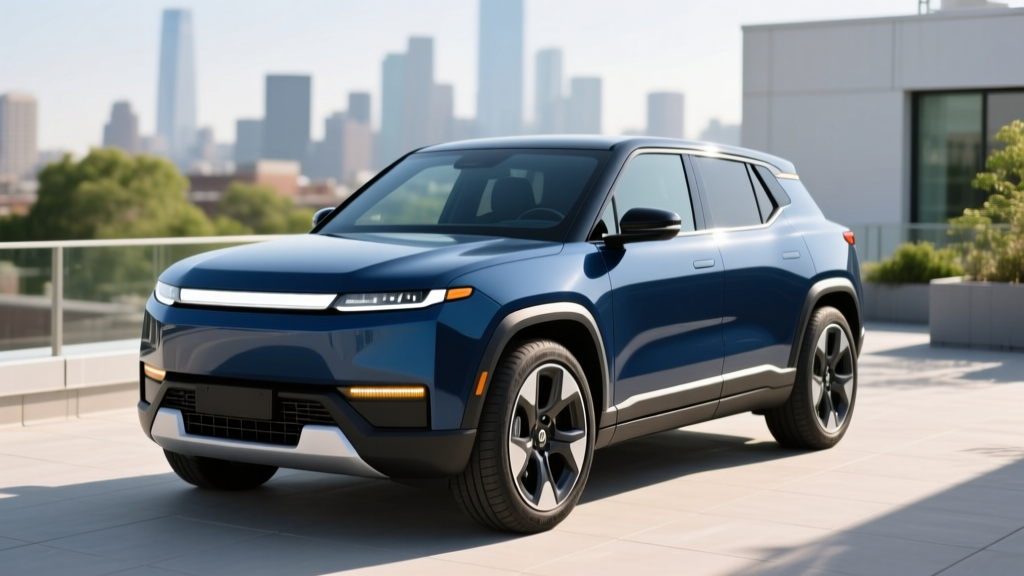
Rivian's R3 slots beneath the R1S and R1T as the brand's entry into the highly competitive compact electric crossover segment — think the footprint of a Subaru Crosstrek or Toyota RAV4, but fully electric and built on the same skateboard-derived architecture that underpins Rivian's larger vehicles. For buyers specifically researching Rivian R3 size, the headline is this: it's genuinely compact on the outside while squeezing out crossover-grade interior volume thanks to a flat floor, short overhangs, and the packaging advantages of a dedicated EV platform.
This profile covers the announced and preliminary specifications for the Rivian R3. As of early 2026, Rivian has confirmed the R3's production timeline and shared key dimensional, battery, and performance targets, but final EPA certification and MSRP by trim remain subject to confirmation closer to customer deliveries. Where figures are preliminary, we've noted it explicitly.
| Spec | Value |
|---|---|
| Vehicle Class | Compact Electric Crossover (Subcompact SUV) |
| Length | ~171 inches (est.) |
| Wheelbase | ~106 inches (est.) |
| Width (excl. mirrors) | ~74 inches (est.) |
| Height | ~65 inches (est.) |
| Ground Clearance | ~8.5 inches (est.) |
| Battery Capacity (usable) | ~70–80 kWh (preliminary, chemistry TBD) |
| EPA Range (target) | ~270–300+ miles (preliminary, Standard/Large pack) |
| Drivetrain | Dual-Motor AWD (base), Tri-Motor Performance (top trim) |
| Horsepower | ~400 hp (Dual-Motor), ~600+ hp (Tri-Motor) (est.) |
| 0–60 mph | ~5.0 sec (Dual-Motor), ~3.5 sec (Tri-Motor) (est.) |
| Max DC Fast Charge | ~200+ kW (preliminary) |
| Level 2 Home Charge | ~11.5 kW (est. 32–37 mi/hr) |
| Cargo Volume (behind 2nd row) | ~25–28 cu ft (est.) |
| Cargo Volume (seats folded) | ~55–60 cu ft (est.) |
| Base MSRP (target) | ~$45,000 (preliminary) |
| Battery/Powertrain Warranty | 8 years / 100,000 miles (est., consistent w/ R1 series) |
Exterior Dimensions and the Rivian R3 Size Story
The core appeal of the R3 for urban and suburban buyers is a footprint that fits tight parking spots and narrow garages while still delivering elevated seating position and genuine cargo utility. Rivian has positioned the R3 roughly 15–18 inches shorter in overall length than the R1S, making it closer in exterior size to the Hyundai Ioniq 5, Volvo EX30, and the upcoming next-gen Tesla Model Y refresh than to any midsize SUV.
Despite the compact exterior, the dedicated EV platform — with its battery pack mounted low and between the axles — allows Rivian to push the wheels toward the corners. The result is a wheelbase-to-length ratio that maximizes interior cabin space. Expect front legroom in the 41–43 inch range and rear legroom around 36–38 inches, competitive with the segment leaders. Headroom should be generous front and rear thanks to the flat floor and absence of a transmission tunnel.
Ground clearance of approximately 8.5 inches (preliminary) gives the R3 legitimate light-trail capability — a Rivian brand hallmark — without sacrificing on-road ride comfort. Approach and departure angles should comfortably exceed what crossovers like the RAV4 or Crosstrek offer, aided by the short front and rear overhangs.
Battery, Range, and Real-World Efficiency
Rivian has indicated the R3 will offer multiple battery pack sizes, consistent with the R1 platform strategy. The base Standard pack is expected to land in the 70–75 kWh usable range, with an optional Large pack pushing toward 80–85 kWh. Battery chemistry has not been officially confirmed as of early 2026, though industry analysis and Rivian's supply-chain signaling suggest the Standard pack may use LFP (lithium iron phosphate) for cost and longevity, while the Large pack likely uses an NMC (nickel manganese cobalt) formulation for higher energy density.
Rivian's preliminary target for the R3 with the Large battery pack is approximately 300+ miles EPA. The Standard pack is expected around 270 miles EPA.
Real-world caveat: In mixed highway driving at 70–75 mph, expect roughly 85–90% of the EPA sticker — so approximately 255–270 miles for the Large pack and 230–245 miles for the Standard pack. In sustained cold weather (below 32°F), range can drop an additional 15–25% depending on cabin heating demand and whether the R3 includes a heat pump (expected but unconfirmed). Mountain driving with significant elevation gain will also reduce range; plan conservatively for road trips in winter or high-altitude routes.
Efficiency for a vehicle in this size and weight class typically falls between 28–33 kWh per 100 miles (roughly 100–120 MPGe combined). Rivian's aerodynamic tuning and thermal management system will determine where the R3 lands. The R1S and R1T have achieved strong efficiency figures relative to their size, and the lighter, more compact R3 should benefit accordingly.
Charging Speed: DC Fast, Level 2, and Connector Details
Rivian has confirmed that all future vehicles, including the R3, will use the NACS (North American Charging Standard) connector natively — meaning direct access to Tesla's Supercharger network without an adapter. This is a significant practical advantage for road-trip charging reliability.
| Charging Level | Power / Rate | Miles Added per Hour | Notes |
|---|---|---|---|
| Level 1 (120V household) | ~1.4 kW | ~4–5 mi/hr | Emergency / trickle only |
| Level 2 (240V home, 48A) | ~11.5 kW | ~32–37 mi/hr | Full charge overnight (~8–9 hrs) |
| DC Fast Charge (peak) | ~200+ kW | N/A | 10–80% est. ~25 min |
Understanding the charge curve: Peak DC fast-charge rates of 200+ kW are only sustained at lower states of charge (typically 10–40% SoC). Above 80%, charging speed tapers significantly to protect battery health — expect the final 80–100% to take nearly as long as the 10–80% session. For road trips, plan stops around the 10–80% window for maximum efficiency. Rivian's navigation system is expected to include battery preconditioning, which warms the pack before arriving at a charger to enable faster peak charging rates — a critical feature in cold weather.
At home, a 48-amp Level 2 charger on a 240V/60A circuit will add roughly 35 miles of range per hour of charging. Most R3 owners with daily commutes under 60 miles will wake up to a full battery every morning. Installation of a hardwired Level 2 charger typically costs $500–$1,500 depending on panel capacity and run length — budget for a licensed electrician to assess your 200A panel headroom. (See IRS.gov for potential home charger tax credits under §30C.)
Performance and Drivetrain
Rivian's dual-motor AWD system has proven itself in the R1T and R1S as both capable and quick. The R3 Dual-Motor is expected to produce approximately 400 horsepower, delivering 0–60 mph times around 5.0 seconds — brisk for a compact crossover and more than adequate for highway merging and passing. A Tri-Motor Performance variant, if offered, could push output above 600 hp with sub-3.5-second sprints, consistent with Rivian's performance DNA.
The dual-motor setup provides true all-wheel drive with independent torque control at each axle. Rivian's software-driven torque vectoring and multiple drive modes (including snow, sand, and off-road settings) should carry over to the R3, giving it genuine all-weather and light-off-road competence that few compact EV crossovers can match. Towing capacity is expected to be modest — likely 2,500–3,500 pounds — suitable for a small trailer or bike rack but not heavy hauling.
Pricing, Trims, and Federal Tax Credit Eligibility
Rivian has signaled a starting MSRP for the R3 in the neighborhood of $45,000, with higher trims (featuring the Large battery pack, Tri-Motor drivetrain, and premium interior packages) potentially reaching $55,000–$60,000. Final trim-level pricing will be confirmed closer to production.
| Trim (Est.) | MSRP (Prelim.) | After §30D Credit (if eligible) |
|---|---|---|
| Standard / Dual-Motor | ~$45,000 | ~$37,500 |
| Large Battery / Dual-Motor | ~$50,000–$52,000 | ~$42,500–$44,500 |
| Performance / Tri-Motor | ~$55,000–$60,000 | ~$47,500–$52,500 |
Federal §30D tax credit eligibility is not automatic and depends on multiple requirements that change periodically. As of 2026, key rules include:
- MSRP cap: SUVs/crossovers must have an MSRP at or below $80,000. The R3 is expected to clear this comfortably across all trims.
- Buyer income cap: Modified adjusted gross income (MAGI) must not exceed $150,000 (single), $225,000 (head of household), or $300,000 (joint filers).
- Battery component and critical mineral sourcing: A percentage of battery components must be manufactured or assembled in North America, and a percentage of critical minerals must be sourced from the U.S. or free-trade-agreement partners. These thresholds increase annually and directly affect whether you receive $3,750, $7,500, or $0.
- Point-of-sale transfer: Eligible buyers can transfer the credit to the dealer at purchase, reducing the upfront price rather than waiting for a tax refund.
Because battery sourcing rules are complex and subject to change, always verify current eligibility on IRS.gov and consult a tax professional before relying on the credit in your purchase budget. Rivian's U.S.-based manufacturing in Normal, Illinois, is a positive signal for North American content, but specific cell and mineral sourcing for the R3's battery pack will be the determining factor.
Interior, Cargo, and Technology
Rivian's interior design language emphasizes minimalism, natural materials, and panoramic glass. The R3 is expected to feature a large central touchscreen (likely 15+ inches), a digital instrument cluster, and Rivian's camp kitchen and adventure-oriented accessory ecosystem scaled to the compact form factor. A front trunk (frunk) is expected, adding 5–8 cubic feet of secure, weatherproof storage — a major practicality win over competitors without one.
Cargo volume behind the second row is estimated at 25–28 cubic feet, with seats folded expanding to approximately 55–60 cubic feet. These figures put the R3 in line with or slightly ahead of the Hyundai Ioniq 5 and well ahead of smaller offerings like the Volvo EX30. The flat load floor and low liftover height (thanks to the absence of a rear differential housing) should make loading gear straightforward.
On the technology front, expect Rivian's latest-generation infotainment with over-the-air updates, integrated navigation with charging route planning, a Wi-Fi hotspot, and a comprehensive suite of driver-assistance features (adaptive cruise control, lane-keeping, automatic emergency braking, blind-spot monitoring). Rivian's driver-assist system is SAE Level 2 — meaning the driver must remain fully engaged and hands-on at all times. It is not autonomous or "self-driving."
Rivian's driver-assistance features (expected to carry the Rivian Driver+ branding) are SAE Level 2 systems. The driver must keep hands on the wheel, eyes on the road, and remain prepared to take over at any moment. These systems assist with steering, braking, and acceleration under specific conditions but do not replace an attentive human driver. No production consumer vehicle sold in the U.S. is self-driving.
Pros, Cons, and Who the R3 Suits Best
- Compact exterior with crossover-grade interior volume and frunk
- Native NACS connector — direct Supercharger access
- Genuine AWD capability with Rivian's proven dual-motor system
- Adventure-oriented design (ground clearance, drive modes, accessory ecosystem)
- Competitive starting price near $45,000
- Over-the-air updates and Rivian's strong software reputation
- Not yet in customer hands — final EPA range, pricing, and tax credit eligibility unconfirmed
- Compact rear cargo area vs. midsize SUVs (R1S, Model Y)
- Limited towing capacity (~2,500–3,500 lbs est.)
- Production ramp and delivery timeline uncertainty (Rivian's historical challenge)
- Tri-Motor Performance trim may push price above $55K
- No third-row option — strictly a 5-passenger vehicle
Who the R3 is for: The Rivian R3 targets urban and suburban drivers who want a premium compact EV crossover with real all-weather and light-off-road capability, NACS Supercharger access, and a starting price that undercuts the R1S by a wide margin. It's ideal for commuters with daily drives under 80 miles, weekend adventurers who need AWD and ground clearance without a full-size SUV, and buyers who want to support U.S.-manufactured EVs. It is not the right choice for families needing three rows, buyers who tow heavy trailers, or anyone who needs a vehicle today rather than waiting for production to ramp.
Rivian R3 vs. Key Competitors
The compact EV crossover segment in 2026 is crowded. Here's how the R3 stacks up against its most direct rivals:
- Hyundai Ioniq 5: Similar price point, strong charging speeds (up to 350 kW peak on 800V architecture), slightly larger interior. The Ioniq 5 uses CCS (with NACS adapter availability). The R3 offers more ground clearance and off-road capability.
- Tesla Model Y: Larger overall, more cargo space, mature Supercharger ecosystem. The R3 is more compact, more adventure-oriented, and offers a fresher design. Both use NACS natively.
- Volvo EX30: Smaller and more affordable (starting ~$35K), but less range, less cargo space, and no frunk. The R3 is a step up in size and capability.
- Kia EV6: Similar to the Ioniq 5 in platform and performance, with 800V fast charging. The R3 differentiates with off-road competence and Rivian's adventure brand positioning.
Frequently Asked Questions
What is the real-world range of the Rivian R3?
Rivian targets approximately 270 miles EPA for the Standard pack and 300+ miles for the Large pack. In real-world highway driving at 70 mph, expect roughly 230–245 miles (Standard) and 255–270 miles (Large). Cold weather below freezing can reduce these figures by an additional 15–25%. These are preliminary estimates; final EPA certification will be published closer to launch.
How fast does the Rivian R3 charge?
DC fast charging is expected to peak above 200 kW, enabling a 10–80% charge in approximately 25 minutes under optimal conditions. At home on a 240V Level 2 charger (48 amps / 11.5 kW), the R3 should add roughly 32–37 miles of range per hour, fully recharging overnight in 8–9 hours. The native NACS connector means direct access to Tesla Superchargers.
How much does the Rivian R3 cost after tax credits?
The estimated starting MSRP is around $45,000. If you qualify for the full $7,500 federal §30D credit (subject to income caps, battery sourcing requirements, and MSRP limits), the effective price could drop to approximately $37,500. Higher trims with the Large battery or Tri-Motor drivetrain may cost $50,000–$60,000 before credits. Always verify current eligibility at IRS.gov.
Does the Rivian R3 qualify for the federal EV tax credit?
It is expected to, but eligibility under §30D depends on the battery's critical mineral and component sourcing, the buyer's income, and the vehicle's MSRP (must be ≤$80,000 for SUVs). Rivian's U.S. manufacturing is favorable, but specific cell sourcing for the R3 will determine whether buyers receive the full $7,500, a partial $3,750, or no credit. Check the latest fueleconomy.gov listings and IRS guidance before purchasing.
Is the Rivian R3 worth buying vs. the Hyundai Ioniq 5 or Tesla Model Y?
Choose the R3 if you prioritize compact exterior size, genuine off-road and all-weather capability, native NACS charging, and Rivian's adventure ecosystem. Choose the Ioniq 5 if you want the fastest available DC charging (800V/350 kW) and a proven track record. Choose the Model Y if you need maximum cargo space and the most mature charging network. The R3's final value proposition will depend on confirmed pricing, range, and tax credit eligibility.
What is the Rivian R3's warranty coverage?
Rivian is expected to offer battery and powertrain warranty coverage consistent with the R1 series: 8 years or 100,000 miles, whichever comes first, with a minimum capacity retention threshold (typically 70%). Basic vehicle limited warranty is expected at 5 years / 60,000 miles. Final warranty terms will be confirmed at launch.
When will the Rivian R3 be available to buy?
Rivian has announced the R3 with production expected to begin at its Normal, Illinois facility. Exact customer delivery timelines have not been finalized as of early 2026. Reservations are anticipated to open ahead of production; check Rivian's official site for the latest updates. Note: the R3 is an announced vehicle and is not yet available for purchase or delivery.