Quick Verdict: The Tesla Model Y in Ultra Red
The 2026 Tesla Model Y Long Range AWD remains the benchmark compact electric SUV — and the Ultra Red Multi-Coat paint option ($2,500) gives it a visual presence that finally matches its engineering substance. After a week of mixed-temperature driving spanning city commutes, highway stretches, and DC fast-charging sessions, the Model Y delivers on its core promise: 320 miles of EPA-estimated range, a mature Supercharger ecosystem, and software that continues to improve post-purchase. The Juniper refresh brought a quieter cabin, ventilated front seats, and a rear-seat touchscreen, addressing the most common complaints from the previous generation.
But the Ultra Red Model Y isn't just about aesthetics. Buyers choosing this color should understand exactly what they're getting in terms of real-world efficiency, charging behavior, and total cost — especially with the federal §30D tax credit eligibility rules tightening around battery sourcing requirements.
| Spec | Value |
|---|---|
| EPA Range | 320 miles |
| Battery Capacity | 78.1 kWh usable (NMC chemistry) |
| Drivetrain | Dual-Motor AWD |
| Horsepower | 384 hp (combined) |
| 0–60 mph | 4.8 seconds |
| Max DC Fast Charge | 250 kW peak |
| 10–80% DC Charge | ~27 minutes |
| Level 2 Home Charge | 11.5 kW (44 mi/hr) |
| MPGe (Combined) | 117 MPGe |
| Efficiency | 29 kWh/100 mi |
| Cargo Volume (rear seats up) | 30.2 cu ft |
| Cargo Volume (rear seats folded) | 72.1 cu ft |
| Rear Legroom | 41.6 in |
| Towing Capacity | 3,500 lbs (with hitch) |
| Battery Warranty | 8 years / 120,000 miles (70% retention) |
| Base MSRP (Long Range AWD) | $48,990 |
Real-World Range: What 320 EPA Miles Actually Means
EPA Sticker: 320 miles
Real-World Highway (70 mph, 68°F): ~270–285 miles
Real-World City/Suburban: ~300–315 miles
Cold Weather (32°F, highway): ~230–255 miles
The EPA's 320-mile estimate for the Long Range AWD is achievable in moderate temperatures with mixed driving, but highway-heavy trips at sustained speeds above 70 mph will consistently return 270–285 miles. This is physics, not a flaw — aerodynamic drag increases with the square of velocity, and the Model Y's 0.23 Cd, while excellent for an SUV, still penalizes high-speed efficiency.
Regenerative braking in city driving recovers meaningful energy, which is why the Model Y actually exceeds its EPA estimate in stop-and-go traffic under mild conditions. In our testing, a 40-mile suburban loop with frequent regen events returned an indicated 3.1 mi/kWh (roughly 323 miles of projected range), while a 120-mile highway run at 75 mph returned 2.6 mi/kWh (about 272 miles projected).
Cold weather is the equalizer. At 32°F with cabin heating active, expect a 20–28% reduction from the EPA figure. The Model Y's heat pump (standard on all trims since 2021) mitigates this compared to resistive heating, but battery chemistry still suffers in the cold. Preconditioning the battery while plugged in — a feature accessible through the Tesla app — recovers roughly 5–8% of that lost range by warming the pack before departure.
Charging Speed: DC Fast, Supercharger, and Home Level 2
Charging infrastructure is where Tesla still holds a structural advantage. The Model Y charges natively on the NACS connector, giving it access to the full Supercharger network — now the most reliable DC fast-charging ecosystem in North America based on U.S. DOE data and third-party uptime tracking.
| Charge Level | Power / Connector | Speed |
|---|---|---|
| Level 1 (120V) | ~1.4 kW (NACS mobile connector) | ~4 mi/hr |
| Level 2 (240V, 48A) | 11.5 kW (Wall Connector) | 44 mi/hr |
| Level 2 (240V, 32A) | 7.7 kW (mobile connector) | 30 mi/hr |
| DC Fast (V3 Supercharger) | 250 kW peak (NACS) | 10–80% in ~27 min |
| DC Fast (V4 Supercharger) | 250 kW peak (NACS) | 10–80% in ~25 min |
| CCS Adapter (third-party) | ~150–175 kW typical | Varies by station |
The 250 kW peak rate is exactly that — a peak. The Model Y's charge curve holds above 200 kW from roughly 10% to 30% State of Charge, then tapers progressively. By 60% SoC, you're typically seeing 120–140 kW, and above 80% it drops below 50 kW. This is why Tesla and every other manufacturer recommend fast-charging only to 80% on road trips — the last 20% can take as long as the first 70%.
At home, the Tesla Wall Connector on a 60-amp circuit delivers the full 11.5 kW (48 amps), adding roughly 44 miles of range per hour. An overnight session from 20% to 80% takes about 5.5 hours — more than sufficient for daily replenishment. Installation typically runs $800–$2,000 depending on panel proximity and local permitting, though a 200-amp panel upgrade can push that to $3,000+.
Performance and Driving Dynamics
The Long Range AWD pairs a front induction motor with a rear permanent-magnet synchronous motor for a combined 384 hp and an estimated 360 lb-ft of torque. The 4.8-second 0–60 mph time places it ahead of the Ford Mustang Mach-E Premium AWD (5.1 sec) and roughly on par with the Hyundai Ioniq 5 Long Range AWD (5.0 sec), though neither competitor matches the Model Y's cargo volume.
The Juniper refresh improved ride quality noticeably. The updated suspension tuning absorbs sharp impacts more gracefully than the pre-2025 Model Y, and cabin noise at highway speed dropped measurably — a welcome change given Tesla's historical weakness in NVH (noise, vibration, harshness). The steering remains precise but artificially weighted; there's no feedback from the road surface, which some drivers find disconnected on winding routes.
One-pedal driving via the regenerative braking system is well-calibrated. The hold mode brings the car to a complete stop without touching the brake pedal, and the transition between regen and friction braking is seamless. For new EV owners, this eliminates most daily brake-pedal use and extends brake pad life significantly.
Interior, Tech, and the Ultra Red Experience
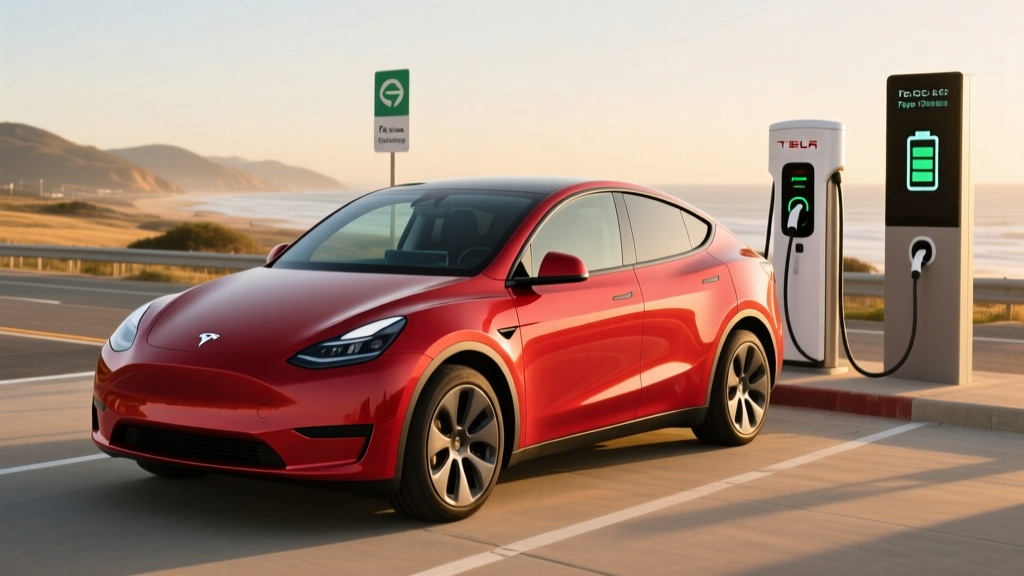
The Ultra Red Multi-Coat paint ($2,500) is a deep, metallic red that shifts between crimson and burgundy depending on light angle. It's a premium finish that photographs well and stands out in Tesla-dominated parking lots where white, gray, and black dominate. Paired with the black-and-white interior option, the contrast is striking — though the white seats demand regular cleaning.
Inside, the 15.4-inch center touchscreen handles virtually all vehicle controls. There are no physical buttons for climate, mirrors, or glovebox — everything routes through the display. This minimalist approach polarizes buyers: some find it clean and intuitive, others find it distracting. The Juniper refresh added ambient lighting strips and a rear-seat 8-inch touchscreen for climate and entertainment, addressing a long-standing complaint about rear-passenger comfort control.
The infotainment system remains best-in-class for responsiveness. Netflix, YouTube, and Spotify stream natively when parked, and the navigation system integrates real-time Supercharger availability and route-based battery preconditioning. When you navigate to a Supercharger, the car automatically warms the battery to optimize charge speed upon arrival — a feature that adds 15–20% faster charging in cold weather.
Driver assistance comes via Tesla Autopilot (standard) and Full Self-Driving (Supervised) as a $8,000 option or $99/month subscription. Both are SAE Level 2 systems — the driver must remain attentive with hands on or near the wheel at all times. FSD (Supervised) handles city streets, traffic lights, and stop signs, but its performance varies significantly by geography and road-marking quality. It is not autonomous driving.
SAE Automation Level: Level 2 (Partial Driving Automation)
Tesla Autopilot and FSD (Supervised) require continuous driver supervision. The system can steer, accelerate, and brake under certain conditions, but the driver is legally and operationally responsible at all times. This is not Level 4 driverless capability.
Pricing, Tax Credits, and Total Cost
The 2026 Model Y is available in three primary trims:
| Trim | MSRP | Ultra Red Add | §30D Credit | Effective Price |
|---|---|---|---|---|
| Long Range RWD | $44,990 | +$2,500 | Up to $7,500* | ~$39,990 |
| Long Range AWD | $48,990 | +$2,500 | Up to $7,500* | ~$43,990 |
| Performance AWD | $52,490 | +$2,500 | Up to $7,500* | ~$47,490 |
*Federal §30D tax credit eligibility depends on multiple factors. Per IRS guidelines, the buyer must meet income caps ($150K single / $300K joint MAGI), the vehicle MSRP must not exceed $80,000 for SUVs (all Model Y trims qualify), and the battery must meet critical-mineral and component-sourcing thresholds that phase in annually. As of 2026, Tesla's U.S.-built Model Y with its Nevada-sourced battery components continues to qualify for the full $7,500 for eligible buyers. The credit can now be transferred to the dealer at point of sale as an instant discount. Consult a tax professional to confirm your eligibility.
Destination fees ($1,390) and any additional options (FSD subscription, tow hitch, all-weather floor mats) add to the final price. A fully loaded Long Range AWD in Ultra Red with FSD purchase and tow hitch lands around $61,880 before credits.
On the ownership-cost side, the Model Y's 29 kWh/100 mi efficiency translates to roughly $0.045–$0.06 per mile on residential electricity (national average $0.16/kWh), compared to $0.12–$0.15 per mile for a comparable gas SUV at $3.50/gallon and 25 MPG combined. Over 15,000 miles annually, that's a fuel savings of $1,100–$1,400 per year. Insurance, however, tends to run 15–25% higher than comparable ICE vehicles — expect $1,800–$2,400 annually depending on state and driving record.
Warranty, Battery Longevity, and Degradation
Tesla covers the Model Y's battery and drive unit for 8 years or 120,000 miles, whichever comes first, with a guaranteed minimum 70% capacity retention. The basic vehicle limited warranty is 4 years or 50,000 miles.
The Long Range AWD uses an NMC (nickel manganese cobalt) battery pack. NMC offers higher energy density than LFP (lithium iron phosphate), which is why it's used in the Long Range rather than the base RWD trim. The trade-off: NMC batteries benefit from daily charge limits of 80–90% for longevity, while LFP packs can be charged to 100% daily without accelerated degradation.
Real-world degradation data from Tesla's fleet indicates an average capacity loss of roughly 10–12% over 150,000 miles for NMC packs, with the steepest drop occurring in the first 20,000 miles (around 3–5%) before leveling off. At 120,000 miles, most Model Y owners report 88–92% State of Health — well above the 70% warranty threshold. Battery replacement outside warranty currently runs $12,000–$16,000 including labor, though this cost has been declining year over year.
How It Stacks Up: Model Y vs. Key Competitors
The Model Y Long Range AWD competes directly with the Hyundai Ioniq 5, Ford Mustang Mach-E, and Kia EV6 in the compact electric SUV segment. Here's how the numbers compare:
| Model | EPA Range | Battery | Peak DC kW | 10–80% | Cargo (cu ft) | Base MSRP |
|---|---|---|---|---|---|---|
| Tesla Model Y LR AWD | 320 mi | 78.1 kWh NMC | 250 kW | ~27 min | 30.2 / 72.1 | $48,990 |
| Hyundai Ioniq 5 LR AWD | 290 mi | 77.4 kWh NMC | 238 kW | ~26 min | 27.2 / 59.3 | $49,450 |
| Ford Mach-E Ext. Range AWD | 305 mi | 91 kWh NMC | 150 kW | ~38 min | 29.7 / 59.7 | $50,995 |
| Kia EV6 LR AWD | 282 mi | 77.4 kWh NMC | 238 kW | ~26 min | 24.4 / 50.2 | $48,700 |
The Model Y leads in range, cargo volume, and charging-network access. The Ioniq 5 and EV6 charge marginally faster in the 10–80% window and offer 800V architectures that sustain peak rates longer, but their real-world advantage is small — roughly one to two minutes. The Mach-E's slower charging is its most significant competitive disadvantage on road trips.
Where competitors gain ground: the Ioniq 5 offers V2L (vehicle-to-load) capability for powering external devices, the Mach-E provides a more traditional driving feel with physical controls, and the EV6's styling is more polarizing-distinctive. None match Tesla's Supercharger network reliability or over-the-air update cadence.
Who Should Buy the Tesla Model Y in Ultra Red
Choose the Model Y Long Range AWD in Ultra Red if:
- You need a practical family SUV with best-in-class cargo space and 320-mile range for road trips
- You value access to the Supercharger network for stress-free long-distance travel
- You want a vehicle that improves via OTA updates after purchase
- You have home Level 2 charging access and a daily commute under 100 miles round-trip
- You want the visual distinction of Ultra Red in a sea of white and gray Teslas
Look elsewhere if:
- You prefer physical buttons and traditional instrument clusters (consider the Mach-E or Ioniq 5)
- You need V2L capability for camping or tailgating (Ioniq 5 or EV6)
- You drive in extreme cold regularly and want maximum range retention (consider LFP competitors or a PHEV)
- You want a more engaging, communicative steering feel (Porsche Macan EV, BMW iX3)
Pros and Cons
Pros
- 320-mile EPA range with real-world usability for 250+ mile highway trips
- Supercharger network access — most reliable DC charging in North America
- Best-in-class cargo volume (72.1 cu ft with seats folded)
- Class-leading software, OTA updates, and route-based preconditioning
- Strong efficiency at 29 kWh/100 mi (117 MPGe combined)
- Ultra Red Multi-Coat is a premium finish that elevates the design
- Qualifies for full $7,500 federal tax credit for eligible buyers
Cons
- Touchscreen-only controls frustrate some drivers; no physical climate knobs
- Steering lacks road feedback compared to European competitors
- NMC battery benefits from 80–90% daily charge limits (vs. 100% for LFP)
- FSD (Supervised) remains Level 2 — performance inconsistent by region
- Insurance premiums 15–25% higher than comparable gas SUVs
- Ultra Red paint adds $2,500 and shows swirl marks without careful washing
- No V2L or bidirectional charging capability
Frequently Asked Questions
What is the real-world range of the 2026 Tesla Model Y Long Range AWD?
In mixed driving at moderate temperatures, expect 280–310 miles. Highway-only driving at 70–75 mph yields 270–285 miles. In freezing temperatures (32°F or below), plan for 230–255 miles. The EPA 320-mile figure is achievable primarily in warm-weather city/suburban driving with regenerative braking.
How fast does the Model Y charge at home and on DC fast chargers?
On a Level 2 home charger (11.5 kW / 48A), the Model Y adds 44 miles of range per hour, fully replenishing overnight. On a V3 or V4 Supercharger, it peaks at 250 kW and charges from 10% to 80% in approximately 27 minutes. The charge curve tapers significantly above 80%, so fast-charging beyond that point is time-inefficient.
How much does the Tesla Model Y cost after the federal tax credit?
The Long Range AWD starts at $48,990 MSRP. With the Ultra Red paint ($2,500) and the full $7,500 §30D credit applied at point of sale, the effective price drops to approximately $43,990 before destination and options. Eligibility requires meeting IRS income caps, MSRP thresholds (under $80K for SUVs — all trims qualify), and battery-sourcing requirements. Confirm eligibility with a tax professional.
Does the 2026 Tesla Model Y qualify for the federal EV tax credit?
Yes, as of 2026 the U.S.-built Model Y qualifies for the full $7,500 federal §30D clean vehicle credit for eligible buyers. Per IRS rules, the buyer's modified adjusted gross income must not exceed $150,000 (single) or $300,000 (joint), and the vehicle must meet critical-mineral and battery-component sourcing thresholds. The credit can be transferred at point of sale as an instant price reduction.
Is the Tesla Model Y worth buying over the Ioniq 5 or Mach-E?
It depends on your priorities. The Model Y wins on range (320 vs. 282–305 mi), cargo space (72.1 vs. 50–60 cu ft), and charging-network reliability. The Ioniq 5 and EV6 offer V2L capability and marginally faster sustained charging. The Mach-E provides more traditional controls and a sportier steering feel. For road-trip-heavy families who value Supercharger access, the Model Y remains the strongest all-around choice.
What's the battery warranty, and how long will the Model Y battery last?
Tesla warranties the battery for 8 years or 120,000 miles with a minimum 70% capacity retention guarantee. Real-world fleet data shows NMC packs losing roughly 10–12% capacity over 150,000 miles, with most degradation occurring in the first 20,000 miles. Out-of-warranty replacement costs $12,000–$16,000, though this is trending downward.
Is Ultra Red worth the $2,500 premium?
From a purely financial standpoint, Ultra Red does not significantly affect resale value compared to Pearl White or Solid Black. However, it is one of the most visually compelling colors in Tesla's palette and distinguishes the vehicle in a market saturated with neutral tones. The multi-coat process requires more careful maintenance — hand-washing and ceramic coating are recommended to prevent swirl marks on the deep metallic finish.