Quick Verdict: The Electric Truck That Plays It Straight
The Ford F-150 Lightning doesn't try to reinvent the pickup — it electrifies the one America already buys 750,000 of per year. For 2026, the Lightning carries over the dual-motor AWD architecture, extended-range battery option, and Pro Power Onboard that made it a workable jobsite and job-site-adjacent tool since its 2022 launch. What separates it from the Rivian R1T, Chevrolet Silverado EV, and Tesla Cybertruck isn't a radical skateboard or steer-by-wire — it's familiarity. The cab, the bed, the controls, the dealer network. If you've driven an F-150 in the last decade, you can drive a Lightning in the first five minutes.
But familiarity also means compromise: a body-on-frame conversion that keeps the Lightning heavier and less efficient than a ground-up EV, real-world highway range that falls short of the EPA sticker, and DC fast-charging speeds that trail the latest 800-volt architectures. Below is everything a 2026 buyer needs to know — exact numbers, real-world deltas, and ownership economics — before signing the paperwork.
Range, Battery, and the Real-World Miles You'll Actually See
EPA Range: 240 miles (Standard Range, 98 kWh usable) / 320 miles (Extended Range, 131 kWh usable)
Real-World Expectation: Expect 200–220 mi highway in mild weather for the Standard Range pack, and 265–285 mi for Extended Range. In sub-freezing temperatures, subtract 20–30%. Towing a 5,000-lb trailer can cut range roughly in half.
Ford uses NMC (nickel-manganese-cobalt) pouch cells supplied primarily by SK On. The Standard Range pack stores 98 kWh usable; the Extended Range pack stores 131 kWh usable. Neither pack uses LFP chemistry, so Ford recommends an 80% daily charge limit for longevity and 100% only before long trips — a consideration if your commute leaves little margin on the smaller pack.
Efficiency on the EPA cycle lands around 70–78 MPGe combined depending on trim and wheel size, which translates to roughly 47–53 kWh per 100 miles. That's thirstier than a Tesla Cybertruck AWD and a Rivian R1T Dual-Motor, both of which benefit from more aerodynamic shapes and lighter dedicated-EV platforms. The Lightning's bluff front end and ~6,500-lb curb weight show up on the energy meter, especially above 70 mph.
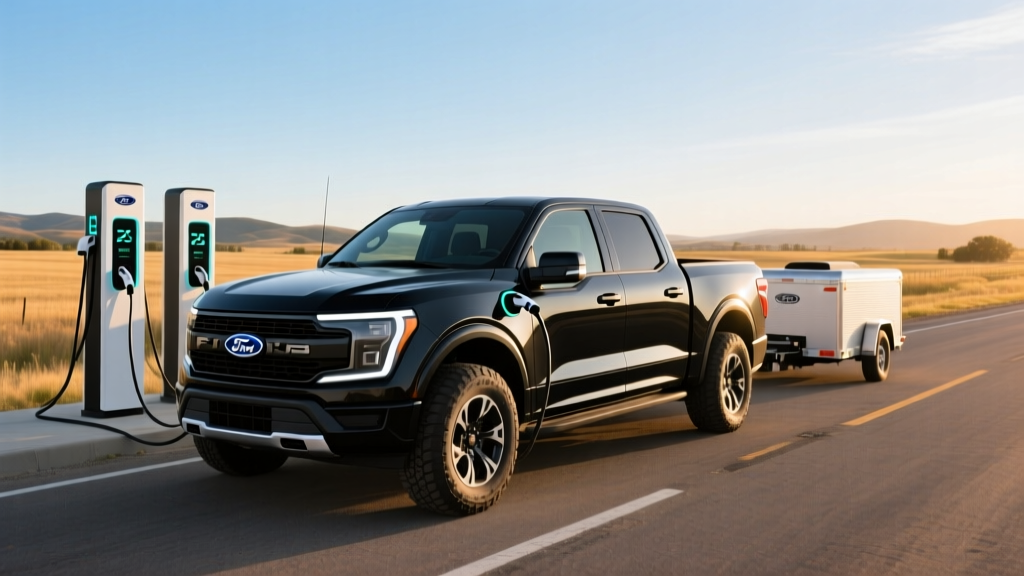
For fleet and worksite buyers, the bigger variable is payload and towing. Ford rates the Lightning up to 10,000 lbs towing (with the Max Trailer Tow Package on XLT/Lariat Extended Range). In our experience and consistent with independent testing, towing 7,000–8,000 lbs on the highway drops range to roughly 120–160 miles on the Extended Range pack — usable for regional hauling with planned DC stops, but a non-starter for cross-country towing without careful logistics.
Charging Speed: DC Fast, Level 2, and the Home Setup You'll Need
The Lightning's DC fast-charging ceiling is 150 kW on the Standard Range pack and 155 kW on the Extended Range pack — respectable for a 400-volt architecture, but a generation behind the 800-volt trucks and crossovers now peaking above 250 kW. Ford publishes a 10–80% time of approximately 41 minutes on the Extended Range pack at a 150 kW-capable station; expect closer to 45–50 minutes in practice once you account for charge-curve taper above 70% SoC and station variability.
| Charging Level | Power | Time / Rate | Notes |
|---|---|---|---|
| Level 1 (120V outlet) | ~1.4 kW | ~2–3 mi/hr | Emergency/trickle only; ~100+ hrs for full pack |
| Level 2 (240V mobile cord) | 9.6 kW (40A) | ~14 mi/hr | Standard mobile cord; NEMA 14-50 outlet |
| Level 2 (Ford Charge Station Pro) | 19.2 kW (80A) | ~30 mi/hr | Requires hardwired 100A circuit; overnight full charge |
| DC Fast Charge | 150–155 kW peak | 10–80% in ~41–45 min (Ext. Range) | CCS1 connector; tapers hard above 80% |
Home charging is where the Lightning quietly excels. Ford's optional 80A Charge Station Pro, installed by a licensed electrician on a dedicated 100-amp circuit, replenishes the Extended Range pack in roughly 8 hours — meaning even a depleted day of towing can be erased overnight. Budget $600–$1,300 for the wall unit and $800–$2,500 for professional installation, depending on panel proximity and whether your home's service needs a 200A upgrade. The 19.2 kW onboard charger is one of the largest in any consumer EV and is a genuine differentiator for owners with heavy daily mileage.
One more home-charging perk: Pro Power Onboard turns the Lightning into a 2.4 kW (standard) or 9.6 kW (optional) mobile generator via bed and cabin outlets, and with the optional Home Integration System it can back-feed up to 9.6 kW to your house during an outage. That's enough to run essentials — fridge, sump pump, lights, router — for days, a feature that shifts the Lightning from vehicle to resilience asset.
Performance, Drivetrain, and Daily-Driving Impressions
| Spec | Standard Range | Extended Range |
|---|---|---|
| Drivetrain | Dual-motor AWD | Dual-motor AWD |
| Horsepower | 452 hp | 580 hp |
| Torque | 775 lb-ft | 775 lb-ft |
| 0–60 mph | ~3.8 sec | |
| Max Towing | 7,700 lbs | 10,000 lbs (w/ Max Tow Pkg) |
| Max Payload | ~2,235 lbs | ~1,800 lbs |
| Battery (usable) | 98 kWh NMC | 131 kWh NMC |
| EPA Range | 240 mi | 320 mi |
| Efficiency | ~78 MPGe | ~70 MPGe |
Even the base 452-hp Lightning outruns any gas F-150 short of the Raptor, and the 580-hp Extended Range model feels properly quick for a 6,500-lb truck. The dual-motor AWD system provides genuine off-pavement traction, and the independent rear suspension — a departure from the live axle on gas F-150s — gives the Lightning noticeably better on-road manners than its ICE sibling, with less hop over broken pavement when the bed is empty.
Ride quality is comfortable but not plush; this is still a body-on-frame truck tuned to carry load. Steering is light and numb by performance-SUV standards, appropriate by truck standards. Brake feel with regenerative blending is among the better executions Ford has delivered, and one-pedal driving is usable around town once you acclimate.
Driver assistance is handled by Ford Co-Pilot360 2.0, with BlueCruise hands-free highway driving available on divided highways as a subscription after the initial trial. To be clear: BlueCruise is an SAE Level 2 system — eyes-on or eyes-off depending on the roadway, but the driver remains responsible. It is not Level 4 autonomy, and it will disengage in construction zones, poor lane markings, and adverse weather.
Interior, Cargo, and the Mega Power Frunk
Inside, the Lightning is essentially a 14th-generation F-150. That's both the compliment and the critique. Materials, switchgear, and ergonomics mirror the gas truck — which means a spacious cabin, upright seating, and a 12-inch (or available 15.5-inch portrait) SYNC 4 touchscreen with wireless Apple CarPlay and Android Auto. Rear legroom in the SuperCrew is a generous 43.6 inches; front legroom is 43.9 inches. Cargo volume behind the rear seats is roughly 52.8 cu ft in the 5.5-foot bed configuration.
The headline storage feature is the Mega Power Frunk — 14.1 cu ft of lockable, drainable, weather-sealed front trunk space with 400 lbs of payload capacity. It's genuinely useful for tools, groceries, or camping gear that you'd rather not leave in the open bed, and it's a packaging win that gas trucks simply can't match.
Build quality on 2026 models has benefited from Ford's post-launch production refinements at the Rouge Electric Vehicle Center, though panel-gap variance and occasional interior rattle remain more common than on the Rivian R1T. The SYNC 4 infotainment system is responsive and logically menued, but the reliance on touchscreen for climate and tow settings will frustrate gloved worksite users — physical knobs would be an improvement.
Pricing, Trims, and the 2026 Federal Tax Credit Picture
The 2026 F-150 Lightning lineup spans four main trims, with MSRPs that have stabilized after the volatility of the 2022–2024 launch years. Approximate base MSRPs (including destination) are:
- Pro (Standard Range): ~$57,000
- XLT (Standard Range): ~$64,000
- Lariat (Extended Range): ~$77,000
- Platinum (Extended Range): ~$97,000
As-tested pricing on a well-optioned Lariat Extended Range with the Max Trailer Tow Package and BlueCruise typically lands in the $82,000–$86,000 range before incentives.
§30D Federal EV Tax Credit — Current Rules (IRS):
- Up to $7,500 for new qualifying EVs; credit amount depends on battery-component and critical-minerals sourcing thresholds.
- MSRP cap for trucks/vans/SUVs: $80,000 — so Pro, XLT, and most Lariat configurations qualify, but Platinum and heavily optioned Lariats may exceed the cap.
- Buyer AGI caps: $300,000 joint / $225,000 head of household / $150,000 single.
- Point-of-sale transfer: Eligible buyers can apply the credit as a down-payment reduction at the dealer rather than waiting for tax filing.
- Foreign Entity of Concern (FEOC) rules: Battery components and critical minerals must not originate from prohibited entities — a requirement that has tightened annually and affects the Lightning's credit tier.
Always verify current-year eligibility at IRS.gov's clean vehicle list and consult a tax professional. Credit amounts and sourcing rules have shifted year to year.
| Trim | Base MSRP | Est. After $7,500 Credit | Credit Eligibility |
|---|---|---|---|
| Pro Std Range | ~$57,000 | ~$49,500 | Likely qualifies (under $80K cap) |
| XLT Std Range | ~$64,000 | ~$56,500 | Likely qualifies |
| Lariat Ext. Range | ~$77,000 | ~$69,500 | Qualifies at base; optioned builds may exceed $80K cap |
| Platinum Ext. Range | ~$97,000 | N/A | Exceeds $80K MSRP cap — ineligible |
How It Compares: Lightning vs. Rivian R1T, Silverado EV, and Cybertruck
The Lightning's competitive set has expanded, and each rival answers a different question:
- Rivian R1T Dual-Motor: More efficient, faster-charging (800V architecture on newer packs), more adventurous off-road, and higher perceived build quality. Priced higher, smaller dealer footprint, and no frunk on par with the Mega Power Frunk.
- Chevrolet Silverado EV: Larger Ultium battery options, higher max range EPA (on the 4WT/200+ kWh pack), and GM's Super Cruise. But the Silverado EV is a different body style from the gas Silverado — not a drop-in replacement — and availability has been constrained.
- Tesla Cybertruck AWD: Stainless body, 48V architecture, strong efficiency for its size. Polarizing design, limited towing range, build-quality variability, and no traditional dealer service network.
The Lightning wins on familiarity, dealer network breadth, Pro Power Onboard, and the lowest barrier to entry for a full-size electric pickup. It loses on efficiency and peak DC charging speed. For buyers who want an F-150 that happens to be electric — rather than an EV that happens to be a truck — it's still the default answer.
Pros
- Body-on-frame F-150 ergonomics and dealer service network
- 19.2 kW Level 2 onboard charger — best in class for home replenishment
- Pro Power Onboard and home backup capability
- 14.1 cu ft Mega Power Frunk is genuinely useful
- 580 hp Extended Range is properly quick (0–60 in ~3.8 sec)
- BlueCruise hands-free highway driving on mapped routes
Cons
- Real-world highway range ~15–20% below EPA, worse in cold
- DC fast charge capped at ~155 kW — slower than 800V rivals
- Towing drastically reduces range; ~120–160 mi at 7,500+ lbs
- Efficiency (~47–53 kWh/100 mi) trails Rivian and Cybertruck
- Platinum trim exceeds $80K MSRP cap for §30D credit
- Interior quality and panel gaps trail Rivian R1T
Warranty and Long-Term Ownership
Ford backs the Lightning with a 3-year/36,000-mile bumper-to-bumper warranty and a 5-year/60,000-mile powertrain warranty. The high-voltage battery is covered for 8 years or 100,000 miles, whichever comes first, against defects and capacity loss below 70% of original capacity — a threshold consistent with most mainstream EVs but worth noting, as 30% degradation still represents a meaningful range hit on a truck you may be depending on for work.
Long-term battery degradation data on Lightning packs is still maturing. Early 2022–2023 SK On NMC packs have shown moderate degradation in high-mileage fleet use, with some owners reporting 5–8% loss in the first 30,000 miles before leveling off — typical for liquid-cooled NMC chemistry. Ford's battery thermal management system is active and preconditioning for DC charging is supported, which helps preserve longevity.
Ownership costs benefit from reduced maintenance (no oil changes, fewer brake replacements thanks to regen, no transmission fluid) but are offset by higher insurance premiums — typically 15–25% above an equivalent gas F-150 — and potentially higher tire wear given the truck's weight. According to fueleconomy.gov, electricity costs for the Lightning average roughly $0.06–$0.10 per mile at residential rates, versus $0.18–$0.24 per mile for a gas F-150 EcoBoost at $3.50/gallon — a meaningful per-mile savings that compounds for high-mileage drivers.
Who Should Buy the F-150 Lightning (And Who Shouldn't)
Choose the F-150 Lightning if:
- You want an electric full-size pickup with the lowest learning curve and a Ford dealer within 30 miles.
- Home charging is available and you can install a 19.2 kW Level 2 station for overnight replenishment.
- You value Pro Power Onboard for jobsite tools, tailgating, or home backup power.
- Your daily driving is under 200 miles and towing is regional, not cross-country.
- You want a truck that looks, feels, and services like an F-150.
Look elsewhere if:
- You tow 7,000+ lbs over long distances regularly — range logistics become punishing.
- Peak DC charging speed is a priority (Rivian R1T and Silverado EV charge faster).
- You want maximum efficiency per kWh (Cybertruck and R1T beat the Lightning).
- You need a Platinum-level luxury truck — at $97K+, the Lightning Platinum exceeds the §30D credit cap and competes with more refined options.
Frequently Asked Questions
What is the real-world range of the Ford F-150 Lightning?
EPA estimates are 240 miles for the Standard Range pack and 320 miles for the Extended Range pack. In real-world highway driving at 70–75 mph in mild weather, expect roughly 200–220 miles from the Standard Range truck and 265–285 miles from the Extended Range truck. Cold weather (below freezing) reduces these figures by 20–30%, and towing a 5,000+ lb trailer can cut range roughly in half.
How fast does the F-150 Lightning charge at home and on the road?
On a DC fast charger, the Lightning peaks at 150–155 kW and reaches 10–80% in approximately 41–45 minutes for the Extended Range pack, with taper above 70% SoC. At home, the available 80A Ford Charge Station Pro (19.2 kW) adds roughly 30 miles per hour of charging and can fully replenish the Extended Range pack in about 8 hours. A standard 40A mobile cord on a NEMA 14-50 outlet delivers ~14 mi/hr.
Does the 2026 F-150 Lightning qualify for the federal EV tax credit?
Many Lightning configurations do, but eligibility depends on MSRP (capped at $80,000 for trucks), buyer AGI ($150K single / $300K joint), and battery-component/critical-minerals sourcing rules under §30D. The Pro and XLT trims typically qualify; Lariat qualifies at base MSRP but may exceed the cap when optioned; the Platinum exceeds the cap and is ineligible. Always verify at IRS.gov and consult a tax professional.
Is the Lightning worth buying over the Rivian R1T or Silverado EV?
It depends on the use case. The Lightning wins on familiarity, dealer network, Pro Power Onboard, and price of entry. The Rivian R1T wins on efficiency, charging speed (800V architecture), and off-road capability. The Silverado EV offers higher max range on its largest battery pack. If you want an F-150 that's electric, the Lightning is the answer. If you want the best EV that happens to be a truck, the Rivian makes a strong case.
What's the biggest drawback of owning an F-150 Lightning?
Range under load. The Lightning's bluff aerodynamics and ~6,500-lb curb weight make it less efficient than dedicated-EV trucks, and towing or highway driving in cold weather compresses range significantly. Owners who can charge at home nightly and whose daily routes stay within 150–200 miles rarely notice. Owners attempting 300-mile highway days or regular heavy towing will plan charging stops carefully.
How long will the Lightning's battery last?
Ford warrants the high-voltage battery for 8 years or 100,000 miles against defects and capacity loss below 70% of original capacity. Real-world NMC degradation data on early Lightnings suggests 5–8% loss in the first 30,000 miles with the curve flattening thereafter. With proper care — avoiding routine 100% charges, using preconditioning before DC fast charging, and minimizing repeated deep discharges — the pack should outlast 150,000+ miles with acceptable capacity retention.