If you've been tracking the Tesla Model Y Performance Europe rollout, the 2026 Juniper refresh has fundamentally altered the calculus for European EV buyers. The latest iteration of Tesla's best-selling crossover arrives with a redesigned interior, a revised thermal management system, and a tweaked powertrain that shifts the efficiency-versus-speed balance. But beyond the press-release superlatives, what does the Model Y Performance actually deliver on the Autobahn, in Scandinavian winters, and at public fast-chargers from Lisbon to Stockholm?
This review dissects the 2026 Tesla Model Y Performance with a data-first lens: exact WLTP figures, real-world range reconciliation, DC charging curves, and ownership economics under current EU incentive frameworks. Whether you're cross-shopping the Porsche Macan Electric, BMW iX3, or Volvo EX60, the numbers below will tell you exactly what you're buying.
2026 Tesla Model Y Performance: Core Specifications
| Specification | 2026 Model Y Performance (EU) |
|---|---|
| WLTP Range (combined) | 580 km (~360 mi) |
| Real-World Range (highway, 120 km/h) | ~430–460 km (~267–286 mi) |
| Battery (usable) | 78.1 kWh, NMC (Nickel Manganese Cobalt) |
| Drivetrain | Dual-Motor AWD |
| Power Output | ~450 hp (335 kW) combined |
| 0–100 km/h (0–62 mph) | 3.7 seconds |
| Top Speed | 250 km/h (155 mph) |
| Max DC Fast Charge | 250 kW (peak) |
| 10–80% DC Charge Time | ~24 minutes |
| AC Home Charging (11 kW, 3-phase) | ~7.5 hours (0–100%) |
| Efficiency (WLTP) | ~14.4 kWh/100 km |
| Cargo Volume (rear seats up) | 854 L (30.2 cu ft) |
| Cargo Volume (rear seats folded) | 2,158 L (76.2 cu ft) |
| Frunk | 117 L (4.1 cu ft) |
| Warranty (Battery & Drive Unit) | 8 years / 192,000 km (120,000 mi), 70% retention |
| Vehicle Warranty | 4 years / 80,000 km |
Range and Efficiency: What the WLTP Sticker Doesn't Tell You
The 580 km WLTP figure positions the Model Y Performance among the most efficient performance SUVs in Europe. The Juniper's improved aerodynamics (drag coefficient reportedly around 0.22 Cd) and the next-generation heat pump contribute meaningfully here. Tesla publishes a WLTP consumption of approximately 14.4 kWh/100 km, which is excellent for a dual-motor AWD vehicle producing 450 hp.
However, European buyers need to contextualize this number. WLTP includes low-speed urban phases, moderate acceleration, and mild ambient temperatures. For a more practical baseline:
- Highway cruising (120 km/h, 15°C): ~17.0–17.5 kWh/100 km → ~445–460 km range
- Autobahn at 140 km/h: ~19.5–20.5 kWh/100 km → ~380–400 km range
- Winter highway (0°C, heater on): ~20.5–23.0 kWh/100 km → ~340–380 km range
- City with regen (20°C): ~13.5–14.5 kWh/100 km → ~540–580 km range
The NMC battery chemistry in the Performance variant offers higher energy density than the LFP packs in the RWD model, which is why Tesla reserves it for the dual-motor trims. NMC degrades slightly faster than LFP over thousands of cycles, but Tesla's 8-year/192,000 km warranty with a 70% capacity retention floor provides reasonable protection. Based on fleet data from Teslamate aggregators, most Model Y NMC packs retain 90–93% capacity after 80,000 km, with degradation tapering off significantly after the first 30,000 km.
Charging Speed: 250 kW Peak, but Read the Curve
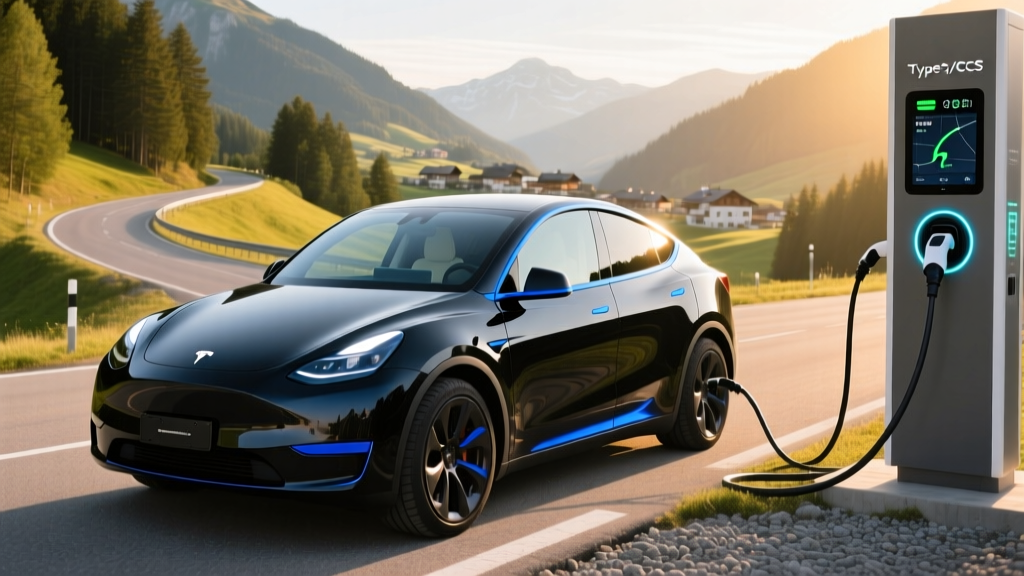
The 2026 Model Y Performance supports up to 250 kW DC fast charging on Tesla's V3 and V4 Superchargers, which dominate the European network. The CCS2 port (standard on all EU-market Teslas since 2019) also works with third-party networks like Ionity, Fastned, EnBW, and Shell Recharge.
| Charging Method | Power (kW) | Speed (km/hr added) | Notes |
|---|---|---|---|
| DC Fast Charge (Supercharger V3/V4) | Up to 250 kW peak | ~1,000+ km/hr (at peak) | 10–80% in ~24 min; tapers sharply above 80% |
| DC Fast Charge (Ionity/CCS2, 350 kW capable) | Up to 250 kW peak | ~1,000+ km/hr (at peak) | Same curve; vehicle-limited to 250 kW |
| AC Level 2 (11 kW, 3-phase wallbox) | 11 kW | ~60 km/hr | Full charge in ~7.5 hours; ideal for overnight |
| AC Level 2 (7.4 kW, single-phase) | 7.4 kW | ~40 km/hr | Full charge in ~11 hours |
| AC Level 1 (2.3 kW, household Schuko) | 2.3 kW | ~12 km/hr | Emergency/trickle only; ~34 hours for full |
The charging curve matters more than peak kW. The Model Y Performance hits 250 kW only between roughly 10–30% State of Charge (SoC). From 30–50%, it holds approximately 200 kW. From 50–70%, it drops to ~150 kW. Above 80%, it falls below 60 kW to protect battery longevity. This means the commonly cited "10–80% in 24 minutes" figure is realistic at a V3 Supercharger with a preconditioned battery — but if you arrive at a charger cold (without the car's navigation-based battery preconditioning active), expect 28–32 minutes as the pack warms up.
For European road trips, the Supercharger network remains the gold standard for reliability. Tesla's Supercharger map shows dense coverage across Western Europe, with expanding presence in Poland, Czech Republic, and the Balkans. Non-Tesla networks (Ionity, Fastned) work seamlessly via the CCS2 connector, though pricing and availability vary.
Performance and Driving Dynamics
The dual-motor AWD powertrain produces approximately 450 hp (335 kW) combined, launching the Model Y Performance from 0–100 km/h in 3.7 seconds. That's supercar-rivaling acceleration in a family crossover. Top speed is electronically limited to 250 km/h — relevant for unrestricted Autobahn sections in Germany.
The Juniper refresh brought revised suspension tuning: firmer adaptive dampers, a slightly lower ride height, and improved steering feel over the pre-2025 model. It's still not a Porsche Macan in terms of corner-carving precision, but for a 1,979 kg electric SUV, the body control is impressive. The Performance model includes:
- 21-inch Überturbine wheels with performance tires
- Performance brakes with larger front rotors
- Lowered sport suspension
- Track Mode (adjustable regen and stability control)
- Carbon fiber interior trim
Regenerative braking remains strong and enables one-pedal driving in most scenarios. Tesla removed the user-adjustable regen setting several years ago, so the strength is fixed — most owners adapt quickly, but it's worth noting if you're transitioning from a vehicle with adjustable regen.
Interior, Tech, and the Juniper Refresh
The 2026 Juniper interior is the most significant upgrade since the Model Y launched. Key changes:
- Ambient lighting wrapping the dashboard and door panels
- Ventilated front seats (finally standard on Performance)
- Rear-seat entertainment screen (8-inch, climate and media controls)
- Power-folding second-row seats
- Improved cabin insulation — noticeably quieter at highway speeds
- Updated 15.4-inch touchscreen with faster processor
Cargo space remains generous: 854 L behind the second row and 2,158 L with seats folded, plus a 117 L frunk. Rear legroom measures approximately 1,040 mm, adequate for adults on long journeys. The panoramic glass roof creates an airy cabin but does increase solar heat gain in summer — Tesla's tint helps, but a sunshade accessory is a common aftermarket purchase in southern Europe.
Autopilot and FSD (Supervised): All European Model Y vehicles ship with Basic Autopilot (lane centering, adaptive cruise). Enhanced Autopilot (€3,800) adds auto lane change, Navigate on Autopilot, and Smart Summon. Full Self-Driving (Supervised) is available in Europe as of late 2025 at €7,500, though its capabilities in the EU remain more limited than in the US due to UNECE regulatory constraints on steering automation. FSD in Europe currently operates under stricter speed and maneuver limitations.
European Pricing and Incentives (2026)
Tesla prices vary by European market due to VAT differences, registration taxes, and local delivery fees. As of early 2026, approximate pricing for the Model Y Performance is:
| Market | Base Price (incl. VAT) | Notable Incentives |
|---|---|---|
| Germany | €59,990 | No federal purchase subsidy as of 2024; company car tax advantage (0.25% rule for EVs) |
| Netherlands | €61,490 | SEPP subsidy ended; BPM exemption for zero-emission vehicles continues |
| France | €57,990 | Bonus écologique reduced to €0 for vehicles over €47,000; leasing subsidy available for lower-income buyers |
| Norway | ~NOK 620,000 (~€54,500) | VAT exemption on first NOK 500,000; 25% VAT above that threshold (introduced 2023) |
| Sweden | ~SEK 689,000 (~€61,000) | Klimatbonus ended Dec 2022; company car tax reduction remains |
| United Kingdom | £59,990 | No purchase grant; BIK company car tax at 2% (rising to 3% in 2025/26, 4% in 2026/27) |
| Italy | €58,490 | Ecobonus up to €5,000 (income-dependent, subject to fund availability) |
| Spain | €55,990 | MOVES III plan: up to €7,000 with scrappage (subject to availability) |
Important note on US tax credits: If you're a US-based reader researching the European Model Y Performance for comparison, note that the US-market Model Y is built at Giga Texas and may qualify for the IRS §30D federal tax credit (up to $7,500) depending on MSRP caps, buyer income limits, and battery component/critical mineral sourcing requirements. The European Model Y (built at Giga Berlin) does not qualify for US credits. Check current IRS §30D rules for US eligibility.
Ownership Costs: How Does It Compare?
The Model Y Performance occupies a unique niche: it undercuts traditional luxury performance SUVs on price while matching or exceeding their acceleration. Here's how it stacks up against key European-market competitors:
- Porsche Macan 4 Electric: ~€84,000, 630 km WLTP (rear-boost), 0–100 in 5.2s — more refined, longer range, significantly more expensive
- BMW iX3 (2025 refresh): ~€67,000, 460 km WLTP, 0–100 in 6.8s — more conventional luxury feel, less range, slower
- Volvo EX60 (upcoming): Announced, expected ~€65,000, ~550 km WLTP — not yet available for delivery
- Audi Q6 e-tron: ~€74,000, 540–625 km WLTP, 0–100 in 5.8s — premium interior, PPE platform, higher price
- Mercedes EQB 350: ~€62,000, 400 km WLTP, 0–100 in 6.2s — compact 7-seater, less range, less performance
The Model Y Performance's total cost of ownership in Europe is compelling, particularly in markets with low electricity costs and strong company-car tax advantages. Home charging at €0.25–0.35/kWh yields a fuel cost of approximately €3.60–5.00 per 100 km — roughly one-third to one-quarter the cost of a comparable petrol performance SUV at current European fuel prices.
Who Should Buy the Tesla Model Y Performance in Europe?
- You want the fastest acceleration in the segment for under €65,000
- You value Supercharger network reliability for frequent road trips
- You need practical cargo space (854 L rear + 117 L frunk) with performance
- You're a tech-forward buyer who prefers OTA updates and minimal physical controls
- Company car tax benefits in your market make the Performance trim financially logical
- You prioritize maximum range over acceleration (the Long Range AWD offers ~600+ km WLTP at lower cost)
- You want traditional luxury materials and dealer service (Porsche, BMW, Audi)
- You need a third row (the Model Y's EU version is strictly 5-seat; no 7-seat option unlike some markets)
- You drive primarily in dense urban areas where the RWD Long Range is sufficient and cheaper
Pros and Cons
- 3.7s 0–100 km/h — quickest SUV in its price bracket
- 250 kW DC fast charging with ~24 min 10–80%
- Supercharger network reliability across Europe
- Juniper interior upgrades (ventilated seats, rear screen, quieter cabin)
- 854 L cargo + 117 L frunk — highly practical
- OTA updates continuously add features
- Strong efficiency (~14.4 kWh/100 km WLTP) for a performance AWD
- Real-world highway range ~430–460 km, not the WLTP 580 km
- Winter range drops to 340–380 km without preconditioning
- No third-row option in Europe
- FSD (Supervised) capabilities limited in EU vs US
- Minimalist interior not for everyone (no physical buttons, no instrument cluster)
- Service center wait times can be long in some EU markets
- 21-inch wheels reduce range vs smaller wheel options
Frequently Asked Questions
What is the real-world range of the Tesla Model Y Performance in Europe?
The WLTP rating is 580 km, but real-world highway driving at 120 km/h in mild weather yields approximately 430–460 km. In cold weather (sub-zero), expect 340–380 km. City driving with regenerative braking can approach the WLTP figure of 580 km.
How fast does the Model Y Performance charge at home and on the road?
On a DC fast charger (Supercharger V3/V4 or Ionity), it peaks at 250 kW and charges from 10–80% in approximately 24 minutes with a preconditioned battery. At home on an 11 kW three-phase wallbox, a full charge takes about 7.5 hours. On a standard 2.3 kW household outlet, expect roughly 34 hours for a full charge.
Does the European Model Y Performance qualify for the US federal EV tax credit?
No. The European Model Y is manufactured at Giga Berlin and does not qualify for the IRS §30D credit, which requires North American final assembly. US buyers should look at the Giga Texas-built Model Y for potential credit eligibility, subject to MSRP caps, income limits, and battery sourcing requirements.
What incentives are available for the Model Y Performance in Europe?
Incentives vary significantly by country. Germany eliminated its federal purchase subsidy in late 2023 but maintains a 0.25% company car tax rate for EVs. Norway applies VAT only on the portion of the price exceeding NOK 500,000. France's bonus écologique excludes vehicles over €47,000. Spain's MOVES III offers up to €7,000 with scrappage. Check your local transport ministry for current availability.
Is the Model Y Performance worth it vs the Long Range AWD?
If you value acceleration (3.7s vs ~5.0s 0–100 km/h) and the Performance suspension/brake upgrades, the premium is justified. If maximum range and lower cost matter more, the Long Range AWD offers approximately 600+ km WLTP at a lower price and is the better choice for most buyers who don't regularly drive at track-adjacent speeds.
How does battery degradation affect the Model Y Performance over time?
NMC batteries in Tesla vehicles typically lose 8–10% capacity in the first 80,000 km, then degradation slows significantly. Tesla's warranty guarantees 70% capacity retention for 8 years or 192,000 km. Fleet data suggests most owners retain 88–92% capacity at the 5-year mark under normal use patterns.
Can I use non-Tesla chargers with the Model Y Performance in Europe?
Yes. All European Model Y vehicles use the CCS2 connector standard, compatible with Ionity, Fastned, EnBW, Shell Recharge, and most public DC networks. You can also use the Tesla app or the car's built-in navigation to find and pay at select third-party chargers.